Showing posts with label Lent20. Show all posts

Saturday, April 11, 2020

Flexibility for Future

The pandemic continues. It will for some time. Reuters posted a video in which children share, among others things, their difficulties with physical distancing. How to help them?

The Guardian tweeted a post from its Family Section:
At no point do the makers of Sesame Street say any of this will be easy [for parents]. But neither did they suggest the future has to be grim.
“I hope [people can see] a picture of joy within this moment,” Gibson said. “The act of rallying together toward a common goal is not a sad occasion.”

Friday, April 10, 2020

Three-Day Drama

During the Triduum each day has its liturgy, and each liturgy is compete. Yet after each liturgy the momentum of the mystery is not resolved. That momentum builds and finds itself complete on Easter.

The pandemic is a steep challenge to making sense of our lives this Holy Week.
___________________
Wiki-image Dietmar Rabich / Wikimedia Commons / “Dülmen, St.-Viktor-Kirche, Innenansicht--2018--0596-8” / CC BY-SA 4.0

Unwarranted Use Does Not Implicate

The fragile—because of time, language and culture—documents Christians call their scriptures remain a timeless resource for memory, consolation as well as personal and communal conversion and growth. Like other resources they have been misused to promote selfish, misguided ends. Misuse does not mean a resource itself is flawed or abysmal.
Some have misused the New Testament writings to vilify Jewish people. To Jesuit Nicholas King that misuse is shameful. He concisely shows that the “extraordinary library that is the New Testament…was written by good Jews, and that it is unfounded, even perverse, to call it ‘anti-Jewish.’”
___________________
Wiki-image P46 | PD-US

“Reclaiming Holy Week”

From its archives Sojourners tweeted Shane Claiborne’s post of 2015. That year Africa had seen one year without deaths by polio, and China had ended its 1-child policy. In the U.S. the majority of citizens were not middle class, and the rate of deaths by gun was the same as by motor vehicle (about 93 people per day).

In his post Mr. Claiborne recalled joining others one Good Friday: ”We carried the cross into the streets and planted it outside the gun shop in our neighborhood. We had our services there.”

God was alive among the gathered Christians. Remembering the death of God’s son was a prelude to living the resurrection—just as during the 2020 pandemic Holy Week.

Thursday, April 09, 2020

Praying the Supper

Contemplative praying lets scenes of scripture happen to us. We make ourselves available in ways that are conducive for us; God’s life does the rest. Jesuit Tucker Redding at America Magazine calls his series "Imagine."

Postponed Renewal, Ongoing Praying

Each year the bishop of a diocese gathers with faithful and priests to bless the sacred oils used in sacraments throughout the year. This year those masses have been postponed.

At the mass the bishop asks the priests to renew their priestly commitment and asks the assembled faithful to pray for the priests. In a kind gesture Vincent Cardinal Nichols, Archbishop of Westminster, posted a request for prayers for priests.

Monday, April 06, 2020

Pope Francis on Palm Sunday

In 2 ½ minutes.

Meditate for a Minute

From Franciscan Media Twitter feed:

Sunday, April 05, 2020

Deeper to Reach the Destination

A media post was on target Palm Sunday. “Some Christians…are leaning deeper into their faith, using contemplative prayers to stay centered throughout difficult and death-filled days.” Contemplative evokes different connotations. In Christian spirituality it connotes a focused relationship with God.


Deepening relationship with God is the common denominator in invitations from Pope Francis, Patriarch Bartholomew I (“may the blessing of the Lord…accompany us in our journey, transform our voluntary isolation into genuine communion, and become our prayer and destination to appreciate the meaning of this”), local leaders, media of different kinds.

“Leaning deeper” is not for a select few. The import of this afternoon’s post on confronting a sacramental challenge equals leaning deeper. Noticing what we have overlooked until the pandemic arrived; noticing things differently because of the pandemic; noticing in new ways and stretching to notice: they are a few examples of “leaning deeper.” Perhaps noticing voices in Palm Sunday’s passion reading can add depth to the leaning.
___________________
Wiki-image Feuille de palmier by “Eric Freyssinge| CC BY-SA 4.0"

Gain in Loss: an Interview

A
s Christians accompany Jesus during Holy Week a guide could assist this year’s different experience of it. “Dominican Father Paul Murray is one of English-language Catholicism’s most prominent contemporary theologians and poets,” Mr. John L. Allen prefaced his 2-part interview. Part 1 looks at history and the necessity for “spiritual communion.” “Forced solitude” and “affliction” shape Part 2. (The link to Part1 is at the top.)


Saturday, April 04, 2020

5 in 1

Thinking Faith tweeted five helps to enter Palm Sunday. Though it and all the days of Holy Week are starkly different, “we can still walk with Jesus.”

Friday, April 03, 2020

Daily Experience, Lenten Moment

The Constitution on the Church of the Second Vatican Council promptly identified the church as “the People of God.” In that second chapter it noted the singular status of the family or household: “The family is, so to speak, the domestic church:” parents pass on the word of faith to children  and encourage them to grow into their vocations in life (n. 11).

Congregation of Jesus Sister Gemma Simmonds suggested, “Perhaps this is a good time for us to reflect on how we do domestic Church, and how the great liturgical moments in the year or the great theological themes that underpin them permeate our ordinary lives.” One lenten moment for many is the Sacrament of Reconciliation. Pope Francis and the Vatican have reminded that the impossibility of celebrating the Sacrament of Reconciliation does not prevent God from forgiving a person’s sins.

The pandemic and our prudent, courageous actions to stay home provide an opportunity to grow beyond the image of the church as a toll house: “The Church, whether institutional or domestic, frequently acts, ‘as arbiters of grace rather than its facilitators. But the Church is not a tollhouse; it is the house of the Father, where there is a place for everyone, with all their problems.'"
___________________
Wiki-image Return of the Prodigal by “James Tissot | PD-US"  upload

Wednesday, April 01, 2020

Faiths Share Quandary About Practice

CSM Staff writer Harry Bruinius posted a report that answered an editorial question that precedes it: “During the pandemic, what does it mean to come together and pray?” Religious leaders are responding creatively. Yet the innate human drive to gather, intensified in ritual gestures in hallowed places, leave many feeling empty and fully of questions. The results of prudent closure of worship spaces and physical distancing “have even presented profound theological conundrums.”

Update: In yesterday’s America Magazine Colleen Dulle considered in more detail the Roman Catholic perspective. Ms. Dulle opened with a first-person account of joining a livestream celebration of Sunday mass.
___________________
Wiki-image Cavernous interior,  Juma Mosque in Shemakha by “shankar s. | CC BY 2.0"

___________________
[This evening: Isolating Need Not Result in Loneliness]

Sunday, March 29, 2020

Imagining the Sunday Gospel

On the Fifth Sunday of Lent many Christians hear the gospel passage of Jesus raising Lazarus from the dead [RCL; RCL]. We have the time to read it reflectively while we are home. Reflective reading allows us to inhabit the scripture; its word is living and effective. We can allow scripture to have an effect on us.
Jesuit Brian Purfield walks us through the narrative. At the outset he asks, “How can [the raising of Lazarus] speak to us in our current situation?”
___________________
Wiki-image Jesus Wept by “James Tissot  | PD-US"

Sunday, March 22, 2020

Sunday word, 22 Mar 20

Homily of Fr. Paul Panaretos, S.J., blogged during Coronavirus
Presence and Attitude

Ours are sobering days. Physical distance limits social contact and interaction. Concern is personal as well for others. Fear lurks close behind concern, and fear can close doors that caution allows us to open. The door of self-restraint leads us to make better choices about what not to do and what to do.
In these unprecedented days—unprecedented for us who experience them—are we aware of a Presence close to us, upholding us, working new things in us? These critical times have changed our routines, yet they do not change the goal of Christian living: risen Christ Jesus. Our crisis can help us deepen our friendly union with him: how we recognize Jesus in our present experience; ways Jesus has enlightened us in the past that may help us in our markedly different circumstances; ways Jesus is clearing  our inward sight and freeing our hearts.

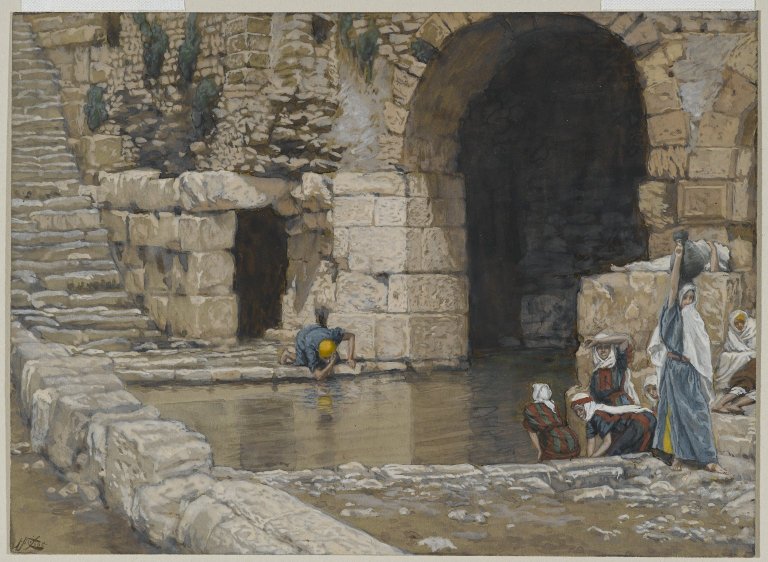
The encounter the man blind from birth had with Jesus allows me to notice more clearly Jesus’ attitude and St. Paul’s conviction about it: we have his attitude.1 We often think of Jesus’ attitude as expressed in action: gentle self-giving, and that is correct. Jesus’ focused trust on God allowed made his self-giving possible. The man born blind came to enjoy this trust when Jesus gave him sight. Two moments from the encounter: his language and his experience.

The man used the language Jesus spoke, soon to him, before to the woman of Samaria2 and later at Jesus’ arrest and trial3: I am. People of biblical faith had long noted it echoes God’s name God gave Moses: tell the Israelites [enslaved in Egypt] that I AM sent me to you.4 God was clearly concerned for the suffering.  In today’s gospel encounter Jesus showed that God’s concern continues. Neighbours were uncertain if the man had been the blind beggar. He replied I am (the man). The man had a presence, a value he had not had before. His attitude had become like that of Jesus.

After neighbours the religious authorities interrogated him; he braved them. The religious authorities had created a climate of fear. They had questioned the man’s parents. They were afraid of the authorities’ publicly known verdict: expulsion from the synagogue…[of] anyone [who] acknowledged Jesus as the Christ. When the authorities interrogated their son their verdict did not intimidate him. He expressed himself matter of factly about who Jesus was: He is a prophet.

Jesus’ language and Jesus’ attitude: both deepened an insight: healed by Jesus causes us to be like Jesus. Healed by Jesus does not cause us to mouth Jesus’ words in an empty fashion. Baptism into Jesus—our healing from world-oriented living to spirit-led godly living—causes us to act like Jesus, our healing saviour: with greater courage, feeling and generosity for and with others.

When so many must forego eucharist that sustains our baptisms into Christ, we need to draw courageously on Christ really present in other ways: close to us; upholding us; working new things in us; communicating to us via hope, faith and love. Perhaps the absence of being in a gathered faith community that nourishes itself with the eucharist opens us to modes of divine presence we could not know.

In your daily 15 minutes with Jesus this week, 
  • Rest in our triune God
  • Ask the man blind from birth to present you to Jesus
  • Chat with Jesus: praise him for dying and rising for us; thank him for baptizing us with his Spirit to be like him
  • Ask Jesus for grace to sense his presence abiding with us in our days empty of their routine
  • Close saying slowly the Lord’s Prayer. Jesus gave it to us to grow more like him, alive with his healing Spirit, more trusting in God and filled with hope in everyone’s value.
Link to this homily’s Spiritual Exercise
____________
  1. Philippians 2.5; 1Corinthians 2.16.
  2. John 4.26, last Sunday’s gospel; followed by: 6.35, 41, 48, 51; 8.12, 24, 28, 42, 58; 10.7, 9, 11, 14; 11.25; 12.32; 13.19; 14.2, 6; 15.1, 5; 17.24; 18.5-6, 8.
  3. Arrest, 18.5-6, 8; trial, Mark 14.62; Luke 22.70.
  4. Exodus 3.14.
____________
Wiki-image Blind man washes in pool at Siloam PD-US; Pool of Siloam PD-Release

Tuesday, March 10, 2020

Daily word, 10 Mar 20

2nd Tuesday of Lent (10 Jan 2020)
Homily of Fr. Paul Panaretos, S.J., 5-day directed retreat
4Ps
Lent is our opportunity to recommit to live the faith of Jesus more consistently. None of us wants to give lip-service Jesus, to our Christian life. Lip-serve, Jesus clearly said, will not win us entry into the kingdom of heaven.1 Our lenten practices can help us accept Jesus’ invitation to allow our lives to speak eloquently. Jesus was not the first to recommend that we do good and make God’s justice our aim. Prophet Isaiah was one of many who recommended both. Isaiah advised how do both for his time and circumstances: redress the wronged, hear the orphan’s plea; defend the widow. Orphans and widows included all the vulnerable ones in his society.

Justice is always social. Justice involves institutions and systems. An act of charity is personal: what one does for another; or help a person offers to aid this or that emergency. All Christians journey together in Lent; it is social in the way of God’s justice. By gracing our time God opens the way for us to cooperate with God’s justice.

Because it involves systems and institutions making justice our aim seems beyond you and me. Lent reminds us that we are cooperators with God’s justice; Lent allows us to practice the fine points of Christian living so they become daily practice. Practice is key. Practice develops and develops us. An example from our world.

While we are keenly aware now of our need to redress the wrong we have done to our planet, in 1987 Pope St. John Paul II reminded that
A true concept of [human, social] development cannot ignore the use of the elements of nature, the renewability of resources and the consequences of haphazard industrialization: three considera-tions which alert our consciences to the moral dimension of development.2

In 1991 Ecumenical Patriarch Bartholomew convened an ecological gathering in Crete entitled “Living in the Creation of the Lord.”3 Later, John Paul addressed “the worrying…ecological question which accompanies the problem of consumerism and which is closely connected to it.”4 A development in Catholic social teaching followed when John Paul added to its principles a seventh: care for creation. Pope Francis has amplified this with Laudato Si!5 and by his other catecheses and homilies.

Our time and circumstances differ from those of Isaiah and Jesus. Yet God’s longing for justice among people by people for every created being abides. I rehearse this brief history of the development of Catholic social teaching to encourage our developing practice of God’s justice. Focus on the fine points, our individual choices we make daily. Each choice affects positively or negatively: the planet; peace; poverty; and parity, that is, economic justice that redresses the wronged. This graced season helps our choices incarnate God’s mercy. Our choices for God’s justice make it a joyful time.

___________
  1. Matthew 7.21.
  2. “The Social Concern of the Church,” 34.
  3. John Chryssavgis, The Green Patriarch: Ecumenical Patriarch Bartholomew and the Protection of the Environment.
  4. Centesimus Annus, 37.
  5. Laudato Si! helps us see interconnection by its phrase“integral ecology.”

___________
Wiki-images by: Auckland Museum Chemist’s scale CC BY 4.0; The Blue Marble PD-US