Friday, October 05, 2018

Daily word, 05 Oct 18

26th Friday of the Year (05 Oct 2018) 
Jb 38. 1, 12-21; 40. 3-5; Ps 139; Lk 10. 13-16
Homily of Fr. Paul Panaretos, S.J. during Full Spiritual Exercises
Breathing With God
The Book of Job exquisitely describes the problem of suffering among humans, esp. innocent people. Daily mass every other year exposes us to the book in a whirlwind tour: from ch1 to 3 to 9 to 19; to 38 and the beginning of ch 40 today and ch 42 tomorrow. The Book of Job does not answer why bad things happen to good people. The drama of Job reminds that God is with us when bad things happen as well as good things.

God’s close presence to humans is nothing new. God is mystery who ever eludes us. Joyce Rupp’s title for God is apt: “Elusive One.”1 It describes the One beyond us who is also nearer to us than our breathing. Suffering makes it difficult to breathe—physically as well as spiritually. If praying is spiritual breathing then turning to the Book of Job in calamity may be a worshipping assembly’s best first step: to echo Job, What can we answer? 

As a Jesuit apostolate we decided to devote the first Friday of each month as a healing balm for all who have suffered abuse within and beyond the church. Focused prayer certainly frees me to stand closer with those who suffer lifetimes of emotional, physical and spiritual trauma. No one helped me feel that spiritual suffering than the one who said, “[my abuser] took away from me…Not just my innocence but my faith.”2 What can we answer? 

Through Job’s emotional, physical and spiritual suffering Job alone could only find his way. His so-called friends did not help him. Professionals who counsel and guide suffering people today hold the stories of traumatized people and offer them ways to cope so they may reach healthier plateaus: the climbs are theirs; counsellors and therapists offer them direction to help them climb.

What about us? Our prayers for the abused and abusers serve us, too. Our prayers for them put us in touch with our needs for healing: both recovery from our wounds and reshaping us to grow more gentle, more respectful and live as more confident friends of Jesus. We may revisit our Blessed Histories to cherish how God’s grace has suffused our personal histories and remember: things we cannot change, God was present; things we can change, God is present to help us make changes; things in the future: God will be present when what has yet happen arrives.

Another reason to revisit our Blessed Histories is that we are not God—as Bernie told us Tuesday. Bernie was not parroting a truism. It is a fact: none of us is God. We often forget—though abused people lose memory against their wills—that all are precious to God. Nothing we say in answer to God is ever adequate. Our God truly takes our breath away—likely the only difficulty breathing that is not pained or painful. Sharing together God’s love transforms our lives. God is healing balm for us and our lives, too. Healing balm, God answers us; God answers us continually with God’s Word, Jesus. Retreat frees us to hear God answering us and welcome God’s healing. Retreat also frees us to speak God’s answer to others—even if they reject it.

__________
  1. Her Out of the Ordinary: Prayers, Poems, and Reflections for Every Season. Notre Dame, IN: Ave Maria Press, 2000, 2010.
  2. “A clergy sex abuse survivor’s story and its lessons for restoring faith,” America Magazine, 31August2018.
__________

Wiki-image Jesus healing PD-US

Sunday, September 09, 2018

Sunday word, 23 Sep 18

Twenty-third Sunday of the Year B (09 Sep 2018)
Homily of Fr. Paul Panaretos, S.J.
Essential One
My initial impression about these scriptures circled around opened. Isaiah: then will the eyes of the blind be opened, the ears of the deaf be cleared. Jesus made then now: he put his finger into the man’s ears and, spitting, touched his tongue; then he looked up to heaven and groaned, and said to him…“Be opened!”…immediately the man’s ears were opened, his speech impediment was removed, and he spoke plainly.

My impression morphed into questions: what is to be opened in me; in us; in the church; in the world? Each of us probably knows the opening, the clearing, the unburdening each of us desires. In these recent months and future ones we probably want for the church honesty and open transparency so healing may begin. For the world—James spoke to a great longing: an end to partiality among us and discrimination everywhere. Jesus empowers us to be opened.

Being opened does not suggest emptiness for us. Being opened suggests being willing and able to receive. Being opened means letting go in order to make room for something or someone. When Jesus healed the deaf man who had a speech impediment opening to receive happened. Jesus did no speaking because the man could not hear. An earlier miracle happened without speech: a woman touched Jesus’ clothes and was healed. In the moment Jesus knew power had gone out from him.1 Here Jesus directed his power three ways.

Jesus put his finger into the man’s ear. I imagined myself as the man: feeling Jesus’ finger in my ear let me know he was addressing himself to my deafness. When Jesus groaned I saw he was not speaking as I saw others do; he was like me! You and I may find Jesus spitting and touching the man’s tongue off-putting; but ancients held that saliva had healing properties.2 Perhaps Jesus did it because words were useless. Jesus’ action was not natural healing but divine healing: finger in the man’s hear, spitting and touch[ing] his tongue—Jesus himself, his power, divine power entered the deaf man and the man welcomed Jesus. Jesus’ power opened his hearing and cleared his speaking.

I appreciated anew Jesus and Jesus’ power, and I appreciated myself anew. Jesus’ healing was no folk remedy but the gift of the power of God long hoped for and at times unrecognized. Al-though I knew Jesus was most attentive to everyone, this episode helped me appreciate him more. I also appreciated our freedom: we are free to welcome Jesus’ power into us or decline it.

Certain physical conditions and illness can lead to anguish, self-absorption, sometimes even despair and revolt against God. [They] can also make a person more mature, helping one discern in life what is not essential so that one can turn toward that which is.3 Turning toward Jesus is the essential. The Sacraments offers us Jesus and strength to welcome Jesus more into our lives. Healing is not identical to curing. Healing is growing whole; or better, living more peacefully no matter our limitations.

Jesus’ miracles of healing impress on us that we cannot heal ourselves. The ways they began highlight that: a person came to Jesus and asked; or as in this gospel selection and others, people brought to Jesus one who needed help.4 Opening ourselves to welcome more deeply Jesus begins and continues our healing. Praying, celebrating sacraments, practicing charity and adjusting lifestyle are four significant ways we open ourselves to Jesus and let Jesus do what we cannot.

In your daily 15 minutes with Jesus this week
  • Rest in our triune God.
  • Ask Mary and your patron saint to present you to Jesus. 
  • Chat with him: praise him for dying and rising for us; thank him for giving us himself in his sacraments which welcome him into us.
  • Ask him for grace to feel and know his friendly presence guiding you.
  • Close saying slowly the Lord’s Prayer. His words, give us this day our daily bread, remind us our triune God nourishes us to receive the crown of life that the Lord has promised to those who love him.5
Link to this homily’s Spiritual Exercise
___________
  1. Mark 5.27-30.
  2. Pliny the Elder, Natural History, Book 7, Ch. 2.
  3. Catechism of the Catholic Church [CCC], 1501.
  4. Brought to Jesus appears in Matthew 4.24; 8.16; 9.2, 32; 12.22; 14.35; 17.16; Mark 7.32; 8.22; 9.17, 20; Luke 4.40.
  5. James 1.12; note 2.5, the last verse of today’s reading.

___________

Tuesday, August 28, 2018

Daily word, 28 Aug 18

Memorial of St. Augustine (28 Aug 2018)
Homily of Fr. Paul Panaretos, S.J. on 8-day Directed Retreat
Bookend Virtues
Early in the retreat Bill encouraged that no one outdoes God’s generosity. I hope each of us has has been drawing on God’s generosity to us. St. Augustine reminds me in the final hours of retreat that it helps to summon another virtue: patience. We want to stay on retreat and not miss what God desires we enjoy. It is all too easy to visit what awaits us at home. Visiting what awaits me on re-turn from retreat does not affect what awaits me; only on my return can I do anything. Patience helps me recognize things as they are; and frees me to let God continue to shape me for life after retreat.

Augustine received the gift of patience in part by inheriting it. At he first did not know patience was part of his DNA, so to say. Remembering his mother yesterday reminds us of her patience. She longed for her son to become a Christian. Augustine recalled her desire that she expressed to him near the end of her life: “One thing only there was for which I desired to linger in this life: to see you a Catholic Christian before I died.”1 

Persevering patience in his DNA helps us appreciate that Augustine could say with no tinge of regret: “Late have I loved you, O Beauty so ancient and so new, late have I loved you.”2 No regret; his words communicate refreshing fulfilment.

God was not totally off Augustine’s radar. He longed for beauty and goodness; finding it frustrated him. Not so different from us. Augustine again: “I looked for a way to gain the strength I needed to enjoy you, but I did not find it until I embraced the mediator between God and humans, the man Christ Jesus, who is also God, supreme over all things and blessed for ever.”3 “Embracing Jesus Christ” echoes a modern conversion-phrase: “accepting Jesus as one’s saviour.” Or, Pope Francis’ favoured verb regarding Jesus and others: encounter. Frustrated—even refusing—to embrace, accept or encounter Jesus does not frustrate Jesus’ patience with us. The more we savour Jesus’ patience with us, the more we live by Jesus’ care and less by our compulsions.

Jesus patiently called you to retreat and you accepted. Jesus patiently is with you on retreat and you are responding. Jesus called you to share and possess his life now—to use St. Paul’s phrase—and you are responding. None of us has been deceived; we have been encouraged. Continue to savour what you have received. To savour patiently enjoys more deeply what our triune God waits patiently to offer us on retreat.
__________
  1. Confessions, Book IX.10.26.
  2. Confessions, Book X.27.38.
  3. Confessions, Book VII.18.24.
__________
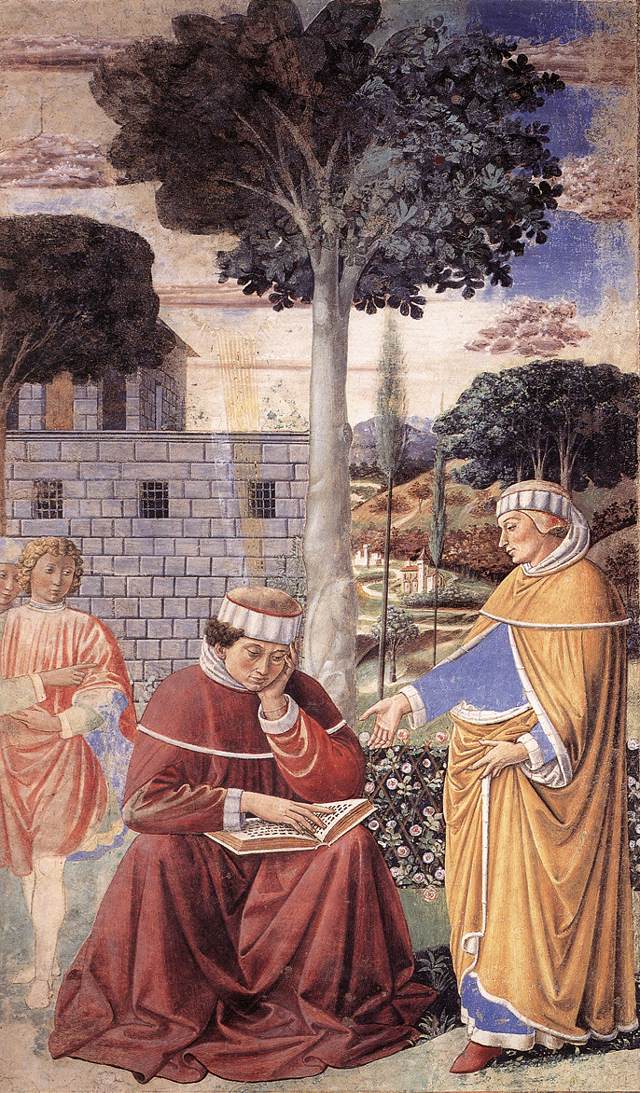
Wiki-image Conversion of Augustine PD-US

Friday, August 24, 2018

Daily word, 24 Aug 18

Feast of St. Bartholomew (24 Aug 2018)
Homily of Fr. Paul Panaretos, S.J. on 8-day Directed Retreat
Introducing
I can easily miss God’s fidelity to me. Jesus embodied God’s fidelity for us. The Book of Revelation is about God’s fidelity—even contrary to appearances. Risen Jesus began the Book of Revelation: on Patmos John received visions for both the eye and ear. John heard risen Jesus speak to him about churches he had known before being exiled; risen Jesus encouraged John to write letters to the churches. All that happened to John was for the people in those churches, to console them.

We celebrate the Feast of St. Bartholomew with a fulfillment-passage from the Book of Revelation. It showed me God’s fidelity again. God’s messenger spoke to John, saying, “Come…I will show you the bride, the wife of the Lamb.” The angel took me in spirit to a great, high mountain and showed me the holy city Jerusalem.” That happens for us on retreat. We desire a share in God’s life for us: we retreat for God to offer it anew or again; God begins meeting our desires. It may take more time to unfold than we’d like. Yet God is faithful; nothing is lost on retreat.

Continue to meet God. Pray for the grace of meeting. Know that God will find you because God creates us and knows us with a glance. Jesus knew Nathaniel Bartholomew on seeing him under the fig tree. Being known by Jesus opened a new way of knowing for Nathaniel; we may call it God-recognition. It was clear and deep: someone from a place scripture had never extolled Nathaniel recognized as Rabbi…Son of God…King of Israel. Retreat-recognition is simultaneously God-recognition and graced self-recognition. It is also power, power to help us introduce others to the God we meet.

_________
Wiki-image Nathaniel under the fig tree PD-US

Saturday, August 18, 2018

Daily word, 18 Aug 18

Nineteenth Saturday of the Year (18 Aug 2018) 
Homily of Fr. Paul Panaretos, S.J. on 8-day Directed Retreat
Savouring
In  dramas on stage, in film, in novels: a message as it unfolds speaks more powerfully than the set, costumes, time. As they unfold scriptures communicate God’s essential message. Circumstances historical, cultural and social are helpful; so great is their distance from us they cannot help us as we would like; surely not as much as the unfolding of God’s message in specific writings.

Our gospel selection began to unfold on Tuesday. Jesus welcoming children to his disciples’ chagrin follows two recent moments: Jesus more than encouraged disciples to be childlike—unless you change—conduct yourselves with childlike openness and wonder—you will never enter the realm of God;1 then immediately after Jesus spoke of forgive-ness and marriage—Thursday and Friday’s gospel selections—people brought…children…to Jesus that he might lay his hands on them and pray.

Bernie noted on Tuesday that chapters 18 & 19 in the First Gospel the voice of Jesus addressed Matthew’s church community and each one since. The leading image—childlike openness—shapes how we are to be, to keep disposing ourselves. As we grow up we grow out of childlike openness; we may even feel outgrowing it is our destiny. Jesus says our destiny rests in recovering our openness and wonder so we may receive creation as gift.

To cultivate childlike openness requires help. I do offer my willingness and my desire, but alone I cannot cultivate it; I need to be blessed. Blessing shares in the life of our triune God. Parents in the gospel seemed to act on their instinct to help their children: they brought Jesus their children for him to bless. Worship deepened their instinct.

Every Yom Kippur parents bless their children2 by “placing both their hands on [each] child’s head.” Many parents did this every Sabbath.3 The oral tradition preserved recalled that people asked blessings of righteous ones—often elders: a righteous person would “pray for [children] to merit Torah and good deeds. …and to teach that they were pleasant and their deeds hand-some and white to heaven.”4 Parents recognized Jesus lived the covenant of God with God’s people and practiced good deeds; sure reasons to ask him to pray their children would be like him.

We might savour today how we found ourselves in Messiah Jesus’ presence these days. That may be sufficient. Some may be moved to consider how to cultivate at home what being in risen Jesus’ presence on retreat has opened or unfolded for us. Nothing may be said at all; one may bring oneself to Jesus and simply be with the embodiment of God, be with the one who is ever ready to bless us and bless our lives and “to teach that [we are] pleasant” to Jesus and feel more alive with his Spirit.

__________
  1. Matthew 18.3.
  2. Erev Yom Kippur blessing. The Day was instituted at Leviticus 16.29-30. 
  3. Shloma Majeski, Chapter Seven: The Blessings and Prayers Of a Rebbe. The Sabbath Prayer from “Fiddler on the Roof” is a window on parents praying for their daughters.
  4. Tractate Soferim 18.5. A period during the 1st and into 2nd Centuries.
__________