Friday, July 03, 2009

Encyclical Key

Entitled, "A key to reading Benedict's social encyclical," Mr. John L. Allen Jr.'s recent post offers a guided preview of the pope's encyclical due next week, Tuesday.

In this "key" Mr. Allen makes a point that news media may either miss or not elaborate.
Though the pope may not spell it out quite this way, much of Caritas in Veritate could well shape up as an attempt to synthesize three of the most persistent -- and, Benedict would doubtless say, artificial -- dichotomies in recent Catholic experience:

* Personal conversion versus social reform;
* Pro-life versus peace and justice commitments;
* Horizontal versus vertical spirituality.

All three points can be understood as partial versions of one "grand dichotomy," that between truth and love.
Christian love is active, something it has always been and will always be. The Christian desire aims to love genuinely and not in an "artificial" way. Reading Mr. Allen before reading Pope Benedict may help to that.

Wednesday, July 01, 2009

More Popular + A Quiz

Citizens of which two countries gave a rating of 'more popular' to President Obama than his own country?

  • A WorldPublicOpinion.org poll included the question, "'[Would President Obama] do the right thing regarding world affairs?'”
  • At the end of June the Christian Science Monitor noted that in its brief summary of some of the results of the poll

Hints:
The poll targeted "countries that make up 62 percent of the world’s population," according to the CSM report; and

The two countries are not on the same continents.


Find the answers in the CSM report.

Monday, June 29, 2009

Closing Year Opens More About Encyclical

Pope Benedict closed the Year of Paul with Evening Prayer I of the Solemnity of Ss. Peter and Paul. The pope presided at the Basilica of St. Paul Outside-the-Walls. His homily Sunday evening also previewed his forthcoming encyclical due for release in next month.

Mr. John L. Allen Jr. pointed out at that the appearance of the encyclical "may well seem largely anti-climactic." Extracts of it have been appearing in the Italian press; however, the "pontiff actually scooped himself by devoting his remarks for the close of his “Pauline Year” to the theme of Caritas in Veritate, “Charity in Truth,” also the title of his long-awaited meditation on the economy."

Read Mr. Allen's remarks today to appreciate the forthcoming encyclical and its cosmic dimension for each Christian.
Benedict argued that because Christ’s love extends to the entire universe, Christian concern for the world must likewise have a cosmic dimension. Though the pontiff did not develop the point last night, on previous occassions that insight have provided the basis for a strong environmental message.
The link also redirects readers to more analysis of the soon-to-be-released encyclical.
____________________________________________
Wiki-image by Jakob Øhlenschlæger of statue of St. Paul at the basilica over the place where was martyred is used according to the Creative Commons Attribution ShareAlike 3.0 license.

Sunday, June 28, 2009

Sunday word, 28 June 2009

13th Sunday of the Year B (28 Jun 2009)
Wis 1. 13-15; 2, 23-24; Ps 30; 2Co 8. 7, 9, 13-15; Mk 5. 21-43
Homily of Fr. Paul Panaretos, S.J.
Faith First
I don’t know about you, but I remember hearing more than a few times in my religious training that the miracles of Jesus proved his identity and instilled faith in those who witnessed them. Had any of you heard those or similar words? I thought as much.

Such points of view get accepted into common understanding. The common understanding (which in this case is “misunderstanding”) overshadows any challenge to it, even ones that come from scripture itself.

Faith comes from hearing, as St. Paul wrote./2/Today’s gospel selection offers such a challenge.The woman, who said “If I but touch his clothes, I shall be cured,” demonstrated faith in Jesus before she tasted Jesus’ healing power. The woman was a flesh-and-blood challenge to the misunderstanding that miracles preceded faith. Skeptics might muse that surely she was on the fringe of one or another large crowd in which Jesus had performed a miracle. Scripture doesn’t muse: she had heard about Jesus, and her learning was one that came to her ears not from witnessing Jesus at another time./1/

We are hearers, who have never seen Jesus in the flesh. Our faith-hearing is more significant than we may think. The woman in the gospel reminds us of that. The fact that she is unnamed has this advantage: we can easily lend our names to her experience: “When Kathy had heard about Jesus”; or, “When Kevin had heard about Jesus.”

That advantage is of great value when it comes to our relationship with scripture: In whom do we see ourselves as we read it? Our seeing changes as we grow and develop as humans and as people of faith. Also certain things remain constant, a sinful tendency as well as a fruit of the Spirit, to which any of us may be inclined. The Book of Wisdom voiced God’s undying purpose and the lurking of the Enemy of our human nature, always vying for our allegiance.
God fashioned all things that they might have being; and the creatures of the world are wholesome [and humans are] the image of [God’s] own nature. But by the envy of the devil, death entered the world, and they who belong to his company experience it.
The drama of Christian living is seeking to appropriate God’s desire and brighten the image of God’s own nature in ourselves. That begins by hearing and is deepened by hearts open and receptive to God and skilled at noticing what the Enemy of our human nature subtly and shrewdly has us think is wholesome and godly but is not.


St. Paul put this in practical terms of excelling: As you excel in every respect, in faith, discourse, knowledge, all earnestness, and in the love Jesus and the saints have for us. Every respect includes excelling in generosity, supplying others’ needs, in Paul’s language.

Even more practical are the many ways that Gesu Parish and School assist us throughout our development to live our faith. Those many, varied ways help you and me to keep hearing Jesus address our hearts; to keep touching him; and to keep drawing others close to him and to his recreating love.

In your daily 15 minutes with Jesus this week pause in the love and light of our triune God. Ask the unnamed woman in the gospel to present you to Jesus. With her to help you, draw close to Jesus, and speak clearly to Jesus about what surrounds your heart or pours from it. Ask Jesus to embolden you to draw near to him—even to run to Jesus—so that Jesus may renew your life. Close saying slowly the Lord’s Prayer, which Jesus gave us to praise God for rescuing us, and to allow God to provide for us and to change[ our] mourning into dancing. Jesus’ prayer takes courage: courage to praise God; and courage to allow God to transform our lives to be ever more wholesome and brimming with faith.


_______________
1. The Greek verb specifies what “comes to one’s ears.”
2. Romans 10.17.
______________________________________________
Wiki-image by Michael Manas of Jairus and the woman touching Jesus' cloak is used according to the Creative Commons Attribution ShareAlike 2.5 license. Wiki-image by Yoruno of a blessing Jesus is used according the Creative Commons Attribution ShareAlike 3.0 license.

Friday, June 26, 2009

Saturday word, 27 June 2009

12th Saturday of the Year (27 Jun 2009)
Gn 18. 1-5; Resp Luke 1; Mt 8. 5-17
Homily of Fr. Paul Panaretos, S.J.
Miracles of the Servant

Matthew’s gospel was composed for a community of Jewish-Christians, people of the covenant God initiated with Abraham. They were different from others because they came to believe in Jesus as revealing and fulfilling in his person that very covenant. God had come close in Jesus, proclaimed by them to be Emmanuel, which means “God is with us.”/1/

The community for which Matthew composed his gospel defined themselves as distinct from those for whom the Mosaic way of living in the world was ultimate. In Jesus’ time and after, the Pharisees and then the rabbis interpreted Moses to and for the people.

Believers in Jesus and believers in Moses were neighbors. Believers in Jesus inhabited the symbolic world of Moses, and they sought to explain, both to themselves and to those, who worshiped in the synagogue down the street, why they no longer worshiped there.

That’s why the First Gospel brims with explicit references to the Hebrew scriptures. These references are indicated either after an event: All this took place to fulfill what the Lord had said through the prophet.../2/; or before a statement: It is written…./3/

For the community of Matthew’s gospel these statements indicate that it truly breathed the atmosphere of the covenant. For us the statements are clues. First, they are clues to how the community reread their scriptures in the new light of Jesus. Second, some of them even help us faithfully interpret Jesus’ actions as in today’s gospel selection. Jesus healed to fulfill what had been said by Isaiah the prophet: He took away our infirmities and bore our diseases.

Chapters 8-9, which we began hearing at mass yesterday, contain 10 miracles. Matthew interpreted them with this verse from Isaiah./4/ The one who took away [human] infirmities and bore [human] diseases was the Servant of God. Several rabbis interpreted the Suffering Servant as “King Messiah.” Rabbi Moshe Kohen Ibn Crispin of 14th Century Spain noted
if anyone should arise claiming to be himself the Messiah, we may reflect, and look to see whether we can observe in him any resemblance to the traits described here; if there is any such resemblance, then we may believe that he is the Messiah our righteousness./5/
A record of rabbinic discussions begun 500 years before Jesus noted
The Messiah—what is his name?…as it is said, “surely he has borne our griefs and carried our sorrows: yet we did esteem him a leper, smitten of God and afflicted….”/6/
The First Gospel reminds us of who we are and strive to be: sisters and brothers of Messiah Jesus, women and men who seek to live in ways, which point to reconciling as well as model it. That is no option! By Jesus’ Spirit you and I are servants after the manner of Jesus. We provide our world with the link to God with us, who our world still needs.

____________
1. Matthew 1.23.
2. Matthew 1.22 and following.
3. Matthew 4.4 and following.
4. Isaiah 53.4.
5. From his commentary on Isaiah, quoted in The Fifty-third Chapter of Isaiah According to the Jewish Interpreters, Ktav Publishing House, 1969, Volume 2, pages 99-114.
6. Babylonian Talmud, Sanhedrin 98b. Find both of these citations and more here.
__________________________________________________________
Wiki-image of Jesus healing Peter's mother-in-law is in the public domain.

Monday, June 22, 2009

Vatican Eye on the Heavens Moving

This month the Vatican Observatory, housed since 1939 at the papal summer palace in Castel Gondolfo. Its move there--after 300 years--was necessary because of increased "light pollution" in the city of Rome. The observatory will move to Albano, Italy. Its new home

will give the Jesuits who work there better living and working space, and better accommodate visitors to the Observatory. ...
The move is an undertaking that involves the 22,000-volume library, which includes a collection of ancient books, as well as works by Copernicus, Galileo, Newton, Kepler and others.
The Vatican Observatory has its own website full of information about its history as well as current events, research, instrumentation, publications and activities.
___________________________________________________________
Wiki-image of a piazza near Albano's cathedral is in the public domain.

Sunday, June 21, 2009

Sunday word, 21 June 2009

12th Sunday of the Year (21 Jun 2009)
Jb 38. 1, 8-11; Ps 107; 2Co 5. 14-17; Mk 4. 35-41
Homily of Fr. Paul Panaretos, S.J.
Honor Not Power

On the first day of this month a Passionist Priest, Fr. Thomas Berry, died. The natural world fascinated him from boyhood. Fr. Berry deeply explored the natural world and history of cultures. God is not abstract but always making self-revelation through the natural order. Fr. Berry’s First Principle (of 12) stated:
“The universe, the solar system, and planet earth in themselves and in their evolutionary emergence constitute for the human community the primary revelation of that ultimate mystery whence all things emerge into being.”/1/
I quote Fr. Berry to emphasize his point that the universe needs no context; it cannot have one for us. Individuals need contexts: family of origin; faith; spouse; personal vocation; and the like. For example, I’m a Panaretos, who is a celibate, a Jesuit, a priest. Things, too, are mediated to us via our senses in the context of our experience. Yet the universe tells its story on its own, which may be why it awes us.

Fr. Berry’s insight offers entry into today’s scriptures to help us appreciate them more. In the Sunday lectionary the first reading is chosen to harmonize with the gospel reading, in which Jesus revealed and fulfilled what God had revealed in early heroes and heroines of faith.

Job, whom we know better because of the calamities the befell his family, property and his body, sought to comprehend his grievous misfortune. That is the movement of the Book of Job. His sorrow morphed into anger, and his anger into arrogance toward God, whom Job could not dismiss from his heart and mind. We came in on Job realizing his arrogance by appreciating that God’s power is “primary,” which humans experience as akin to the sea, because our puny power cannot enclose it.

In the divine cross-examination of Job, God speaks of creating. Genesis speaks about God creating. We just heard God speak in the first person about creating. God heaped image upon image: God spoke in feminine imagery of womb as well as builder’s imagery, and where Job got hung up—like all humans—on power.

In the ancient Mediterranean world power deserved proper honor. After the divine cross-examination, Job admitted his angry arrogance. I know that you can do all things, and that no purpose of yours can be hindered. I have dealt with great things that I do not understand; things...which I cannot know. ...Therefore I disown what I have said, and repent in dust and ashes./2/ Scripture is clear that Job had no need to honor God with any thing more!

The disciples saw Jesus exert power over a stormy sea. They didn’t scratch their heads over his identity. Their question, “Who then is this whom even wind and sea obey?” did not flow from puzzling over Jesus’ identity but what honor Jesus deserved from them. Mediterranean peasants appreciated an extensive order of spirits and people who possessed power to do what ordinary humans could not do. People needed to show proper honor to such powerful beings. Not only that day on the sea, Jesus often behaved beyond his lowly human origins, always increasing his disciples’ concern to honor him properly.

A particular way people demonstrated honor was by showing loyalty. We hear faith and think propositions first; Hebrew- and Greek-speaking people thought loyalty first. Our loyalty to Jesus, as our Christian service clearly demonstrates, is not about our power. It’s about entering into new relationships with each other, with those in need, indeed with the earth itself. Jesus invites us, like God invited Job, to reconsider our loyalty to our Creator and Redeemer so we may live as the new creation, which baptism has recreated each of us and by which Jesus’ eucharist sustains our baptisms.

In your daily 15 minutes with Jesus this week, quietly present yourself to our triune God. Ask the disciples to present you to Jesus so you may pledge again your loyalty to Jesus. Tell Jesus what your heart moves you say about his re-creation of you at each moment. Ask Jesus for his help to grant you peace in your tumult and awe in being created anew by him and in him. Close by saying slowly the Lord’s Prayer. Praying it slowly allows us to deepen our awe before God, one another and even to look afresh at our earth, its powers and its bounty given us to love God more easily and wholeheartedly./3/

______________
1. From his “Twelve Principles for Understanding the Universe and the Role of the Human in the Universe Process.”
2. Job 42.2-6.
3. Paraphrase of St. Ignatius of Loyola: his Spiritual Exercises, [23].
____________________________________________
Wiki-images of Job and Jesus calming a storm are in the public domain.

Thursday, June 18, 2009

This Ignatian LIfe

This blog states its purpose at the tab, About This Project:
The Ignatian Life web site is dedicated to exploring how to live Ignatian Spirituality. Much of what is “out there” about living in this tradition regards how Jesuits live and practice the faith. But Ignatian spiritual practices have implications not only for Jesuits, but also for lay men and women, single and married, young and old.

At this web site we seek to capture some of that diverse perspective.
Readers of this blog may find helpful This Ignatian Life: Ignatian Spirituality in Real Time.

Wednesday, June 17, 2009

Wednesday word, 17 June 2009

Dominic Lonardo funeral (17 Jun 2009)
Is 61. 1-6; Ps 23; 1Th 4. 13-18; Jn 14. 1-6
Homily of Fr. Paul Panaretos, S.J.
Divine As Well As Human

On behalf of Gesu Parish, I extend our prayers and heartfelt sympathy to you, Joseph and John at the death of your dear brother, Dominic. In part I pray that you be more courageous than your grief is sharp. Your confidence in our risen Messiah will help you grieve well. Dominic’s nephews, nieces and their families grieve, too. You will all experience his presence in real and new ways.

Today the Catholic church bids farewell to one of hers. I offer a few words to console and strengthen you in your grief; to help you appreciate God’s astounding compassion by noticing Jesus’ victorious dying and rising were present in Dominic./1/

I am at a disadvantage because I did not know Dominic. You moved away from Gesu well before my arrival. I am grateful to Joe and Pat for drawing a portrait in words of Dominic for me. Because Joe coordinated things from Washington so well, John, you were present in spirit on Monday when Joe and Pat met with me.

We gather in University Heights, the home of your youth, in your boyhood parish of Gesu. While we gather people near and as far as Milwaukee, both Carolinas, Floridian cities, of course, California and New Jersey have expressed their condolences to you and their fond memories of and how Dominic affected their lives on the Plain Dealer guestbook webpage. Some of the people who expressed their sentiments on it may be only a few of the many with whom Dominic kept in touch.

I’d like to reflect with you on one aspect of our life with Jesus, which Dominic enjoyed. What moved me in getting acquainted with Dominic through you was the aspect of Jesus we call prophetic. Baptized into Jesus incorporates us into our Messiah, whom we describe as Priest, Prophet and King. Those titles are remembered as each of us was anointed with fragrant chrism, that oil named for Jesus’ Spirit. As the priest anointed the newly baptized Dominic—indeed as priests anoint all infants—with the chrism of salvation, he spoke:
As Christ Jesus was anointed Priest, Prophet and King, so may you live always as a member of his body, sharing everlasting life./2/
Membership in Jesus’ body is not passive. It’s an active incorporation into the risen life of our Messiah Jesus. That means that by baptism our Christian living is priestly because our living sanctifies our world; our Christian living is royal because it imparts new values to all for the sake of our world; and our Christian living is prophetic because our living communicates divine life to our world.

Prophet and prophetic may suggest doom and gloom because we so often use the words in that context. That use limits their first meaning because prophets are megaphones for God, who uses human speech and living to communicate with humans. Prophets channels divine life to us: at times prophets challenge; they also affirm and inspire godly living.

Prophets are “thoughtful” and “deliberate,” two words, you Pat, used in describing Dominic. In recalling Dominic’s youthful career as Mr. Magic, Joe, you summarized by saying that one of your brother’s outstanding gifts as “he captured the hearts and feelings of people in addition to their attention.” Those are prophetic features. “thoughtful” and “deliberate”; “captured the hearts and feelings” are prophetic qualities.

All of us baptized into Jesus and into one another—his body—are called to focus on Jesus and to reshape our lives according to his life, to make our way of choosing ever more in sync with his gospel. That kind of focus we call praying, and the act of praying helps our spirits to follow the promptings and the lead of Jesus’ Spirit.

Paying attention to Jesus’ heart and to our hearts allows God to recreate us at each moment, as oaks of justice and ministers of our God, as Isaiah reminded us.

The ministry God gives each of us connects people. Dominic “connected with people,” which is why people were attracted to him and why so many kept in touch. What I hope you will always remember and cherish is that while connecting with people is a human quality, it’s a divine quality at the same time, a grace given to us so that we can make a return of love to God more easily each day we live on earth./3/

Isaiah offered us a litany of the effects of God’s Spirit in action: to bring glad tidings to the lowly, to heal broken hearts, to announce... [God’s] liberty...and to comfort all who mourn. We tend to think of Isaiah’s words as a prophet’s job description, and so they are. They also describe effects on people God’s Spirit accomplishes through us when we give ourselves to the Spirit.

Artis Claudle of Charlotte, North Carolina, one who used the Plain Dealer Guestbook, expressed the concrete effect Dominic had on him: “I miss him, love him, and will never ever forget the impact he has had on my life all these years.”/4/ Dominic gave himself to Jesus’ Spirit, who empowered him to effect Artis and many others in concrete ways.

Dominic’s hugs, his smile, his warm, voice-mail messages, his joy with his family gathered are more concrete effects. Dominic allowed himself to be moved by Jesus’ Spirit, which is why he was able to affect the lives of people the ways he did.

These effects allow us to taste God’s love here and now. Tasting God’s love now can limit our hope in its fullness to come. Yet God’s love is both present and future as Jesus reminded us. Jesus reminder we heard in his words to his disciples: I am going to prepare a place for you...and I will come back again and take you to myself, so that where I am you also may be. Where I am going you know the way.

Fortunately for you, his family and friends, Dominic pointed the way for you to continue your travel—even for me, who only knows him through your kindness. Dominic will continue to guide you as you experience his presence in those real and new ways which God promises each of you, ways you will discover.

___________________
1. Cf. Order of Christian Funerals, 27.
2. Rite of Baptism for Children, 141 & 63.
3. Paraphrase of St. Ignatius of Loyola: his Spiritual Exercises, [23].
4. Plain Dealer online Guest Book, p. 1.
_________________________________________________________________
Wiki-images of Isaiah and Jesus' farewell to his disciples are in the public domain.

Tuesday, June 16, 2009

Year of Prayer for Priests


Following on the Year of St. Paul, which closes with Evening Prayer on the Solemnity of Ss. Peter and Paul, Apostles (29 June), will be a Year For Priests. It will begin on the Solemnity of the Sacred Heart of Jesus on 19 June. It will conclude in Rome with an international gathering of priests with Pope Benedict on June 19, 2010.

Pope Benedict announced the year in an address about the "missionary dimension of the priesthood." The description on the U.S. Bishop's website also lists events connected with it and encouraging everyone to pray for priests, transitional deacons and seminarians.

Sunday, June 14, 2009

Sunday word, 14 June 2009

Body and Blood of Christ Jesus (14 Jun 2009)
Ex 24. 3-8; Ps 116; Hb 9. 11-15; Mk 14. 12-16,22-26

Homily of Fr. Paul Panaretos, S.J.
Water-Jar Living

We consider the Sacrament of Jesus’ Body and Blood from many angles. His Body and Blood has shaped us in many ways and will continue to shape us differently and anew in our futures. This year in our annual festive celebration our scripture selections invite us to consider the Eucharist by noting covenant and remembering.

Very briefly about covenants: in the ancient Middle East a covenant was a relationship of unequals, the greater providing for the lesser partner. In return for protection or for use of water of an oasis, say, the one who offered privileges expected certain behavior as well as tribute in return. That’s the covenant-significance of the people’s acclamation to Moses, “All that the Lord has said, we will heed and do.”

Jesus’ entire ministry prepared and shaped his disciples to live their covenant with God more wholeheartedly. Loving God and loving others summarized covenant-living. Few words, which we know, challenge us all.

At the end of his life, dining at their most sacred meal, Jesus transformed covenant by giving his disciples himself:
he took bread, said the blessing, broke it, gave it to them, and said, “Take it; this is my body.” Then he took a cup, gave thanks, and gave it to them, and they all drank from it. He said to them, “This is my blood of the covenant, which will be shed for many.”
His phrase, blood of the covenant, would not have sounded at all strange to his disciples. Biblical covenants were ratified in blood. Blood normally evokes death in our minds, but not to the Semitic, and thus, Jesus’ mind! Jesus offered his disciples himself! Jesus, who transformed the covenant, asked his followers to remember him each time they broke bread and shared a blessing cup of wine.

Biblical—thus ancient Middle Eastern culture generally—biblical remembering was and is much richer than recall. Recall retrieves a fact, a face, a phone number: recall retrieves data. Ritual remembering—remembering in the context of a ceremony—makes present an event which occurred in the past. Our liturgical remembering is not recall.

Our liturgical remembering makes Jesus present in our midst and within our hearts. Distance disappears between us and Jesus & his first disciples, who ate with him his last Passover meal. Thus, covenant, the new covenant ratified in Jesus’ blood, emerges for us. It invites us to practice which Jesus taught, to more wholeheartedly and more freely honor God and respect and care for all people, especially those in need.

That’s what the new covenant ratified in Jesus’ blood, his very blood we drink at his altar, invites us to do. Our longings to do that and to see others do that are themselves gracious gifts of our Creator and Redeemer! How well we know that those graced longings clash with other longings: to live more conveniently; not to be bothered; desiring to be the center of our universes. When that clash exists, when we feel it inside, when we’d rather not do the Christian thing because we’ll stand out or look odd: we will love God and others when we choose to do what may go against the culture’s tide.

When Jesus sent two of his disciples to get things ready for their Passover meal and said to them,“Go into the city and a man will meet you, carrying a jar of water. Follow him,” they would not have missed him. Why? In that culture women ordinarily drew water and carried it in jugs from wells./1/ Will loving God and others always make us stand out like him? No, but at times it will. Will we usually feel it will make us stand out? Yes. That’s recalling our new covenant and being reshaped by it. When we do follow Jesus’ lead, we remember him and become his real presence wherever we are.

In your daily 15 minutes with Jesus this week, pause in the love of our Triune God. Ask the disciples who prepared the Passover to present you to Jesus to converse with him. Tell Jesus what moves you most about sharing his Body and Blood; then tell him how you desire to witness to his new covenant. Ask for his grace to live your desire with courage. Close by saying slowly the prayer Jesus taught us. When we say it we do not only recall God’s love and Jesus’ counsel about praising and forgiving. Each time we pray it we refashion ourselves into Jesus’ presence where we live, work and play.

______________
1. See Genesis 24.11.

___________________________________________
Wiki-image of the Last Supper is in the public domain. Wiki-image of water jar by Marie-Lan Nguyen is used according to the Creative Commons Attribution 2.5 license.

Monday, June 01, 2009

On Retreat. . .


. . .from 31 May through 08 June


__________________________________________________________
Wiki-image of Rock Outcrop is in the public domain.

Sunday, May 31, 2009

Sunday word, 31 May 2009

Pentecost B (31 May 2009)
Ac 2. 1-11; Ps 104; 1Co 12. 3b-7, 12-13; Jn 20. 19-23
Homily of Fr. Paul Panaretos, S.J.
Giving Voice to Jesus’ Heart

If we don’t use a language, we lose it, the saying goes. That saying is true. We hear the word language, and our first thought is what people speak: English; Spanish; Greek; Arabic; Hungarian; French; German or Sinhalese. Language is speech. However, language is more than the spoken word. Artists speak with colors and shapes, shades and hues. Musicians speak by moving air through vocal chords, or through reeds, pipes of every shape or by striking instruments. Mathematicians speak with numbers and with contours. Lovers speak with their hearts and their actions, more than words, allow others to understand their heart-language.

Musicians need to practice their language and they do by devoting time and energy to playing instruments, which include the human voice. Non-musicians appreciate music by devoting time to listen to music of every sort.

Artists practice their language by applying colors to canvas and to paper repeatedly. Non-artists appreciate their art by spending time wandering through museums and drinking in the plastic arts their eyes behold.

Mathematicians practice their language endlessly arranging numbers or imagining and drawing geometric shapes, looking for patterns to emerge. Non-mathematicians need to know how to give and get money when making purchases and how to do other calculations which allow us to take care of homes and autos and how to feed families and friends.

Pentecost celebrates the language of God’s heart. God created us and all humans in the image of God. Because we are prone to interpret images by our standards, God became flesh and blood for us in Jesus to focus clearly and unmistakably the divine heart and God’s desires for creation. Holy Spirit, the personality of Jesus and divine energy of his Father, continues to impart to us the divine language through manifold gifts.

How does Holy Spirit impart the divine language and communicate the divine desires? When it comes to heart-language, poetry expresses it better than prose or numbers or other rational communication. The Sequence, the hymn before the gospel today, is our helpful poetry:

Where you are not, [one] has naught,
Nothing good in deed or thought,
Nothing free from taint of ill.

Heal our wounds, our strength renew;

On our dryness pour Thy dew;

Wash the stains of guilt away:


Bend the stubborn heart and will;

Melt the frozen, warm the chill;

Guide the steps that go astray.


On the faithful who adore

And confess you, evermore
In your sev’nfold gift descend;

Give them virtue’s sure reward;

Give them Thy salvation, Lord;

Give them joys that never end
./1/

The emphasis is on receiving the Spirit via its sev’nfold gift. In language terminology that is hearing the Spirit, who speaks in manifold ways. That is exactly what the scene in the Acts of the Apostles described. Holy Spirit used the speech of the apostles to communicate wonder God had worked in Jesus by raising Jesus from death. “Are not all these people who are speaking Galileans? Then how does each of us hear them in his native language?”

Because the language of God’s heart exceeds spoken language, Jesus was direct: “Receive the Holy Spirit.” We know we have received Jesus’ Spirit when we are transformed and act as Jesus’ hand, feet, eyes and heart for our world.

In your daily 15 minutes with Jesus this week, continue to feel recreated by our triune God. Ask Mary and the disciples to present you to Jesus. Hear Jesus address you lovingly and say, “Receive [my] Holy Spirit. Allow my Spirit to refashion your heart and your life.” Speak to Jesus how you feel his Spirit, and speak your desires and your fears and your hopes. Close by saying slowly the prayer Jesus taught us. Each time we pray it we give voice to the heart of Jesus, who desires us to rely on him more and to live so that others hear his voice through our actions.

____________
1. This translation of the entire text of Veni, Sancte Spiritus is attribted to the 13th Century Archbishop of Canterbury.
__________________________________________
Wiki-image of Pentecost is in the public domain.

Wednesday, May 27, 2009

Papal Message for World Communications Day

2009 marks the 43d World Communications Day. The papal message noting it was subtitled, "New Technologies, New Relationships. Promoting a Culture of Respect, Dialogue and Friendship."

Early in his message Pope Benedict named three new technologies: "mobile telephones and computers...and...the internet." The pope recognized that young people have capitalized on them and
have grasped the enormous capacity of the new media to foster connectedness, communication and understanding between individuals and communities, and they are turning to them as means of communicating with existing friends, of meeting new friends, of forming communities and networks, of seeking information and news, and of sharing their ideas and opinions. Many benefits flow from this new culture of communication: families are able to maintain contact across great distances; students and researchers have more immediate and easier access to documents, sources and scientific discoveries, hence they can work collaboratively from different locations; moreover, the interactive nature of many of the new media facilitates more dynamic forms of learning and communication, thereby contributing to social progress.
"Social progress" has been a recurring theme of popes. In the modern era Popes Leo XIII noted the changes in labor technologies, both their ability to enhance progress as well as the dangers inherent if they were allowed to control and objectify humans. He devoted an encyclical (a circular letter of a pope to the faithful, and in modern times, extended to "people of good will") "of new things" (opening words in the Latin) that were affecting capital and labor, caused, in part, by then-new new technologies.

In the last century Pope Paul VI devoted an encyclical to "The Progress of Peoples."

[Encyclicals are long: one-screen summaries are available for The Progress of Peoples--Summary and Of New Things--Summary are helpful.]

What began in the 18th and 19th Centuries in Europe and the United States as development, although not everyone shared its effects, had become worldwide in the 20th Century. Pope Paul noted this world-wide feature. Even in the 16th Century, the Age of Exploration, development was limited to the stronger and wealthier nations. Those nations took for themselves the resources of new-found lands, inhabited by native peoples. The practice continues into the present.

In his message this year Pope Benedict emphasized the "many benefits" of communications technologies: "communicating with existing friends, of meeting new friends, of forming communities and networks, of seeking information and news, and of sharing their ideas and opinions." This blessing of the internet comes from a pope fully aware of the harmful things present in the new communication (indeed, all) technologies.

In a lecture given shortly before World Communications Day, 24 May 2009, Director of the Vatican Press Office, Fr. Frederico Lombardi, S.J., both echoed Pope Benedict's emphasis on friendship and dialogue, and recalled when Fr. Lombardi directed a television broadcast for Pope John Paul II, who was amazed at its power and cried, "Blessed be television!"

God works with the internet to promote communion among all peoples. The church does not desire to be estranged from the net.
_____________________________________________
Wiki-image of Mat Honan's photo is used according to the Creative Commons Attribution 2.0 license.

Tuesday, May 26, 2009

Tuesday word, 26 May 2009

St. Philip Neri, Memorial (26 May 2009)
Ac 20.1-8; Ps 68; Jn 17. 1-11a
Homily of Fr. Paul Panaretos, S.J.
Future Now

Today’s gospel began Jesus’ solemn prayer at the Last Supper. We will hear it through to its conclusion as the gospels at mass tomorrow and Thursday. It is a remarkable blessing because Jesus’ prayer states that the disciples already possessed eternal life/1/ and glory/2/ and were being consecrated/3/ by the love of God in them as it abided in Jesus./4/

One thing making his blessing remarkable is that the disciples shared in Jesus’ glory in the present moment! That is equally true of disciples in each age. Even more remarkable was the fact that the disciples shared Jesus’ eternal life, glory and consecration before Jesus was exalted on the cross!

That the future was already present boggles our minds. We are linear thinkers, after all and our thinking moves in one way, from past to present to future. Jumbling the order is upsetting, to say the least. Worship at the altar, however, jumbles the order without end.

The eucharist, we profess, makes the once-and-for-all sacrifice of Jesus, present at each altar. We profess, too, to share in the divine life now, even though we have yet to share it fully. Fulness in the future does not make divine life more real. More available, perhaps, but not more real. Yet in the present everything, human and divine, is available to us in part not in full.

Today’s Memorial of St. Philip Neri, suggests to me that prayer, especially the Eucharist and the Liturgy of the Hours, transposes future, present and past. We ought not try to constrain prayer to our routine approach to time; rather, we do best to follow prayers lead. Philip is known for bringing priests into prayerful fraternity with the goal of guiding others to live their baptisms fully.

Philip may be less known for prolonged ecstasies while saying mass. As one biography sketched, his “[altar] server sometimes used to absent himself for two hours and then come back when the saint returned to normal.”5 Jesus’ Last Supper prayer causes me smile and wonder, not at Philip’s ecstasy, but at what is “normal”: routine existence or being possessed by God’s glory.


____________
1. John 17.3--today’s gospel selection.
2. John 17.22--Thursday’s gospel selection.
3. John 17.19--Tuesday’s gospel selection.
4. John 17.26--Thursday’s gospel selection.
5. See this first entry of five.
____________________________________________
Wiki-image of St. Philip Neri is in the public domain.

Monday, May 25, 2009

Monday word, 25 May 2009

Seventh Easter Monday [U.S. Memorial Day] (25 May 2009)
Ac 19.1-8; Ps 68; Jn 16. 29-33
Homily of Fr. Paul Panaretos, S.J.

Two Needs
Even as the Acts of the Apostles suggests the ineluctable movement of Jesus’ Spirit among people to spread his gospel and to upbuild the church, Luke’s account recognized the movement of the Spirit was not without twists and turns. We heard one of them.

Believers in the great cultural center of Ephesus only knew the baptism of John. It introduced people to reforming their lives. Spirit baptism, the baptism Jesus commissioned his followers to practice, empowered people to lived reformed lives not just reform their lives.

All of us know the difference from experience. We set new directions for our lives in a variety of areas--exercise; diet; choosing to read more than watching TV; offering time at a shelter; making a point to keep in touch with people; setting aside time with family; you can others.

We set new directions for our lives, and it isn’t long that we find ourselves veering back to a patterns we wanted to change! Reforming our lives is one thing, indeed; living reformed lives is not easy. Perseverance is truly saintly. Perseverance returns us to a life-giving path from which we’ve strayed or never really began.

The paths I mentioned are human. Those I mentioned and those you name as yours challenge us to exploit our human potential to the advantage of each individual and society. We accept Jesus’ Spirit as part of our lives so that, along with our humanity, the image of God in whom we have been created may shine more clearly to each person and in society. Welcoming Jesus’ Spirit is not without twists and turns. We do it reluctantly sometimes; at other times we drink in Jesus’ Spirit; sometimes we even spit out the Spirit, who earlier had slaked thirsts so hard to name yet so very real.

Memorial Day reminds us of twists and turns that threats to society have posed and continue to pose. War’s greatest threat to individuals is death. The death of combatants snuffs out lives too young. Their deaths tear them from loved ones with a finality defying description. Today, war kills more noncombatants than before.

This wrenching pain felt by people had long found an outlet in both spontaneous and planned expressions of remembering and honoring the dead in our nation’s Civil War. Like many streams meeting to form a river, those spontaneous and planned expressions of remembering and honoring the dead gave birth to Memorial Day.

Some say that when Congress passed the Holiday Act of 1971, moving Memorial Day from May 30 to the last Monday in May, its meaning drowned in a three-day weekend. Our human need to honor those who gave their lives in serving our country runs deep. Another need, at once human and divine, calls us.

Pope Paul VI, expressed it before the United Nations General Assembly in October 1965, in that era when nations felt greater need to end the threat of war. Pope Paul made his impassioned plea and pledge: “No more war, war never again!” Other popes have repeated it and clothed it in their words.

People can reform their lives so that they shun battlefields of territory as well as of the heart. Yet, we need power from beyond ourselves to live peacefully and to cultivate peace. We Catholics, joined by other Christians, know that Jesus’ Spirit empowers us to live peacefully and to cultivate peace.

Honoring our dead does not challenge us, that is, it comes naturally. Living the pledge of “No more war, war never again!” does not come naturally. Our war-dead, like the survivors of war, want our honor of them to include living the pledge of peace. We honor them well when we also call on Jesus’ Spirit, and desire to grow more familiar with the Power, who empowers us to wage and to live peace.
________________________________________________________________
Wiki-image is used according to the GFDL.

Sunday, May 24, 2009

Sunday word, 24 May 2009

Ascension (24 May 2009)
Ac 1. 1-11; Ps 47; Eph 4.1-13; Mk 16. 15-20
Homily of Fr. Paul Panaretos, S.J.
Looking Forward

The Ascension of Jesus is more about us than about Jesus. That was true for the first disciples, too. To them Jesus had said, “Go into the whole world and proclaim his good news to every creature.” Jesus would abide with them through his Spirit, in a more real way than if they could see him as they had when he was with them.

Ascension is the enthronement of Jesus as Messiah, Lord and Redeemer of the universe. The beginning of the Acts of the Apostles, which opened our liturgy of the word, presented Jesus’ ascension as his enthronement and as something more: the commissioning by Jesus of his successors to continue his prophetic and redeeming work, which he had begun.

That is why we can say that the Ascension is more about us, his contemporary successors, than it is about Jesus. If Jesus had remained physically present, he would have been available only to those immediately present to him in space and time. Scripture contains other leave-takings so that people could begin their ministry, announce God’s desires and fulfill their lives.

One example was Moses, who had to leave for Joshua to succeed him. Joshua, son of Nun, was filled with the spirit of wisdom, since Moses had laid his hands upon him; and so the Israelites gave him their obedience, thus carrying out the Lord’s command to Moses./1/

Another example was Elijah, who was taken up into heaven,/2/ so that his protege, Elisha, could receive a double portion of his mentor’s prophetic spirit./3/ Both Joshua and Elisha were empowered by the spirit after their mentors left them.

Likewise, Jesus’ successors received the promise of Holy Spirit at his ascension. However, leave-takings of every sort are difficult, even when a gift is given. That’s why we sympathize with the disciples gazing heavenward, looking intently...as Jesus was lifted up...from their sight.

Because we know how their mission would unfold and that they would continue Jesus’ work, the angel’s question was more than appropriate. “Men of Galilee, why are you standing there looking at the sky?” It propelled the disciples to begin to proclaim Jesus as Messiah.

Today is a turning point, then, from looking back to looking forward. We have spent six weeks looking back and savoring the resurrection of Jesus. Today we look forward to our role in the proclamation of his gospel and begin to recall how Jesus’ Spirit empowers us to preach Jesus, dead and risen, with our lives. We look forward to taking up again the mantle, which makes us successors of Jesus and apostles to our world.

Because our mantle is Jesus’ Holy Spirit, the Spirit infuses us with his power and life. We don’t wear the Spirit; the Spirit refashions and reshapes us into witnesses for one, holy, catholic and apostolic church, the source of Jesus’ life for the world.

We join the parents and godparents of Jemma Ann D’Amico, Eugene William Richter and Carly Sandra Heflin as they begin to give witness to their children born anew in Jesus. We are fortunate that you chose to baptize your children with us at this mass: you remind everyone more eloquently than I could say what it means to look forward to giving witness to the good news of our risen Lord Jesus by how we live.

In your daily 15 minutes with Jesus this week, continue to feel recreated by our triune God. Ask your patron saint to present you to Jesus. Converse with Jesus about your life and the ways you give witness to his gospel with your life. Ask for the grace to be more alert to the prompting of Jesus’ Spirit equip you for building up the body of Christ in your lifetime. Close by saying slowly the Lord’s Prayer, which Jesus gave us to know in practical ways each day how to live as his successors.

___________
1. Deuteronomy 34.9.
2. 2 Kings 2.1; 11-13.
3. 2 Kings 2.9.
____________________________________________
Wiki-image of Benjamin West's Ascension of Jesus is in the public domain. Wiki-image of Juergen Kappenberg's photo of a column remembering Ascension and Pentecost is used according to the Creative Commons Attribution ShareAlike 2.5 license.

Saturday, May 23, 2009

Saturday word, 23 May 2009

Sixth Easter Saturday (23 May 2009)
Ac 18.23-28; Ps 47; Jn 16. 23b-28
Homily of Fr. Paul Panaretos, S.J.
The Asking Hour

In the Fourth Gospel, the word hour fell from Jesus’ lips with a particular meaning. His hour was the time of his glorification on the cross, of being lifted up to draw all people to himself./1/ That was the time when Jesus no longer spoke in figures but most clearly about [his] Father and his vocation.

The gift of Holy Spirit made the disciples representatives of Jesus and empowered them to continue his ministry in different places and different times. One thing, though, would not be different. Jesus’ disciples would encounter opposition even to death./2/ An hour would come for each disciple; and that would be the time to ask the Father for anything, which would strengthen the disciple’s resolve and keep the disciple single-minded in serving in Jesus’ name.

Chances are that we hear Jesus say anything for any time. That is not faithful to Jesus’ words; we will share, each in each one’s way, in Jesus’ hour. Our share in Jesus’ hour seals God’s love for us. Our share in Jesus’ hour makes God’s love visible to others.

How do others see God’s love? Faith in God and union with Jesus in his church enlightens eyes. Yet, even people without faith or reject it and the church are not unmoved when disciples make God’s love visible. For some it may take a long time to come to faith or to the church of Jesus. Sharing Jesus’ hour is never done in vain. It is the most powerful way that we bring strength to other disciples.

____________
1. John 12.32.
2. See John 13.36.
____________________________________________
Wiki-image of the triumph of Jesus the Messiah is in the public domain .

Sunday, May 17, 2009

Sunday word, 17 May 2009

Easter Sunday6 (17 May 2009)
Ac 10.25-26,34-35,44-48; Ps 98; 1Jn 4.11-16; Jn 17. 11b-19
[Because Ascension is celebrated on Sunday, the 2d reading and gospel may be taken from the 7th Sunday of Easter]

Homily of Fr. Paul Panaretos, S.J.
Universal Not Ethnic


We may be tempted in the Easter season to think danger had passed for the church with the resurrection of Jesus. God had validated the ministry, the life and dying of Jesus by raising him from death. Yet dangers faced the early disciples in many forms. However, the most dangerous step did not come from outside the church but from within: reaching out to those who were not Jews to include them in the promises God made first to Abraham.

To make the move from an ethnic religion to a universal one--from Judaism to Christianity--dripped with fear, anxiety, contention and debate among the apostles. The Acts of the Apostles presented the promises God made first to Abraham as the gift of Holy Spirit. A key lesson was that no one--not even an apostle--can domesticate the Spirit of God. It began with a vision while Peter was praying.

Our first reading brought us onto the scene after Peter had had a vision/1/ of various foods, many of which were not kosher. When he refused to eat, a voice in his vision bade him to eat, which perplexed him greatly. His vision threatened his identity as a Jew and all the symbolism of Judaism. It was no hunger-induced vision as his next encounter proved: Cornelius and his household were similar to the non-kosher foods of his vision: Jews didn’t mix with gentiles./2/ Yet what did Peter’s vision mean?

Peter began to understand that risen Jesus’ command to him and the apostles, to preach the forgiveness of sins in [Jesus’] name to all the nations/3/ did not mean within boundaries but to include all peoples; in other words, to be a universal gospel not an ethnic one. In the house of Cornelius, Peter put it this way: “In truth, I see that God shows no partiality. Rather, in every nation whoever fears [God] and acts uprightly is acceptable to [God].” That was astonishing for Peter, a Jew, to say when we recall that only the Jews awaited a messiah.

Peter was grasping as he spoke that to which his vision had called and prepared him. How would it unfold? As Peter grasped and as he spoke, the holy Spirit fell upon all who were listening to the word. ...astounded that the gift of the holy Spirit should have been poured out on the Gentiles also [before baptism!], caused Peter to call out in awe, “Can anyone withhold the water for baptizing these people, who have received the holy Spirit even as we have!”

Gentiles and Jewish-Christians shared the gift of God’s Spirit! The implications of living that shared gift the early church would discover and wrangle over at all levels. The bond of God’s Spirit, not a bond of human making, not only united all who believed in Jesus as Messiah and Lord. It challenged, and it continues to challenge believers to accept who God accepts and to do so wholeheartedly. God abides in us to help us accept that challenge.

God abides in us by God’s Spirit. We are to foster unbroken fellowship with one another. That is how we abide in God and with each other. We are able to do this by the gift of God’s Spirit, which makes Christian love much more than a feeling and a human power. Not only with one another: we are to extend ourselves so that others may respond to God who is impartial, universal and who desires God’s people to grow more like Jesus, who revealed God’s love in flesh and blood. Abiding in divine love changes how we act, live and choose. We may perceive that change as most dangerous to ourselves and difficult to undertake. That’s why Jesus gave us his Spirit.

In your daily 15 minutes with Jesus this week, continue to feel recreated by our triune God. Ask Peter and Cornelius, who both desired to live as friends of Jesus and for Jesus to consecrate their lives, to present you to Jesus. Converse with Jesus, asking him to strengthen your relationship with Jesus and to encourage you to let go of what hinders your relationship with Jesus. Ask for the grace to act, live and choose in ways which harmonize with Jesus’ gospel. Close your prayer by saying slowly the Lord’s Prayer. Each time we pray it we re-consecrate ourselves to Jesus, and Jesus consecrates us in the truth of his risen life as apostles to our world.

____________
1. The Greek word in Acts 10.10 ekstasis, from which we get our word ecstatic. Its root meaning is a change of state, here in a way of approaching the world with one’s mind that is not the usual way. The verse makes clear that Peter was not ecstatic as the word may suggest to us; instead he was hungry and wished to eat, and he was at prayer even as the meal was being prepared.
2. See Acts 10.19. The entire chapter of simultaneous visions and then Holy Spirit falling on Cornelius and his household before they were baptized is a splendid narrative depicting discernment.
3. Luke 24.47.
_____________________________________________
Wiki-image of the baptism of Cornelius is in the public domain. Wiki-image--photograph by Giovanni Dall'Orto--of Jesus teaching his apostles is in the public domain.
Saturday, May 16, 2009

Saturday word, 16 May 2009

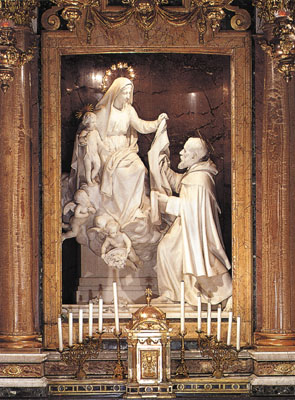
St. Simon Stock, Carmelite(16 May 2009)
Eph 6.10-13,18; Ps 1; Jn 15. 9-17

Homily of Fr. Paul Panaretos, S.J.
England, Elijah and a Pilgrim

Today Carmelites celebrate the Englishman, St. Simon Stock. In the 13th Century during the crusades Simon made a pilgrimage to the Holy Land. He met hermits on Mount. Carmel. Mount Carmel is a ridge of mountains, rising 1740 feet above the sea. It is a continuation of the hills of Samaria, which divided Galilee to the north from Judea to the south./1/

Mount Carmel drops steeply into the Mediterranean. Caves dot its cliffs, which provided shelter for people who left the world to live in prayerful solitude. The hermits Simon met remembered Elijah and his followers. When it became too dangerous for pilgrims and natives because of the crusades, Simon returned to England with some of the hermits.

To live they begged, like the Franciscans and Dominicans, orders familiar to the people. The mendicant Carmelites--new way of living for them--elected Simon as their Superior-general.

As their order began to grow Simon established new houses. The shift from solitary to communal living was not easy. That shift was difficult for the Carmelites, who sought to live solitary lives. Also, the established orders resented the newcomers and their devotion to Mary.


That may surprise us, yet that is how it was. Introducing something new plays on human insecurity and challenges accepted ways. When Simon withdrew from everything for some relief from the problems vexing him and the Carmelites, Simon beheld Mary presenting him with a brown scapular to protect him and all Carmelites from “eternal fire. It shall be a sign of peace and a safeguard in times of danger.”/2/ Mary depends on her son’s mediation, and she offered Simon relief through her maternal care so that Simon would depend on Jesus’ mediating love, too.

Simon's story is not a familiar one to us “non-Carmelites,” which is why I rehearsed it. God works in surprising ways to help people save their souls. An Englishman in the Holy Land met hermits who continued to remember Elijah, not only Simon’s help to salvation but others’ as well. People resented them and without realizing it resented God’s ongoing efforts to save the world.


That is not what Jesus encouraged, as we heard in the gospel, but to abide in [his] love. Grow[ing] strong in the Lord, to use St. Paul’s phrase, is not a brash effort. Grow[ing] strong in the Lord is a discerning effort, which seeks to notice God moving in all things, the new as well as the familiar. That requires humility, something that St. Simon Stock had and encourages all Jesus’ friends to cultivate and to nourish no matter anyone’s vocation.


____________
1. Find Mount Carmel and its ridge at D 5 on this map.
2. This timeline contains the full quotation at 1251 on the timelime.
_______________________________________________________
Wiki-image of St. Simon Strock receiving the scapular from Mary is in the public domain.