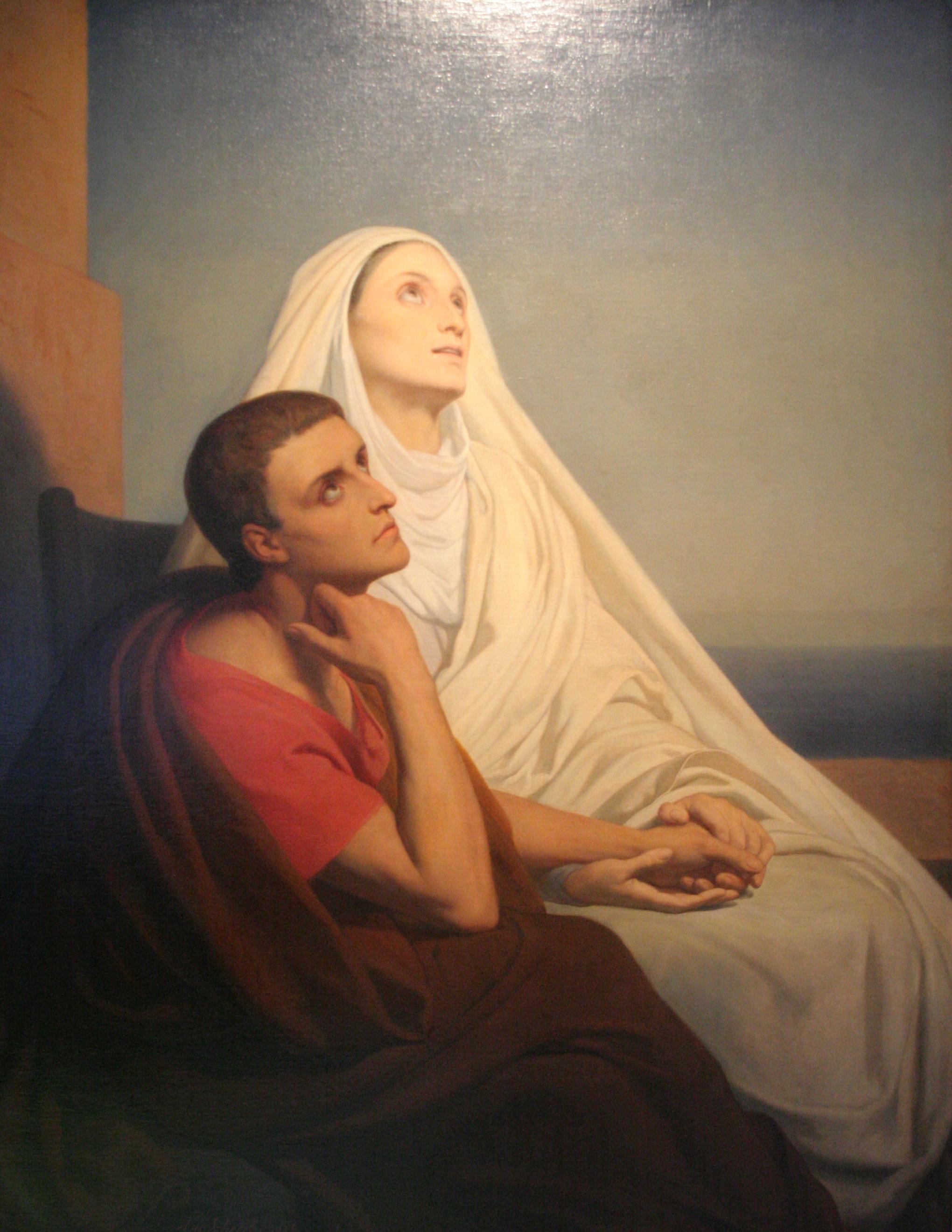
Praying for the dead has been part of the church from its earliest days. Many of the first pastors of churches made statements about praying for the dead and its benefits. However, more telling is a request by a woman of her son because it testifies that praying for the dead was by then a 400-year-old practice. Dying Monica requested of her son, Augustine, “One thing only I ask you, that you remember me at the altar of the Lord wherever you may be.”1
Praying for the dead also celebrates the lives of those God has created and given us, lives which continue in God’s presence; lives God will reunite with us when death will be no more. My sister and her family and I are grateful for your prayers for our mom. Gesu was represented well at her funeral. Yet, none of us can be everywhere, and so to console you, we pray for my mom together.
 Elaine and I remain particularly grateful to all the staff of Huron Woods, our mom’s residence the past two years: from administration to maintenance; from housekeeping, dining to pastoral care; and round-the-clock caregivers. Huron Woods, on the campus of St. Joseph Mercy Hospital, in Ann Arbor, Michigan, offered our mother exceptional care and Elaine and me great peace of mind. We learned much about compassion and devotion. We ask you to pray for them because they had told us our mom won their hearts.
Celebrating the paschal mystery of our Messiah Jesus with attention to its many faces puts us in touch with the roots of our faith. Paschal, as you know, means our faith is rooted in Jesus’ suffering, dying and rising, which we celebrate these days with confident, joyous solemnity. My mother began dying on Holy Thursday and died Easter Wednesday, which made it a poignant Triduum and Easter Octave for Elaine and me. Holy Thursday and Good Friday need little comment. Holy Saturday is different. Holy Saturday is a quiet day in the Western church. It celebrates no sacraments in churches and only takes the eucharist to the dying.
The Eastern church’s liturgy is not as quiet. A hidden, rattling sound is that liturgy’s reminder that Jesus descended among the dead, and that his risen presence brought great distress to the prince of the dead. Also in that liturgy the sound of tapping symbolized Jesus opened the gates of the netherworld so all the dead could enjoy Jesus’ resurrection and its freedom. I noted this mark of our paschal faith at my mom’s funeral. Then and now we reaffirm that Elizabeth Panaretos in death enjoys freedom, peace and immortality. Yet we are very aware of the stinging loneliness—always frustrating and often frightening and confusing—her Alzheimer’s foisted on her.
You desire to console me, my sister and her family in the solitude we face now that Elizabeth has set down her 90 years. You desire to console yourselves in the face of your losses, especially of loved ones. We need consolation because we don’t feel fully their freedom, peace and immortality. We need consolation because death confounds us. We go to lengths to deny death, but when we are face to face with a deceased, we have two choices. If we collude in our denial-efforts they will leave us empty. Or, we may choose to treat death as a sacred moment in our life’s journey. The painful experience of absence reigns when we deny. When we treat death as a sacred moment in our journey of life, we make room for a “loving desire to be with” whomever has died.
Our “loving desire to be with” is not my original insight, although I have come to make it mine. Our “loving desire to be with” was the insight of my former General Superior, Jesuit Fr. Peter-Hans Kolvenbach, in his reflection on the Virgin Mary’s “sorrow and weariness” at the death of her Son. In a paschal move Fr. Kolvenbach distinguished between loneliness and solitude, saying, “The sorrow and weariness which…accompany the solitude of Our Lady make us sense that this solitude is a loving relationship to Christ experienced in [her] inability to have a living encounter with him. In other words, the torture of separation [did] not lead Our Lady into isolated loneliness, but direct[ed] her along the path of solitude—solitude, precisely because it entails openness to the other and lives from the desire to be with the other. The love which [establishes] the subtle difference between loneliness and solitude is a crucible, in which absence does not create a void but only serves to deepen the presence so desired.”2
Our mother’s expressions of her total love for our father, whose absence she experienced for nearly 10 years, made “of her solitude a sign of love” like Mary for her Son. From the moment of our father’s death, Elizabeth did not close in on herself. Instead, her hope transformed her longing; her faith gave her new sustenance; and she loved more freely. Our mother, ever loving, even when it exacted personal costs from her, began to love in a new way. The woman who was always enterprising and resourceful allowed others to care for her—totally in her last two years—and she did so with graced graciousness not mere human politeness.
 Our mother’s loving solitude held our father, and Elaine and me, and so many, many people—blood relations, in-laws, friends and even enemies—in her heart throughout her life and the lifetimes and deaths of each of those many, many people. My experience of our mom’s loving solitude has taught me much about how God has created me to be a Jesuit, a man Jesus has called to be his companion in our world for its sake. Looking at my sister, Elaine, and her spouse, Abe, and their children and grand-children, suggests just as strongly how our mom’s loving solitude has taught my sister and her family about God’s unique desires for them.
Our mom was at peace with herself enough to enjoy life, to laugh with others and to laugh at herself earlier in her life and late in it. Her peace was a grace because she was challenged in many ways throughout her life. She lived confident that she awoke daily, guarded with God’s power through faith, as the First Letter of Peter reminded us. Her faith allowed Elizabeth to be generous with love and affection in many forms, and to excel at both by her genuine concern, hospitality and tables of food prepared from scratch.
Although she enjoyed overall good health, Alzheimer’s deprived her from enjoying it in her final years, which sharpened our sadness. Now she is whole. This is what we Christians mean by being redeemed. Christian redemption is no mere transaction. It is being made whole, liberated and found by our good shepherd. Being redeemed is being loved and enjoying affection individually yet in no lonely fashion but with all sharers of the faith of Jesus. Our creed names the sharers of the faith of Jesus the communion of saints.
All Christians are saints because we have died and rose with Jesus in baptism. We seek to grow and do justice to our baptisms. We also entrust our rebirth in baptism to open onto our salvation which stands ready to be revealed in the last days, that is, being made whole, liberated and found by our good shepherd. Entrusting ourselves to this faith of ours is ever a challenge. My mother lived that challenge, feeling deeply its joys, doubts, “sorrow and weariness.”
I am faced with her bodily absence. Physically absent, I am not separated from her, just as your dear ones are not separated from you. My mother’s request is St. Monica’s: “One thing only I ask you, that you remember me at the altar of the Lord wherever you may be.” No one needs to be a priest to do that. The benefit is my mom’s and that of your dear ones. We also enjoy a benefit: we remember them as we remember Jesus, our risen Lord. That twin memory transforms loneliness into Christian solitude so we may more freely live as friends of Jesus and one another. Our memory of our dear ones also inspires us to serve more freely, even when it exacts personal costs from us. That has been and continues to be an infallible sign that in impartial ways, we already are being made whole, liberated and found by our good shepherd.
___________
- His Confessions, IX:11.
- Words in quotes from Peter Hans Kolvenbach, S.J., “Christ’s Descent into Hell,” The Road From LaStorta, p. 79 [no publication data other than ISBN# 1-880810-40-9].
__________________________________________________________


