Showing posts with label Faith Experience. Show all posts

Thursday, December 10, 2020

Letting Go

The pandemic has removed things and activities from daily life. Clinging to them prevents choosing wisely to remain healthy. Clinging also denies opportunities to grow, even to notice God’s invitations to more life.


Jesuit Brother Joe Hoover suggested that “when we are asked to do a simple thing that makes sense, like letting things go during a ferocious pandemic, it might be God is preparing us to receive something profound in return.”

Monday, April 20, 2020

Emotion, Urgency, Hope

Jesuit Greg Kennedy’s recent book was released before the pandemic changed our lifestyles: Reupholstered Psalms: Ancient Songs Sung New. It is “a magnificently illustrated book which is, as the title explains, a version of the Psalms adapted for today’s readers to give them hope.” Greg explained more in an interview.

Monday, April 13, 2020

Continued Entrance into the Mystery

The first witnesses to the Resurrection catechized others so they could enter the mystery. Catechesis come from  Greek: to echo down into the ears. Once a person began to reverberate with the Resurrection mystery baptism was celebrated. Baptism began the process of mystagogy: being led more deeply through the same mystery. The Church takes time for both catechesis and mystagogy.

The Christian conception of time is not limited to the modern one in which humans usually operate: unilinear and forward. It is an intersection: human time with divine time. The Kairos video exemplifies the intersection as it leads through the Resurrection mystery from our present moment.


Friday, March 27, 2020

Invitation to Grow Closer

St. Athanasius helped 4th-Century Alexandrian Christians prepare for Easter. He closed a section of his letter:
Such is the wonder of [God’s] love: he gathers to this feast those who are far apart, and brings together in unity of faith those who may be physically separated from each other.
Three days ago Sojourners Communications Assistant Miguel Petrosky began his conclusion:
“We can believe that God is present and still be either six feet away or in the safety of our homes on Sunday morning. The church will always be the church no matter how physically close its members are. God isn’t just found in the confines of a physical church building—God meets us where we are.”
Humans transcend distance, too. We are transcending with greater intent from online classrooms to online chapels. Jesuit Novice Bosco Noronha described “a consoling sense of unity in the body of Christ” as he helped others worship by livestream.
___________________
Wikimage Panathenaic Webcam Icon by "Mazenl77 / CC BY-SA 3.0"

Friday, November 15, 2013

Claimed by God

Opinions about commitment in the modern world abound: it is a victim of a throwaway society; few give themselves to it; most are wary of it; it is old-fashioned; it does not satisfy; and more. Perhaps people rush commitment to soon. Does something precede making a religious commitment? In an essay by Anna Nussbaum Keating allowing God to claim people seems prior.

The ways men and women make God’s claim of them tangible for themselves varies. One of those ways is tattoos. Many moderns react viscerally to them. Ms. Keating recalled an eighth-century church council had decided that “a Christian bearing a tattoo ‘for the sake of God’ was deemed worthy of praise.”
_______________________________________________

Monday, February 25, 2013

Lent’s Goal

Lenten practices—fasting; deeper praying; almsgiving—are not ends in themselves. They are helps to open to transformation and to something countercultural: “accepting failure.” In Lent’s opening days Jesuit Brendan Busse considered that. As Lent progresses Jesus’ story keeps inviting Christians to that exercise. 
_______________________________________
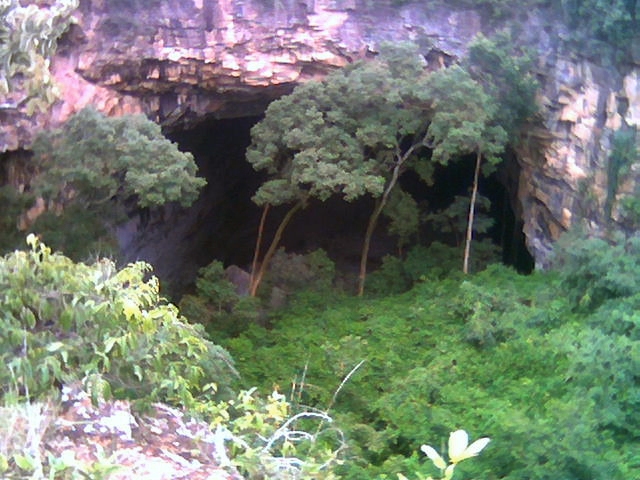
Wiki-image of Buraco das Araras was released to the public domain.

Saturday, February 02, 2013

E-Retreat

Time or money prevents some people from retreating to another place to enjoy quiet time with God. Jesuit Fr. Jim Martin responds and fills a need. 


Book Trailer: TOGETHER ON RETREAT by James Martin from harperone on Vimeo.
ORDER HERE: http://www.harpercollins.com/books/Together-Retreat-James-Martin/?isbn=9780062270092

How can we find God? How can we pray? What can we learn about Jesus from the New Testament stories about his ministry around the Sea of Galilee? In this innovative e-book, Rev. James Martin, S.J. invites us on an actual retreat to answer those questions and to encounter God’s presence in prayer and meditation.

Martin, an experienced spiritual guide, teaches you how to pray with Scriptures and answers your questions about prayer in ways that are accessible to both doubtful seekers and devout believers. This fresh, insightful and personal retreat experience is a must for anyone looking to explore this ancient practice in a contemporary way.

Monday, January 14, 2013

History of a Union

Once a year news stories are devoted to “Orthodox Christmas.” The stories include a photo or two, mention the different date and, usually, the Julian calendar. On any day little space is given to the history of Orthodoxy in the U.S. A brief essay, focusing on people instead of dates and posted at CNEWA, is a great introduction to the complex origin of the Orthodox Church in America: from “Orthodoxy arrives” to “a new Church.”

_________________________________________________
Wiki-image by Andrew Gould of Holy Ascension church used by CC BY-SA 2.0.

Monday, January 07, 2013

Ongoing

Though the Twelfth Day of Christmas has passed, its season continues through the Baptism of the Lord. Yesterday focused on the magi journeying to find the newborn King. Each person journeys in every age. The magi were led on their journey by a star. Was it a star? More important, does it continue to shine for contemporary travelers? Jesuit Guy Consolmagno of the Vatican Observatory was asked about the Star of Bethlehem. He began his answer by reminding that the question “has hidden within it all sorts of wildly wrong assumptions.”  

________________________________________________________

Wiki-image of Jerusalem sky was entered into the public domain by Zwergelstern.

Saturday, October 20, 2012

Document on Revelation Turns 50

Dei verbum [Word of God] are the first words of the Second Vatican Council’s document on revelation. Jesuit James Corkery notes:
But for the personal intervention of Pope John XXIII, our understanding of revelation might still be that promulgated by the First Vatican Council (1869-1870). So how did Vatican II change the way we think about revelation?
Read his answer and more on the “character of revelation” and how it “flavoured the entire Council.”
______________________________________________________________________________

Friday, August 24, 2012

Tongue in Cheek

Jesuit Fr. James Martin portrayed Jesus having a bad day. The irony of his “the not-so-social gospel” is that many consider the challenges of Jesus to be “just metaphors.”

_____________________________________________________________________

Wednesday, May 09, 2012

Felicitous Followup


Commonweal published an excerpt of a book to be released in July. “A Crush on God: How a Young Priest Helped Me Hear Jesus” by Kaya Oakes narrates in an engaging way the fruits of spiritual direction and spiritual conversation. It aptly follows yesterday’s post about spiritual direction. (A link to Ms. Oakes’ book follows the excerpt.)
_______________________________________________________
Wiki-image by Mooreanna13 of Quarter Meal Mural used by CC BY-SA 3.0.

Tuesday, May 08, 2012

Who Offers? Who Receives?


Spiritual direction, that is. A Boston Globe article yesterday described how varied the art is and how it has grown in use.
__________________________________________________
Wiki-image by JJ_Harrison of Richea Scoparia used by CC BY-SA 3.0.

Saturday, April 28, 2012

Neuroscience and Spiritual Experience

The tweet, leading to the article by Dr. Kevin Nelson, M.D., was an apt quote from C.S. Lewis: “Unless I believe in God, I cannot believe in thought.” Dr. Nelson has been exploring “the processes of spiritual sensation” for over 30 years. He asks if faith can reside in the brain.

_____________________________________________________________

Wiki-image by Jens Langner of a brain PET scan has been released into the public domain.

Saturday, December 03, 2011

Living With Uncertainty

By “learn[ing]to live with uncertainty,” Jesuit Father Larry Gillick does not mean an uncertain living. He speaks to everyone as he shares in a few minutes his “simple story” of vocation.

Thursday, May 05, 2011

Great Title: "A Catholic Elevator Speech"

How easy to be tongue-tied when asked an unexpected question and in a usually silent space, an elevator! The particulars of her experience Susan Klemond described:
When a co-worker recently asked me why I’m Catholic, the question took me off guard. I have good reasons for choosing this faith but none of them came to mind at that moment. This was a chance to put the faith in a positive light for an interested, yet skeptical person.
Her post offers resources, within it and links to more, to have untied tongues more often.

___________________________________________________
Wiki-image of elevator panel is used according to the Creative Commons Attribution-ShareAlike 3.0 Unported license.

Wednesday, May 04, 2011

Wideness in God's Mercy

Osama bin Laden may be a contemporary "test-case" for the hymn's assertion, "There's a wideness in God's mercy." Jennifer Fulwiler posted her reactions, which followed long after watching the events of 11 September 2001 unfold:
It wasn’t until I came to believe in God and started learning about Catholic teaching that I would look back on that awful day and have my mind reel as I tried to absorb one of the most difficult moral truths I’d ever heard: That God not only could, but wants to forgive Osama bin Laden. That even someone who was responsible for a terror attack that slaughtered thousands could ask for God’s forgiveness, and receive it.
Read her post here.

Jesuit Father James Martin was in New York on 11 September 2001. He posted his reaction to the news that bin Laden had been killed and the Christian call to him
. . .I am not blind to the death and destruction caused by Osama bin Laden. . . .Osama bin Laden was responsible for the murder thousands of men and women in the United States, for the deaths and misery of millions across the world, and for the death of many servicemen and women, who made the supreme sacrifice of their lives. I am glad he has left the world. And I pray that his departure may lead to peace.

But as a Christian, I am asked to pray for him and, at some point, forgive him.

Read his post here.

Monday, April 12, 2010

St. Luke's Gospel: Movie and Personal Stories

The Levijoki, St. Francis of Assisi (Ann Arbor, Michigan) parishioners, have created a website featuring a movie of the Gospel According to St. Luke. The entire third gospel in the Revised Standard Version is narrated by Orson Welles and Alexander Scourby.

Featured, too, are testimonies by Catholic young adults. Their stories allow viewers to meet others who have discovered and experienced what Luke’s Gospel records.