Monday, November 30, 2009

Faith and One's Work

The difficult economic situation is a global one. People are moved to engage faith; others seem convinced faith never fit in the workplace. For people familiar with Ignatian spirituality or who desire to engage it, work and faith are never separate. British Jesuit Keith McMillan recently offered "a method of helping those in the business world to bring the values of their faith to their professional life."

While written from the perspective of the United Kingdom, Father McMillan briefly mentions the U.S. contribution that helped start Faith in the Workplace [FIWP] in London. Father McMillan also offers a concise description of the monthly, 1.5 hr-long meetings plus a testimonial from one person in business for whom FIWP is part of that person's life.

In sum, Father McMillan encouragingly answers the question, "How can one be both a good Christian and a successful business leader?"

Saturday, November 28, 2009

Sunday word, 29 Nov 2009

Advent Sunday1 (29 Nov 2009)

Jer 33. 14-16; Ps 25; 1Th 3. 12-4.2; Lk 21. 25-28, 34-36

Homily of Fr. Paul Panaretos, S.J.

Advent Assurance For Daily Living


We begin another Advent. We begin “a season of joyful and spiritual expectation.”1 That description of Advent by the church—“a season of joyful and spiritual expectation”—is important for us to recall because over its history the church observed Advent as a miniature Lent, which Advent is not. Because some of us can remember that and most of us are affected by how Advent was observed, the church’s definition of Advent as “a season of joyful and spiritual expectation” helps us appreciate better what we’ve begun. This year I want to reflect with you on Advent’s shape and to what today’s scriptures point.

Advent, which means arrival, celebrates that Jesus, who was born and shared our human nature, died and rose and sits at God’s right hand2 in glory. His human birth was his first advent. Jesus is also present among us by his spirit and will return in glory to give his faithful followers a share in his glory.3 You and I await is his future, second advent.


As always the church engages us where we are: living lives of faith, hope and love. Advent opens the same way, where we are, living with faithful vigilance Jesus’ second advent. Advent renews our sights on Jesus’ future advent to revitalize our faith today and to encourage us to live it. As we near our celebration of the birth of Jesus, Advent recalls the past, Jesus’ birth, which began to transform human history and life. Do today’s scripture readings help our ongoing transformation? I believe they do.


Today’s readings flow with friendship language: promise; covenant; friendship; hearts. They also echo behavior flowing from friendship: kindness and constancy; [God’s] justice, our conduct; humble action; and vigilance. The word promise threads through the bible, usually about God’s promise to people. Jesus fulfilled God’s promise for Jesus was and is access to God’s life, and Jesus gives us a share in it. While we think friendship a human bond, God desires our friendship and established a covenant so God’s friendship would win and free our hearts. Keeping the covenant embraced various human behaviors.


Behavior flowing from friendship makes it a living, pulsing, human truth not some ideal. Friends and friendly people show kindness. They also are faithful, loyal, committed and devoted in deed and word. God’s devotion is God’s justice, which was, is and will be God’s desire that we live in right relationship with God, with others and with all created things.

The norm for human conduct is humble action: to cultivate an awareness of my Creator and Redeemer so that I will not act as though I am the center of my universe. To act as if one were the center of the universe is not only not humility, it’s idolatry. Idolatry minimizes God or takes God’s place. To minimize God or to take God’s place is the root sin of all sins.


Each of us knows how we minimize God or do not respect God’s goodness. We need to be vigilant with ourselves. Yet, living our Catholic faith is not just a matter of personal scrutiny. Living our faith acts with the assurance that our Messiah Jesus accompanies us; living our faith joyfully anticipates his glorious return. Welcoming his friendship and extending it to others are how we live sure that our Messiah accompanies us and will return to complete his promises to us. Although clothed in human forms, Jesus’ friendship offers us divine gifts. Jesus graces our human kindness to give others his peace. As agents of his peace we transform the world one person and one moment at a time.


In your daily 15 minutes with Jesus this week, ask to see with the Trinity’s vision, to see others and the world as if for the first time. Ask the disciples to present you to Jesus. Speak with Jesus in your words requesting new freedom from fear and anxiety to live his good news as Jesus created you to live it. Ask Jesus for the grace to be a disciple, who is faithful, loyal, committed and devoted in deed and word. Close, saying slowing the Lord’s Prayer. Jesus gave us the words, thy kingdom come, to heighten our joyful expectation, and the next words, thy will be done, to help us act in sync with his gospel-kingdom day by day.


____________

  1. General Norms for the Liturgical Year and Calendar, #39.
  2. Psalm 16 and Hebrews 10.12, part of the Liturgy of the Word of the 33rd Sunday of the Year, recall that. It also testifies to the overlapping of the final Sunday of the Year, Advent and Christmas!
  3. The Third Eucharistic Prayer for Masses with Children expresses both Jesus glory with his Father and his abiding presence with his church: Jesus lives with you in glory...he is also here on earth among us.
____________________________________________________________________________
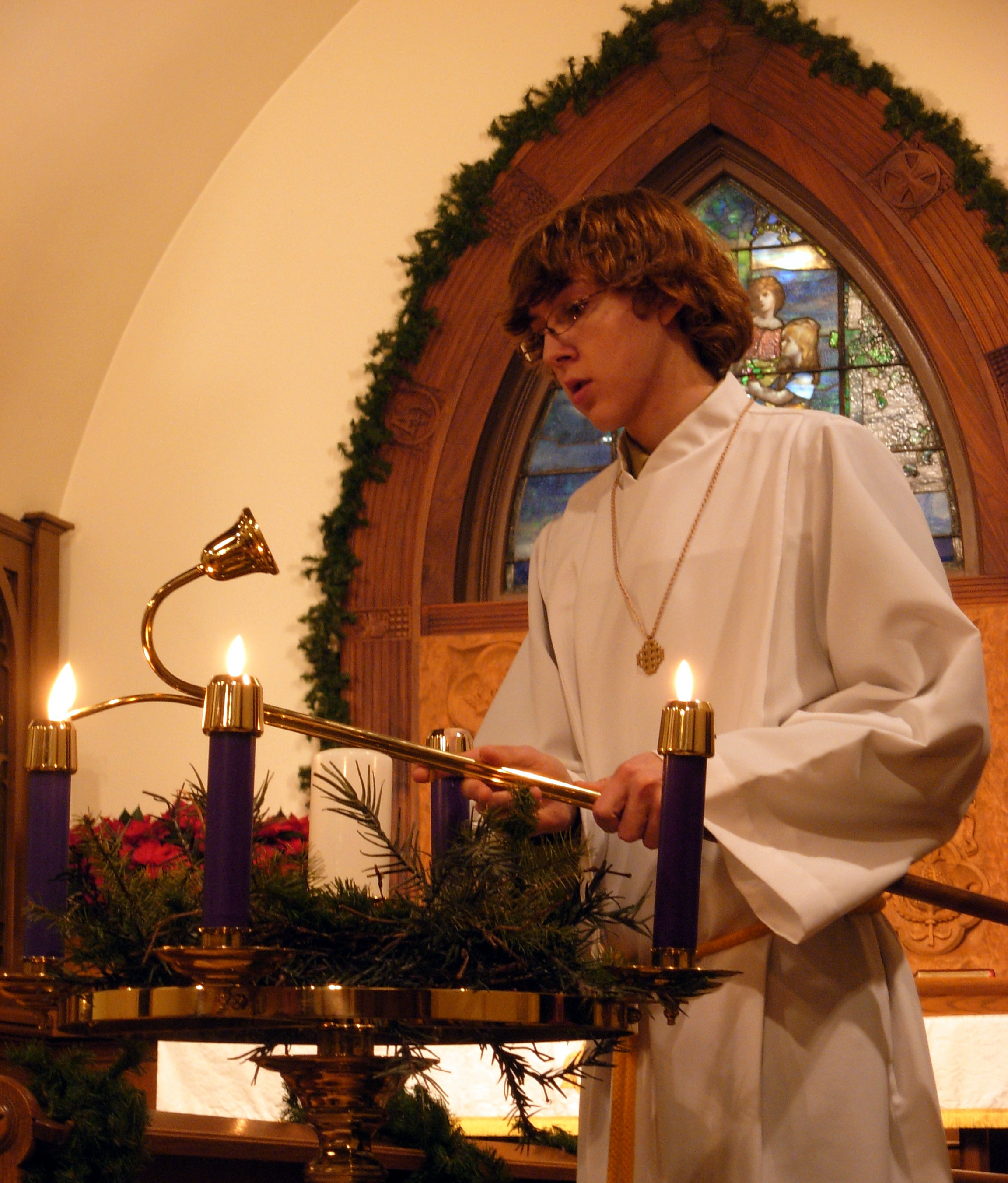
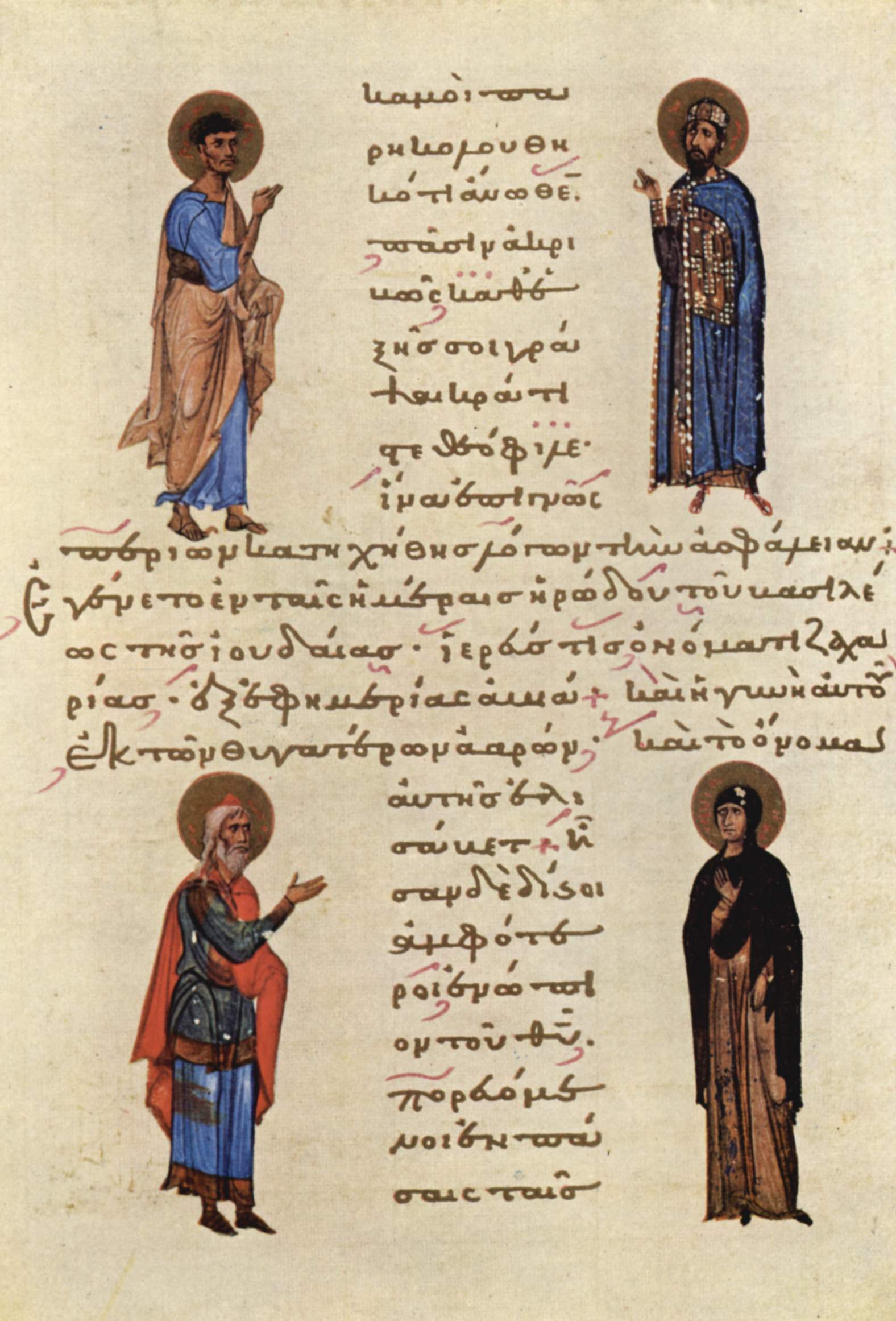
Wiki-image by Jonathunder of lighting an Advent wreath is used according to the Creative Commons Attribution ShareAlike 3.0 license. Wiki-image of the first page of Luke's gospel (first six verses) in a Byzantine edition is in the public domain.

Saturday word, 28 Nov 2009

34th Saturday of the Year (28Nov 2009)

Dn 7. 15-27; Resp. Dn 3; Lk 21. 34-36

Homily of Fr. Paul Panaretos, S.J.

Alert Not Charmed


Because many of us celebrate mass between Sundays we have noticed the prophet Daniel’s message this last week of the liturgical year had one theme with different expressions. The theme was power, human and godly, earthly and heavenly. Rather than working in concert with godly power, human power had grown arrogant. Arrogant in kings, who led others into captivity—the context of the Book of Daniel; arrogant in the kingdoms themselves depicted by beasts, which caricatured power wielded by humans.


A caricature exaggerates striking characteristics to make a point. In Daniel’s vision he beheld beasts devouring and crushing...and trampling humans and the rest of creation, rather than preserving, strengthening and building creation in the manner of true stewards. The beastly features opposed humans, whom God created in the divine image, and humane stewardship.


Stewardship involves of creation,1 especially its crown, humans. Power that abuses does not harmonize with God’s kingdom. In proclaiming the kingdom, Jesus emphasized the harmony of human and divine, and God’s initiative to help people to become realigned with God in deed and word: our vocation daily until Jesus’ return.


Luke’s Jesus offered no timetable of events before the return of the son of Man, a sobriquet in circulation before Daniel’s time. Instead, he encouraged an alert vigilance not an idle one; a calm and even approach to the world; and to pray for strength to persevere in that approach.


The distractions of daily life need not be only its anxieties. Earlier in his teaching, Jesus remarked that even the pleasures of daily life can choke the word [of God] so that it does not come to maturity in human behavior or language.2


A parallel with safety is apt. Safety pros teach that the more familiar our surroundings, the less alert we are to potential hazards. Similarly, in our desires we don't notice insidious dangers. Insidious dangers may have harmful effects equal to those coming from a visible, external source, even a beastly one, to exploit Daniel’s vision. Yet Jesus encouraged a vigilance to free us not make us paranoid; a vigilance that would offer us strength; a vigilance that would make us confident so that we can stand firm with head held high3 whenever the son of Man may come.


For us who live in secure comfort, Jesus may encourage us to employ alert vigilance lest life charm us to forget God has given all things to us so we may exercise holy stewardship not become puffed up by any power we have. To be alert that way to exercise holy stewardship is not to be a caricature-Christian but to truly and effectively minister to each other.


_____________

  1. This is dear to Pope Benedict. It has been his General Intention this entire month.
  2. So Jesus explained part of the Parable of the Sower in Luke 8.14.
  3. See Luke 21.28, which is part of Jesus’ parable and his interpretation and teaching in these final verses of this chapter.
___________________________________________________________________

Wiki-image of Jesus' teaching about the end of the temple is used according to the Free Art License.

Sunday, November 22, 2009

Sunday word, 22 Nov 2009

Christ the King (23 Nov 2009)
Dn 7. 13-14; Ps 93; Rv 1. 5-8; Jn 18. 33b-38
Homily of Fr. Paul Panaretos, S.J.
Chronic or Gracious? God’s Love is Both

When a child is born healthy parents rejoice, free to imagine a future with grand potential for their youngster. When someone lands a new job, the person rejoices to have financial and work security and is free to imagine and set goals and contribute to family and society.

Our rebirth in baptism, made alive in Jesus Christ…the faithful witness, the firstborn of the dead and ruler of the monarchs of the earth, initiated our freedom to rejoice that we share Messiah Jesus’ royal, priestly prophetic mission.

“Priestly people” is a royal title: God set us apart in Jesus to glorify God. It’s a prophetic title, too: we are free to imagine new life dawning in the darkness and hum-drum of daily existence until new life shines as the son of Man...on the clouds of heaven presents us before the Creator’s throne.

Priestly people also know challenges. A child’s birth; beginning a new job; as well as being reborn in Jesus and the future’s far reaches: much unexpected lay between. A healthy infant can develop a syndrome in childhood which changes life for the youngster, parents, the entire family.

A job’s financial and work security don’t insulate a worker from challenge, frustration, even agony. Life in Jesus does not rule out suffering now. Jesus not only indicated his life would ultimately end on the throne of his cross; Jesus repeatedly alerted his disciples that witnessing to his cross and his kingdom entails lives of cross-bearing. We’d rather deny that. Denial is strong.

When a chronic condition appears with no warning and begins to dog a formerly healthy child, parents struggle immensely to cope, often denying it’s happening. When unexpected adversity tarnishes the luster of a new job, we can feel we’ve made a mistake with our lives.

So, too, all of us always confront our tendency to deny Jesus in one form or other. A person may feel deluded by the people who passed on the Christian faith. Another may feel that Jesus can in no way be in season in one’s time, life or circumstances. Still another may feel it’s impossible for the crucified Jesus to be the almighty, let alone the Beginning and End./1/

We’re no different from Jesus’ contemporaries. Those who staked their lives and hopes that Jesus was the Expected One: he wasn’t the individual they thought he’d be. Pilate demonstrated this was not only the disciples’ problem. It was a human problem. My kingdom does not belong to this world.How would a ruler make sense of that? Jesus’ mission to testify to the truth stirred in Pilate no idle question, “What is truth?” though Pilate may have asked it from the position of his power rather than genuine desire.

To ask Jesus what truth is was to ask Jesus who he is. No human response satisfactorily answers that. All power finds its meaning in Jesus. Someone once rearranged the letters of a Latin translation of Pilate’s question, What is truth?/2/ He arrived at this answer: The man standing before you.

Jesus never is precisely who we think him to be: nor are our children, our jobs, even our church. God doesn’t abandon us to our chronic conditions, our poor selves, even our strengths. Rather, God’s perpetual graciousness reveals to us God’s truth and the truth of ourselves. When we allow our truth to be revealed we experience a release,/3/ even while we feel captive in a world of illness, dysfunction and rejection as was Jesus. Jesus is our King precisely because he commanded no things. Giving himself to God’s truth, he gained his. This is the essence of our feast of Jesus as King: we remind ourselves to be open, not striving, and to rely more on the perpetual grace of his redeeming glory.

In your daily 15 minutes with Jesus this week, bask in the life of the Trinity. Ask your patron saint to present you to Jesus. Thank Jesus for creating you and redeeming you. In your words ask Jesus for the grace to surrender to him so you and your life will be a faithful witness of his Spirit alive in you. Close, saying slowly the Lord’s Prayer. Jesus gave it to us to help us live our royal, priestly, prophetic mission with renewed courage and conviction.


____________
1. The meaning of Alpha and Omega in Revelation 1.8 of the Second Reading.
2.
Quid est veritas? Est vir qui adest. This appeared in Ripely’s Believe it Or Not in the 1950s.
3. See Romans 8.21.
_____________________________________________
Wiki-images from an ancient gospel folio of Jesus before Pilate and of a detail of Jesus before Pilate are in the public domain.

Saturday, November 21, 2009

Saturday word, 21 Nov 2009

Presentation of the Virgin Mary (21Nov 2009)
Zech 2. 14-17; Resp Lk 1; Mt 12. 46-50
Homily of Fr. Paul Panaretos, S.J.
Implications

The Incarnation is an epicenter of our faith. The Presentation of Mary in the temple focuses us on her future as the human temple, the one who would give God’s word human nature, and fulfill God’s desire. The prophet Zechariah gave voice to it: I am coming to dwell among you, says the Lord. That dwelling burst the limits of human imagination, as well as hope. We’re no mere onlookers to this amazing grace. We’re part of God’s desire, indeed we’re part of God’s family. That has implications.

One implication is that we cannot think of God’s family in human terms. Jesus reshaped any thinking in both gesture and word. His gesture is easily overlooked: stretching out his hand toward his disciples. Jesus stood between—like a bridge not a wall—his disciples and his Father. Jesus continues to be that bridge by the power of their Spirit, the same spirit who overshadowed Mary and incarnated God’s word. In words Jesus amplified his gesture: my Father...my brother, sister and mother.

A second implication is that we cross the bridge, who is Jesus; in other words, our action, our cooperation with Jesus makes us and keeps us as God’s family. Jesus expressed that this way: whoever does the will of my heavenly Father is my brother, and sister, and mother.

A third implication is that Jesus, bridge and access to God, whom he called his Father, discloses this family that is both divine and human. Also, Jesus disclosed a pattern of living for members of God’s family. Accepting and desiring to replicate in one’s life the pattern of Jesus’ life accepts Jesus’ choice of a person to be part of God’s family. The scenes immediately before and after this one dramatized that.

Immediately before this scene was yet another demonstration of the religious leaders refusing to accept Jesus. They would not tolerate him! They accused Jesus of driving out a demon from a man by the power of the prince of demons not by the spirit of God./1/ Immediately after the scene we heard in today’s gospel, large crowds again come to hear Jesus and be with him./2/ Hearing was and remains the beginning of replicating in one’s life the self-giving pattern of Jesus and his confidence in his Father’s powerful presence.

Jesus’ sharing, his revealing the divine desire; our acceptance of it and living it means that God’s family, the community of the church of Jesus, is an extraordinary one. Its bonds have a greater value than human-family bonds. Human bonds are summarized by blood and personal identity as men and women. Divine bonds flow from listening and imitating Jesus. Divine bonds are fragile, too, because not listening and not imitating Jesus weaken and even shatter divine bonds.

The divine desire to dwell among us will never ebb. Mary remains for us the exemplar of hearing and heeding the divine desire and for each one who desires to be his brother, sister and mother.

______________
1. Matthew 12.22-45.
2. Matthew 13.1-35.
_____________________________________________
Wiki-image of an icon of the Presentation of Mary is in the public domain.

Sunday, November 15, 2009

Sunday word, 15 Nov 2009

33rd Sunday of the Year (15 Nov 2009)
Dn 12. 1-3; Ps 16; Hb 10. 11-14,18; Mk 13. 24-32
Homily of Fr. Paul Panaretos, S.J.

Embrace Desire

At the annual close of the liturgical year in the weeks before Advent, the bible selections for the liturgies challenge how we view and read the bible. Specifically, it challenges us about time, which shapes how we think. Like these: ‘Is it time to go?’ ‘Are we there yet?’ ‘I’ve another meeting in half an hour.’ ‘The Year 2009 will be over in 46 days; 1111 hours; 67240 minutes; 4 billion, 34,565 seconds.’ That one was over the top, yet time shapes our thinking. It straight-jackets us, and who doesn’t long to be free?

So we leave our time, 60 minutes of it on Sunday, to enter with one another kingdom-time, which the Psalmist described: A thousand years in [God’s] eyes are merely a yesterday [to us]./1/ Our notion of time contradicts that of the bible, so we let the bible pass; or we refuse to take it seriously; or we feel it’s not for us because it’s outdated—time again!—just not in tune with us.

That’s high and mighty! Yet, we treat the bible arrogantly and think little of it. Then Jesus makes us think with his image-intense language about time and place:

Then the sun will be darkened, and the moon will not give its light, and the stars will be falling from the sky, and the powers in the heavens will be shaken….then they will see ‘the Son of Man coming in the clouds’ with great power and glory...then he will send out the angels and gather his elect from the four winds, from the end of the earth to the end of the sky.

Those thens—three of them: who doesn’t want each to be a ‘when?’ When will the heavenly lights be darkened? When will we see ‘the Son of Man coming in the clouds’ with great power and glory? When will Jesus send out the angels and gather his elect...from the end of the earth to the end of the sky? With the certitude and exactness of our atomic clocks, we want to know those times so we won’t be caught off guard; so we won’t miss Jesus, the divine Son of Man; so at the very least we’ll have a “date with an angel,” who’ll lead us to freedom.

We don’t taste freedom because we refuse Jesus’ witness that then—his word; and ‘when’—our puny desire—are secret from us who know so much: ...of that day or hour, no one knows, neither angels...nor the Son, but only the Father.

What to do? Enlarge our desire not figure out Jesus’ image-intense language and read it like a train schedule. How? The Letter to the Hebrews, also dripping with image-intense language, offers this. God raised from death our high priest,/2/ the divine Son of Man, who took his seat forever at the right hand of God. Plus, the psalm reminds us the faithful person will, too, sharing the fullness of joys in your presence, [O God], the delights at your right hand forever.

We’ll never know the how Jesus took his seat forever at the right hand of God. Yet we have experienced it: healing; forgiveness of sin; living faithfully; showing compassion, receiving compassion; feeling grace embrace us, guide us and inspire us to choose, act and speak faithfully. Those and other revelations of God’s heart are ours! Sitting at the right hand imagines them and stirs us to imagine them. Not a cold fact a ticket-stub at Severance Hall gives, sitting at the right hand of God invites us to desire the delights of God here, now, moment by moment. God will take care of the future: [God] will send out the angels and gather his elect from the four winds.

To desire that is a strong and great desire! It’s a desire, which transforms our minds, our hearts, how we choose and what we choose. It’s God’s desire become our desire that we begin enjoying the freedom of the children of God/3/ even as we wait to enjoy it completely. Oh-oh! I’m sliding into earthly time, which mutes great desires, and I’m dragging you with me. So. . .

In your daily 15 minutes with Jesus this week, step out of time as you enter the life of the Trinity. Ask your patron saint to present you to Jesus. Praise Jesus for proclaiming the delights of the kingdom dawn among us even when we’re unaware. Beg Jesus for the grace to take him at his word; to trust in God’s secrets and desire them rather than figure them out to the last detail. Close, saying slowly the Lord’s Prayer. Jesus gave it to us to recognize our needs; to ask God to supply them; and most of all to give true freedom to us needy folk enslaved by time, which cannot save.


____________
1. Psalm 90.4.
2. Hebrews 4.14, from Second Reading, 29th Sunday of the Year (18 October in 2009).
3. Romans 8.21.
__________________________________________________________
Wiki-images of angels from an ancient folio and of the Emission Nebula are in the public domain.

Thursday, November 12, 2009

Thursday word, 12 Nov 2009

Mary Jo Reagan funeral (12 Nov 2009)
Sirach 44. 10-15; Ps 23; Romans 8.35-39; John 14. 1-6
Homily of Fr. Paul Panaretos, S.J.
Faith-bond

On behalf of Gesu Parish and the community of the Sts. Mary and Joseph Home, I extend our prayers and heartfelt sympathy to you, Bernie and Paul, at the passing of your sister. Be more courageous than your grief is sharp. Your confidence in our risen Messiah will help you and your families grieve well. Sisters, caregivers and residents, I extend those sentiments and prayers to you as well. You will help one another experience Mary Jo’s presence in real and new ways.

Today the Catholic church, Gesu Parish and this caring residence bid farewell to one of theirs. I offer a few words to console and strengthen you in your grief; to help you appreciate God’s astounding compassion by noticing Jesus’ victorious dying and rising were present in Mary Jo Reagan./1/ I want to help us all connect Mary Jo, whom you had the pleasure to know better than I did, with the mystery of Jesus’ dying and rising we celebrate today. I want to reflect briefly with you on the scriptures Mary Jo and others chose for her funeral mass.

I’d like us to begin with memory. Memory is more than discreet facts or ideas. Memory of a human is a portrait of that person, giving us access to who that person was and who that person came to be in our experience. The Book of Sirach is clear about that: the virtues of godly people are remembered, not forgotten. Virtues don’t exist separate from people; people embody them or not. To say that we remember Mary Jo’s virtues is to say we remember her. Surely, more than we remember her. By her life as an educator and a counselor, Mary Jo touched many lives, helping young people shape their futures. Memory lives in people. Memory shapes people.

The memory of Jesus in the early church/2/ to the present describes the transforming power of our risen Messiah. In addition to human memory, Jesus’ Spirit continues to make him present. The life of Jesus continues through his Spirit, given to us. Mary Jo allowed Jesus’ Spirit to flow through her. Her professional career was only one way. Another was her faith in Jesus, which animated Mary Jo. Her participation in the sacramental life of the church connected her with its many helps—for sacraments function to help us on our pilgrim way to the kingdom Jesus proclaimed./3/ Nourished by God’s word and the Eucharist moved Mary Jo to serve. One way was her role in the Patna Mission Circle, in which U.S. Catholics assisted the work of the Jesuits in northeastern India. Another was her devotion to our Blessed Mother, which helped her help others and moved her to volunteer in a variety of ways.

Many of you knew Mary Jo and will remember her as a person who never complained. I appreciate what that memory means and will mean to you because my parents were not complainers. After my mother needed to “get things out,” as she’d say to me, she would apologize for burdening me. She surprised me each time she would apologize because she never made her need feel like a burden to me.

What will your memories of Mary Jo mean? Memory, again, is more than discreet facts and ideas; it’s a living portrait of a person. St. Paul said well what this can mean for you who bid farewell to Mary Jo: nothing can separate us from the love of Christ Jesus. Christ Jesus is our common bond, our faith-bond. In faith we bury our sister, and in faith we accompany and support Bernie and Paul, who no longer have their sister available to them. In faith we support the sisters and caregivers here who let go of one more person, who allowed them to show love.

We use that phrase, brother and sister, at times too casually and miss the meanings it offers: united in Jesus; united with each other as God’s creations; called to serve one gospel both in common and in personal ways; united in Jesus’ desire to prepare a place for each of us and for us together.

Jesus preparation of a place for us is a metaphor for nothing less than Jesus creating us anew! Creating is what Jesus does at each moment. Creating is not a past event; it is who Jesus fashions each of us to be every moment. That may be a new way to think about God creating through Jesus by their Spirit, but that has been true from all ages. You and I tend to think in terms of time and history more than in terms of Jesus at work for us now.

What Jesus creates now, and how we surrender to Jesus’ creative shaping and transforming of us our poor language describes with images: We feel new; we notice something about ourselves we did not before; we sense our deep desires changing or growing more clear; and we live from them in ways we find surprising. If any of us need help to notice what Jesus creates now, and how we surrender to Jesus’ creative shaping and transforming of us, a more recent memory of Mary Jo--that is, her recent life--can help.

Walking into Mary Jo’s room revealed how she surrendered to Jesus’ creative shaping and transforming: her paintings. It can be one thing or a combination that unlocks our potential. I don’t know what it was for Mary Jo; maybe you do. What is important is that Mary Jo surrendered to a new way of seeing and of expressing color, shape, perspective, light and shadow, the natural world and ways humans shape the world—in short, Mary Jo surrendered anew to Jesus creating her. Painting immerses one in the awe of Jesus creating. It is one way of many to immerse ourselves in awe of the divine. Painting—indeed all arts—is another metaphor for Jesus creating.

Jesus has created Mary Jo anew: she enjoys the place Jesus promised to prepare for her; her luster as an image of God is being burnished; Jesus sets her in a frame of his shaping, so she may be truly radiant; and Jesus gives her life that we cannot imagine. More than that, Jesus is also recreating us. One day he will return in glory to reunite us all in his undying life. Funerals remind us that is true with the words, life is changed not ended./4/

Mary Jo not only lived change, she embodied the most real change, Jesus’ paschal life: united with Jesus and alive in the love of God in Christ Jesus our Lord. Choosing to cooperate with grace, Mary Jo lived a virtuous life. She is for us both our sister and a living memory of Jesus. We will retell her wisdom and faith the more we, like Mary Jo, surrender to Jesus’ creative shaping and transforming of us.


___________________
1. Cf. Order of Christian Funerals, 27.
2. The phrase was used by Nils A. Dahl and bequeathed to his students and his students’ students, who have enriched Christian memory as a communal experience, which shapes individuals. In 1976 the phrase entitled a collection of essays by Dahl.
3. A Prayer after Communion in the Sacramentary and the Order of Christian Funerals expresses that.
4. Cf. Preface for Christian Death I, Roman Missal.
____________________________________________
Wiki-image by Soman of muted sunlight over the Ganges River in Patna is used according to the Creative Commons Attribution ShareAlike 3.0 license. Wiki-image of a door panel representing the triumph of Jesus is in the public domain.

Tuesday, November 10, 2009

Tuesday word, 10 Nov 2009

Amalia Kaminisky funeral (10 Nov 2009)
Eccl 3. 1-11; Ps 23; Rm 5.1-11; Jn 16. 19-24
Homily of Fr. Paul Panaretos, S.J.
Running the Risk

On behalf of Gesu Parish, I extend our prayers and heartfelt sympathy to you, Albert, at the sudden passing of your spouse of 55 years; to Bruno, Louis and Sarina at the death of your sister; and to Katherine, Albert, Caroline, Christine and Anne at the death of your mother. Your children grieve, too. Be more courageous than your grief is sharp. Your confidence in our risen Messiah will help your children grieve well. Tim, Matt, Sarah, Mary, Elizabeth, Albert, Marshall, Maddy, Alexandra, Anna, Claire and John, you will help your parents to experience your grandmother’s presence in real and new ways. All of Amalia’s family will experience her presence in real and new ways.

Today the Catholic church and Gesu Parish bid farewell to one of hers. I offer a few words to console and strengthen you in your grief; to help you appreciate God’s astounding compassion by noticing Jesus’ victorious dying and rising were present in Amalia Kaminsky./1/

We are grateful for the family’s words of remembrance. Their words help us connect Amalia with the mystery of Jesus’ dying and rising we celebrate today. I want to reflect briefly with you on the scriptures Amalia’s family chose for her funeral mass. Amalia, as we know—and you better than me—was a person of faith. Faith shapes us, yet its shaping does no violence to our selves. As we Catholics say, “Grace builds on nature.” That Catholic conviction shapes my reflection.

Something I learned about Amalia from her family was easy for me to appreciate. When my father was 20, a stroke crippled his father, and my father became responsible for the home and lives of his father, mother, sister and his. Becoming head of the household in a practical way, shaped my father into both a responsible man and someone who appreciated everything as gift—even that for which he labored.

At half my father’s age, Amalia’s mother died and she became caregiver and caretaker. What-ever we may say about how that shaped her and, perhaps set a direction for her life, that event certainly did not warp who Amalia was. As we heard, she was stylish, caring, loving and selfless. Amalia was ready to give you her blouse, scarf or sweater if you complimented it.

Amalia knew that God-with-us in Jesus did not obliterate the human aspect of the world with its limits and imperfections. To use the words of Ecclesiastes, both time and the timeless--God’s self--exist together. This graced knowledge testifies to those virtues we name coming from God: faith; hope; love. They are not obvious; we know them by the actions they prompt and the effects they allow us to produce.

St. Paul said well for all time how we recognize someone who lives those virtues all we desire to live; and Amalia embodied them: we glory in hope of the glory of God. Not only that, but we even glory in our afflictions, knowing that affliction produces endurance, and endurance, proven character, and proven character, hope. Hope does not disappoint.

I translated St. Paul literally to help us appreciate the faith of your sister, spouse, mother, grand-mother & friend: we glory in...the glory of God. St. Paul’s point is not one of human initiative or of any conditioned state in which one finds oneself. St. Paul points us to God taking the initiative to reconcile us and give us peace, even when things may point to the absence of reconciliation and peace.

People reconciled by God through Jesus by their Spirit can glory, not on the basis of accomplishments—Amalia did not do that; nor about limitations, which Amalia came to to know intimately, but because they feel clothed by a secure felt-knowledge of God loving them. If anyone wants to know from where Amalia’s humble strength, her strong humility comes it was from knowing she was clothed by God’s loving care. You, her family above all, made that divine love real and gave it human contours; you personified it, giving it each of your names.

Clothed with God’s love that way is nothing short of miraculous! I am speechless when I consider that Amalia persisted in her humble strength, her strong humility in the face of being a long-distance runner, who lived these last years of her life with Parkinson’s disease and its ravages. Your sister, spouse, mother, grandmother and friend will be for you a parable of God’s love well lived.

After Anne completed Gesu School, Amalia was free to work beyond her home. She was the “media lady” at and for the school. Another kind of service became even more dear to her. Timing can be grace, and Gesu Parish embarked on RENEW, which is as its name suggests, a renewal, both personal and parish-wide. “RENEW happened at the right time,” as Caroline put it, “for our mother to serve with other women.” As someone who has personally experienced RENEW, I can say that service is first giving glory to God and growing in a graced personal relationship with Jesus. It is personal, and because it is not private, it is a relationship in Jesus shared with one’s small group of seekers. Knowing Jesus impels the group to serve others in his name.

That’s a compressed description. RENEW is a remarkable journey for anyone who risks it. I say “risks” on purpose because when we allow God to transform and enlighten us, we behold parts of ourselves that confuse us, frighten us or that we would rather not notice. Yet, the grace is that we do that in the company of Jesus, his Father and their Spirit. While no one sees one’s life in an arc of time from past to present to future, beholding ourselves with graced vision—to see ourselves as God does—we do integrate our past into our present in order to live our future in surprising ways.

With regard to Amalia I have pondered her shaping at age 10 when she became a caregiver and learned that responsibilities have joys not only burdens; through her adult years as a long-distance runner, who never expected to Parkinson’s disease would catch her. Like the disciples, from the other side of the Last Supper, who had confidence in their risen Savior, so that they had no qualms about conversing with him as they once had, Amalia had much to converse about with Jesus. Her RENEW journal is a guidepost for her family, a record of her graced conversations with Jesus.

Although it is a searing sadness for you because she is no longer available to you, your sister, spouse, mother, grandmother and friend has crossed the finish-line. Her joy is complete. Her strength is restored, and God continues to pursue her with God’s goodness and love, completing her graced transformation.

She remains your intercessor but with a new advantage: Amalia is one of the faithful departed, who prays for each of you to grow in the faith of Jesus to be the person Jesus created. As each of you discerns how to live the faith of Jesus at home, at school, at work, in your neighborhoods and your parishes, you will take the baton of virtues of both Amalia and God and cover the distance she has prepared you to cover. Each of you is living testimony to a disciple of our day. Amalia would want you to extend the glory of God she found to give her life rich, strong, simple and abundant meaning.

___________________
1. Cf. Order of Christian Funerals, 27.

____________________________________________
Wiki-images of a Resurrection icon and a Last Supper icon are in the public domain.

St. Leo the Great

Pope John XXIII was inspired by the 5th-Century Pope St. Leo, a great proponent of church unity. Pope John attributed much inspiration to his predecessor when Pope John convoked the Second Vatican Council.

On the 15th Centennial of Pope Leo's death, Pope John wrote an encyclical. It is worth reading to learn about Pope Leo and to see how his very different time and place was a home to the one church of Jesus the Christ.

Sunday, November 08, 2009

Sunday word, 08 Nov 2009

32nd Sunday of the Year (08 Nov 2009)
1Kgs 17. 10-16; Ps 146; Hb 9. 24-28; Mk 12. 38-44
Homily of Fr. Paul Panaretos, S.J.
She Revealed Jesus

As Jesus drew near the end of his ministry, he came to Jerusalem to suffer, die and be raised on the third day./1/ As we begin to close another liturgical year in which we more deeply immerse ourselves in the mystery of our Messiah Jesus, today’s gospel views Jesus in the area outside the temple,/2/ its treasury. In a very spacious area with terraced walls, Jesus could have sat away from many people moving about near the temple treasury, yet near enough to notice facial expressions and other body language.

Jesus saw the crowds; the religious professionals—the scribes, Pharisees, elders; wealthy people; and his disciples. Jesus spoke to everyone, and when we hear and read Jesus speaking to his disciples, Jesus is addressing us, his disciples today, the church.


The two scenes in today’s gospel—Jesus’ remarks about the scribes and a poor widow may seem connected by a slender thread of coincidence. So we may ask, “Do Jesus’ words speak to us?” I suggest that they remind us that God protects God’s faithful, and they urge us to act with confidence in that protection.

When Jesus addressed the crowds, his disciples heard him, too. His disciples knew that scribes had the legal right to administer estates. They earned that trust by their standing as religious leaders. Some scribes were trustworthy, yet by Jesus’ day enough had squandered the estates of many to enrich themselves. Greed was a human temptation not limited to the scribes. Jesus knew that. He named them as only one example of what to beware, much the way people warn friends to beware people who won’t be fair with them. As we say and hear, “Watch out for scam artists who….” Jesus warned his disciples about people who made a show of their faith instead of living it and living by it.

Greed is a symptom of a need to be in greater control of one’s life. The word life includes both human life and one’s possessions. From the vision of faith, however, my human life and all I have are gifts to me from my Creator. All—life & possessions—are given us to manage and manage well. It’s false to think 90% is mine and 10% is God’s. All is God’s, who gives to humans to manage as best they can.

Confident faith frees us to be loving stewards. Confident faith has practical aspects, which Jesus may have been teaching the crowds that day, of honesty and fairness not exploitation and greed. In the crowd Jesus saw the poor widow. She was his parable! The poor widow modeled confident faith because she came to the treasury and put in two small coins worth a few cents. She did not put in one and keep one for herself. Her confident faith that God would safeguard her and guide her journey through life freed her. Moreover, Jesus saw how she and the crowd put in their offerings. As it happens so often, we with more have more to distract us from giving freely and faithfully.

That is exactly how Jesus gave his life in his passion, which followed not long after the way the poor widow gave her offering in the temple that day! Jesus’ confident faith freed him to die in order to live, giving our lives new purpose.

What is our new purpose? This parable of Jesus is less about money and more about our manner of living. Because we eagerly await him, this is our new purpose: we desire to make Jesus’ faith ours and to put Jesus’ faith into action until he comes to bring salvation to us and to many who will come to know him because of our manner of living.

In your daily 15 minutes with Jesus this week, ease into an awareness of the Trinity recreating you. Ask the poor widow to present you to Jesus. Thank Jesus for you faith and consider how freely you live your faith: Am I a good steward of God’s many gifts? Am I a loving steward, or am I an anxious steward, who needs to manage anxiety more than God’s gifts? Ask Jesus for the grace to live your faith more freely. Close by saying slowly the Lord’s Prayer. Jesus gave it to us to say daily, so we might live more freely this day, this hour, this moment. For not by our schemes but by faith’s freedom are we parables for each other and everyone we meet.


____________
1. Mark 8.31-33; 9.30-32; 10.32-34.
2. At the 1:50 mark of the video above the viewer enters a colonnade on one side of the Court of Women, which was the area of the Treasury
_________________________
Wiki-image rising sun seen through a hole in the Temple wall is in the public domain.

Tuesday, November 03, 2009

November's Night Sky

Stars, planets and the most distant galaxy visible with the naked eye brightens the longer hours of night in November.

This month's night sky offers a new morning star to greet early risers.

[In the star-map to the right, M31 is that "most distant galaxy" mentioned above.]

__________________________________________
Wiki-image by lxitixel of a star-map of Andromeda is used according to the Creative Commons Attribution ShareAlike 3.0 license.