Tuesday, October 02, 2007

Tuesday word, 02 Oct 2007

Guardian Angels (02 Oct 2007) Zechariah 8. 20-23; Ps 87; Mt 18. 1-6,10
Homily of Fr. Paul Panaretos, S.J.

Model Angels


That beings are present in two realms, the world and in the realm of the divine, is very ancient. It’s much older than the bible. In the tradition of Israel, the spirits God charged to protect humans have been named guardian angels.

They, like all angels, minister before the Trinity. and also minister by accompanying people during their lives. We may never be aware of their presence although we might become aware of some of the effects of their presence to us.

Guardian angels, I suggest, also model how we are to act, especially toward little ones. Little ones, as we heard Jesus use it in the gospel, are not only small in stature or young in years. Little ones are also the least among us and the least anywhere: as long as you did it to one of these least ones, you did it to me, Jesus reminded people who couldn’t figure how they had encountered their Lord without seeing him./1/

All Jesus’ words in this chapter of the first gospel address the inner life of the church, the way believers are to be with and toward each other. We are to receive the least not scandalize/2/ them; nor are we to despise them. Our active concern for them also seeks to nourish and cultivate their faith. Can you imagine a guardian angel not doing that? Angels guard not only our bodies. Angels guard our spirits: our interior lives; our desire to respond willingly to Jesus.

Because greatness is measured by smallness each of us is a little one. To become like children means to become more and more dependent on our Savior Jesus, his Father and their Holy Spirit. That is always a challenge, which makes us more and more in need of divine assistance in every way we receive it. Jesus, our model of faith, reminds us that divine assistance is also given so that we may become clearer models to and for each other.


_____________
/1/ See Matthew 25.31-46.
/2/ Verse 6, which speak of this, was not included in the lectionary reading of the gospel selection. Yet, it is integral to Jesus’ instruction to his disciples in each age.
______________________________________________
Wiki-image of an 18th century oil-painting is in the public domain.

Sunday, September 30, 2007

Sunday word, 30 Sep 2007

26th Sunday of the Year (30Sep2007) Am 6. 1a,4-7; Ps 146; 1Tm 6. 11-16; Lk 16. 19-31
Homily of Fr. Paul Panaretos, S.J.
On Our Doorsteps

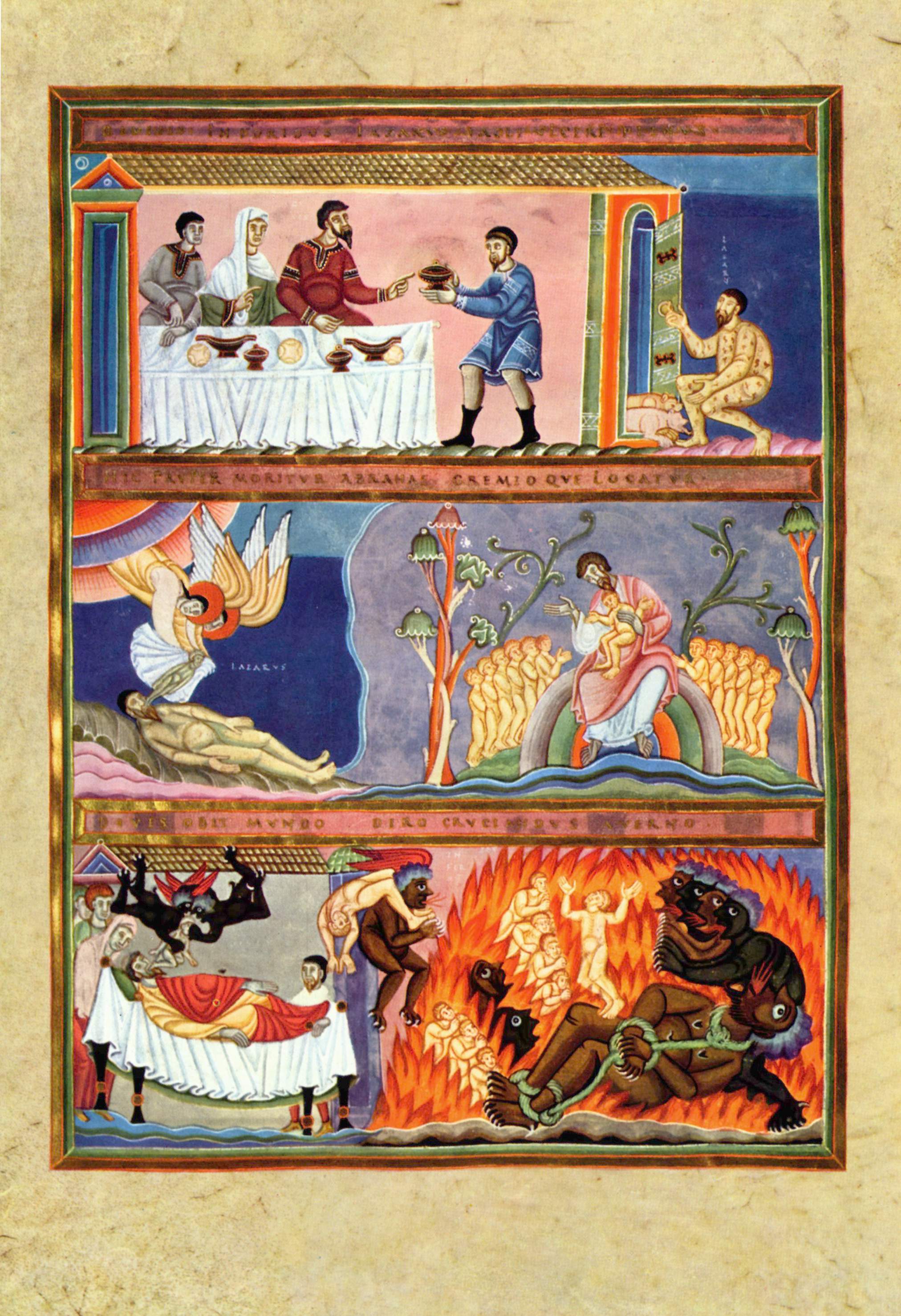
The irony of Jesus’ parable of the rich man and Lazarus is this: the rich man, who cried for mercy from the netherworld, never showed mercy to the poor man dumped at his doorstep. The parable suggests to me that the rich man had to step over Lazarus on his comings and goings and never noticed him.

Like his brothers, to whom he begged Abraham visit, the rich man had torah--the law and the prophets. Prophet Amos, we heard, reminded that fidelity to God does not allow for wanton revelry, which leads to complacent, inattentive attitude toward the poor. An older use of wanton fits here: playfully mean or cruel.

This was not new in Jesus' day. This was a sentiment among many ancients. In the later first century when Luke wrote his gospel and Acts of the Apostles to help us remember Jesus, the wealthy and any fortunate enough to read knew a similar description from a Roman, non-Christian poet:
Wearied and hopeless, the old clients leave the door, though the last hope that a man relinquishes is that of a dinner; the poor wretches must buy their cabbage and their fuel. Meanwhile their lordly patron will be devouring the choicest products of wood and sea, lying alone upon an empty couch; yes, at a single meal from their many fine large and antique tables they devour whole fortunes. Ere long no parasites will be left! Who can bear to see luxury so mean? What a huge gullet to have a whole boar—an animal created for conviviality—served up to it! But you will soon pay for it, my friend, when you take off your clothes, and with distended stomach carry your peacock into the bath undigested! Hence a sudden death, and an...old age [without a will]; the new and merry tale runs the round of every dinner-table, and the corpse is carried forth to burial amid the cheers of enraged friends!/1/
That imagery echoed in Jesus’ listeners, in the assemblies like ours where gospels were read around altar tables and bread was broken and wine shared.

Our stewardship of the earth begins with one another. The proverb has it: “Charity begins at home,” and I add, “while watching the news.” Whenever a scene of malnourished children or adults, a scene of people ravaged by disasters, by war, by other kinds of violent hatred would appear on the screen, I’d hear my mother sigh. It was the same sound mom made when she would be with me when I was sick. Even for strangers my mother felt--and still feels--compassionate concern. My mother allowed another’s suffering to touch her. My mom alerts me to the arrogant and heard-hearted rich man, who treated Lazarus like a servant: cool my tongue and warn [my brothers] lest they too come to this place of torment. After life this was more attention the rich man ever gave Lazarus, whose name means God is my help.

The rich man, and by implication his brothers, were heard-hearted and would reject any visit by God to them--even if someone were to rise from the dead.

Someone recently reminded me that God is always present to us; we are not always present to God. To help Lazarus on the doorsteps of our poorest metropolis, Cleveland, begins when our notice of them moves our hearts with compassion to show compassion. If Jesus’ parable of the rich man and Lazarus causes us to feel, “I don’t want to be like the rich man!” then our hearts are not hardened, and we are not hopeless. Plus, that feeling is our cue that Jesus has visited us in yet another way.

In your daily 15 minutes with Jesus this week, be more aware how the Trinity lavishly blesses you. Ask Lazarus to introduce you to Jesus so you may converse with our crucified and risen One. In addition to expressing gratitude consider your gifts as ways in which Jesus visits you. The words of Jesus and the apostles remind us to feed the hungry, who are one way Jesus visits us. Resolve how you can respond to Jesus visiting you. Close by saying slowly the Lord’s Prayer, which keeps our hearts supple so we can show more readily to others Jesus’ love for us.
____________
/1/ Juvenal, Satires 1:130-144.

/2/ The Greek Lazarus translates the Hebrew, Eliezer, which has this meaning.
______________________________________________
Wiki-image of the rich man and Lazarus is in the public doimain. Wiki-photo by Lisa Chamberlain of downtown Cleveland is used under the Creative Commons Attribution ShareAlike 2.0 license.


Saturday, September 29, 2007

Saturday word, 29 Sep 2007

Archangels Michael, Gabriel, Raphael (29 Sep 2007) Dn 7. 9-10,13-14; Ps 138; Jn 1. 47-51
Homily of Fr. Paul Panaretos, S.J.
Angelic / Apostolic


The last of the Divine Praises, which we usually hear at the close of a liturgy of benediction, summarizes the way we bless God today: “Blessed be God in his angels and in his saints.” Life in the church seeks to mirror the life of the Trinity, which is communion, communion of the Divine Persons. The church is a communion of sister churches. Our common vocation invites us to cultivate communion with one another and with all.

Not only does our triune God accompany this communion on earth; so, too, does the communion of saints, which includes hosts of spirits who have praised God from all ages.

Pope St. Gregory taught that among the spirits angels are ones sent by God “to deliver some message.” Scripture names three to denote their ministry...among humans: Michael, one “who is like God?”; Gabriel, “God’s strength”; and Raphael, “God heals.”/1/

In this communion our spirits are clothed with flesh. We are different from angels. Our bodies limit us in time and space. Limited as we are in our communion on earth, we are sent to witness to Christ with our bodies and our lives. We are “apostolic” as we also profess in our creed: we’ve been sent forth on this mission.

As we embark each day on our apostolic missions as friends of Jesus, today reminds us that we are part of a communion which God protects in St. Michael and heals and guides in St. Raphael. God strengthens us, too, to announce in our own ways what God’s strength, Gabriel, made known to Mary: God favors and strengthens us to make Jesus known by the ways we live and glorify him.


_____________
/1/ Homily 34, 8-9; in Office of Readings, Liturgy of the Hours, IV, p. 1435-6.
_________________________________________________________

Wiki-photo used under the GNU Free Documentation license.

Friday, September 28, 2007

Information Network Bringing Technology to Poor


Today ends the "10th continental conference being held by the Information Network of the Church in Latin America (RIIAL), an organization promoted by the Vatican communications dicastery. The conference ends Friday."

At its opening in Tecucigalpa, Honduras, last week Archbishop Claudio Maria Celli, the president of the Pontifical Council for Communications said
no one should be excluded from the "banquet of culture," and the poor must be given the chance to access technology.
RIIAL is responding to info-poverty, which it considers a challenge in this age of communication.

Eyes are around the world, especially focusing on Africa, which is very disconnected from electronic communication.
________________________________________________________
Wiki-image of an Apple iBook is in the public domain.

Thursday, September 27, 2007

40 Days For Life

Yesterday began a 40-day initiative in 80 cities. The Roman Catholic Church observes the month of October every year in order to focus everyone's attention on life and respect for it.

This new initiative concentrates on only one of the many respect-life issues, abortion. Zenit.org began its announcement:

U.S. Kicks Off 40 Days for Life
Nationwide Campaign to End Abortion

WASHINGTON, D.C., SEPT. 26, 2007 (Zenit.org).- People of faith and conscience from some 80 cities in 33 states are launching the largest simultaneous pro-life mobilization in American history, said the 40 Days for Life campaign director.
Readers may move directly to its home page at the this sign-up for information and learn more about this initiative.
_______________________________________________________________
Wiki-photo used under the terms of the GNU Free Documentation license.

Wednesday, September 26, 2007

Ignatius of Loyola: Saint and Guru

The most recent edition of the electronic service of Company Magazine begins with a report about Hindu students, who "now consider [St. Ignatius of Loyola] their revered guru."

The saint's annual feast is 31 July.
For centuries the feast has been the Church's "exclusive affair," commented Jesuit Father Francis Palliparambil, the school headmaster. But this year "our students set a new historic trend," he told UCA News. He hopes students in Jesuit institutions in more than 100 countries will emulate his students.


Tuesday, September 25, 2007

Welcome Congress Back to Work

ww logo

The September 21, 2007, Volume 2 Number 29 issue of the emailed Catholic Weekly closed encouraging citizens to welcome back Congress and remind it of its unfinished work.


Participate in the Campaign to Reduce Poverty: Welcome Back Congress and Send a Message about What Remains to be Done

WHAT: This September, get involved in the Campaign to Reduce Poverty in America by welcoming Congress back to Washington with a message about what still needs to be done for those living in poverty in our nation.

Your active involvement with Catholic Charities USA's poverty campaign and communicating with your Members of Congress has played a strong role in moving some important legislation during the first half of the 110th Congress. These include steps in the right direction by raising the minimum wage, and moving forward legislation reauthorizing both the State Children's Health Insurance Program (SCHIP) and the Food Stamp Program.

But much work remains to be done, and your help is needed!

ACTION NEEDED: Click on "Take Action" and enter your zip code to send a message to both of your Senators and your Representative starting today and ask them to make the right decisions about programs that serve the most poor and vulnerable. To get you started, we have provided a preformatted letter that you can localize and personalize.

BACKGROUND:

SCHIP: The House and Senate have both passed legislation to reauthorize the State Children's Health Insurance Program (SCHIP). Both bills provide significant improvements to SCHIP in the areas of new resources, outreach and enrollment practices, and changes to mental and dental health coverage. They differ in the amount of resources that are available. The House provides $50 billion over five years and the Senate $35 billion.

The President has threatened to veto any SCHIP legislation that increases the funding above $5 billion so strong support for this successful program from members of Congress is essential. The Senate bill is a bipartisan measure that passed with 68 votes, which makes it veto proof. The House bill passed on a party line vote and is not veto proof. In September both chambers will meet to iron out the differences between the two bills. The current SCHIP program will expire on September 30th and a number of states will face a shortfall if the program is not reauthorized and appropriately funded. Click here to read Catholic Charities USA's most recent letter to Congress on SCHIP.

Farm Bill/Food Stamps: Now that the U.S. House of Representatives has passed its version of the 2007 Farm Bill, the U.S. Senate will now take up the issue. We are asking the Senate to support a strong nutrition title to help food stamp recipients and to support policies that help rural communities and small producers. Click here to read Catholic Charities USA's most recent letter on the Farm Bill.

Funding: Congress has yet to finalize funding decisions for discretionary programs that fund human services. While the House has passed a measure with some modest increases, the Senate has yet to act. Click here to read Catholic Charities USA's most recent letter on funding issues.

Prisoner Re-Entry: The Second Chance Act is pending in both the House (H.R. 1593) and the Senate (S. 1060). This important legislation would provide grants to states, community-based, and faith-based organizations to begin to address the need for drug and mental health treatment, job training and education opportunities, and housing, as well as other critical services for individuals when they return to the community after exiting the prison system.

SSI: Legislation is now pending in the Senate that would extend benefits to elderly and disabled refugees who have lost their SSI benefits due to the restrictive seven-year time limit set by congress in the mid-1990s. Congress originally thought seven years would be enough time for refugees and asylees to become naturalized citizens, and thereby preserve their SSI eligibility. However, many refugees and asylees have not been able to make it all the way through the citizenship process in seven years, despite their very best efforts. The delays are due to a variety of factors, including backlogs at federal immigration offices and new procedures implemented after September 11. The first wave of victims is now starting to hit the time limit. Many elderly and disabled refugees and asylees have been left destitute as a result. In addition, many may lose health insurance because SSI and Medicaid eligibility are linked in some states. Click here to read Catholic Charities USA's most recent letter on SSI.

Thank you-- your efforts make a difference!

For more information, please contact Christin Driscoll, Senior Director for Policy Development and Advocacy, at cdriscoll@catholiccharitiesusa.org.

***
Washington Weekly is a publication of the Social Policy Department of Catholic Charities USA and is published regularly when Congress is in session.
Catholic Charities USA
1731 King Street, Alexandria, VA 22314
socialpolicy@catholiccharitiesusa.org

Monday, September 24, 2007

Visitor to Cleveland Helps It Revisit and Understand Racism

Dr. Beverly Daniel Tatum visited Cleveland last week. She added one day to her busy schedule and addressed citizens Saturday morning at Church of the Covenant on Euclid.

Dr. Tatum has been involved in helping all people understand racism and racial stereotypes in order that people become more free to treat everyone justly. She shared that a conversion moment which led her to reconnect with organized religion then go on to study theology in order to "speak to clergy in their own language" and to help them lead others better when it comes to race.

She wrote Why Are All The Black Kids Sitting Together in the Cafeteria?": A Psychologist Explains the Development of Racial Identity in order to bring her conversations with educators, clergy and students to a broader audience.

Dr. Tatum wrote an essay published in the Washington Post on Sunday to shed light on the crisis in Jena, Louisiana.

Sunday, September 23, 2007

Sunday word, 23 Sep 2007

25th Sunday of the Year (23Sep2007) Am 8.4-7; Ps 113; 1Tm 2.1-8; Lk 16. 1-13
Homily of Fr. Paul Panaretos, S.J.

Lemonade of Crisis


Today’s gospel reading, a maze for 21st-century hearers and readers, can entangle us, but it does not have to. Its parable Jesus used to reveal that giving alms in faith draws us closer to God.

To forgo giving to those in need is always easy. We also read stories in the media about people who give fraudulent alms and about nations, who pledge millions to help victims of disasters, but their money never follows their pledges. Sadly, many individuals and nations are not reliable./1/ Jesus’ parable is about being reliable in the sense of being faithful and true. Jesus revealed himself as the faithful and true witness/2/ of divine fidelity. How can we best appreciate this parable?

First, Jesus told this parable to teach his disciples. Jesus taught his disciples with positive encourage-ment. A saying most of us have used is one way to appreciate his kind of encouragement: “If you are given lemons, then make lemonade.” Lemons are sour, so lemons easily stand for crises in our lives. We can wilt before crises, or we can respond in positive ways, which “making lemonade” suggests.

The crisis in Jesus’ parable is essential to it. The master of the household occasioned the crisis, when he demanded his squandering steward, “Prepare a full account of your stewardship, because you can no longer be my steward.” The steward was finished, so his master could only applaud the way the steward responded to his crisis, his final accounting, his visitation by his lord. His scattering possessions, which occasioned his dismissal, now occasioned his acceptance by those for whom he reduced their payments.

Jesus did not reverse the Seventh Commandment, You shall not steal. Remember, the squandering steward was finished. Instead, Jesus encouraged his disciples--then, and us now--to be more resourceful, more prudent and more clever in our response to our risen Lord, who visits us to invite us to join him to proclaim his gospel. Further, we disciples ought to use possessions of this world wisely in order to secure the most “real thing,” namely a share in God’s life.

Jesus’ not-obviously-clear sayings, which follow the parable, clearly share a movement: reliable in something tiny, reliable in something greater; wicked in something tiny, wicked in something greater. That which is tiny refers to possessions and that which is greater refers to how we dispose ourselves to God, who is the most real.

Possessions, things, all of creation can help us to make a return of love to our Creator./3/ When we stop treating them as gifts, which our Creator has given to us to help our stewardship, and more as entitlements, then possessions and all created things become idols--Mammon. Putting ourselves in the service of Mammon prevents us from making a return of love to our Creator by sharing with others in greater need. From God to Mammon is always a tiny step, indeed. Our use of possessions determines how we bestow ourselves before God, whether we accept Jesus’ invitation to join him as his disciples or not.

Almsgiving, assisting others, can cause us to look outward only. Yet the first alms any of us gives is oneself to God. Our interior disposition, our sense of God gracing us, moves us to desire to help others. Appreciating the things of the world as gifts God gives us to assist our stewardship of the world is a potent prayer of praise and shapes us more like Jesus, who calls us.

In your 15 minutes with Jesus each day this week consider your gifts and the Trinity who are the source of all them for you. Ask Jesus’ Spirit to enlighten your mind and refresh your heart in order to be more alert to how Jesus personally loves you. Allow your gifts to float to the surfaces of your heart and mind. As each one does--the roof over your head; clean water to drink and in which to bathe; significant people in your life; your parish; your school; your job; and more--savor each one; express your gratitude to Jesus. Resolve one way that you will live your appreciation to Jesus for loving you so greatly. Close by saying slowly the Lord’s Prayer, which reminds us all we have is divine gift and which shapes our hearts to use them more reliably, more prudently and more faithfully.

____________
/1/ We translate one Greek word variously: faithful, trustworthy, reliable.

/2/ The phrase came to John in his revelation by Jesus’ self-revelation to John on the island of Patmos. See Revelation 3.14.

/3/ This paraphrases St. Ignatius of Loyola: “The other things on the face of the earth are created for the human beings, to help them in the pursuit of the end for which they are created [to praise, reverence and serve God our Lord, and be means of doing this to save their souls]” (Spiritual Exercises, 23.2 and [23.1]).
_________________________________________________________
Wiki-images of the East Window of St. Andrew, Sydney, depicting the ministry of Jesus, and of The Worship of Mammon are in the public domain.

Saturday, September 22, 2007

Wall: Real or Faulty?


"Separation of church and state" was a phrase in "an 1802 letter of Thomas Jefferson to the Danbury Baptists," which has become universally accepted: from a piece of occasional correspondence to presumed constitutional doctrine. Mr. John L. Allen Jr. reported this week about how Auxiliary Bishop Thomas J. Curry of Los Angeles is calling "to 'abandon the language of church/state separation' altogether."

Mr Allen cited some illustrations, which the bishop used:
The “wall” image, Curry said, has also fostered what he described as a false notion that the government has a positive role as a promoter of individual religious freedom. This illusion, he said, has produced an ever-increasing cycle of demands for new religious exceptions to public law:
  • The use of drugs such as peyote in religious ceremonies;
  • Refusal to display one’s photo on a driver’s license on the grounds that it violates scriptural bans on graven images;
  • Refusal to use a social security number on the grounds that “only God should number us”;
  • Refusal to accept blood transfusions for oneself or one’s children;
  • Refusal to send children to public schools beyond a certain level.

In each case, Curry said, there may be an argument for accommodation of these behaviors on the grounds of fairness or compelling public interest, but it’s not because the behavior is religious.

While courts may best understand the First Amendment, courts do no always make their understanding fit with the decisions they render.
__________________________________________________
Wiki-photo of Thomas Jefferson's Mt. Rushmore likeness is used under the GNU Free Documentation license.

Wednesday, September 19, 2007

"Transportation By the Numbers"

Environmental Defense offered these numbers about driving in the U.S.

Transportation By The Numbers

Transportation facts underscore the need for reform

Posted: 18-Sep-2007; Updated: 19-Sep-2007

Print Email Share on Facebook

Take action for smart transportation

Take action for smart transportation

Transportation is one of the biggest causes of global warming pollution in the U.S. Our inefficient use of roadways and public transportation are only part of the problem.

Check out our list of startling facts and figures.

239 MillionNumber of cars and light trucks on U.S. roads.

2.7 trillionTotal vehicle miles traveled in the U.S. in 2006.

160%Increase in the amount of miles driven since 1970 in the U.S.

$66.3 BillionAmount spent by local, federal and state governments on U.S. highways in 2005.

5%U.S. share of the world's population.

45%U.S. share of world's total global warming pollution from vehicles.

28%Percent of U.S. global warming pollution coming from transportation.

15Number of states that have adopted California's global warming pollution limits on cars.

3The Big Three car companies (GM, Ford and Chrysler) that have joined USCAP, a partnership calling for a US national cap on global warming emissions.

0Number of federal bills passed to cap and reduce America's global warming pollution from all sources.

Take Action»

Tell a Friend»

Tuesday, September 18, 2007

About Austria and the Pope


Pope Benedict completed his first papal visit to Austria, 7-10 September. John L. Allen Jr. accompanied him on the trip. Just prior to the trip, Mr. Allen previewed the trip in his enlightening weekly post in his 7 September "All Things Catholic": Looking for signs of a 'great awakening' in Austria.

One might be surprised to find the present Governor of California mentioned. Austrians, according to one poll, trust Mr. Schwarzenegger more than Pope Benedict.
________________________________________________________
Wiki-image of a French promotion of "Terminator3" is used under the GNU Free Documentation license.

Monday, September 17, 2007

Papal Reflections on Peace

These Catholic Resources for Discernment were introduced on this blog earlier. The latest part arrived late last week.

Papal Reflections on Peace

More Info

Sixth Part in Iraq: Resources for Discernment

This is the sixth in a series of reflection pieces offered to assist Catholics with our discernment on the war in Iraq. (For more visit www.jesuit.org/iraq) This installment invites us to reflect on the recent calls for peace from Pope Benedict XVI. These selections are more pastoral in tone than the previous installments discuss peace in more general terms.

- Pope Benedict's address at Assisi, on the 800th anniversary of Saint Fancis' conversion. June 17, 2007.

- Pope Benedict's address in Cadore, Italy, during his summer vacation. July 22, 2007.

When Cardinal Ratzinger was elected Pope he chose the name Benedict, in part, because of the previous Benedict's commitment to peace. In his very first general audience the Pope explained
that, "I wished to call myself Benedict XVI to be united ideally with the venerated Pontiff Benedict XV, who led the Church in a troubled time because of World War I. He was a courageous and authentic prophet of peace and he did his utmost with strenuous courage from the start to avoid the drama of the war and then to limit its inauspicious consequences. Following his footsteps, I wish to put my ministry at the service of reconciliation and harmony among men and nations, profoundly convinced that the great good of peace is, first of all, a gift of God, a fragile and precious gift to be invoked, defended and built day after day with the contribution of
all."

In recent months, the Pope has increased calls for peace. He urges us not only to condemn war but to work for peace, and suggests that a "reasonable and sincere dialogue" is critical to an enduring peace.
____________________________

Here are a few reflection questions you might consider:

What are the moral and ethical norms that underlie Pope Benedict's comments?

What do you think the Pope means by his call to work for peace? What does it mean to you?

Is there anything in particular that struck you when reading the pieces? What might the Lord be saying to you through this?

May the Prince of Peace guide our nation and world, and our participation in it.

Sunday, September 16, 2007

Sunday word, 16 Sep 2007

24th Sunday of the Year (16 Sep 2007) Ex 32. 7-11,13-14; Ps 51; 1Tim 1. 12-17; Lk15. 1-32
Homily of Fr. Paul Panaretos, S.J.
Letting God Be God

Crossing white water in order to get to the other side of a gorge is perilous, and the image of it can cause us to check if our shoes leak. Close to home, crossing where Silsby, Belvoir and Wrenford intersect in their by-no-means even way is perilous, too. Every crossing there is a brief driver’s ed class. Still more perilous to us Christians is failing to cross cultures, namely from our own to the culture of Jesus.

That kind of crossing is very real even though it occurs not in a boat or car or on foot but in our imaginations. Jesus’ culture was a first-century, Mediterranean culture. You and I encounter first-century, Mediterranean culture each time we hear Jesus speak to us from the gospel. We even encounter a much older Mediterranean culture in the Hebrew scriptures. That means crossing from the 21st to the first century and earlier requires us to let go of our instantaneous, technological way of thinking. Entering into the Mediterranean culture means being sensitive to reputation and honor, or to “saving face.

We may isolate saving face to the Far East but it was--and is--very much part of the Near East, too--Palestine, Israel and Arab states. When we are aware of that then Moses’ imploring the Lord begins to make sense. The God, who brought out of the land of Egypt a ragtag band, cannot willy-nilly give in to anger and let wrath blaze up against [God’s] own people. For God to be God, God forgives and shows mercy. This honor and reputation of God, indeed God’s identity, is both divine and also humane, like the father in Jesus’ perhaps-too-familiar parable.

His first two parables, featuring Luke’s characteristic pairing of a man and a woman, here a shepherd and a homemaker, vividly portray the anxiety that comes with loss, and how anxiety can induce us to act. The shepherd risked the other ninety-nine sheep to seek the lost one; and who of us hasn’t turned
upside down office, home, playhouse or bedroom to find something dear to us?

Jesus’ third parable of lost and found details emotional conflict that is common across all cultures. The younger son disregarded Honor your father and mother when he asked his father for his inheritance while his father was very much alive and in good health! His father did not abuse his son for his reckless and selfish insensitivity. More, the father seems to have spent long hours watching for his son: While he was still a long way off, his father caught sight of him, and was filled with compassion. He ran to his son, embraced him and kissed him. Plus, he would not allow his son to complete his carefully rehearsed speech. God is this eager, Jesus suggested, to watch for and welcome us, who wander from his covenant.

The Pharisees and scribes could not imagine such a humane, affectionate and prodigal God. They--at least to hear their side of things of which Jesus constantly received an earful--
who had served God and never disobeyed God’s orders, could not identify themselves as children of Jesus’ humane, affectionate and prodigal God. Worse, their self-image seems to have been slaves instead of sons: vigilant to carry out orders and resenting others with whom Jesus’ fraternized, dined and whom he welcomed.

St. Paul once was not welcoming, and by his own admission, a blasphemer and a persecutor and arrogant. He knew well that Christ Jesus came into the world to save sinners, that God’s very heart is vigilant for the lost. A blasphemer and a persecutor and arrogant person--add your own unwelcoming, resentful quality--who admits that knows in a deeply felt way that God is ever-vigilant for just that kind of person.

God desires no one to stand outside of the heavenly banquet, which is clear from those to whom Jesus addressed these three parables, the Pharisee and scribes: Tax collectors and sinners were all drawing near to listen to Jesus, but the Pharisees and scribes began to complain, saying, “This man welcomes sinners and eats with them.”

The younger son did not care about “saving face.” He wanted his father to be his father; and Jesus suggested God was very much like that father. The elder son, and the Pharisees and scribes, cared so much about themselves that their self-concern blocked them from experiencing God’s merciful love of them and of everyone else. I'm often tempted to be like that.

In your 15 minutes with Jesus this week, become more aware of the Trinity loving you with their love, which is better than life./1/ Ask St. Paul, foremost sinner-become-saint, to introduce you to Jesus so that you may converse with Jesus in affectionate familiarity, as friend to friend. That, after all, is Jesus’ desire. While you speak with Jesus, saying what you need or asking for what you desire most, ask him for the grace to communicate more frequently and to welcome Jesus as your brother, who is your Messiah. Resolve one way how you can do that. Then close by saying slowing the Lord’s Prayer, which shapes our hearts more like Jesus’ heart and reminds us that we are not God’s slaves but our Father’s daughters and sons.
___________
/1/ The phrase comes from Psalm 63.2 It is unique in the Old Testament because only in this verse is anything valued more than life, and it is God’s love!
_________________________________________________________
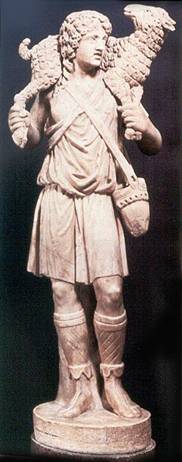
Wiki-images of Rembrandt's The Return of the Prodigal Son and The Good Shepherd are in the public domain
.

Saturday, September 15, 2007

25 Tips For Seniors Become Freshmen

Anyone with a daughter or son, sister or brother, niece or nephew, who just began college, may want to email that person the 25 tips of Nora Bradbury-Haehl. The contributing editor at BustedHalo.com (which bills itself as "An online magazine for spiritual seekers in their 20s and 30s") wrote them for college freshmen because the world they experience is different, confusing and sometimes lonely.

Her tips help former high-school seniors negotiate collegiate life in healthy and productive ways. Emailing them will guarantee your new college student will receive them.
______________________________________________
Wiki-image of Yale's Harkness Tower is in the public domain.

Friday, September 14, 2007

Friday word, 14 Sep 2007

Exaltation of the Holy Cross (14 Sep 2007) Nb 21. 4b-9; Ps 178; Phil 2. 6-11; Jn 3. 13-17
Homily of Fr. Paul Panaretos, S.J.

Wearing Jesus’ Cross


We trace this Solemnity of our Lord Jesus to two events in history. The first was the 4th-century dedication of the church of the Holy Sepulchre in Jerusalem on this day. Sts. Constantine and Helen, his mothe
r, honored the places where Jesus died and rose and built a church over them. The second event was the recovery of Jesus’ cross from Persians in the 7th century, an event which led the church to mark with this festival.

This festival of the Lord is not dark; Its focus and its invitation is glory not passion and agony. A phrase we associate with Lent captures its glory and shapes and guides our prayer: We adore you O Christ, and we praise you because by your holy Cross, you have redeemed the world!

Jesus’ death and resurrection transformed the cross from an instrument of death to the source of healing. The ultimate healing, of course, we name salvation, sharing in his risen life. We share it already in part, and when Jesus returns in glory we will share it completely.

That means that we not only gaze upon the cross, touch it and even kiss it--all three signs of reverence and affection. We wear the cross. As I shared with our children at their mass this morning, we wear the cross each time we trace it on our bodies, In the name of the Father and of the Son and of the Holy Spirit. Think of it: when we trace our Christian badge on ourselves, it does not cause us fear or pain. Jesus transformed the cross, canceling its fear and pain. When we trace our Christian badge on ourselves it increases our confidence, reminds us of our source of peace, Jesus, and that our lives give him witness.

To paraphrase a native of India, who had an encounter with Jesus which led him to be a Christian missionary: ‘If we do not wear the cross of [our] Master, the cross of the world, with all its earthly goods, will weigh heavily upon us. Which cross have you taken up?’ Sundar Singh asked. Indeed, the cross of the world, in whatever form it takes, has a biting sting only Jesus’ cross can heal.
____________
The statement of Sundar Singh (1889-1929) about the two crosses is:

“If we do not bear the cross of the Master, we will have to bear the cross of the world, with all its earthly goods. Which cross have you taken up? Pause and consider.
”

It may be found in Bread and Wine: Readings for Lent and Easter.

One sketch of Sunday Singh may be found at this link.
_________________________________________________________
Wiki-image is used under the Creative Commons Attribution 2.5 license.

Thursday, September 13, 2007

Freedom Is Not a Singular Virtue. . .

. . .although many think and act as if it were.

Universal health care has come to the fore once more. This time director Michael Moore put things together into a movie, Sicko. Whether one agrees with him or disagrees, the logic of agreement or disagreement is rarely explored. People react--even intelligent people as well as people who asked for and received from the people the power to shape our futures. We call them politicians. Some of them and others
believe that the only language that can be used to argue for taking care of one another is the language of rights. But Jesus never mentioned rights when he commanded us to serve one another.
So Gordon Marino reminded readers in his recent, brief essay in Commonweal, the Catholic weekly. He aptly entitled it, "Me, Not We: What Ails Our Heath-Care System."

The loudest (and likely very expensive) recent rebuttals against universal health care in the United States distracted serious thought about it by enlisting people to holler about waiting for care. Who doesn't wait? Everyone waits, yes, sometimes too long. Very sad to say, some people die waiting. Pharmaceutical firms and profit-motivated health-care managers do not seem to be abhorred when people die waiting. People deserve quality health-care available to all, especially children, seniors and all rendered vulnerable because of preexisting conditions.

Wednesday, September 12, 2007

Wednesday word, 12 Sep 2007

23d Wednesday (12 Sep 2007) Col 3. 1-11; Ps 145; Lk 6. 20-26
Homily of Fr. Paul Panaretos, S.J.
Consolation and Conversion

The blessings and woes Luke puts on the lips of Jesus are not as well known as the more familiar ones in the First Gospel. These Lukan ones contain a key: consolation now. Our best way to appreciate and to understand that is by a phrase used earlier in the gospel, the consolation of Israel. You recall that Simeon and Anna, who were present in the temple when Jesus’ parents presented their first-born to God, were upright people who awaited the consolation of Israel. Simeon proclaimed that the birth of Jesus fulfilled that, that Jesus was the consolation of Israel. Being in Jesus, dying and rising with Jesus, to use baptismal imagery, steers our lives into a new direction, into Jesus’ direction. That direction is described and named by faith.

Resurrection life culminates in glory, sharing the glory of our risen Lord, when he appears. In the meantime, we live our resurrections by lives of faith.

To live faith has much more to do with what is seen and practiced: thus, St. Paul’s language of behavior in this section of his Letter to the Colossians.

The people of Colossae had sought new, higher and greater things outside themselves, individually and the community. That led to their rude and reckless living with one another. Dying and rising with their Messiah Jesus in baptism steered them to live with sensitivity and compassion, the sensitivity and compassion of Jesus.

Resurrection faith transforms living beyond mere politeness to a true care for others and recognizing Christ...in all, who is our reason not to discriminate against anyone. Our future glory in Christ depends on living well now and for all to see our new life hidden with Christ in God.
_________________________________________________________
Wiki-image is in the public domain.

Tuesday, September 11, 2007

Tuesday word, 11 Sep 2007

23d Tuesday (11 Sep 2007) Col 2.6-15; Ps 145; Lk 6. 12-19
Homily of Fr. Paul Panaretos, S.J.
Misunderstanding To Relationship

I was in college with man who remains a beloved priest and a good pastor. He’s a person who can get away with saying anything--and does. He jests, he’s not vicious. I think we all know people in our lives like that. However, if I jested in some of the same ways with the same words, I would be misunderstood to put it mildly. We can misunderstand language and focus on it rather than understand another’s heart or intentions. My friend reminds me that is very true with St. Paul’s Letter to the Colossians.

St. Paul’s Letter to the Colossians has long been and still is widely misunderstood. Some do not think Paul wrote it, but that assertion is not persuasive. More sad, however, is this: because Paul, writing to Gentiles of a Greco-Roman city, used words they knew well like mystery, philosophy, elemental powers, fullness of the deity, principalities and powers, modern people have focused on that language and not how Paul used it. This is how he used it.

St. Paul used their language to point to Jesus, the crucified and risen Messiah, and how people who were buried with him in baptism, in which you were also raised with him through faith in the power of God, who raised him from the dead. Baptism--all the ancients knew ritual washings with water--replaced circumcision and brought [all people] to life along with him.


Relationship with Messiah Jesus was Paul’s purpose. Notice his opening words: Brothers and sisters: As you received Christ Jesus the Lord, walk in him, rooted in him and him and built upon him and established in [his] faith as you were taught, abounding in thanksgiving. Our relationship with Jesus is important because Jesus chooses us to extend his prophetic mission. We know that because we respond positively to Jesus. Jesus chose his apostles, not because they understood him, but because they responded to him positively unlike the scribes and Pharisees. Keeping fresh our relationship with Jesus, crucified and risen, anchors us in him in order to share in his fullness more and more and invite others to join us in him.
______________________________________________
Wiki-image used under the GNU Free Documentation license .

Monday, September 10, 2007

Monday word, 10 Sep 2007

23d Monday (10 Sep 2007) Col 1.24-2.3; Ps 62; Lk 6. 6-11
Homily of Fr. Paul Panaretos, S.J.
On Our Way to Maturity


This confrontation between Jesus and scribes and Pharisees has two features worth noting. First, Jesus realized their intentions, literally knew their thoughts, certifies that Jesus was a prophet of God. That means no mind-reader reader but a reader of human hearts, as the Psalmist sang, The Lord knows human thoughts/1/, and as Jesus observed in another place, the heart gives birth to all thoughts./2/ In a confrontation with some Pharisees just before this one, Luke recalled, Jesus knew their thoughts and said to them in reply, “What are you thinking in your hearts?”/3/ In scripture the heart is the wellspring of thoughts, intentions and actions.

Second, already in his Chapter 6 of his gospel, Luke prepared for the trial of Jesus by stating the Pharisees’ intention: they were senseless with anger and discussed together what they might do to Jesus. Why did their hearts, so enraged, poison their thoughts and warp their intentions?

The Pharisees protected the Sabbath and the rest of torah by making equal every observance of its commands and rituals. The Sabbath was cited most because it contrasted Jews with the world. The ancient world, its easy for us to forget, had no weekends let alone one work-less day. Imagine telling your conqueror and controller that you did no work the same day each week!

Jesus, in testing his testers, “I ask you, is it lawful to do good on the sabbath rather than to do evil, to save life rather than to destroy it?” showed in God’s hhttp://www.blogger.com/img/gl.link.gifeart not every observance is equal and that responding to human needs exceeds all others in the moral realm.

This applies to us today. This was St. Paul’s goal: he desired to form everyone in the gospel of Jesus so that all may become mature in Christ. St. Paul sought to prepare us to become fully developed in our Messiah. Where in this development of heart and action are we? Consider asking today for the grace to know that more clearly and to become even more mature in Christ.
____________
/1/ Psalm 94.11.
/2/ See Matthew 15.19.
/3/ Luke 5.22.
_________________________________________________________
Wiki-image used under the terms of the GNU Free Documentation license.