Showing posts with label Lent15. Show all posts

Thursday, April 02, 2015

Holy Thursday word, 02 Apr 15

Not Ornamental
Mass of the Lord’s Supper B (02 Apr 2015)
Homily of Fr. Paul Panaretos, S.J.
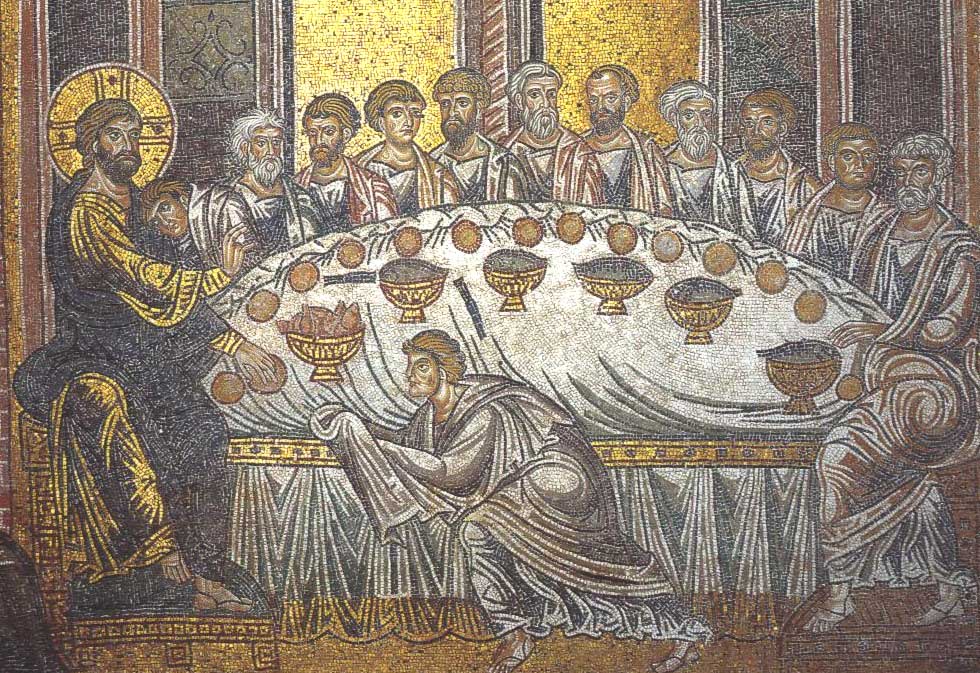
When we gather around the tables of God’s word and God’s son our words never adequately express the mystery. We enter our triune God’s life and love God shares with us. We name the mystery Father, Son, Holy Spirit. The mystery feels more intense tonight and the next three days. As a way in to the mystery I will focus on a detail of the Lord’s Supper the Fourth Gospel’s remembers for us: Jesus took a towel and tied it around his waist. Why that one? Laundry.

I recently laundered kitchen towels. In the kitchen I don’t stint on using towels. I don’t want to rearrange or transfer grime from surface to surface. And thoroughly damp towels cease to dry things. Dry towels fascinate me—their physical properties: surface area; absorption; the weight of water and towels’ thirsty materials. Their properties are impressive. You and I are not here to be impressed. We are here because we are more than our physical selves; we are embodied spirits. We thirst: we desire more humane and worthy lives. As I folded kitchen towels I thought of us: Jesus responds to our thirsts; to us he has given a new fascination, a sacred appeal to the humble towel. As he said, I have given you a model to follow.

When he took a towel that night he celebrated Passover his final time Jesus transformed it. All who use towels as he did and imitate him, Jesus transforms into priestly, prophetic witnesses to him and servants of his mission. All the baptized are shaped into priestly, prophetic witnesses to him: both the priesthood of the faithful and those in ordained ministry. We exercise our priesthoods everywhere—sometimes in church. This night Jesus modeled what exercising our priesthoods looks like: If I… the master and teacher, have washed your feet, you ought to wash one another’s feet. I have given you a model to follow. By doing the most menial task, Jesus tells Christians in every age no task of serving is beneath our priesthoods.

Jesus made clear service marks us as his. In remembering that the church links service with eucharist. We can say: eucharist begets service; and service leads to eucharist. The portion of St. Paul’s letter to the Corinthians we heard this night confirms the link. In the earliest written memory of the night he was handed over, St. Paul recalled Jesus interpreted the Passover bread and cup as his self-offering, his self-service: my body for you; [my blood for you,] drink it to remember me.

Paul wrote what he received from the Lord to respond to a practice among Corinthian Christians: they did not serve one another. Paul had observed: When you meet in one place…it is not to eat the Lord’s supper, for in eating, each one goes ahead with his own supper, and one goes hungry while another gets drunk.1 And that in a Christian community of around 200 members!2 How easy it has always been to be mindful of and even serve those beyond our circles and to neglect our blood relations as well as our sisters and brothers in Christ Jesus!
The related neglect is equally un-Christian: to serve only those like us and by Christ united to us. Christian service responds to everyone. Jesus modeled that! The night he took a towel and tied it around his waist he commanded his followers—then to this night in Greenville—to extend the pattern of his caring everywhere; Jesus gives us his Spirit so we may do it.

Jesus’ towel symbolized love in action. Love in action makes us more human and “make[s] society more human, more worthy of [each] person.”3 The next time you see a towel recall how Jesus used it for us. Let every towel remind us to fulfill his new commandment in our daily living. Let every towel ask us:
  • “Has my baptismal call to serve become ornamental, no longer vital to my life in my Savior?”
  • “Do I draw strength to serve, to live my Christian identity, by worshiping Jesus in word and sacrament?”
  • “Am I growing more curious about Jesus and longing to deepen my relationship with him?”
  • “In my personal praying do I chat with Jesus as one friend to another?”
  • Jesus’ towel questions communities not just individuals:                   “Do we continue to grow aware of what Jesus has done for us and what he longs to do for others through us?”
This is no ordinary night. Tonight we adore the one we will soon consume. We can savor him; what he has done for us; and imagine what he will do for us. Beginning tonight we can let his towel question us, encourage us, renew our fascination with him, his pattern of living, dying and rising and guide us to emulate our model for the sake of our world.

___________
  1. 1Corinthians 11.20-21.
  2. H.H. Drake Williams III, “Obstacle for a Church Planter: Paul’s Greatest Obstacles in Planting the Church,” Not Weary of Well Doing: Essays in Honor of Cecil W. Stalnaker. Wipf and Stock Publishers, 2013, p. 56. [Wayne Meeks estimated 300.]
  3. Compendium of the Social Doctrine of the Church, 582.

Sunday, March 29, 2015

Sunday word, 29 Mar 15

Seeing Ourselves
Passion (Palm) Sunday of the Lord B (29 Mar 2015)
Homily of Fr. Paul Panaretos, S.J.

Before mass we stood at the gates of Jerusalem as the Messiah King entered them. Our hearts are those very gates. How did we welcome the Messiah King? He is a very unlikely king. He was not the messiah longed for by his contemporaries; he entered their lives just the same.


Today each one’s heart is Jerusalem’s gates. Today Jesus desires to enter our hearts and abide in us. His selfless love moves us to consider ourselves. Perhaps someone is like Peter: ready to announce the faith with lips but refuses to allow one’s heart to own Jesus in his suffering. If that is anyone’s struggle, take courage: Jesus never disavowed Peter. Jesus sought him out to restore him and build his church on him and his brother apostles.

Third-century bishop, Gregory of Nazianzen, suggested each of us can find ourselves in our Messiah’s Passion. I cannot improve on his suggestion to help us:

“If you are a Simon of Cyrene, take up your cross and follow Christ. If you are crucified beside him like one of the thieves, now, like the good thief, acknowledge your God. For your sake, and because of your sin, Christ himself was regarded as a sinner; for his sake…cease to sin. Worship him who has hung upon the cross because of you, even if you are hanging there yourself. Derive some benefit from the very shame; purchase your salvation with your death. Enter paradise with Jesus, and discover how far you have fallen. Contemplate the glories there…


“If you are a Joseph of Arimathea, go to the one who ordered his crucifixion, and ask for Christ’s body. Make [yours] the [atonement] of sins for the whole world. If you are a Nicodemus, like the man who worshiped God by night, bring spices and prepare Christ’s body for burial. If you are one of the Marys, or Salome, or Joanna, weep in the early morning. Be the first to see the stone rolled back, and even the angels perhaps, and Jesus himself.”1

In Jesus’ Passion is every sort of atmosphere of prayer: darkness; light; fear; forgiveness; pleading; denying and recognizing; fleeing and following; watching; wondering; praising.

In your daily 15 minutes with Jesus this week
  • Rest in the Trinity, who desired from their eternity to save the human race.2
  • Ask those who hailed Jesus as King to present you to Jesus.
  • Speak to Jesus: praise him as your King.
  • Ask Jesus for grace to guide you in personal darkness to be a source of his risen light and life to others.
  • Close saying slowly the Lord’s Prayer. His prayer becomes our personal connection with Jesus: he transforms how we live and how we move through life.

Link to this homily’s Spiritual Exercise

____________
  1. From his homily, Oratio 45, in Office of Readings, Liturgy of the Hours for Fifth Lenten Saturday.
  2. Ignatius described the divine desire in his Contemplation on the Incarnation in his Spiritual Exercises, [102]
____________

Sunday, March 15, 2015

Sunday word, 15 Mar 15

Left to Ourselves
Fourth Sunday of Lent B (15 Mar 2015)
Homily of Fr. Paul Panaretos, S.J.

I will focus on one verse from the gospel. Before today I did not have courage to reflect on it with people gathered at the tables of God’s word and God’s son: the light came into the world, but people preferred darkness to light, because their works were evil. Let me begin with an experience of darkness and light.

Away from cities and towns we experience light differently. Street lamps and 24-hour shining signs nearly blind us to starlight. Away from them we see light from stars perforate the night sky from its height to horizon. Almost everywhere we have a weak sense of darkness.

I had a strong experience of it in a cavern. It was an easy walk; we barely noticed the downward slope of the gently lighted path. Our guide would pause every so often and turn on a light above. He then showed and explained what was before us. Midway our guide asked if any one feared the dark. No one did. Our guide suggested that our distance into the cavern would allow us to experience subterranean darkness. He asked any of us with flashlights to turn them off. Then he turned of the path lights and the one above us. It was a new experience. Immediately I brought my hand an inch from my nose. In that moment I had a felt-knowledge of the saying: “So dark I could not see my hand in front of my face.”

My experience gave me new appreciation for light. Even in dark places at a new moon darkness is not total. The faintest of light leaks in. If physical light is nearly ever-present, how much more is God, whom we call Light? It describes God well: Just as we see by light more than we see light, we don’t see God who creates us each moment. Light was the first thing God’s word created.1 God was the source of the light by which Israelites could see each other during the plague of dense darkness in Egypt.2 The Psalmist personalized what any could allow to remain an idea: the Lord is my light.3 The Nicene Creed allows us to echo the Psalmist, to make those words ours.

As we do that this gospel asks us if we practice what we profess. It questions us in layers:
  • God so loved the world. Do we love God?
  • God sent his Son…to save the world. Do we believe Jesus embodied God for us and our salvation?
  • Do we count on Jesus’ saving us and working now for us? St. Paul’s words help us: God, who is rich in mercy, because of the great love he had for us, even when we were dead in our transgressions, brought us to life with Christ.
  • Do we let ourselves fall into God’s mercy and love for us? Or are we name-only Catholics who reduce God to our expectations or make God a problem to solve?

If we count on Jesus saving us now; if we do believe; and if we cultivate a loving, personal relationship with God; then do we live our belief in God, our confidence in Jesus’ saving us and our love for God in Jesus through their Spirit? To live our belief, our confidence and our love for our triune God means our actions match our words; it means our works reflect the divine light and shine it in the world’s darkness. It means we cooperate with the grace by which we have been saved. It means we share Jesus’ mission of bringing light to our world. Pope Francis has told us, “We have this mission. …We carry this light. If a Christian extinguishes this light, his life has no meaning: he is a Christian by name only, who does not carry light.…”4

Carrying the light of Christ is not heroic. Yes, it takes effort for left to ourselves we prefer darkness to light. This darkness is not limited to atrocious things people do to others—some even in the name of God! This darkness includes our rudeness to others, our harm to creation and people and our insensitive inactions, our sins of omission.

Jesus coming into our world shows us that God saving is a mutual enterprise: by graceGod’s role, and about it we boast so others may enjoy God’s grace of light and life; our role is to do what we are created to do: deeds of light, life, mercy and peace—deeds modeled for us by Jesus’ disinterested love and his faith in God, his Father and ours.

In your daily 15 minutes with Jesus this week
  • Rest in our triune God’s faithful light and life-giving love.
  • Ask Nicodemus, St. Paul and your patron saint to present you to Jesus.
  • Chat with him: praise him for being God’s light sent into the world to free us from what enslaves us.
  • Ask Jesus, “Release me from my cavern of darkness and give me courage to extend your mission of light, life, mercy and peace.”
  • Close saying slowly the Lord’s Prayer. Jesus gave us his prayer as our daily, practical guide to extend his mission he lovingly entrusts to us.

Link to this homily’s Spiritual Exercise

___________
  1. Genesis 1.3-5.
  2. Exodus 10.22-23.
  3. Psalms 27.1.
  4. Sunday Angelus, 9 February 2014.

____________

Sunday, March 08, 2015

Sunday word, 08 Mar 15

Guided By God’s Heart
Third Sunday of Lent B (08 Mar 2015)
Homily of Fr. Paul Panaretos, S.J.
Imagine exploring wild territory for the first time. You have a guide. A guide means several things. You’re not alone; that is consoling in conditions that can bewilder, even frighten. Guides help us see what we would not see. In the Amazon rain forest our guide pointed out what I would have overlooked: an ivy climbing many trees. From the guide I learned the tree-climber is related to our philodendron.

Guides help us train our ears to hear what we would not; they help us recognize a sound we would say is a bird when it may be a frog; or to distinguish a living sound from noise. Guides help us stay on a path, choose a safer path or a more rewarding one. After paying attention to guides we become like them: able to distinguish what had been a blur to our senses. The close attention we pay to guides shapes us to help others notice more.

That brief look at guides helps us appreciate how the people God brought…out of…slavery…in Egypt understood God’s commandments and the rest of what we call God’s law. We hear law from our American experience and stress rules: rule of law is our phrase. Those freed from slavery in Egypt and their descendants viewed the commandments as guides to live according to God’s heart.

The commandments guided the them to take on God’s qualities. The commandments fashioned relationship with God. They also forged a shared identity as God’s people. Both relationship and shared identity are not the fruit of rules, plain and simple.

Sharing God’s qualities shapes our daily living. Examples. God giving life shapes us to promote life not take it and to respect and honor others. God’s fidelity shapes us to be faithful: to keep our promises; to be truthful in all we do. God’s generosity to us frees us to be generous. Cultivating an awe of God’s generosity to us allows us to see the things of the world as gifts and to use them in cooperation rather than competition.

Those freed from slavery in Egypt and their descendants appreciated God’s law as access to God’s qualities and a guide to live God’s qualities in daily life. On it they heaped praises we made ours with the psalm. God’s law was perfect, refreshing, trustworthy, giving wisdom, rejoicing the heart, clear, enlightening, true, just, everlasting, more precious than…purest gold, sweeter than…honey. To those freed by God and their descendants God’s law exceeded rules.

Rules do not summon praise. God’s life in us and for us summons praise. Praise is a spirit action. God is spirit,1 and God created us images of God.2 That means we are spirits clothed in flesh. Our goal is to maintain the qualities of God’s heart. To maintain includes preserving; refurbishing; keeping in good condition; nurturing; professing; and living what we profess.

Jesus gives us access to God’s life not only God’s qualities of fidelity and generosity. Jesus, the power of God and the wisdom of God, revealed God’s life giving power in his person. He shares with us God’s life-renewing power by his resurrection. His self-gift of his Spirit has made us temples, treasuries of God’s life, God’s qualities, of the Spirit of Jesus.3

We—even Christianity—can work contrary to the Spirit of Jesus he has given us. The cleansing of the temple is not a history lesson for disciples of Jesus. Jesus now lives more powerfully with us by his Spirit. His power shapes us into his body. Our vocation is a rewarding challenge: to let ourselves be shaped more by his Spirit instead of by the marketplace. That means to respect and share creation though the world’s rule wants us to devour resources and hoard things. It means extending compassion instead of leaving everyone behind. It means contributing to the progress of others instead of competing for money and power as if they give us life or meaning. To be part of Jesus’ body always will be a scandal and foolishness in the marketplace. In his church Jesus entrusts himself to his sisters and brothers as God’s guiding life, power, wisdom and strength for the sake of the world.

In your daily 15 minutes with Jesus this week
  • Rest  in  our triune God’s faithful, life-giving love.
  • Ask St.Paul and your patron saint to present you to Jesus.
  • Chat with him: thank him for enduring temptations like us; praise him for imparting to us God’s life-renewing power by his resurrection.
  • Ask Jesus to fashion you more by his Spirit to show day to day his fidelity, compassion and disinterested love in which we were baptized. 
  • Close saying slowly the Lord’s Prayer. Jesus gave us his prayer so we may live the qualities of our triune God by walking more closely with Jesus in a world at odds with him.

Link to this homily’s Spiritual Exercise

___________
  1. John 4.24.
  2. Genesis 1.27.
  3. 1 Corinthians 6.19; Romans 8.11.

____________
Wiki-images: The Ten Words on stained glass by Ji-Elle CC BY-SA 3.0; Expelling merchants from the Temple PD-US

Sunday, March 01, 2015

Sunday word, 01 Mar 15

One Like Us
Second Sunday of Lent B (01 Mar 2015)
Homily of Fr. Paul Panaretos, S.J.
Look to how you hear paraphrases1 a prophet’s warning. The New Testament gave it an important place; it stresses our need to welcome Jesus and his saving work with faith and not solely with human logic. We may express its practice in two words: faithful listening. In scripture to listen is less about ears hearing—a body’s ability—and more about personal attention: to take in; to accept; to obey. It is God’s desire for us and all disciples. We heard God announce it on the mountain of Transfiguration: Listen to…my beloved Son. Today’s worship offers us models of listening: Abraham who listened faithfully; and Peter who did not. First, Abraham.

Abraham had responded in faith when he first met God: Go forth from your land, your relatives, and from your father’s house to a land that I will show you.2 Those words began the story of Abraham. Abraham went. Year later when he was told to bind Isaac, Abraham told Isaac, “God will provide the sheep for the burnt offering.”3 The lectionary omits that verse from the reading. That is sad because it helps us feel Abraham’s faith at work. It guides us not to be distracted from Abraham’s faithful listening. The verse leads us to anticipate God’s faithful intervention,“Do not lay your hand on the boy…Do not do the least thing to him.” God had told Abraham before Isaac was born, My covenant I will maintain with Isaac.4

I am not saying it was easy for Abraham. Abraham personified the Psalmist words, I believed, even when I said, “I am greatly afflicted.” Faith does not override our humanity; faith heals and completes humanity. That is true when evidence before us suggests otherwise. God is faithful even when we, like Abraham, are sorely tested.

God’s fidelity uniquely entered our history in Jesus. Before Jesus and after his time on earth many believed God would work through a messiah to save God’s people from their oppressive rulers. During and after Jesus’ ministry the rulers remained the Romans. Peter acknowledged Jesus as God’s messiah.5 Jesus told him he would suffer and die before being raised; Peter would not accept a suffering messiah: he took Jesus aside and began to rebuke him.6 

Six days later Jesus took Peter, James, and John and led them up a high mountain and…was transfigured before them. Did Jesus give Peter time to cool down and come around? If he did, Peter had not changed; he remained terrified. On the mountain, as the week before, Peter wanted to control Jesus, who told Peter and the others he would suffer. On the mountain Peter wanted to control and capture in three tents the glory he beheld. On the mountain he saw Jesus as no different from Moses or Elijah, most important men of God. The voice from the cloud not only told Peter and his two partners Jesus’ identity; it tells us and what we are to do: listen to Jesus not to Peter or those who hear and consider as we are quick to do. That word alonethey saw Jesus alone? It means only: only Jesus and his pattern of living, dying and rising lived by us let us learn God’s faithfulness.

Peter’s coming to faith and his faltering make him an important model as well as intercessor for us. Coming to faith means looking directly to Jesus and listening to him more attentively. Listening to Jesus means directing our attention to him in ways both personal and communal. Not only are we like Peter coming to faith and faltering at times. Jesus accompanies us so we may be transformed like Peter: he eventually lived faith as unwaveringly as did Abraham. They both pray for us on our faith journeys.

In your daily 15 minutes with Jesus this week
  • Rest in our triune God’s faithful, life-giving love.
  • Ask Abraham and St. Peter to present you to Jesus.
  • Chat with him: praise him for enduring temptations like us; thank him for revealing his Father’s fidelity to us and the human race.
  • Ask Jesus for grace to let him be our pattern of discipleship: to shape us to live more for others as he did.
  • Close saying slowly the Lord’s Prayer. Jesus gave us his prayer so we may daily live as true disciples of Jesus in a world that often distracts us from him.

Link to this homily’s Spiritual Exercise

___________
  1. Isaiah 6.9. Note f. at the link does not include St. Paul’s mixed quotation at Romans 11.8 in which he included it.
  2. Genesis 12.1.
  3. Genesis 22.8.
  4. Genesis 17.21.
  5. Mark 8.29.
  6. Mark 8.31-33.

____________

Sunday, February 22, 2015

Sunday word, 22 Feb 15

Breaking Our Rules: Revisited
First Sunday of Lent B (22 Feb 2015)
Homily of Fr. Paul Panaretos, S.J.
Last week’s gospel let me notice afresh that lepers and Jesus broke rules that kept them apart. Their rule-breaking was not license; their rule-breaking allowed the reign of God to break into our world. Jesus and the leper showed me I impose rules on myself to keep me apart from Jesus. I sought to uncover my rules, break them and draw nearer to Jesus. In few days I realized I had received my lenten focus. As you enter lent I thought to share with you how the pillars of lent are helping me apply the grace I have received.

Lent’s pillars, as you know, are fasting, almsgiving and praying. To each I will attach a rule, a rule to break. First, I suggest we Christians fast from the entitlement rule. Here’s what I mean. To live generously both rewards and costs. Their costs deplete us unless we make time to replenish ourselves with rest, reflective prayer, friends, exercise and spiritual companionship. When we don’t replenish properly we risk feeling entitled.

We often replenish ourselves well. Sometimes we turn to unhealthy distractions. We withdraw into activities that are neither true exercise, rest, prayer nor companionship—human or spiritual. I know withdrawal into self instead of opening to life giving restoration. After ministering generously I can be tempted to want to be repaid in currencies of unhealthy distractions. If I don’t keep alert I become my temptations! This lent I want to guard my graces and not boast of them. Beginning to ride on graces, silently boasting of them, opens the door to the Tempter instead of keeping it shut tight against it.

How to fast from the entitlement rule? We may think of Pope Francis and exercise discretion if we feel entitled to gossip1; we may increase our visits here or any church, chapel or shrine if we feel entitled to diminish our friendship with Jesus; we may set aside two minutes each supper to name how we recognized Jesus alive during the day. Ask Jesus to help you identify your entitlement rule and how to fast from it.

Second: give alms to break the stinginess rule.
Heightened awareness about caring for the planet, promoting personal and social health and protecting the vulnerable fosters frugal behaviors: with resources; with food and ease; monitoring power over others. It is good to be sparing or economical. Yet a frugal one risks turn-ing stingy. Though it means sparing frugality itself does not close hearts. Stingy means closed-hearted; its sound is tight compared to the muted openness of frugal.

Christian stinginess focuses on Jesus-and-me to the exclusion of others. Christian stinginess considers Jesus is on my side more than I am at his. Christian stinginess clamors with the indignation of apostles in formation wanting sole rights to the power Jesus’ name bestows.2 Leaving a room or a yard better than finding it is an ecological alms; a moment helping another is a social alms; Sending a note to a younger sibling or friend is an interpersonal alms; it shapes us to edify others beyond family and friends. This Lent give alms that thwart Christian stinginess you confront.

Ignatius of Loyola befriended lent’s third pillar. His rule, or norm, for praying: chat with Jesus as one friend to another. What self-imposed rules limit our friendship with Jesus? A brief look at friendship can shed light.

Friends use their time wisely to fulfill responsibilities so they have time to devote to each other. You know and do that. What remains to do? Break rules you impose on yourself that keep Jesus from befriending you and you him. How? Two examples: If giving more time to Jesus helps your mutual befriending, then put Jesus on your calendar to be in his company.

Second: others may not venture to chat with Jesus and limit themselves to a few, albeit venerable, ways of praying. Friends who refuse to be creative around each don’t let their relationship deepen. We create without words. We communicate with more than words. When St. Paul counseled, pray without ceasing,3 words alone were not on his mind. He was a self-proclaimed tongues-speaker4 who did not advocate its inexpressible groanings5 for everyone.6  Prayer also involves images and memories. St. Paul savored Jesus choosing him as his apostle and revisited the memory often; his savoring made the moment vivid in his letters.7

Pray with more than words this lent. Uncover and break rules you impose on relating with Jesus that keep you from more intently, more intensely organizing your life around him, his vision and his desires.

In your daily 15 minutes with Jesus this week
  • Pause in our triune God’s true rest, life-giving love.
  • Ask St. Paul and your patron saint to present you to Jesus.
  • Chat with him: praise him for enduring temptations like us; ask Jesus to help you identify rules you impose on yourself that keep you distant from each other.
  • Ask Jesus for grace to break your rules so can draw nearer and be kinder, more generous and more free like him.
  • Close saying slowly the Lord’s Prayer. No prayer better appeals to God and helps us be ambassadors of the new creation in our risen Lord.

Link to this homily’s Spiritual Exercise

___________
  1. Francis repeatedly warns against gossip’s poison. Most recently, last Sunday. [Here if not yet translated into English.]
  2. See Luke 9.49. In Matthew 19.13 || Mark 10.13 the disciples mani-fest their stingy feelings when they rebuked those who brought children to Jesus.
  3. 1Thessalonians 5.17.
  4. 1Corinthians 14.18.
  5. Romans 8.26.
  6. 1Corinthians 14.19. Ch. 14 holds his reservations and qualifications.
  7. Paul opened his letters with his self-awareness and in some (1Corinthians 9 and Galatians) defended it: apostle.

____________

Wiki-images: Jesus tempted PD-US; Noah Giving Thanks by A. Davey CC BY 2.0