Showing posts with label Lent11. Show all posts

Saturday, April 16, 2011

Saturday word, 16 Apr 2011

Lenten Saturday5 A (16 Apr 2011)

Ez 37. 21-28; Resp Jer31. 10, 11-12abcd, 13; Jn 11. 45-56

Homily of Fr. Paul Panaretos, S.J.

Four Questions for Us


In the world of sentences words are arranged in various ways to communicate meaning. In the world of faith lives become arranged to communicate ultimate meaning, meaning which affects people and the world. In the world of sentences people arrange words. In the world of faith people experience power to arrange their lives. Arrangement in grammar is called syntax. The scriptures we heard suggest that faith has its syntax: power to arrange lives.


The line between exercising energy to arrange words and experiencing power to arrange one’s life, if we drew it, is best expressed as a dotted line: using energy is distinct from receiving it; once we experience power to arrange our lives, we are called to live from our newly arranged selves. In a phrase that is putting our faith into action.


Faith is a relationship with our triune God. Faith’s syntax helps us melt into the life of the Trinity. In practice it looks this way: when we put faith into action we embody God and God’s desires for us and our world. Discerning God’s desires takes effort because we tend to see from our limited perspective.


Ezekiel’s words we heard highlight three divine desires: unity; life; and a promised intimacy. The first desire was communicated by words describing the then-present condition of Israel and Judah: never again shall they be divided into two kingdoms. Unity among the hearts and minds of people was the unspoken prerequisite for that unity, which always risked being lost.


The second desire, life, was communicated by they shall live by my statutes and carefully observe my decrees. This desire was as old as God, who entered into a covenant with the people Israel not for their sakes only but for the world. Their living union was to be a covenant of peace to promote their living union among everyone.


The third desire was astounding: My dwelling shall be with them; I will be their God, and they shall be my people. God would personally indwell among the people, a breathtaking intimacy then and now, and a power God, not humans on their own, could realize: I will make them one nation upon the land. The world of sentences cries, Notice God is the subject not humans!


Yet God never denies us our agency or capacity to exercise our energies; we enjoy both as gifts of God. How easy to lose sight of that! Expressed in language of experience, how easy it is to mouth our responsorial instead of living from it: The Lord will guard us. The deliberations of the Sanhedrin were blind to that: “If we leave [Jesus] alone, all will believe in him, and the Romans will come and take away both our land and our nation”—as if one can take what God gives! The implications for us I offer as four questions.


Have our Lenten practices, prayer and worship restored our relationship with God indwelling us? Have they refreshed our spirits with God’s Spirit and deepened our union with the God of life for the sake of others? Have they helped us appreciate our human agency and our capacity to exercise our energies as gifts God gives us to enjoy, cultivate and to refresh our world? Have we allowed Lent to rearrange us—not do violence to us but rearrange us—so we enjoy a deeper and more vital relationship with God, who makes us a covenant of peace to the nations today?


If we answer Yes to them, let our praise of God ring clearly and long. If we answer No or if we are unsure, it is never too late to enter Lent, as St. John Chrysostom wisely reminded one Easter Sunday long ago.* All of us have Holy Week to meet in new ways our triune God, who makes of each of us a new creation, to embody and live God’s covenant of peace.


__________

* His words are proclaimed in every Orthodox church each Easter. Note especially the second stanza.


__________________________________________________________

Wiki-image of a depiction of Caiphas is in the public domain.


Thursday, April 14, 2011

Admitting Guilt: Archbishop Romero's Wisdom

Sin's social and personal aspects often are not spoken of simultaneously. Archbishop Romero did so while exhorting the Salvadoran people he served.
How easy it is to denounce structural injustice, institutionalized violence, social sin! And it is true, this sin is everywhere, but where are the roots of this social sin? In the heart of every human being. Present-day society is a sort of anonymous world in which no one is willing to admit guilt and everyone is responsible.
Easter makes it possible to acknowledge and admit real guilt. Easter, after all, is the context of Lent. Archbishop Romero spoke of Easter in Lent.

Sunday, April 10, 2011

Sunday word, 10 Apr 2011

Lenten Sunday5 A (10 Apr 2011)

Ez 37. 12-14; Ps ; Rm 8. 8-11; Jn 11. 1-45

Homily of Fr. Paul Panaretos, S.J.

New Purpose


For any of us with a fear of closed spaces Jesus command to Untie [Lazarus] and let him go is more than welcome. Not merely a release from burial bands, but a freedom to live again and in a new way. Of that I am convinced because of my father.


He had had a heart attack, which lasted a while, and coronary bypass surgery saved him. Some days later a friend of my father visited him. I arrived shortly before his doctor stepped in that day. My father introduced the doctor to his friend, “Meet the man who saved my life.”


The freedom Lazarus experienced surely was no longer bound by physical death. Like my father Lazarus may well have been freed from his sickness which weakened him to the point of death. Like my father and countless others, Lazarus enjoyed a freedom that lay deeper than that. In religious language this depth goes by “interior.” It is a freedom so real that it cannot be confined, yet we do not automatically live it.


This freedom is a gift both received and shared. It registers in many ways. The earliest Christians reminded us that it registered as an experience of power. They named it as authority, boldness, energy and power1 for personal transformation as well as announcing the good news of Messiah Jesus’ death and resurrection.


St. Paul reminded us it was no impersonal force but the living power of God: Holy Spirit. St. Paul easily equated Spirit of God with Spirit of Christ. More, and this is easy for us to miss because Paul’s language was not ours: flesh does not mean “body”; and spirit does not mean “mind.” Things of the flesh are not necessarily physical but the ways we measure reality as if we were the center of the universe and not God. We measure this way by impulse, which indicates our freedom is compromised. As St. Paul expressed it from experience, What I do, I do not understand. For I do not do what I want, but I do what I hate.2


Using stronger language St. Paul said our impulse makes us oppose God: the concern of the flesh is hostility toward God.3 Again my patron saint needs to be clarified: he spoke not psychological language but religious language. The point is not hostile feelings toward God, but our pattern of choosing which shuts out God and God at work in our world. On our own we are helpless, but we are not helpless because God’s gift is at once personal and intimate: the Spirit of the one who raised Jesus from the dead dwells in you.


In the portion of his letter we heard, St. Paul turned from the unfortunate condition of our marred freedom not to mention it again. Rather, he extolled the gift of Holy Spirit dwelling in us. The Second Vatican Council taught, in language we understand easily, if you and I are to “to cling to what is good [we cannot] achieve [our] own integrity without great efforts and the help of God's grace.”4 God’s grace is God’s life, Holy Spirit given us by our Messiah and Lord, Jesus.


Lent helps us reclaim our original freedom by helping us to notice clearly our impulses, our obsessions and our fears. Our Lenten practices help us move through impulses, obsessions and fears and rise above them. We become better able to make choices to live from our faith not our fear. Faith’s freedom empowers us to reshape our lives after the cross and resurrection of Messiah Jesus and to have his attitude in our daily lives. The closer we remain to the cross and resurrection of Jesus, the more free we become to affect our world. Our Catholic paradox is a rewarding challenge.


In your daily 15 minutes with Jesus this week, compose yourself in our triune God. Ask Lazarus to present you to Jesus, who gave him a new lease on life and new purpose to live it. Speak with Jesus: praise him for dying and rising for you; ask Jesus for the grace to rise above what keeps you from proclaiming his dying and rising by how you live. Close saying slowly the Lord’s Prayer. His words, lead us not into temptation on our lips, are not restricted to wrong actions. They beg the grace to conform ourselves more and more to the One who saved us by his dying and rising.


____________

  1. Numerous are the appearances of these words throughout the NT as a concordance demonstrates.
  2. Romans 7.15.
  3. Romans 8.7, the verse immediately before the verse which began today’s second reading.
  4. Church in the Modern World, 37, of the Second Vatican Council.
____________________________________________________________________________________
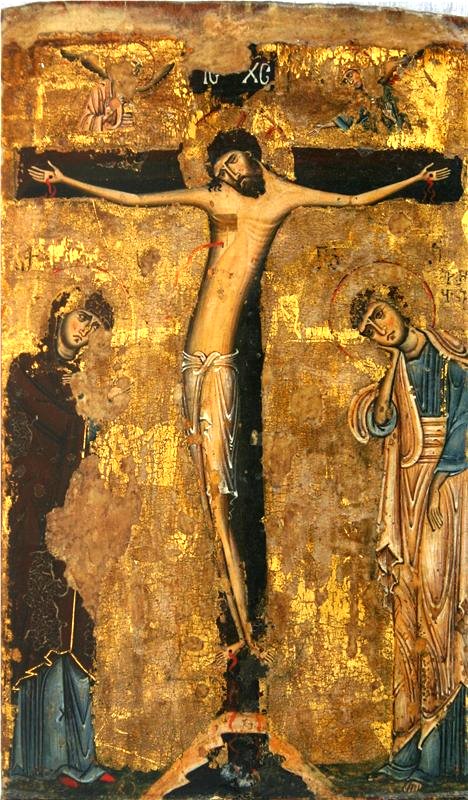
Wiki-images of the raising of Lazarus and an icon of the crucifixion are in the public domain.