The Word enfleshed.
Showing posts with label Advent11. Show all posts
Showing posts with label Advent11. Show all posts
Saturday, December 24, 2011


Tuesday, December 20, 2011
In the United Kingdom non-Christians are supporting Christmas. As Alexander Goldberg noted:
The ‘War on Christmas’ myth needs to be debunked. I share similar concerns to my closest Christian neighbours that the festival risks becoming on one hand a secular consumerist feast or on the other a time when the majority of the population wrongly believes it has to play down celebrations so as not to offend others.Read his remarks about the HappyChristmas4All campaign.
Monday, December 19, 2011
Lineage

The lineage of important people was common in ancient Near East societies. This evening’s antiphon recalls Jesse as the primogenitor of the Second David, Jesus.
One of the earliest images of this line in stained glass is in Chartres Cathedral.
One of the earliest images of this line in stained glass is in Chartres Cathedral.
_____________________________________________
Wiki-image of the Jesse Tree window is in the public domain.

Sunday, December 18, 2011
Outstretched Arm
This evening’s antiphon recalls God’s mighty power to save. The 18 December antiphon begins with the title of Lord. Its Hebrew word, adonai, replaced the divine name, which was
 not pronounced. Paragraph 3 at the site Hebrew for Christians explains. It also lists the several uses of adonai.

Two years ago, Paul Zalonski, posted a summary of all the O Antiphons with a graphic: read vertically and left then right to see their order for the week.
_____________________________________________
Wiki-image of O Adonai chant is in the public domain.

Sunday word, 18 Dec 2011
Advent Sunday 4 (18 Dec 2011)
Homily of Fr. Paul Panaretos, S.J.
Reconciled By the Incarnation
Today’s liturgy and its scripture selections shape our immediate preparation to celebrate our Savior’s birth. The opening prayer reminded us that our celebration of God’s birth among us also asks God that “[Jesus’] Passion and Cross…[may bring us] to the glory of his Resurrection”1 and our participation in it. One way this divine-human participation functions is reconciliation. A brief word on the Incarnation as reconciling us to God.
St. Ignatius of Loyola imagined the Incarnation as flowing from the heart of the Trinity from their eternity. He invited us to consider the Divine Persons gazing upon the surface of the earth
 seeing humans being born and dying, loving and hating, happy and sad, flourishing and struggling, “so many people aimless, despairing, hateful and killing; so many undernourish-ed, sick and dying, so many struggling with life and blind to any meaning. With God I can hear people laughing and crying, some shouting and screaming, some praying, others cursing.”2 That is an accurate assessment of things today.

Staying close to reality allows us to be real about God. God is not an idea. God is our Creator and Redeemer. God’s intimate desire to remain involved with creation and fulfill it Ignatius expressed this way: the Divine Persons “decide in their eternity that the Second Person should also become a human being to save the human race.”3
The Incarnation is about us! God in Jesus by their Spirit desired to restore our original dignity to us. That restoration shapes our vocation in life. Each of us begins with oneself. Whom do I love? What is alive in me? What do I nourish? What gives me meaning? As one considers these gracious gifts, their opposites surface in our minds and hearts: Who irritates me, or worse? What is not life-giving for me? What do I neglect or refuse to cultivate within me? How do I squander my gifts and my purpose in life?
When we are honest about ourselves this way, then we open ourselves to the mystery of God working in us, with us and for us. We notice more clearly how each of us is an image of our Creator and Redeemer, and we tend to see others that way. We also—and this is often a steeper challenge—we notice our need to be saved. We increasingly dispose ourselves to know in a felt way that Jesus is our Savior.
The more honest we are about ourselves, the more compassionate we become. Things that seemed too much for us we see in truer perspective. Our worries and fears do not evaporate, although our confidence to contend with them increases. We grow more alert that by Holy Spirit our Savior is with us wherever we may be. As we cultivate this awareness through daily moments of quiet, prayer and celebrating the sacraments, especially the Eucharist, our personal confidence flows into our daily living. We desire others to enjoy it.
 The Incarnation is the most exquisite relationship. Over 1500 years ago Pope St. Leo wrote that “divine nature and the nature of a servant were…united in one person.”4 The service of the Incarnation is twofold: first, to restore us, reconcile us to our true and original dignity as images of God; and second, to deepen our relationship with God and restore our relationship with each other.
The Incarnation has many practical effects. One is the desire for others to enjoy it, to make it known to all. Evangelizing—passing on our Incarnation faith by our choices and behaviors and styles of living—deepens our relationship with God and makes us ambassadors of reconciliation5 day to day.
In your 15 minutes with Jesus this week
- Pause in the love of the Trinity.
- Ask Mary to present you to her Son.
- In your words thank Jesus, our Divine Savior, for becoming human for you.
- Ask him to increase your confidence in his presence with you and deepen your felt knowledge of his presence.
- Close by saying slowly the Lord’s Prayer. Jesus gave us his prayer so that we may grow more confident that his union with us and us with him through his Incarnation will bring us to the glory of his Resurrection.
Link to this homily’s Spiritual Exercise
____________
- Roman Missal, Fourth Sunday of Advent.
- This paraphrase of St. Ignatius belongs to James L. Fleming, S.J., Draw Me Into Your Friendship: The Spiritual Exercises: A Literal Translation & A Contemporary Reading. St. Louis: IJS, 1996, p. 91.
- Spiritual Exercises of Saint Ignatius, trans. & comm. George E. Ganss, S.J., St. Louis: IJS, 1992, p. 56 [at #102].
- Letter 31, which is excerpted in the Liturgy of the Hours on 17 December.
- The language is St. Paul’s. See 2Corinthians 5.16-21.
_____________________________________________________________________
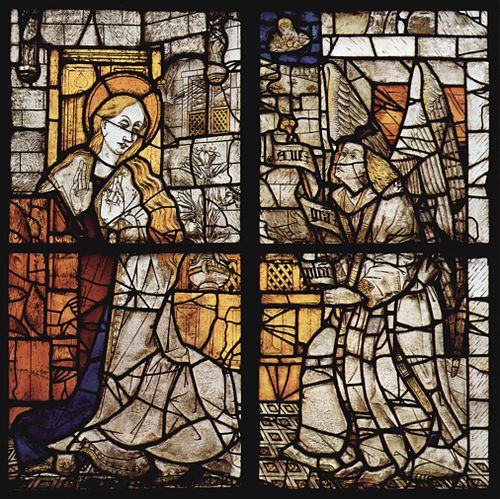
Wiki-image by 3268zauber of an Advent wreath is used according to the CC BY-SA 3.0 license. Wiki-image of an Annunciation window is in the public domain.


Saturday, December 17, 2011
O Antiphons Commence Today
In the Roman Catholic liturgy the days17-23 December have their own formulae. During each Evening Prayer one of seven antiphons is sung before and after the Marian canticle, The Magnificat. They are drawn from images from Old Testament writings. We know them in a familiar Advent song.
[Source: YouTube]
The first words of the antiphons are titles given to Jesus as Messiah. Because they begin with the letter O in the Latin, they are called the O Antiphons. Today’s is Wisdom, O Sapientia.
For all of them, a brief history and their Latin acronym, see the Dominican Friars blogpost of yesterday, on which the above video was embedded.
Sunday, December 11, 2011
Sunday word, 11 Dec 2011
More in Unison
Advent Sunday 3 (11 Dec 2011)
Is 61:1-2a, 10-11; Resp Luke1; 1Th 5. 16-24; Jn 1. 6-8, 19-28
Homily of Fr. Paul Panaretos, S.J.
In my childhood the beginning of Advent seemed to mark a long time. Before I knew it Advent’s midpoint arrived. While Advent’s month of Sundays no longer seems as long, it unfolds no less quickly. We have again reached its Third Sunday. Its liturgy focuses on the coming Solemnity of our Lord’s Nativity.
The Nativity of our Lord is the beginning of redemption: Jesus embodied God, who would release humans from the bondage of sin.1 That alone moved people to rejoice. Yet the mystery of God

Living Christian freedom, the liberty for which Messiah Jesus freed us,3 is what the Prayer Over the Offerings points when it calls, May the sacrifice of our worship, Lord, we pray, be offered to you unceasingly. It does not mean that we are in church 24 hours a day. It means we live the communion we offer and receive gathered as one; each of us living what we offer and receive here in our many places of living, working, learning and playing. When each of us complete[s] by how we live what was begun in [this] sacred mystery, we incarnate and advance God’s saving work in Jesus by their Spirit.
The church has extolled God’s incarnation, the union in Jesus of human and divine,4 as a marriage of humanity with God.5 As they enter into married life, human spouses “think in unison,” as Pope Benedict has observed.6 The way human spouses honor and celebrate marriage is by living their unison more readily. In the marriage of the Incarnation we Christians are to think in unison with our Savior. We begin that when we confess Jesus with our lips7 as our God and brother and act on our words. We act so as not to pay lip-service to what God does for us in Jesus by their Spirit. Jesus reminded us that our deeds confirm or negate our words.8 Today we say it is not enough to talk Christian things; witnesses to Jesus walk the Christian way. The Christian way is not a refined human way of living. The Christian way, living Christian freedom in every circumstance, flows from Jesus’ Spirit: it is of God.
John the Baptizer was one sent from God. The good news of our salvation in Messiah Jesus is alive today because of Jesus’ Spirit at work in prophets and disciples, past and present. You and I make straight the way of the Lord when we do not get in the way of the Spirit but let our lives manifest the power of Jesus’ Spirit, given us in word and sacrament.
“How do we do that?” one may ask. Another may say, “I don’t recognize the Spirit at work in me.” The Spirit is not present in the same way you and I are present to each other. However, traces of the Spirit—we might say, the fingerprints of the Spirit—are in good deeds; in expressions of gratitude for life, for people, for our faith; in the fruits of personal prayer; and in communal worship,
 especially around the tables of God’s word and God’s son. When we are faithful to those practices and to others of our Catholic heritage, we begin to recognize the Spirit at work in us and in the world, and others recognize the Spirit, too.

The result: we are reshaped by the mystery of the Incarnation. We move closer to God who united with us. It is breathtaking to pause and ponder it. “By His incarnation the Son of God has united Himself in some fashion with every person. He worked with human hands, He thought with a human mind, acted by human choice and loved with a human heart.”9 Allowing our Messiah Jesus to work in us is being saved. To think in unison with our Savior is to live God’s delight over us.
In your daily 15 minutes with Jesus this week
- Pause in the Trinity’s saving love for you.
- Ask John the Baptizer to present you to Jesus.
- Praise Jesus for embodying God’s goodness and mercy for you.
- Ask Jesus for the grace to live more in unison with his words and example.
- Close, saying slowly the Lord’s Prayer. Jesus’ prayer schools us to pray and live in greater harmony with others and our Savior, who is with us and who is to come.
Link to this homily’s Spiritual Exercise
____________
- See Matthew 1.21, which specified the name of Jesus, which means the Lord saves.
- 1Corinthians 1.18 is one example from Paul. Peter too, was emphatic, 1Peter 3.21. In Revelation 12.10 the seer, John, heard no less an authority than the voice in heaven announce, “Now have salvation and power come.”
- Galatians 2.4 and Galatians 5.1.
- John 1.14; Philippians 2.6-8; Colossians 2.9; 1Timothy 3.16; Hebrews 2.14-17.
- Psalm-Prayer at Evening Prayer, Monday, Week2. Recently, Pope Benedict XVI summarized this tradition in his encyclical, Deus Caritas Est, 13.
- His 2009 encyclical, Caritas in Veritate, 54.
- Hebrews 13.15.
- Luke 6.46-49 recalled a vivid parable.
- Second Vatican Council, Pastoral Constitution: Church in the Modern World, 22.
___________________________________________________________________
Wiki-images of light from a star-forming region and an artist's depiction of Holy Spirit in the Annunciation are in the public domain.


Thursday, December 08, 2011
Thursday word, 08 Dec 2011
Given and Received
Solemnity of the Immaculate Conception (08 Dec 2011)
Gn 3. 9-15,20; Ps 98; Eph 1. 3-6,11-12; Lk 1. 26-38
Homily of Fr. Paul Panaretos, S.J.
Creation runs through scripture from beginning to end. To use musical language, creation is a principle theme with many variations. Sunday, the Second Letter of Peter reminded us that God assures and encourages us to look forward to new heavens and a new earth.1 How we live, how we witness to our Savior testifies to that new creation. How we live shapes how we anticipate what
 has been emerging in creation from the first Advent of Mary’s son, when he lived, died and rose to absolutely new life. Jesus offers us a taste of that new creation in word, sacrament and service, each given and received.

Recalling Mary’s immaculate conception previews new heavens and a new earth. Mary was conceived without sin to be a fitting vessel for the Son of God. The Mother of God was full of grace for that very reason! This dogma of ours has a practical aspect because Mary’s immaculate conception blesses us with new confidence.
Hers is new confidence because confidence evaporated early in the first creation. The first stewards of creation had the noble vocation to cultivate and care for2 their garden-home and to name every living thing.3 Both took confidence: a trust; a self-possession; and a feeling at home with oneself as well as with one’s surroundings. The enemy of our human nature, which Genesis depicted by a serpent to impart the subtle, crafty wiles abroad in creation, twisted trust into pride. God had given the first humans a single prohibition, “You are free to eat from any of the trees of the garden except the tree of knowledge of good and bad. From that tree you shall not eat.”4 Pride made that tree like the others for the first human stewards. After eating it they grew afraid to meet God, who accompanied them and moved with them day by day. Humans have suffered a crisis of confidence ever since. Mistrust, loss of self-composure and not feeling at home with oneself or one’s surroundings have warped humans from our beginnings.
Yet time has always been pregnant with God’s salvation. In the fullness of time,5 that is to say, when the Lord made known [the Lord’s] salvation to Mary, she overcame her anxiety at the angel’s greeting and announcement that she would be the Mother of God.

We might easily dismiss Mary’s compact response as the reply of a greatly troubled girl, whose married life was soon to begin. Her reply was anything but! Mary’s response was her unequivocal Yes, her confidence in God and God’s promise of salvation. She was different after it, and the world is different because of it. Our world counts on us and all who revere her to imitate Mary’s new confidence so we may transform crisis to renewed faith and be witnesses by our choices and actions of new heavens and a new earth. They continue emerging because of Mary’s son and his life, death and resurrection. Christian faith and its incarnation by action is the Lord’s salvation, given and received.
____________
- Chapter 3.13. This rests between its early mention in Isaiah 65.17 and 66.22 and the Book of Revelation (22.1), which specified it with vivid imagery.
- Genesis 2.15.
- Genesis 2.19.
- Genesis 2. 16-17.
- Galatians 4.4; also see Mark 1.15.
_________________________________________________________________
Wiki-image by Gryffindor of interior of the National Basilica of the Immaculate Conception is used according to CC BY-SA 3.0 license. Wiki-image of Tanner’s Annunciation is in the public domain.


Tuesday, December 06, 2011
The Medicis and Santa

Yes, a connection exists. It seems the Medicis connected with St. Nicholas of Bari in hopes to be as popular as the saint.
Read Fr. Richard Kunst’s post in the Duluth (MN) diocesan paper.
___________________________________________________________________
Wiki-image of a detail of a Pietro di Cosimo painting is in the public domain.

Monday, December 05, 2011
Better Late Than Not At All
Just discovered: an online,
A printable, PDF version of the retreat is also available at that resources-page for any who find print more conducive, or who could benefit from using both formats.
_____________________________________________________________________
Wiki-image by Clemens PFEIFFER of an advent wreath is used according to CC BY 2.5 license.
Wiki-image by Clemens PFEIFFER of an advent wreath is used according to CC BY 2.5 license.

Sunday, December 04, 2011
Sunday word, 04 Dec 2011
Advent Sunday 2 (04 Dec 2011)
Is 40:1-5, 9-11; Ps 85; 2Pt 3. 8-14; Mk 1. 1-8
Is 40:1-5, 9-11; Ps 85; 2Pt 3. 8-14; Mk 1. 1-8
Homily of Fr. Paul Panaretos, S.J.
Welcoming, Receiving, Living
The poetic word, tidings, hails from Old English. It means announcement and news. In Isaiah glad tidings has long been translated good news. God’s good news became gospel: the beginning of the gospel of Jesus the Christ the Son of God. Gospel is about Jesus; more, it is the good news Jesus proclaimed, “This is the time of fulfillment. The kingdom of God is at hand. Repent, and believe in the gospel.”1 Many identify the word gospel with its later meaning as a portrait of Jesus. It first meant the living announcement Jesus made: The kingdom of God is at hand. Gospel’s more important meaning involves and engages us: God’s word invites our response.

Recall Mary’s disposition when she sang her words: The angel had announced she would be the mother of God; she moved through her anxious fear to feel deep within an overwhelming joy in God, whom she named her savior.3
When you and I recall moments when we felt deep joy, we can better appreciate Mary and Jesus and all faithful people. Some examples: When an acceptance letter comes to an eager student longing for it; when someone tells another for the first time, “I love you”; when an unemployed person gets a job; when a patient receives good news after medical tests—name your experience: the reactions are robust. As one person exclaimed: “Yes! Yes! Everything is all right with the world!”
Mary knew every hunger had not been reversed, not every injustice remedied; yet she didn’t lie. She affirmed again God was remaining faithful and true to God’s way. So it is with the student receiving the acceptance letter; the lover who hears what she intuited; the worker working again; the patient, who may never have untroubled health, looking forward to live more days with gusto. They know the reversal is not total, and they do not lie. They, too, echo God’s gracious pattern of recreating life anew.

A vital texture of our prophetic conviction is that God’s faithful, steady pattern of continual creating is unearned. When we hear, Repent, and believe in the gospel, repent “means allowing God to do for us what we cannot do for ourselves.”4 We did not bring ourselves into being, and we cannot give ourselves unlimited future. We can pray for it and welcome it. Of that today’s Prayer Over the Offerings reminds us:
Be pleased, O Lord, with our humble prayers and offerings, and since we have no merits to plead our cause, come, we pray, to our rescue with the protection of your mercy. Through Christ our Lord.
Without knowing Latin, we can hear legal echoes in the prayer. The original language recognized we have no voice;5 legally no voice means no power: no power to give ourselves what God gives in Jesus by their Spirit; yet, we have power to welcome their promise, to receive it and to live it. That is good news, which Advent helps us reclaim.
- Give Jesus 15 minutes each day this week.
- Rest in the creative love of the Trinity.
- Ask John the Baptizer, who began the gospel for the church, to present you to Jesus.
- Praise Jesus for announcing the reign of God.
- Ask Jesus for the grace to welcome his good news and to notice how his word is alive for you and lives in you.
- Close saying slowly the Lord’s Prayer. Jesus gave it to us so that his words could pray for us when our words fail: when life is too much; and when God unlocks joy no words can describe.
____________
- Mark 1.15.
- Luke 1.51-55.
- See Luke 1.47.
- Reginald Fuller, Preaching the New Lectionary, Collegeville, MN: Liturgical Press, 1976, p.290.
- For the curious, two Latin words operate in the phrase, ubi nulla súppetunt suffrágia meritórum [since we have no merits to plead our cause]: meritorum (a merit, service, kindness, benefit, favor) and suffragium (a voting-tablet, ballot, vote, voice, suffrage).
______________________________________________________________________
Wiki-images of John the Baptizer preaching and of a portion of the Isaiah scroll of the Dead Sea Scrolls are in the public domain.


Subscribe to:
Posts (Atom)