Showing posts with label Advent08. Show all posts

Sunday, December 21, 2008

Sunday word, 21 Dec 2008

Advent Sunday4 (21 Dec 2008)
2Sm 7. 1-5,8b-12,14a,16; Ps 89; Rm 16. 25-27; Lk 1. 26-38
Homily of Fr. Paul Panaretos, S.J.
Mutual Confidence

T
oday’s liturgy and its scripture selections shape our immediate preparation to celebrate our Savior’s birth. The opening prayer reminded us that our celebration of God’s birth among us also asks God to “lead us through [Jesus’ mysteries of] suffering and death to the glory of his resurrection”/1/ and our participation in it.

Through our worship God answers our pray to “lead us through [the mysteries of Jesus’] suffering and death to the glory of his resurrection.” Our worship grafts us onto the mysteries of Jesus life, death and resurrection.

I want to reflect with you briefly this morning on a contrast in the very familiar annunciation to Mary that she would be the mother of God. I do it to animate your own prayer and help you discern how God desires to favor you.

Luke’s prophecies of the births of John the Baptizer and of Jesus appealed to his hearers and readers in the 1st-Century Mediterranean world. Soaked in Greek culture they were accustomed to stories of exceptional and extraordinary people to include heavenly messengers and events. The prophecies of the births of John the Baptizer and of Jesus also resumed the history of God’s people, Israel.

The contrasts unfold in detail not only in Luke’s gospel; the liturgical celebrations throughout the year unfold them for us.

You and I are unlike our 1st-Century Mediterranean counterparts when we hear them, yet we still receive compact histories of God’s people about God working in and through them. In both prophecies of the births of John the Baptizer and of Jesus: the Lord, with different titles, is central. The contrasts revolve around the Lord God. Each contrast shouts, ‘Great was John; greater is Jesus.’

John will be great in the sight of the Lord but Jesus will be great and will be called Son of the Most High. John prepare[d] a people fit for the Lord, but Jesus will rule the people. John’s role was temporary, but Jesus’ sovereignty will [have] no end. John was a prophet, but Jesus was more than a prophet, the Son of God. John would be filled with the Holy Spirit as prophets before him, but Holy Spirit and Power of the Most High overshadow[ing] Mary made Jesus the Holy One to whom all prophets pointed./2/

Common to ancient Mediterranean prophecies of the birth of exceptional and extraordinary people were signs, which confirmed the announcements. The contrast between the two signs following Gabriel’s announcements affects us. The two signs: Zechariah, John’s father to whom Gabriel announced John’s birth, was struck mute/3/; Mary was told the fulfillment of an earlier prophecy: behold, Elizabeth, your relative, has also conceived a son in her old age, and this is the sixth month for her who was called barren; for nothing will be impossible for God.”/4/ You may quickly ask, “How does this contrast affect us?” A good question. We have experienced the answer.

Mary was the first person in the gospel to receive confidence from another person’s experience of God’s fidelity. Mutual confidence runs throughout Luke’s writings, but it isn’t confined to them. God’s fidelity to one person is our gift, it’s why we are here. How Catholics, and in particular some of us, have made known God’s fidelity inspired our Catechumens and Candidates to inquire about our Catholic worship and life and seek to become part of us.

Readers of the Sun Press and the Universe Bulletin not only learned about nearly 1000 of us uniting in our service-day, more than a few readers received confidence in their faith, and others may have begun again to notice God at work--or notice for the first time.

“Passing on the faith” is our name for sharing with others God’s fidelity to us. God’s fidelity is God’s life in us. Our relationship with God, faith, is noticing and interpreting God with us each moment. Faith isn’t merely assenting to propositions.

In your 15 minutes with Jesus this week, pause in the love of the Trinity. Then, in your own words, thank Jesus for your faith. Ask him to increase your confidence in him and to reassure you that your faith is resilient more than it is brittle. Close by saying slowly the Lord’s Prayer. Jesus gave us his prayer so that we may grow confident in our faith by the action of forgiveness, which gives us a taste now of the mysteries of Jesus’ “suffering and death [and] the glory of his resurrection.”

____________
1. Sacramentary, Fourth Sunday of Advent.
2. For each pair above see these verse-pairs in Luke’s gospel: 1.15, 1.32; 1.17, 1.33; 1.17, 1.33; 1.15, 1.35; 1.15, 1.35.
3. Luke 1.20.
4. Luke 1.36-37.
__________________________________________________________
Wiki-image of Cavallini's angel and Wiki-image of Rosetti's Annunciation are in the public domain.

Sunday, December 14, 2008

Sunday word, 14 Dec 2008

Advent Sunday3 (14 Dec 2008)
Is 61. 1-2a,10-11; Resp Lk 1. 46ff; 1Th 5. 16-24; Jn 1. 6-8, 19-28
Homily of Fr. Paul Panaretos, S.J.
Climate of the Heart

Recently, someone mentioned to me that talk about our Christian hope for the completion of history--our Savior’s glorious return at the end of time--was not something learned as a young person. Our Christian hope for the completion of history St. Paul proclaimed with his phrase, the coming of our Lord Jesus the Messiah. Advent continues the attention given to the Christian hope for the glorious coming of our Lord Jesus in the liturgies of the weeks before it. Even as Advent prepares us to celebrate the birthday of Jesus in Bethlehem, Jesus’ first arrival, Advent continues to recall our Christian hope of his glorious return at the end of time.

Thus, you and I live between two advents of our Messiah. Our purpose living between them is to testify to the light, Jesus’ life with us, in us and for us. We are prone to tolerate darkness more than light. If Christian light is Jesus’ life with us, in us and for us, then darkness is the absence of Jesus’ life. Humans often hamper and block Jesus' life for one another. Two ways darkness registers in daily living are dilemmas and injustices. An example each of our dilemmas and injustices.

In cities across the country, including those of northeastern Ohio, some service-businesses attract immigrants with promises of work but do not make good on their promises. Another: women, both wed and unmarried, are about to give birth far from family and without access to money and the support that is their due. The Catholic Church through various agencies helps supply basic necessities of life to people denied work and health care to anxious parents-to-be.

Today’s immigrants and anxious parents-to-be incarnate the poor, the brokenhearted, captives and prisoners, who are among us in many ways. They are not far, nor did they only inhabit the ancient Mediterranean world, like Joseph and Mary, who migrated when she was a parent-to-be and a as a young mother.

All of us fit in our own ways into the categories of the poor, the brokenhearted, captives and prisoners of whom the prophet sang. Each of us experiences inadequacy, bruised if not broken hearts, and we are held hostage by forces within and outside our selves. Within: we are enslaved by our sinful tendencies. Without: societal pressures straight-jacket us before we’re even aware they are affecting us.

Advent offers us the opportunity to acknowledge the way people, indeed populations, are held hostage, even ignored and forgotten. Icy chill isn’t limited to the air; another chill is part of the climate of the human heart. Nor does darkness drag on in our shorter hours of day-light only; more real darkness grips our hearts and minds as well. More real darkness of every kind reminds us that we need saving.

Advent is Light piercing our darkness. Advent isn’t about doom, but about both our Christian hope for the completion of history and that Jesus’ life is with us, in us and for us to help us conquer our interior and incapacitating darknesses with him. No one else is effective to warm and brighten our true selves and make us servants of Jesus’ mission.

Advent, though, is not an end in itself. Advent does not fixate on the cold, the dark, the brokenness and what robs our spirits and deprives our bodies. Far from it! Our liberty is rooted in God’s reliability. God illumines our darkness by divine and most real light.

Illumined people are God’s hands filling up the hungry, tending bruises, welcoming strangers, and setting free hostages of all sorts. With that loving attention we make real, for those who need it, God’s embrace and God’s fidelity.

Advent opens us to the glory we call Christmas, not because Jesus needs to be reborn each December, but because we need rebirth, renewal and new dispositions each day. To know our need for innermost renewal leads us to rejoice always. God desires we be renewed personally and do our part to renew our world with Jesus.

In your daily 15 minutes with Jesus this week, ask John the Baptizer to present you to Jesus. Speak with Jesus about ways you experience him enlightening your life and welcome him into every dark corner of your heart and mind. Be as intent as you can. Close by saying slowly the Lord’s Prayer: it models Christian intention, desire and purpose. Jesus’ prayer enlighten us until he fulfills our Christian hope for the glorious coming of our Lord Jesus.

____________________________________________
Wiki-image by Jorge Noriega Sevilla of lamp in Maranatha sanctuary is used according to the Creative Commons Attribution ShareAlike 2.5 license. Wiki-image of an icon of the Baptizer is in the public domain.

Monday, December 08, 2008

Monday word, 08 Dec 2008

Solemnity of the Immaculate Conception (08 Dec 2008)
Gn 3. 9-15,20; Ps 98; Eph 1. 3-6,11-12; Lk 1. 26-38
Homily of Fr. Paul Panaretos, S.J.
Given and Received

Creation runs through scripture from beginning to end. Creation is a principle theme with many variations. Yesterday, the Second Letter of Peter reminded us that God assures and encourages us to look forward to new heavens and a new earth./1/ How we live, how we witness to our Savior testifies to that new creation. How we live shapes how we anticipate what has been emerging since Mary’s Son lived, died and rose to absolutely new life, promise to us. Jesus gives us a taste of that new creation in word, sacrament and service, both given and received.

Recalling Mary’s immaculate conception previews new heavens and a new earth. Mary was conceived without sin to be a fitting vessel for the Son of God. The Mother of God was full of grace for that very reason! This dogma of ours has a practical aspect because Mary’s immaculate conception blesses us with new confidence.

Hers is new confidence because confidence evaporated early in the first creation. The first stewards of creation had the noble vocation to cultivate and care for/2/ their garden-home and to name every living thing./3/ Both took confidence: a trust; a self-possession; and a feeling at home with oneself as well as with one’s surroundings. The enemy of our human nature, which Genesis depicted by a serpent to impart the subtle, crafty wiles abroad in creation, twisted trust into pride: God had given them only a single prohibition, “You are free to eat from any of the trees of the garden except the tree of knowledge of good and bad. From that tree you shall not eat.”/4/ Pride made that tree like any other for the first human stewards. After eating it they became afraid to meet God, who accompanied them and moved with them day by day. Humans have suffered a crisis of confidence ever since. Mistrust, loss of self-composure and not feeling at home with oneself or one’s surroundings have warped humans from that time.

Yet time has always been pregnant with God’s salvation. In the fullness of time, that is to say, when the Lord made known [the Lord’s] salvation to Mary, she overcame her anxiety at the angel’s greeting and announcement that she would be the Mother of God. She was greatly troubled: the human crisis of confidence insinuated itself in her mind while she was in her own home! If that moment were to have a center, it would be the angel’s greeting, “Do not be afraid, Mary...you have found favor with God.” Mary made everything--present and future--revolve around that center by taking the angel, and therefore God, at God’s word: “Let it happen to me as you say.”

Mary’s response was so compact that we might easily dismiss it as the reply of a greatly troubled girl, whose married life was soon to begin. It was anything but! Mary’s response was her unequivocal Yes, her confidence in God and God’s promise of salvation. She was different after it, and the world is different because of it. Our world counts on us and others Christians to imitate Mary’s new confidence so that we may transform our crisis to renewed faith and be witnesses by actions of new heavens and a new earth, already emerging because of Mary’s son and his life, death and resurrection. Christian faith and its incarnation by action is the Lord’s salvation, both given and received.

____________
1. Chapter 3.13. This rests between its early mention in Isaiah 65.17 and 66.22 and the Book of Revelation (22.1), which specified it with vivid imagery.
2. Genesis 2.15.
3. Genesis 2.19.
4. Genesis 2. 16-17.
___________________________________________________________
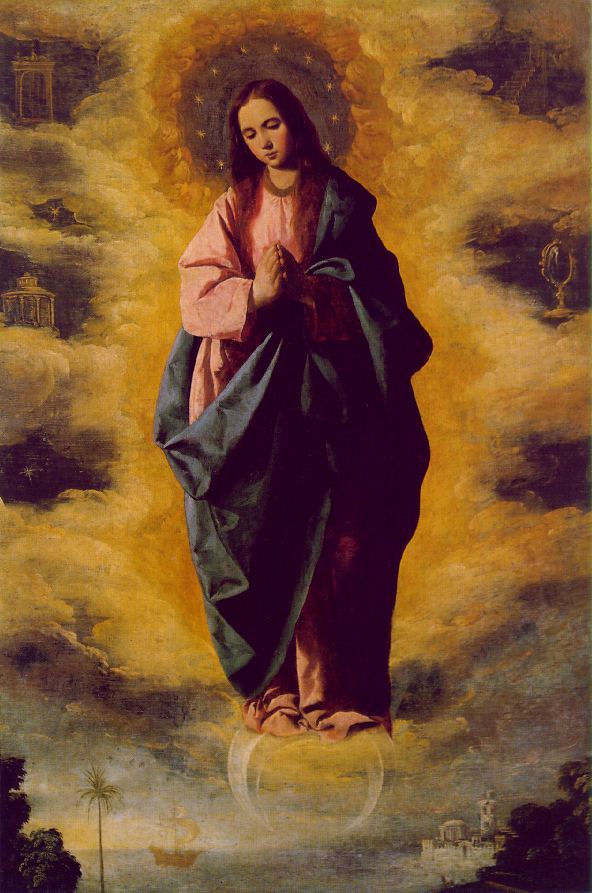
Wiki-image of the Zubaran's Immaculate Conception is in the public domain.

Monday, December 01, 2008

New For Advent

T
he Develpoment Director of the Detroit Province of the Society of Jesus announced Friday in an email to Friends of the Province that in the season of Advent "we reflect on the many times Christ has already come into our lives."

Jesuit Fr. Jim Von Tobel has offered this first Advent reflection to enhance that annual exercise.

Sunday, November 30, 2008

Sunday word, 30 Nov 2008

Advent Sunday1 (30 Nov 2008)
Is 63. 16b-17,19b,64.2-7; Ps 80; 1Co 1. 3-9; Mk 13. 30-37
Homily of Fr. Paul Panaretos, S.J.
We Measure Time Differently

Some may consider sobering Isaiah’s plea, which opened today’s liturgy of the word: Why do you let us wander, O Lord, from your ways, and harden our hearts so that we fear you not? Return for the sake of your servants...Oh, that you would rend the heavens and come to us. If we live with an image of an angry deity rather than God, who is our Creator and Redeemer, then the prophet’s plea would be sobering, indeed even frightening.

However, we know that for us Catholics sobering words invite us to new life not to fear life. Nor are Isaiah’s words imprisoned by time and locked in the unreachable past. We pray at each mass that God would make our hearts more supple and help us walk in God’s ways. Harden[ed] hearts distort the actions which flow from them; they distance us from God, both the results of sin. Catholic worship is clear about that, which is why we pray at each mass after the Lord’s Prayer, “Deliver us, Lord, from every evil and keep us safe in our day. In your mercy keep us free from sin as we await with joy the coming of our Savior, Jesus Christ.”

We pray to walk more resolutely in God’s ways because God in Jesus by their Spirit entrusts us with a mission to be alert to the future coming of our Savior and to his continual presence with us as we extend his saving work.

Jesus did not merely tarry on earth; he formed a people to do his work until that day of his return at the end of time. No one knows that day nor can reckon its hour. People through the ages have wasted so much energy over that even though the authority about our not knowing how to reckon it is Jesus himself: of that day or of that hour no one knows, not even the angels in heaven, nor the Son, but only the Father./*/

The point is not about knowing or guessing. It isn’t about God keeping us out of the loop, as we’d say today. The point is so that our being alert to both the future coming of our Savior and to his continual presence with us won’t be shattered by false prophets of frantic frenzy or of apathetic disregard and unconcern.

That makes us true prophets, who bear a different set of expectations than false prophets whose number is too large. They see the future through the lenses of frantic frenzy, which lead them to fear rather than hope, and through the lenses of apathy, which make them inert rather than servants of Jesus’ name. Prophetic, Christian attitudes to self, others and the world receive expression by prophetic disciples today.

We measure time not by centuries and milennia nor by the rise and fall of nations. No. We measure time by God inviting us in Jesus and by Jesus empowering us to live our baptismal commission as his witnesses day by day.

Jesus encourages us as he encouraged his first disciples: “Be watchful! Be alert!” Jesus encourages us to have a daily concern for our mission. Obsessive focus on the day of the Lord’s second coming distracts us from our mission as prophets today. It distracts us from being aware that we are coworkers of Jesus, who seek to extend his mission and refuse to allow time and its concerns to supersede Jesus’ concerns or to diminish our concern for them.

The grace is that Jesus adapts his concerns and our mission to human time, not the other way around. The end will arrive when the mission is satisfied. That frees us to live without apathy or hysteria so that our mission-efforts will be truly effective. Jesus’ mission is the reason we are alert and eager stewards.

In your daily 15 minutes with Jesus this week, yield control and bask in the love of the Trinity embracing you. Ask the communion of saints to present you to Jesus so that you may converse with him. Speak with Jesus about what worries or disturbs you about being his missionary and about what elates and energizes you when you serve in his name. Desire with all your heart to be a more eager steward of Jesus’ words and deeds. Close by saying slowly the Lord’s Prayer, which reminds us at the start that we are ambassadors of the kingdom of God and that God gives us all we need to be its witnesses.
_____________
* These verses are left out of the passage in the lectionary, but they are crucial to why we live on alert--alert to Jesus’ words and mission.


____________________________________________
Wiki-image of a candle in hand is in the public domain. Wiki-image from an Advent flower shop is used according to the GFDL and the Creative Commons Attribution ShareAlike 3.0 license.