Saturday, May 31, 2008

Saturday word, 31 May 2008

The Visitation (31 May 2008) Rm 12.9-16; Resp Is 12 verses; Lk 1. 39-56
Homily of Fr. Paul Panaretos, S.J.
Very Old and Very Current


The church celebrates this moment in the life of Jesus in the womb of Mary, a moment after learning that she would be the Mother of God. Undoubtedly, Mary pondered that for a good while, but time was not so important because she had replied that she would play her part in God’s providential plan for our salvation.

The church invites us to focus on this moment often, when we pray the Joyful Mysteries of the Rosary. I want to share with you something very old and very current.

In the middle ages in Germany people praying the rosary had a custom of adding the mystery after the word, Jesus, in the Hail Mary. The example given in the history book I was reading was the scourging of Jesus. Thus: “Hail Mary....your womb Jesus, who was scourged for [me]....” I pondered that for some time, and it seemed I could appreciate the mystery more if I did that. I tried it, and I continue to do it.

Sometimes a mystery requires adaptation. The Visitation is such one. This is what has become second nature to me:“Hail Mary...your womb Jesus, with whom you hastened to Elizabeth as a model of hospitality for me. Holy Mary, Mother of God....” I never realized until now that that interpolation was 13 words. It doesn’t seem long at all because that same interpolation allows me to enter deeply into that mystery of the rosary.

Entering the mystery--the entire paschal mystery or aspects of it--plunging into the mystery shapes us more and more into Christian missionaries who transform the world by sincere love, mutual affection, fervent spirit, patient endurance, showing honor, rejoic[ing] in hope, persever[ing] in prayer and excercis[ing] hospitality.

The Christian mystery exercised by Mary or another saint or sainted person is not a past event. It has present effects in the lives and hearts of all who open themselves to the Christian mystery. Jesus always extended hospitality, especially to those others forgot or ignored. Its no wonder because he learned such conscious care in his mother’s womb. The Christian mystery is our womb of wisdom, and gives us new birth in order to transform our world.
______________________________________________
Wiki-image of the Visitation is in the public domain.

Friday, May 30, 2008

Friday word, 30 May 2008

Anthony C. Amaddio funeral (30 May 2008) Ws 3. 1-9; Ps ; Rm 14.7-9,10b-12; Jn 11. 17-27
Homily of Fr. Paul Panaretos, S.J.
“How Are You Doing?”

On behalf of Gesu Parish and personally, I extend our prayers and heartfelt sympathy to you, Mildred, at the passing of your dear spouse; to you, their children, Lynn, Mark, Gregory, Anthony, Teresa, Janet and Michelle at the passing of your father. Your children and theirs grieve, too. I want all of you grand-children and great- grandchildren to remember how much your Papa loved you. It will be hard not to have him in your lives as you did; however, Papa will continue to be with you in different and new ways, which each of you will discover.

The Catholic church bids farewell to a faithful and devoted friend of many years. I offer a few words to console and to strengthen each of you in your grief; to help you appreciate God’s astounding compassion by noticing that Jesus’ victorious dying and rising were present in the life of Tony and in you as well./1/

I preface my remarks with a thank-you to you Mildred and to your beloved spouse of 62 years. Not long after my arrival at Gesu, the three of us stood where Tony’s coffin stands, and you renewed your vows to celebrate 60 years of marriage. That moment I became aware of something I had noticed when I saw you on another occasion. The loving way you were with each other mirrored the way my parents were with each other. As Tony and Michelle told me earlier this week, “[Mom and Dad] were inseparable.” My parents so enjoyed their 60 years of married life that they couldn’t imagine not being one.

Plus, Tony reminded me of my Dad because they both carried themselves with a quiet manner, a quiet which dignified them and possessing smiles which brightened their dignity.

That is far more than coincidence, Mildred. It’s a grace, and it allows me better to appreciate your loss because I have a son’s share in my Mom’s loss of her beloved husband. That same grace also helps me share more in your loss, you sons and daughters of Tony. It’s a grace that also gives me new vision of Jesus’ life, death and resurrection and to see Tony in them.

Tony “quietly got things done.” That’s the image of Jesus the gospels convey: focused with people, not without a sense of humor nor a passionate concern for relatives, friends, disciples and especially the poor. Tony intersected with Jesus those ways.

That kind of focused care may well have appeared foolish to those whose faith-vision was clouded. We know that was one way Tony shone in the world. He shall shine even more brightly in the presence of our risen Messiah.

The Book of Wisdom is not our only reminder of how Tony practiced his faith. St. Paul chimed in with words you, Tony’s family and friends, will always hear with clearer, richer meaning: None of us lives for oneself, and no one dies for oneself. Hearing those words may evoke Jesus as an ideal person to imitate. The risk of viewing Jesus as an ideal person is losing a felt knowledge of Jesus as a real person. Tony’s family, especially, know and will remember a spouse, father, grandpa and great-grandad who had all of them and others in his heart. As Tony put it when you thought he was only napping, “I’m just keeping track of everbody.” Tony did not live for himself. Beyond his family Tony was interested in how others were doing.

The Fourth Gospel also confirms that Tony and Jesus intersected in life. The Fourth Gospel portrays a very human Jesus, who hungers, thirsts, conversed with real people, enjoyed close friendships, and longed for his followers to respond to his invitation--to name some human qualities.

The opening of the selection from this gospel invites us to notice another human quality Jesus had in spades. When Jesus arrived in Bethany he found that Lazarus had already been in the tomb for four days...and many of the Jews had come to Martha and Mary to comfort them about their brother. You and I may know those words so well that we may not feel the stormy bustle they describe. Divine, yes, and also fully human, Jesus arrived in Bethany like the eye in a storm. He consoled Martha, and he encouraged her to know him for whom he truly is: the resurrection and the life.

Again, Tony’s family and friends, who visited Grand River cottage, saw him in the midst of such stormy bustle--“lots of chaos ensuing” is how Tony, Jr. expressed it moments ago. Tony’s children and grandchildren saw the other chaos, the chaos of care in which Tony provided for his father, his Aunt and Mildred’s father, in Tony and Mildred’s home. That is an invaluable lesson in love which will abide with you always.

The bond which Jesus forged between you and your spouse, father, grandpa, and friend, does not unravel with death. We are called to nurture it in a new way, until Jesus returns to reunite us with Tony forever. The way to nurture it is the way you will keep Tony alive in a different, though very real way: to cultivate serenity; to focus on one another and all in need of care more than on yourselves. I’m certain that is how Tony sought to bind you to Jesus and to help your faith grow more alive, better to “understand truth” and “abide with [Jesus and all people] in love.”/2/

___________________
/1/ Cf. Order of Christian Funerals 27.
/2/ Order of Christian Funerals, 398.30: prayer for A Parent.
___________________________________________________________
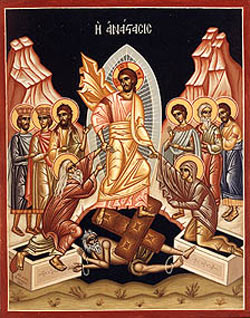
Wiki-image of an icon of the Resurrection is in the public domain.

Tuesday, May 27, 2008

Christianity & Islam: Breathing space as well as exercising the intellect


"Oasis" suggests a spot where one can breathe easier and find refreshment. Oasis is also the name of a project,

an attempt to foster a global network of contacts among Christians and Muslims, attaching special importance to the voices and experiences of Christians who live in majority Muslim nations across the Middle East, Asia and Africa. While Oasis sponsors academic conferences and a journal, it's also devoted to giving voice to real-life experiences of ordinary people, not just intellectual experts and the professional artisans of dialogue.
Angelo Cardinal Scola, Archbishop of Venice, is this project's lead sponsor. Four other cardinals--not
identified with what one might consider "soft" positions on Catholic teaching or practice. That distinguishes Oasis from some other initiatives, which bring the avant-garde of different traditions into conversation, but not the mainstream. Among other things, Christian leaders who gravitate around Oasis are often willing to challenge Muslims on issues of reciprocity and religious freedom more forcefully than one sometimes finds in other inter-religious forums.
The above quotations are from last week's "All Things Catholic" by Mr. John L. Allen Jr.

Cardinal Scola is all for both the populist expression of religions buttressed with strong intellectual support. The 66-year-old Cardinal Scola also has the future of humanity in mind:
Where is the future for humanity? It is certainly not the dogmatic religion or the purist expression of religion, even in the United States. In the United States, there is a populist expression of religion exactly as we have it in Egypt, or in India, or in Pakistan. There's no difference sociologically or culturally between the discourse of the American televangelists and the discourse given through Al-Jazeera. If you respect that kind of faith and you want to promote this, it's a mistake. It's not working for the future, and it's not working for the young generation.
Read Mr. Allen's complete column to appreciate the Oasis Project better and even gain a breath of fresh air around the necessary Christian-Islamic dialogue still in its infancy.
_______________________________________________________________
Wiki-image of an oasis by Hendrik Dacquin aka loufi is used according to the Creative Commons Attribution 2.0 license.

Monday, May 26, 2008

Touching Origins of Memorial Day. . .

. . .began with women, in particular Emma, Sophie and Elizabeth.

_________________________________________________________________________________
Wiki-image is used under the terms of the Creative Commons Attribution ShareAlike 2.5
license.

Sunday, May 25, 2008

Sunday word, 25 May 2008

Solemnity of the Body & Blood of Christ A (25 May 2008) Dt 8. 2-3,14b-16a; Ps 147; 1Co 10. 16-17; Jn 6. 51-58
Homily of Fr. Paul Panaretos, S.J.
More Vital Participation

I want to reflect briefly with you today on Jesus’ body and blood from this perspective: participating in Jesus shapes how we participate in the lives of one another.

For all the differences between St. Paul’s time and culture and our own, the way people choose to associate with others today is remarkably similar. Corinth, a large city had a broad diversity of people due in large measure to the city’s port, as well as a gateway to the interior of the country. Sounds like Cleveland of old, doesn’t it. In both Corinth and Cleveland of old--and now--people voluntarily associated with others moved by similar interests.

Then and now: clubs, ancient and modern; guilds of workers with the same materials and people who shared similar crafts; people with similar tastes in art, music; athletes and soldiers; even the poor and sick--then and now people with similar interests and intersecting roles in society easily participated in each others lives. Ancients' strict class-distinctions--something foreign to our American heritage--made similar interests all the more binding.

Any of us can operate out of similar interests only, because of fear of the unknown, distrust of anything new or a desire to be comfortable. We all know that never to explore ensures a dull life; that never to trust ensures no reward of intimate satisfaction and growth; and to choose only comfort is a springboard to emotional and; spiritual flabbiness. Associating only out of similar interests guarantees listless lives.

The good news St. Paul brought to Corinth, the good news St. Paul offers us, is that Jesus offers himself to us so that we may lead vital lives and associate with those who are different, chiefly the poor, the infirm and those we keep at the margins of society, not to mention our hearts. The ones at the margins were those with whom Jesus had a particular friendship. Jesus’ friendship with humans was not shaped or defined by similar interests. Jesus came inviting sinners, then and now; he came setting free those in bondage.

Jesus’ friendship with humans embodied his friendship with God. Jesus’ friendship with humans allows us to see, hear, touch God’s heart. Even better news is that Jesus refused to be the only channel of God’s heart and God’s freeing, healing love to the world. Jesus gave himself to nourish us and strengthen us to channel God’s freeing, healing love we experience to others.

Jesus’ body and blood are the life and love of Jesus and transform us more and more like him. We become the one we receive! We come more and more to live and breathe an atmosphere that flows not out of similar interests or comforts but from Jesus' very self.

The body and blood our Messiah Jesus is not some representation of Jesus or symbols of his love and self-gift for the life of the world.

Jesus’ vitality, his very being as our Creator and Redeemer, is his Holy Spirit. By Holy Spirit we participate in Jesus’ friendship with God and friendship with humans. As we partake in Jesus we participate in the lives of all people as Jesus commissions us each day.

Understanding St. Paul’s use of friendship language--participation, fellowship--and that we are together within the spiritual borders of the church offers us new insight to the sacrament of the eucharist. That new insight is that our share in Jesus’ body and blood deepens our friendship with Jesus and shapes how we participate in and with the lives of others. In a word, our desire for Jesus’ eucharist moves us beyond ourselves to serve others in order to glorify him.

In your 15 minutes with Jesus this week, begin by asking the Trinity to see yourself, others and the world as they see. Ask St. Paul to deepen your awareness of Jesus and how he abides with you in his body and blood. Speak to Jesus about how you would rather be comfortable and feel no challenge; then about how you hunger for Jesus, thirst for his justice and desire to make him better known. Resolve to receive the eucharist with your new awareness Jesus gives. Close by saying slowly the Lord’s Prayer, which transforms our request for “our daily bread” into power to become the one we receive.
____________________________________________________________________________________
Wiki-image of the Gulf of Corinth is used under the GFDL. Wiki-image of procession at a Eucharistic Congress is in the public domain.

Saturday, May 24, 2008

Saturday word, 24 May 2008

7th Saturday of the Year (24 May 2008) Jms 5.13-20; Ps 141; Mk 10. 13-16
Homily of Fr. Paul Panaretos, S.J.
On the Verge

Today we complete our continuous reading of the Letter of James at daily masses. James encouraged Christians to practice a godly life in contrast to a worldly life. "Worldly" meant this for James: that grasping way of being, which manipulates people by envy, which leads to murder. In contrast, God gives gifts from above,/1/ in James’ phrase. James encouraged his hearers to become a community aware of its gifts and to share their gifts and restore life to the sick.

Sickness may first suggest physical or emotional illness to us. James never discounted either. The church continues to use these very words of his in each celebration of the Sacrament of the Anointing of the Sick. One may be hale and hearty in body and mind and still be spiritually sick. For James one suffers spiritual sickness by speaking with a cutting tongue, when swayed by greed, succumbing to envy and by cultivating a hard spirit. The truth is we are always on the verge of lapsing into spiritual sickness of one sort or another. This is far from being a failing or our fault. Our Creator and Redeemer as well as the “enemy of our human nature”/2/ both desire our loyalties.

Divine grace, when we allow it to enter and take possession of us, makes our hearts more supple and enables us to feel and show compassion. By contrast, following the lures of the enemy of our human nature hardens our hearts and makes us resistant and intolerant. We begin to feel most everyone and everything is unworthy, that nothing measures up to me. We grow to feel that way chronically, and that infects our relationship with God.

That was why Jesus quickly rebuked his disciples. Although spiritual sickness often smolders more than it blazes, it is nevertheless a fire that we need help to extinguish. As sophisticated people we need help, too, because our sophistication, not to mention our culture, quickly downplays spiritual smoldering. The best way we can extinguish it and prepare better to resist future spiritual smolderings, which seek to infect us, is to be childlike as Jesus counsels. To be open, to be readily awed by all things and to be gracious for the least person and thing heeds Jesus’ counsel and restores us to the spiritual health which truly satisfies us.

________________
/1/ James 1.17; 3.15; 17.
/2/ This was a favored way St. Ignatius of Loyola designated Satan. His title reminds us that Satan operates through our human tendencies as does God.
____________________________________________________________________________________
Wiki-image from above the clouds by Vyacheslav Stepanyuchenko is used according to the Creative Commons Attribution 2.0 license.

Monday, May 12, 2008

Sunday, May 11, 2008

Sunday word, 11 May 2008

PentecostA (11 May 2008) Ac 2. 1-11; Ps 104; 1Co 12. 3b-7,12-13; Jn 20. 19-23
Homily of Fr. Paul Panaretos, S.J.
Recreated To Transform our World


One may briefly--and faithfully--describe scripture as recounting in various ways God’s relationship with humans. God began the relationship; humans rebuffed God over and over; yet God never ceased to welcome humans into relation-ship with God, God’s reason for creating us.

St. Ignatius of Loyola equated our creation with the divine purpose and goodwill toward us:
Human beings are created to praise, reverence, and serve God our Lord, and by means of doing this save their souls.

The other things on the face of the earth are created for the human beings, to help them in the pursuit of the [goal] for which they are created./1/
Those of us who grew up long after St. Ignatius but before the Second Vatican Council recognize the saint’s expression in the response we learned to the question, “Why did God make me?”
God made me to know Him, to love Him, and to serve Him in this world, and to be happy with Him for ever in heaven./2/
All created things are gifts of God to help us better to know, love and serve God now and enjoy divine life for ever. Creation is a constellation of created gifts to help us live godly lives, our most important reason to care for it.

Above all created gifts is one gift without par, divine life. God’s life is so rich, so powerful, so vital that we celebrate it as a Person of the Trinity. Pentecost celebrates Holy Spirit as the gift of gifts, “the Lord, the giver of Life,” as we profess in the Nicene Creed.

Like ordinary gifts the divine gift of Holy Spirit is unearned. The graciousness of God is something we humans from our beginnings have been slow to appreciate. Not far along in scripture’s account of human development the Tower of Babel vividly described human striving and our stubborn wills to achieve soaring heights and so make a name for ourselves; otherwise we shall be scattered all over the earth./3/ We know their striving made names for them quite different from what they desired: scattered and confused.

Pentecost reminds us that God in Jesus by their Spirit ends the confusion and unites peoples by the bond of Holy Spirit, more powerful and vital than blood-ties. The condition, the posture of disciples were drastically different from ambitious striving. Jesus had told them to go Jerusalem and “stay in the city until they were clothed with power from on high.”/4/ We tend to overlook the disciples’ posture of attentive waiting, no doubt because waiting is not comfortable and our society shapes us to gratify ourselves at once. We prefer to marvel at the driving wind and the tongues as of fire. The disciples’ posture of waiting dramatically reminds us that we cannot coerce the Uncreated Gift, who is freely given to us for the sake of the world. As God breathed life into the first humans at the dawn of creation, Jesus breathes new life into all his disciples with the commission that we proclaim his peace with our lives.

Pentecost completes the Easter season by summarizing the awe, the doubt, the presence--both mysterious yet concrete--of the numerous exchanges risen Jesus had with his disciples. Pentecost celebrates the completion of what God began with us, of what Jesus accomplished for us, of what their Holy Spirit continues in us and, miraculously, through us, who are not always aware or even welcoming of God’s living activity within us.

In your 15 minutes with Jesus this week, allow yourself to feel and savor the light and loving warmth of the Trinity, creating you each moment. Ask the disciples and Mary to present you to Jesus. Praise him for rising from the dead for you, and ask him for a share in his joy. Consider with Jesus how you have experienced his Spirit in the last 24 hours, and resolve to be more attentive, and more open to the ways Holy Spirit prompts you to live as Jesus’ friend and coworker. Close by saying slowly the Lord’s Prayer, which teaches us both how to wait for the Lord to give; and to live as a person recreated by the Lord’s forgiving Spirit.
_____________
/1/ Spiritual Exercises, 22.
/2/ Baltimore Catechism, Part 1, Q&A 6.
/3/ Genesis 11.4.
/4/ Luke 24.49.
____________________________________________________________________________________
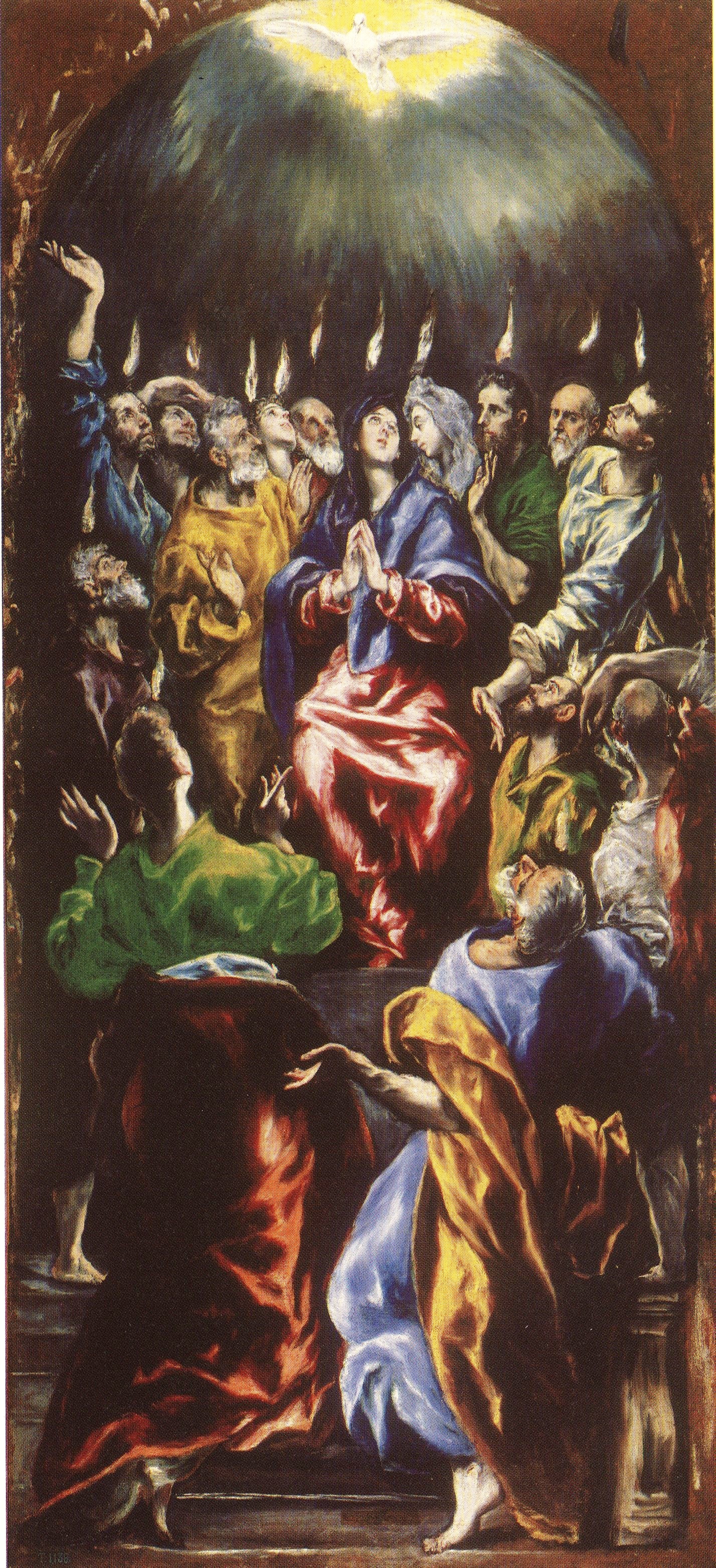
Wiki-image of ElGreco's Pentecost is in the public domain.

Friday, May 09, 2008

Communications Lessons Learned from the Papal Visit

In his weekly column Mr. John L. Allen Jr. considered what Pope Benedict's visit to the U.S. can teach those who communicate via mass-media.

As usual, Mr. Allen sheds light on many things. Accusations that the press is anti-Catholic are not true:

With regard to the press, the problem is not bias against Catholicism or religion, although one can find isolated cases. The real problem is that religion is not taken seriously as a news beat, which means that it does not draw the same systematic, daily coverage as politics, finance, sports and even entertainment. The secular press covers big religious events, in addition to controversy or scandal, but often ignores the daily warp and woof of religious life.
Read Mr. Allen's column to learn about what 83% of Catholics agree.

Monday, May 05, 2008

Monday word, 05 May 2008

Chester Lesinski funeral (05 May 2008) Ws 4. 7-15; Ps ; 1Jn 3.1-2; Mt 11. 25-30
Homily of Fr. Paul Panaretos, S.J.
Unbroken Bond

On behalf of Gesu Parish and personally, I extend our prayers and heartfelt sympathy to you, Dorothy, at the passing of your dear spouse; to you, Jim, Mary, Ann and Tom at the passing of your father. Your children grieve, too. I want all of you grandchildren to remember how much your grandfather loved you. It will be hard not to have your grandfather in your lives as you did; however, he will continue to be with you in different and new ways, which each of you will discover.

Ann and Stella, I do not yet know a sibling’s grief. I do know your grief for your brother, Chet, is unique, and I extend our prayers and heartfelt sympathy to you both.

The Catholic church bids farewell to a faithful and devoted friend of many years. I offer a few words to console and to strengthen each of you in your grief; to help you appreciate God’s astounding compassion by noticing that Jesus’ victorious dying and rising were present in the life of Chet and in you as well./1/

I want to begin by recalling a word: religion. Its root meaning means to bind. Many bonds affect us in our lives. We recall today the bond of 52 years that joined you, Dorothy, with Chet. Unlike some bonds, which constrain, your marriage union was one of love and opened you to each other and to your family. Family trips will always be memories, and the fact that you never employed baby-sitters is an accolade. They are but two examples of how your bond helped you become more flexible and free.

Sports, which was so prized by Chet, creates and deepens bonds between players and fans. I don’t know if Chet thought of it, but sporting allegories, which he used to teach his children, are very at home with religion’s root meaning. Religion was never out of fashion for Chet.

The bond our religion fashions is deeply personal. It is risen Jesus, who draws near to us and binds himself to us and us to him, and through him each of us to another.

Last year this month I visited Chet in the hospital and two weeks later at Hamlet Manor. Despite both his physical condition and being in unfamiliar surroundings, he was not as anxious as a person in similar circumstances could have been. Perhaps I was fortunate. I tend to think otherwise because, “he never complained,” Dorothy and Tom reassured me.
The bond forged by Jesus and by Chet’s family and friends has very practical effects on our daily living.

The Easter season reminds us of Jesus’ solemn promise: “I will not leave you orphans.”/2/ Chet experienced that fidelity of Jesus. It registered for him, especially in these last years, as comfort and easing of his burden of illness. Jesus drew and remained close to Chet through you his family.

The comforting bond of religion is no fiction. Nor is it unrelated to daily living. Chet knew that in his bones. He has passed that to you and desires many others to come to know that through his support of Catholic education. You extend his desire by binding Chet’s memory to the Fr. Dietz Scholarship Fund.

We take comfort that we are God’s children now. Jesus will reunite you with Chet with a bond that can never be broken. His love for you and your love for him preview that bond, which Jesus will forge forever.

___________________
/1/ Cf. Order of Christian Funerals 27.
/2/ John 14.18.

Sunday, May 04, 2008

Sunday word, 04May2008

Ascension (04 May 2008) Ac 1.1-11; Ps 47; Eph 1.17-23; Mt 28. 16-20
Homily of Fr. Paul Panaretos, S.J.
Nearer By Far


The Word of God became flesh when Jesus was born into our history. Heavenly messengers announced his birth. That seems to explain the shepherds’ response to the angels announcement: “Let us go, then, to Bethlehem to see this thing that has taken place, which the Lord has made known to us.”/1/ God’s nearness to us could not be any closer, could it? Or could it?

Throughout his time on earth, Jesus lived with great humility, a word that recalls the earth. Webster reminds us that if people are not “high and mighty,” then they are down to earth and near its people. Jesus’ modest means, his compassion, his dependence on others’ goodness and his remarkable silence before his accusers make Christlike humility a virtue. In Jesus, divinity couldn’t have drawn closer. Or could it?

By dying Jesus rose to his life unlimited by time and space. Risen Jesus appeared to his disciples in doubt, disbelief and paralyzing dismay before much, much joy. Surely Easter was a reunion: of God and humanity, of Jesus and his disciples! God could not have drawn closer; or could God have?

A silly question, someone may wonder. No, a most important question; indeed a crucial one. It’s crucial because anyone who wasn’t present at the birth of Jesus or intersected with his life or was not at his death or didn’t see him risen from the dead could not enjoy that divine closeness. That leaves out all of us and countless others.

Could these be reasons why the disciples stood there looking at the sky as Jesus disappeared from them: that they would no longer enjoy his company; that they reasoned no one else would enjoy it, either?

Perhaps at the moment they felt that way. However, trusting Jesus they went to Jerusalem to “stay in the city until they were clothed with power from on high.”/2/ His promise was his Holy Spirit. Holy Spirit was no ordinary clothing but power to be his witnesses in Jerusalem, throughout Judea and Samaria, and to the ends of the earth. Holy Spirit is power to learn him, power to teach him; power to baptize and make others part of Jesus, part of his body, part of the church, which is his body.

By departing, ascending, by being taken from his disciples’ sight and ours, Jesus makes himself our home. By departing, ascending, by being taken from his disciples’ sight and ours, Jesus makes himself our life. By departing, ascending, by being removed from our sight Jesus is closer to us than he was while on earth. By Holy Spirit, whom Jesus sent from his Father, God is nearer to us than we are to ourselves. So near to us is Jesus that our testimony to him in deed and word continues to make him present. Jesus’ Spirit, God’s power, makes us agents of God’s reign, which continues to dawn in human history.

Being agents of the God’s reign expresses Jesus’ solemn promise to his disciples before his ascension: Amen, amen, I say to you, whoever believes in me will do the works that I do, and will do greater ones than these, because I am going to the Father. Making Jesus known and making others part of Jesus, part of his body, the church are among the greater works.

We abide in Jesus, our home on earth, through prayer and the sacraments, most frequently the Sacrament of his Body and Blood. We Catholics bring people into Jesus, into the church. We rejoice over our Neophytes, baptized and confirmed at the Easter Vigil.

You inspire us; you remind us of our purpose and of our responsibility/4/ to be loving ministers of Christian initiation, and to make disciples of all nations With you Jesus sends us to be his witnesses, to make him more clearly known and felt. Each mass commissions us to go forth in his name empowered by Holy Spirit to transform our world, beginning with ourselves. We are leaven of the world. Christian daily living works the world like hands kneading dough so that its leaven will spread throughout it. The disciples at the ascension remind us to keep working, to keep transforming our world by our greatest and graced means we have, his Holy Spirit.

In your daily 15 minutes with Jesus this week begin in the presence of the Trinity, who creates you with your gifts and your purpose. Ask the disciples to present you to Jesus so that you may converse with him. Praise Jesus for empowering you with his Spirit to make him better known by your daily living. Speak with Jesus about how you follow him and how you can be his his better witness. Close by saying slowly the prayer Jesus taught us. It unites us with the heart of Jesus and makes us more powerful leaven to transform our world.
______________
/1/ Luke 2.15.
/2/ Luke 24.49.
/3/ John 14.12.
/4/ Rite of Christian Initiation of Adults, 9.
____________________________________________________________________________________
Wiki-images of Garofalo's Ascension and of Christ in majesty are in the public domain.

Monday, April 28, 2008

Monday word, 28 Apr 2008

Easter Monday6 (28 Apr 2008) Ac 16. 11-15; Ps 149; Jn 15.26-16.4a
Homily of Fr. Paul Panaretos, S.J.
Intimate Give and Take

We intuitively appreciate the difference between knowing a fact and knowing someone or knowing contentment, anguish, disease, peace, forgiveness and the like. In the first we know about something. In the second we know because of the effects on us of a person, contentment, anguish, disease, peace, and forgiveness. In the original languages of the bible, the verb “to know” functions that way.

In the Fourth Gospel Jesus spoke with his disciples at great length about knowing God. God is no object with quantities to be known and recorded in a data book. God is our Creator, who desires a relationship with us, as Jesus made known in his own person. Relation-ship-knowledge affects us. We know God by God’s affects on us.

St. Ignatius Loyola had a phrase we have come to know and use: “to find God in all things.” It is relational. We know when we find God in daily experiences by the affects on us; how our hearts are opened, like the listener Lydia’s was; how our sense of purpose is refreshed; and by the actions which promote our relationship with God among others.

The knowledge we have of one another demands the we sustain our relationships, which is always a two-way street, intimate give and take. Jesus gives us his Spirit. Prayer and action on flowing from the values and examples of the gospel and the countless holy ones who have gone before us show us our part and encourage us not to fall away but to enjoy God’s life beginning now.
______________________________________________________________
Wiki-image of St. Ignatius by Pierre Lopez is used according to the Creative Commons Attribution-Share Alike 3.0 Unported license.

Sunday, April 27, 2008

Sunday word, 27 Apr 2008

Easter Sunday6 (27 Apr 2008) Ac 8.5-8,14-17; Ps 66; 1Pt 3.15-18; Jn 14. 15-21
Homily of Fr. Paul Panaretos, S.J.
From 1st to 21st Century

The daily ministry of the first apostles involved preaching, that is, announcing risen Jesus to others by telling how they experienced him from the days he chose them to after his resurrection. They announced their word to unbelievers in the Temple and they nurtured the word among believers at table.

However, their world of 1st-century Palestine divided genders strictly. Discussion among men took place in public spaces. Women spoke in homes and in places where they gathered, for example, to get water for their homes or washed clothes. They also ate separately: men with boys older than puberty; and women with girls and all boys younger than the age of puberty. The apostles’ solution was to deputize other ministers of the word--deacons--who could go to other places than the temple to make known risen Jesus. We come upon one of them, Philip, who left Jerusalem for nearby Samaria.

The activity was centered first in Jerusalem, as Jesus had told the apostles, “wait for the promise of the Father about which you have heard me speak...you will receive power when the holy Spirit comes upon you, and you will be my witnesses in Jerusalem, throughout Judea and Samaria, and to the ends of the earth.”/1/

Empowered by Holy Spirit, Philip was extraordinarily successful. This agent of Jesus’ Spirit visited the age-old enemies of the people of Judaea and proclaimed the risen Jesus. They were persuaded by his preaching and they were convinced by the signs he was doing. Jesus told the apostles that they would do greater works than him. Jesus convinced a Samaritan woman, but Philip convinced an entire Samaritan city!

The outward movement from Jerusalem, throughout Judea and Samaria, and to the ends of the earth gave birth to church and validated Jesus’ words that his followers would do greater works than he did. Pope Benedict reminded us on his visit to the United States that “increased fraternity and solidarity, a growth in mutual respect, and a renewed trust and confidence in God, our heavenly Father” are the shape these greater works have in our times./2/

Agents of Jesus’ Holy Spirit increase “fraternity and solidarity; they cultivate growth in mutual respect” as they allow Holy Spirit to work through them. While we are crucial in advancing
the gospel, Holy Spirit works through all people of good will.

Holy Spirit is not confined to our rituals nor do they control Holy Spirit. Fellowship with the apostles guaranteed that. Hence those lines are not at all insignificant: ...when the apostles in Jerusalem heard that Samaria had accepted the word of God, they sent them Peter and John, who went down and prayed for them, that they might receive the Holy Spirit, for it had not yet fallen upon any of them; they had only been baptized in the name of the Lord Jesus. [Peter and John] laid hands on them and they received the Holy Spirit. Their hand-laying symbolized the believer’s communion.

The Greek word we translate with fallen means that Holy Spirit takes possession of us, and we are inspired and impelled by Holy Spirit. Holy Spirit continues to use our humanity, to heal our limitations, to clarify our vision and to renew our “trust and confidence in God, our heavenly Father” and risen Jesus, who are the source of Holy Spirit. Sometimes we emphasize our humanity over the Spirit’s gifts. The Spirit’s gifts work through and enhance our humanity.

Our parish discernment, years in planning, to renovate our buildings calls us to be more confident agent’s of Holy Spirit. “We believe that, as a Spirit-filled community we must promote the spiritual, liturgical, evangelical educational and ecumenical growth of our family of faith. We pledge ourselves to bring God’s Word to the world in which we live and to enliven”/3/ it. Those words of our parish Mission Statement echo the life and work of Philip. They echo Jesus’ promise that his Spirit of truth is with us always. University Heights is not hostile territory; it does need our efforts and support to bring ourselves and the gospel into the 21st century.

In your daily 15 minutes with Jesus this week, let go your anxieties and concerns in the presence of the Trinity, who creates you at each moment with love. Ask for the grace to see with fresh vision and to feel with stronger devotion your “renewed trust and confidence in God.” Ask God to place you with Jesus. Converse with Jesus about your solidarity with him and with your sister- and brother parishioners so that you may give clearer witness to his gospel and help Gesu parish to do the same. Close by saying slowly the Lord’s Prayer. Saying it reminds us that we both announce and promote the kingdom to come.
_____________
1. Acts 1.4-8
2. Farewell Ceremony, John Fitzgerald Kennedy International Airport, New York, 20 April 2008.
3. Gesu Parish Mission Statement printed on the cover of each weekly bulletin.

______________________________________________
Wiki-image of icon of St. Philip is in the public domain.

Friday, April 25, 2008

The story behind the pope's meeting with sex abuse victims

John L. Allen Jr. describes in his weekly column how Pope Benedict's meeting with some sex abuse survivors came to happen.

Don't miss the section, "Opposition," because the pope decided differently from other officials int the church. In the following section ("Signifance"), Mr. Allen noted that "Benedict has set a new standard for candor." The pope squarely faced insitutional innertia--always a powerful force--and moved it despite that force.

Sunday, April 20, 2008

Sunday word, 20 Apr 2008

Easter Sunday5 (20 Apr 2008) Ac 6. 1-7; Ps 33; 1Pt 2.4-9; Jn 14. 1-12
Homily of Fr. Paul Panaretos, S.J.
Before and After

The season of Easter allows us to savor Jesus’ new presence with his apostles and also with us. Jesus was straightforward about his promise: I will take you to myself, that where I am you may also be. Because the first half of today’s gospel is frequently selected for funerals, that and daily experience suggest two questions: Is this being-with-Jesus now? Or, is it after our deaths? The answer is, “Yes!” to both.

To us, limited to time and space, imagining risen Jesus as absolutely unlimited so that he is present at each moment does not come readily. Yet Jesus continually taught, touched and tarried with people in powerful ways that appealed more to imagination, heart and depth of feelings than to what we may call head knowledge. Intellect is important, but intellect shaped by feeling, heart and soul is more important. When we allow Jesus to shape our feeling, heart and soul, our knowing becomes more humane and truly Christian.

Jesus was a real person who lived at a real time and in real places we locate on maps: Palestine; Judaea; Jerusalem; the Upper Room. The Fourth Gospel offers a more important, more real geography centered on God. It named its coordinates: the world and the house of Jesus’ Father; below and above; dark and light; death and life. Jesus, in today’s scene, announced another coordinate: I am going to the Father, which is light years removed from where his opponents refused to leave; or in Jesus’ earlier words to them: Where I am going you cannot come.

Of course maps, like treasure maps or trip-tiks, are not the point. Jesus invites us beyond the confines of maps and encourages us to adopt a way of thinking and imagining both the world and his Father’s house, to which Jesus welcomes his faithful disciples; imagining both our limited existence here and now and Jesus with his Father, prepar[ing] a place for us with him.

Jesus’ risen life welcomes us into his relationship with God, whom he called his Father. Relationship is key. Jesus focused relationships forever: Jesus’ relation with God, whom he called Father; with the world--grand symbol of opposition to God’s abode; with his disciples--his family not limited or defined by blood or ethnicity.

Jesus’ relationship and prayer with his disciples took place at two moments: before his resurrection and after it. Before his glorious resurrection his disciples had limited understanding of Jesus and his words. Their imagination was not supple; it was earthbound: shadows shrouded it; and death seemed the bitter end. After his glorification their imagination soared; their memories of his words were clear; their broken hearts were healed; and they recognized him present in the power of his Spirit, who Jesus breathed on them.

Those coordinates of the world; below; dark and death did not vanish. The disciples were acutely aware that more than those existed. Places Jesus was preparing for them; above; light; and his risen life, unlimited and unending, were not only theirs. Jesus’ risen life set them on mission to communicate that life to others and to be channels to others of his gift to them of himself and his Spirit.

During Easter hearing the Acts of the Apostles, the portrait of the beginning church discovering its sense of self and mission, reminds us that Jesus’ self-gift to us of himself and his Spirit 1) shape our way of thinking and 2) encourages us to deepen our relationship with our Creator and Redeemer so that we can communicate our Creator and Redeemer to others. Healthy communication--in speech; friendship; mutual support; faith sharing; sharing resources--helps us find God more easily, hear God more clearly and follow God’s lead more readily. That is each one’s mission. It also is helps us bring others into Jesus’ presence here and now.

In your daily 15 minutes with Jesus this week, first enter into the more real coordinates of the Trinity, creating you in love, calling you friend, and empowering you with Jesus’ Spirit. Ask the disciples to present you to Jesus so that you may converse with Jesus. Name the gifts with which Jesus has blessed you, and tell Jesus how you use them and how you can use them better. Using our gifts better to build up others is our loving response to God who creates us, redeems us and glorifies us at each moment. Close your 15 minutes by saying slowly the Lord’s Prayer, which both keeps us in God’s presence and guides us on our mission which Jesus began by rising from the dead.

____________________________________________________________________________________
Wiki-images of Jesus and the apostles in Tiffany glass and of El Greco's Resurrection are in the public domain.

Tuesday, April 15, 2008

Virtual March Today

Catholic Charities USA has organized a virtual march on Washington. Our emails allow us to join the "Catholic Charities directors from communities across the country...in Washington, D.C., [today] to meet with legislators about poverty in our nation and what Congress must do to address it."

Today, Join our Virtual March on Washington!

Take Action!


action alert

WHAT: In the coming days, Congress will make important decisions on key programs that support low-income and vulnerable families. They must determine funding for programs that provide health care, home energy assistance, and child care assistance. They must make needed improvements to Food Stamps and other nutrition programs as they reauthorize the Farm Bill. They must also address the current housing crisis and economic downturn which threatens individuals and families across the country.

WHY A VIRTUAL MARCH? Catholic Charities directors from communities across the country will be in Washington, D.C on April 15th to meet with legislators about poverty in our nation and what Congress must do to address it. That day, Catholic Charities USA will also host a Congressional briefing on the "Needs of Young Americans: Strategies to Reduce Poverty".

You can join us! Lend your voice and amplify the message to Congress about our common priorities by taking action TODAY!

ACTION NEEDED: Starting TODAY, click on “Take Action” and enter your zip code for a sample letter that you can customize and ask your legislators to support vulnerable children and families in America.


Monday, April 14, 2008

What Does the Pope Know About. . .

. . .the United States? Plenty!

Mr. John L. Allen Jr. distills several points in his weekly column of last Friday. In that column Mr. Allen offered "various reflections on the United States offered by Joseph Ratzinger over the years, much of which dates from the period before his election to the papacy."

Sunday, April 13, 2008

Sunday word, 13 Apr 2008

Easter Sunday4 (13 Apr 2008) Ac 2. 14a,36-41; Ps 23; 1Pt 2.20b-25; Jn 10. 1-10
Homily of Fr. Paul Panaretos, S.J.
Plural Patterns of Our Single Vocation


Pope Paul VI, 45 years ago, dedicated “Good Shepherd Sunday,” the fourth Sunday of the Easter season each year, to Vocation. I want to reflect with you on our singular vocation and ask you to become more alert to its variety: our single vocation and its plural patterns.

My mother and my father, when he was alive, always were free with my sister and me this way: they encouraged us to be ourselves; to seek what would fulfill us and give us meaning. Elaine is a teacher, which she wanted to be as long as I can remember. I wanted to be a priest as long as I can remember. In our respective roles, Elaine and I share several things: responding to others’ needs; helping people to shape their lives; being aware of individual strengths and weaknesses; respecting each person; extending genuine care and concern; mindful and observant of boundaries.

Discovering one’s way of living God’s universal call to all of us to be holy as God is holy means to discern one’s vocation, to see with our inmost eyes the particular gifts God desires to give us so that we may begin to save []ourselves. The most famous psalm, which we once more made our own response, expressed this gift of the Holy Spirit as a way, a style, a manner of living: Only goodness and kindness follow me all the days of my life; and I shall dwell in the house of the Lord for years to come.

To discover the concrete, individual ways to live the universal vocation to holiness is above all to respond to God’s gift for you. A person’s response doesn’t follow a straight line. My sister began as an elementary teacher then was asked to be a school’s special education person. After many years she taught fifth graders before retiring almost three years ago.

Between my college seminary and graduate seminary studies I was a research assistant to the chief of Infectious Diseases at a large city’s general hospital. God gifted me in many ways in my interim job--work experience, managing my own housing and finances, exploring celibacy from the angle of rest and relationship, to name a few. The happiest day of my life was my ordination as a priest of the Archdiocese of Detroit 23 years ago. I thought I’d be buried with all the archdiocesan priests after a life which rewarded me greatly. Professing my first vows as a Jesuit, 12 years after my ordination, crowned the happiest day of my life.

My life has not been without challenges and desolate experiences. My father died in 2001, and I am making a long goodbye to my mother, who has Alzheimer’s. My Jesuit brothers, friends and you are most supportive.

To each of you I encourage you to be yourself. Be grateful for your abilities and gifts, and acknowledge your limitations. Limitations acknowledged and shared with people you respect and trust, and who respect and trust you, open onto opportunities. Ask yourself: how can I grow more grateful for who I am, what I have and how Jesus stands with me so that [I] may have life and have it more abundantly?

To each parent I encourage you to desire your children’s happy fulfillment in holiness-- whatever expression it may be, especially to build up others, to be a man or woman for others. That seems more difficult to desire for children today.

To each of you living out your vocation to holiness in marriage, in widowhood, as a single person, I encourage you be alert to Jesus’ Spirit prompting you. Jesus’ Spirit prompts us all. Be alert to how others’ lives encourage your own manner of vocation and calls you to love more.

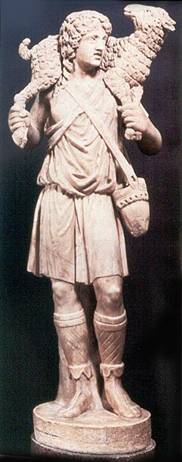
Jesus is our model of selfless love. The Good Shepherd is among the most ancient images of our risen Jesus, in whom each of us has already died and been raised in the waters of baptism.

In your 15 minutes with Jesus this week praise Jesus for his selfless love of you. Ask for the grace to deepen your personal vocation. Speak with Jesus about what gives you meaning and about what challenges you to live as his friend and follower. Close by saying slowly the Lord’s Prayer, which empowers us to live more authentically and to welcome with more open hands, heart, mind and soul the holiness of God, who creates us one moment at a time.
______________________________________________
Wiki-image of the Vatican Museum's Good Shepherd is in the public domain. Wiki-image of photo of Sunlight Through Leaves
by Hana Kirana is used according to the Creative Commons Attribution 2.0 license.

Saturday, April 12, 2008

Video To Welcome Pope

Francis Cardinal George of Chicago has welcomed Pope Benedict with a video posted on YouTube.

Thursday, April 10, 2008

Papal Ambassador to the U.S. on Pope's Visit

Mr. John L. Allen Jr. spoke with Archbishop Sambi, the papal nuncio to the United States. Archbishop Sambi's responses to Mr. Allen's questions illuminate the upcoming visit of Pope Benedict.

Their exchange revealed
In terms of news flashes, one intriguing bit from the Sambi interview is that he left the door slightly open for a private encounter between the pope and victims of sexual abuse while he's in America, saying only that it's "within the field of possibility." He also asserted that speculation about Benedict reading the riot act to Catholic educators during an April 18 session at the Catholic University of America amounts to "instrumentalization" of the pope by American Catholics with theological or political axes to grind.

"The problem is that there are too many people here who would like to be the pope," Sambi sighed, "and who attribute to themselves a strong sense of their own infallibility."

Sambi's trademark sense of humor flashed at other points, such as when I asked if he has personally briefed the boss in preparation for the visit. Smiling, Sambi replied: "I'm not paid to sit here and do nothing!"
Read more of their conversation.