Sunday, June 11, 2017

Trinity Sunday word 11Jun 17

Solemnity of the Most Holy Trinity A (11 June 2017)
Homily of Fr. Paul Panaretos, S.J.
Living Yearning
During enjoyable moments who asks what do they mean? The joy we experienced satisfies us. We feel no need to look beyond our joy: it absorbs us within it. This absorbing is proper human. Usually we consider only a certain few get so absorbed to be united in qualities such as joy or with another person, with God. We name them mystics.

Most significant for them—and everyone’s mystic moments—is this: they sense no distinction between them and, say, their joy; between them and another. Words cannot express their experience; yet mystics try to express it for us. Julian of Norwich was one.

Julian enjoyed revelations—Showings, she named them—of the Trinity and our participation among the triune God.
It is a lofty understanding inwardly to see and to know that God, who is our maker, dwells in our soul, and it is a still loftier and greater understanding inwardly to see and to know that our soul, which is created, dwells in God’s substance. From this substance we are what we are, by God.
She experienced mutual indwelling:
I saw no difference between God and our [human self], but saw it as if it were all God. And yet my understanding accepted the fact that…God is God and our [human self] is a creature in God. For the Almighty Truth of the Trinity is our Father, for he made us and preserves us in himself; the deep wisdom of the Trinity is our mother, in whom we are enclosed; the lofty goodness of the Trinity is our Lord, and in him we are enclosed and he in us.
We are enclosed in the Father, we are enclosed in the Son, and we are enclosed in the Holy Spirit. The Father is enclosed in us—All-power, All-wisdom, and All-goodness: one God, one Lord.1 
This indwelling participation in our triune God is not easy to take. The unlimited “is enclosed in us!” We easily fear losing ourselves, our personal power. Let mystics enjoy this and keep it to themselves: it’s too much for the rest of us! Yet we Christians are who we are because we profess unlimited divinity was enclosed in a woman’s womb and was born for us. In Jesus God united human life with divine life. Matching our profession to our deeds and choices is how we Christians witness to one another and our world.

All this is living mystery. Julian’s efforts to express her showings means none of this is abstract meaning. Our Christian mystery registers as power—we participate in All-power; it registers as wisdom—we participate in All-wisdom; it register as human kindness—we participate in All-goodness. St. Paul enumerated other fruits: love, joy, peace, patience, kindness, generosity, faithfulness, gentleness, self-control.2 These Spirit-fruits are gifts: ours because we participate in the passion, dying and rising of Jesus each moment.3
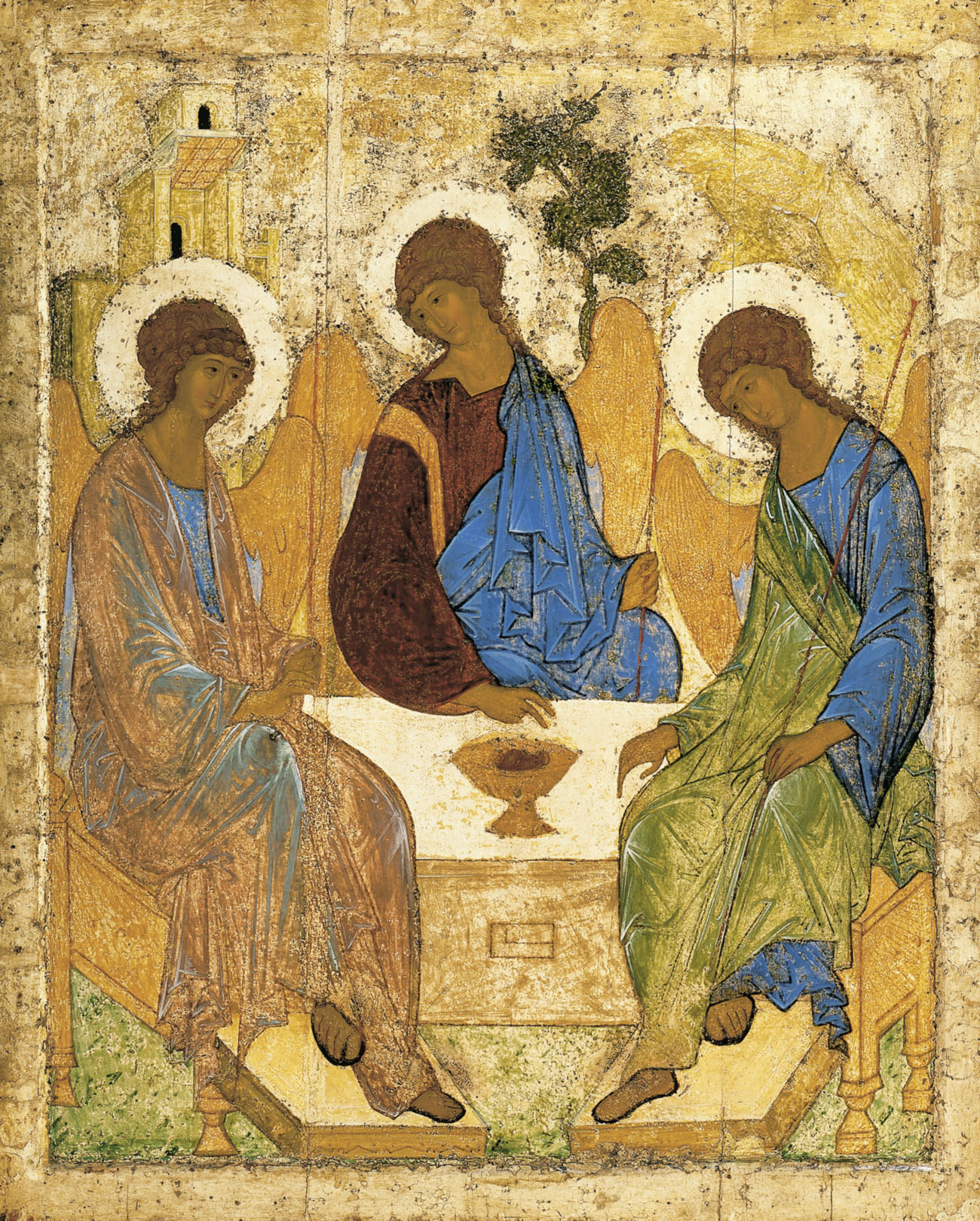
Does a down-to-earth outcome of this participation in the triune Creator exist? Pope Francis is adamant that this is it: “Everything is interconnected, and this invites us to develop a spirituality of that global solidarity which flows from the mystery of the Trinity.”4 Because “everything is interconnected…genuine care for our own lives and our relationships with nature is inseparable from fraternity, justice and faithfulness to others.”5

Perhaps this a grace for us sophisticated, technological folk to yearn: that we may be overcome with joy that we are included within God—a joy that does not overwhelm us but moves us to let our thoughts, choices and actions be done in and with God. The world will be transformed more as we live what we yearn.

In your daily 15 minutes with Jesus this week
  • Rest in our triune God.
  • Ask Mary and the communion of saints to present you to Jesus.
  • Chat with him: praise him for dying, rising and giving us his Spirit; ask Jesus to help you experience we live in him as his witnesses to our world.
  • Ask Jesus for grace to be overcome with his joy because we are included within God.
  • Close saying slowly the Lord’s Prayer. Jesus gave us his  prayer to help our relationship with our Creator grow and to welcome others into it.


Link to this homily’s Spiritual Exercise


——————
  1. Revelations of Divine Love in Sixteen Shewings, 54. The revealer to Julian was “Jesus Christ, our endless bliss” (1).
  2. Galatians 5.22-23.
  3. Galatians 2.19; Romans 6.6, 8-11.
  4. Laudato Si, 240.
  5. Laudato Si, 70.
____________

Sunday, June 04, 2017

Pentecost word, 04Jun17

Pentecost (04 Jun 2017)
Homily of Fr. Paul Panaretos, S.J.
Filling Gift
A popular story has circulated to illustrate important things, less important and least important things in one’s life. Its moral urges: focus on most important things contributes to a meaningful life. The story’s essentials are a professor, students, a jar, rocks, pebbles and sand. Here’s my adaptation.

A professor enters a classroom and sets a large jar on a table before them. Silently the professor places two-inch rocks in the jar until no more can fit. “Is the jar full, class?” The students agree it is full.

The professor proceeds to add pebbles and shakes the jar so the pebbles fill the spaces between the rocks. “Is the jar full, class?” Some students agree it is full. The professor proceeds to add sand; it fills the spaces between the pebbles.

“Consider, class, that this jar is your life. The rocks are what is more important in it—all you’ll value at the end of your life: family; friends; health; fulfilling your hopes and dreams. The pebbles other things that offer you meaning: learning; your job; house; hobbies; colleagues and acquaintances. The sand represents everything else, the ‘small stuff.’ If you focus all your energy on material things and other small stuff, you will not make room for what is most important, meaningful and life-giving.1

Today’s mystery urges us to reverse the story’s obvious logic of what we perceive as large equals most important. By whatever approach we use to enter Pentecost this remains: Holy Spirit is God’s gift; it fills our inmost being and animates our lives. Take the more familiar approach we heard from the Acts of the Apostles. After 50 days Risen Jesus’ presence and power registered as a noise like a strong driving wind, tongues as of fire, and once-timid disciples boldly announcing Jesus in speech that all understood and deeds strongly felt.

Another expression of the gift of the Spirit is more mysterious and personal: On the evening [Jesus rose from the dead]…that first day of the week…Jesus breathed on them and said to them,“Receive the Holy Spirit.” Its accompanying power is power to forgive. Not only is it sacramental power; it includes the power every Christian prays for in the Lord’s Prayer: to forgive as we are forgiven.
This Spirit-power is not earned, is nothing I reach. Rather, the Spirit who is God’s love has been poured into our hearts through the Holy Spirit who has been given to us…while we were still weak.2

Filled by and with the Spirit is often subtle and always intrinsic, innate to us. Our baptism makes Jesus’ Spirit inseparable from us and gives us power to discern. The Letter to the Hebrews imagined the mysterious Spirit-power—finer than the sand in the professor’s valuable story and not taking up space—with its vivid image: Holy Spirit uttered by every word of God is living and effective, sharper than any two-edged sword, cutting through so as to divide soul from spirit, joints from marrow. It is even able to discern the thoughts and deliberations of the heart.3

What might Pentecost offer us today? It invites us to surrender more to risen Jesus’ personal gift. The disciples did not labor to figure out what happened to them when Jesus’ Spirit filled them. They recognized Jesus had baptized them with his presence and power as he had promised4; and they let themselves by intoxicated by it with astonishing effect. Not toxic, Holy Spirit is life. Even more valuable: Jesus’ Spirit is the antidote to the pressures the world exerts; to the violence humans afflict on one another and creation; and to all that subverts life’s meaning and vitality. So none of us miss the obvious: receiving and living risen Jesus’ personal gift of his Spirit empowers us to share it so through us risen Jesus may continue to renew the face of our earth.

Link to this homily’s Spiritual Exercise
___________
  1. One adaptation includes water. Others are animated.
  2. Romans 5.5-6a.
  3. Hebrews 4.12.
  4. Acts 1.5.
____________
Wiki-image The Descent of the Holy Spirit PD-US Christian Logo CorNexus com CC0 1.0

Monday, May 29, 2017

Memorial Day Challenges

The title given the column commands attention: “Memorial Day needs more war stories.” It rides atop Michael Garvey’s reflections for today in U.S. Catholic. Three challenges offer themselves: 1) to enter the stories—the columnists or one’s own—and not take sides; 2) to be touched by an element of a story; and 3) to read with an eye to seeing oneself. Feeling the power of a story is easier than inhabiting a story so it’s power can transform.
___________________
Wiki-image by Metropolitan Transportation Authority of the State of New York of Memorial Day Flag Folding CC BY 2.0

Sunday, May 28, 2017

Sunday word, 28 May 17

Ascension Sunday A (28 May 2017)
Homily of Fr. Paul Panaretos, S.J., on 8-day and Soil and Soul retreats
Befriending People and Our Earth
I easily forget two things: the Ascension of Jesus is about us as well as Jesus; his Ascension was not the first leave-taking Scripture offers. Scripture contains other leave-takings in which people be-gan anew, announced God’s desires and fulfilled their lives. One example was Moses: his dying allowed Joshua to succeed him.1 Another was Elijah: he was taken up into heaven2 so his protege, Elisha, could receive a double portion of his mentor’s prophetic spirit.3 God’s spirit empowered Joshua and Elisha after their mentors left them. Likewise, Jesus’ successors received the fullness of his Spirit when he ascended.

Even when a gift is given leave-takings are difficult. That’s why we sympathize with the disciples gazing heavenward, looking intently...as Jesus was lifted up...from their sight. Because we know how their mission would unfold—that they would continue Jesus’ work—the angel’s question feels appropriate: Men of Galilee, why do you stand looking at the sky? The angelic question propelled the disciples to prepare for their mission to proclaim Jesus as Messiah—to continue what Jesus had begun.

The angel’s question reminds me the Ascension of Jesus is about us as well as Jesus: we are the contemporary successors of Jesus’ first followers. Someone may object, How can we succeed his first followers when we never saw, heard and walked with Jesus as they did? That’s my temptation, too. Physical presence isn’t everything. Jesus’ physical presence made him available only to those immediately with him in space and time. Entering God’s presence—what ascension tries to convey—risen Jesus “began to be indescribably more present in his divinity to those from whom he was further removed in his humanity.”4 Those words of an early pastor echo our faith-conviction that physical presence isn’t everything. The same truth—Jesus is “indescribably more present in his divinity” to us who never have known the human Jesus—encourages us to let risen and ascended Jesus free and empower us to fulfill our lives as stewards of the earth and friends of everyone.  To celebrate Jesus’ Ascension on retreat invites us to be freshly aware of the way his Spirit reassures us and refashions us as risen Jesus’ witnesses in our time where we live.

Link to this homily’s Spiritual Exercise

___________

  1. Deuteronomy 34.9.
  2. 2 Kings 2.1; 11-13.
  3. 2 Kings 2.9-12.
  4. His Sermon 2, 1-4 on the Ascension of the Lord Jesus Christ.
____________

Monday, May 15, 2017

International Day of Families

Today is the 24th UN-proclaimed day focusing attention on the family. Its theme this year is “Families, education and well-being.” Jesuit Nicholas Austin noted that Pope Francis’ exhortation, Amoris Laetitia, is “a word of encouragement…and above all another example of the discerning way of proceeding that the pope has modelled.’    
___________________
Wiki-image by takato marui of Šternberg Family Tree CC BY-SA 2.0

Sunday, May 07, 2017

Sunday word, 07 May 2017


Easter Sunday4 A (07 May 2017)
Homily of Fr. Paul Panaretos, S.J.
Smart Culture
Recent research offers surprises about sheep. Pondering the research as one living by faith deepens one of Pope Francis’ very frequent word-images. First, the research.

The myth that sheep are dumb has long infected us. As a result many are surprised to hear that Jesus’ words—the shepherd calls his own sheep by name and leads them—was recognized by those who first heard him. Sheep of different flocks were often kept in a common sheepfold. Several Palestinian shepherds could call their sheep, sheep would go to specific shepherds.

Recent studies have indicated sheep recognize faces as well as voices: sheep recognize human faces as well as faces of other sheep!1 Vision and hearing—and intelligence, too! Yes, someone ex-plored that. “She discovered that sheep can learn how to navigate out of a complex maze. The en-ticing sight of their fellow sheep friends awaiting them at the finish helped them reach the exit.”2 The animal we may have thought to be dumb is smarter than we thought.

This new information deepened my appreciation for the oft’-repeated phrase on the lips of Pope Francis: “personal encounter.” His namesake, Francis of Assisi, had a personal encounter with its Sultan. Pope Francis visited Egypt late last month because he desires a personal encounter with Islam.3 Francis continues to do as he speaks. He is convinced that these encounters are for us and not leaders only. For Francis personal encounter is a culture: “If we do good to others, if we meet there, doing good, and we go slowly, gently, little by little, we will make that culture of encounter.”4 

Disciples of Jesus are intelligent and offer much to the church and the world. We leaders who serve you ought to be heartened by your wisdom and energy. Helping one another see the face of Jesus in each other and in every other person and remember him is how we all reach “slowly, gently, little by little…that culture of encounter.” Doing good together participates in God’s culture entrusted to us, the Incarnation: divine becoming human and human becoming divine. For exactly this Jesus died, rose and offers us his Spirit every moment.

When we help each other see Jesus we help each other see the honourable one: Jesus was no  villain. The more we look to Jesus the more we share his honour; we become people of honour: we honour others and help them grow that way—all of us doing good. Coming to live together in the presence of God happens over many lifetimes of doing good together. Living together in the presence of God is God’s gift to humans, the gift for which we long.

In your daily 15 minutes with Jesus this week

  • Rest in our triune God.
  • Invite the communion of saints to present you to Our Good Shepherd.
  • Chat with him: praise him for dying and rising for us; thank him for modelling doing good and looking out for everyone.
  • Ask Jesus for grace to help us look out for others.
  • Close saying slowly the Lord’s Prayer. Hallowing God’s name is more than praying; it deepens our reverence for others and for ourselves.
Link to this homily’s Spiritual Exercise
____________
  1. This BBC piece contains links to related news and research.
  2. Quoted in the same BBC piece above.
  3. One example of many who recalled that moment.
  4. From a weekday homily on salvation and Jesus’ insistence that his disciples ought not stop anyone from doing good in his name. The homily gathered international attention. The pope’s words and one helpful comment.
____________

Wednesday, May 03, 2017

99%

Three hundred undersea cables transmit nearly all internet data. Business Insider produced a two-minute video depicting the routes of the cables and their stopping points. A standout stat: laying a single cable “takes several months & costs hundreds of million dollars.”

Friday, April 28, 2017

Risk

The Eighth Amendment of the U.S. Constitution protects citizens from “cruel and unusual punishment.” The amendment figures in the nation’s debate over executing prisoners. One drug used in chemical execution has proven risky, yet some prisons continue using it. The Washington Post reported one state has rushed to use up its supply before it expires. To rush collides with constitutional protection.
___________________
Wiki-image by Politikaner of beveled needle tip CC BY-SA 3.0

Thursday, April 27, 2017

Talk, Tenderness, Trip

Pope Francis is the first pope to have offered a TED talk. The talk is a first, but its focus was all Francis: he “called for more tenderness in the world.”


His visit tomorrow to Egypt is his tender care for the Christians living there and experiencing persecution. The Copts experienced it as Holy Week began.


Tuesday, April 25, 2017

Widening Circle of Concern

Pope Francis’ concern for vulnerable people is well known. Last summer he merged four councils concerned for social justice and human wellbeing into one Vatican department. The department also will help local churches (dioceses) “offer appropriate material and spiritual assistance” to vulnerable people.
___________________
Washers and dryers in the new ‘Pope Francis Laundry,’ established for the homeless in Rome. (Credit: L’Osservatore Romano.)

Tuesday, April 18, 2017

Education, Retreat, Transformation

Tweeted by U.S. Catholic:
“My Jesuit education transformed my life and…I truly believe I have been prepared to lead an extraordinary life with the education that can only be offered at a Jesuit school.”
___________________
Wiki-image by Amerique CC BY 3.0

Sunday, April 16, 2017

Sunday word: Same Day

Orthodox and Catholics celebrate the Resurrection of Jesus on the same day this year. John Chrysostom—saint for both—proclaimed a homily that echoes to this day. Its invitation is timeless.
___________________
Wiki-image © Guillaume Piolle CC BY 3.0

Friday, April 14, 2017

Good Friday word, 14 Apr 17

Good Friday (14 Apr 2017)
Homily of Fr. Paul Panaretos, S.J., Holy Week Retreat, Guelph, ON
“Lightening Marks”

The Passion According to John makes its point: Jesus’ cross wasn’t only an instrument of his shameful torture and death; his cross was the throne of our King’s glory. The gospel’s conviction is no solution: the notions, shame and glory, collide in our minds; our hearts tremble as we try to hold together dying by public asphyxiation and undying presence with God.

Yet Christians remind one another that Jesus’ dying into God’s undying presence calls us not to ignore any suffering and death and to look through human anguish to life. So this vision can be our ever-new vision, Jesus’ cross is our lens. Can we better appreciate Jesus’ cross? venerate it? carry it? A contemporary writer offered a useful image.

Annie Dillard wrote: American “Indians…used to carve long grooves along the wooden shafts of their arrows. They called the grooves ‘lightning marks,’ because they resembled the curved fissures lightning slices down the trunks of trees. The function of lightning marks is this: if the arrow fails to kill the game, blood from a deep wound will channel along the lightning mark, streak down the arrow shaft, and splatter to the ground, laying a trail dripped on broadleaves, on stones, that the barefoot and trembling archer can follow into whatever deep or rare wilderness it leads.”1

Her image helps me see with Jesus. We see lightning marks of other kinds surround us. Lives scarred by suffering and death scar us and cut us deeply. Blood is poured out in numerous places near and far. The cries of the poor and oppressed, and our affirmation of them in deed as well as prayer, call beyond anguish and despair.

Calls beyond ourselves received clear voice from the cross and its mystery. Can we not say the cross of Jesus is the lightning mark of God? Might this be what you and I seek? Holding the cross, bearing our crosses we see ourselves anew: we realize each of us is “the barefoot and trembling archer,” who follows the trail through life’s wilderness to find the very heart of God. Jesus’ cross graces us with his divine spirit and pioneering love. His pioneering love dots the trails of our lives; it trains us and forms us as God’s scouts. 

Trained scouts see what others overlook. God’s scouts note each dot, each drop of blood calls, ‘God loves forever.’ By God’s forever-love God reaches into and beyond the grave. God reaches into and beyond each valley of death that veils from sight the attitude of Christ.2 God reaches into and beyond every setback that prevents us from putting on the attitude of Christ. God’s forever-love alive in us frees us to be “forgetful of self in…generous and ready service of all the abandoned.”3 

Jesus’ attitude frees us to forget self more consistently. His attitude makes no human sense when we forget he nurtured intimate relationship with God: Jesus lived faithful to God’s heart. Jesus invites and graces us to do likewise. Jesus freely continues giving his attitude to all who desire to receive it.

Ask Jesus to help you stay near him and his cross. As you hold it ask Jesus to help you see the cross as the “lightening mark” of God’s pioneering love. For God’s pioneering love Jesus daily chooses us as his trained scouts for the life of our world.

____________

  1. “Heaven and Earth in Jest,” Pilgrim at Tinker Creek, Olive Editions (HarperCollins), 2016 (1974), pp. 14-15.
  2. Philippians 2.5: the Greek word often translated as mind connotes feeling and emotion in addition to intellectual activity; therefore attitude translates the Greek word well.
  3. Society of Jesus, General Congregation 32, Decree 12.4 (Poverty), [260]
____________

Wednesday, April 12, 2017

Three Cues for Three Days

Christians stand at the threshold of their holiest days: the Sacred Triduum. At Thinking Faith Sr. Anouska Robinson-Biggin offered an Ignatian way to enter the Three Days. She suggested three verbs can guide the way.
___________________
Wiki-image by Loïc LLH CC BY-SA 3.0

Tuesday, April 04, 2017

First Country To Ban Mining

America: The Jesuit Review reported that Archbishop José Luis Escobar Alas, leader of the Archdiocese of San Salvador and president of El Salvador’s Episcopal Conference, requested a legal ban to mining of “gold and other metals.” A legal ban was the only recourse because of the nation’s lax mining laws. The Archbishop proceeded
in complete agreement with [Pope Francis’] encyclical ‘Laudato Si’,’ and together with the poorest communities directly threatened by mining…. In our small, densely populated country, [mining] would contaminate the waters…and cause irreparable damage to the environment, to the fauna and flora and, mostly gravely, to people’s lives and health.
El Salvador’s legislative assembly enacted the ban on 29 March.
___________________