Saturday, November 21, 2009

Saturday word, 21 Nov 2009

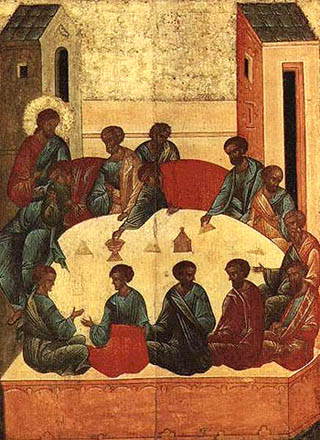
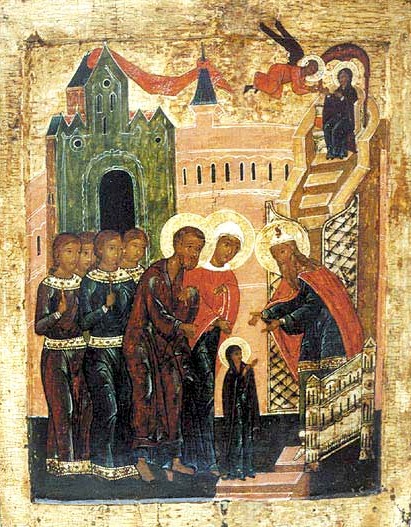
Presentation of the Virgin Mary (21Nov 2009)
Zech 2. 14-17; Resp Lk 1; Mt 12. 46-50
Homily of Fr. Paul Panaretos, S.J.
Implications

The Incarnation is an epicenter of our faith. The Presentation of Mary in the temple focuses us on her future as the human temple, the one who would give God’s word human nature, and fulfill God’s desire. The prophet Zechariah gave voice to it: I am coming to dwell among you, says the Lord. That dwelling burst the limits of human imagination, as well as hope. We’re no mere onlookers to this amazing grace. We’re part of God’s desire, indeed we’re part of God’s family. That has implications.

One implication is that we cannot think of God’s family in human terms. Jesus reshaped any thinking in both gesture and word. His gesture is easily overlooked: stretching out his hand toward his disciples. Jesus stood between—like a bridge not a wall—his disciples and his Father. Jesus continues to be that bridge by the power of their Spirit, the same spirit who overshadowed Mary and incarnated God’s word. In words Jesus amplified his gesture: my Father...my brother, sister and mother.

A second implication is that we cross the bridge, who is Jesus; in other words, our action, our cooperation with Jesus makes us and keeps us as God’s family. Jesus expressed that this way: whoever does the will of my heavenly Father is my brother, and sister, and mother.

A third implication is that Jesus, bridge and access to God, whom he called his Father, discloses this family that is both divine and human. Also, Jesus disclosed a pattern of living for members of God’s family. Accepting and desiring to replicate in one’s life the pattern of Jesus’ life accepts Jesus’ choice of a person to be part of God’s family. The scenes immediately before and after this one dramatized that.

Immediately before this scene was yet another demonstration of the religious leaders refusing to accept Jesus. They would not tolerate him! They accused Jesus of driving out a demon from a man by the power of the prince of demons not by the spirit of God./1/ Immediately after the scene we heard in today’s gospel, large crowds again come to hear Jesus and be with him./2/ Hearing was and remains the beginning of replicating in one’s life the self-giving pattern of Jesus and his confidence in his Father’s powerful presence.

Jesus’ sharing, his revealing the divine desire; our acceptance of it and living it means that God’s family, the community of the church of Jesus, is an extraordinary one. Its bonds have a greater value than human-family bonds. Human bonds are summarized by blood and personal identity as men and women. Divine bonds flow from listening and imitating Jesus. Divine bonds are fragile, too, because not listening and not imitating Jesus weaken and even shatter divine bonds.

The divine desire to dwell among us will never ebb. Mary remains for us the exemplar of hearing and heeding the divine desire and for each one who desires to be his brother, sister and mother.

______________
1. Matthew 12.22-45.
2. Matthew 13.1-35.
_____________________________________________
Wiki-image of an icon of the Presentation of Mary is in the public domain.

Sunday, November 15, 2009

Sunday word, 15 Nov 2009

33rd Sunday of the Year (15 Nov 2009)
Dn 12. 1-3; Ps 16; Hb 10. 11-14,18; Mk 13. 24-32
Homily of Fr. Paul Panaretos, S.J.

Embrace Desire

At the annual close of the liturgical year in the weeks before Advent, the bible selections for the liturgies challenge how we view and read the bible. Specifically, it challenges us about time, which shapes how we think. Like these: ‘Is it time to go?’ ‘Are we there yet?’ ‘I’ve another meeting in half an hour.’ ‘The Year 2009 will be over in 46 days; 1111 hours; 67240 minutes; 4 billion, 34,565 seconds.’ That one was over the top, yet time shapes our thinking. It straight-jackets us, and who doesn’t long to be free?

So we leave our time, 60 minutes of it on Sunday, to enter with one another kingdom-time, which the Psalmist described: A thousand years in [God’s] eyes are merely a yesterday [to us]./1/ Our notion of time contradicts that of the bible, so we let the bible pass; or we refuse to take it seriously; or we feel it’s not for us because it’s outdated—time again!—just not in tune with us.

That’s high and mighty! Yet, we treat the bible arrogantly and think little of it. Then Jesus makes us think with his image-intense language about time and place:

Then the sun will be darkened, and the moon will not give its light, and the stars will be falling from the sky, and the powers in the heavens will be shaken….then they will see ‘the Son of Man coming in the clouds’ with great power and glory...then he will send out the angels and gather his elect from the four winds, from the end of the earth to the end of the sky.

Those thens—three of them: who doesn’t want each to be a ‘when?’ When will the heavenly lights be darkened? When will we see ‘the Son of Man coming in the clouds’ with great power and glory? When will Jesus send out the angels and gather his elect...from the end of the earth to the end of the sky? With the certitude and exactness of our atomic clocks, we want to know those times so we won’t be caught off guard; so we won’t miss Jesus, the divine Son of Man; so at the very least we’ll have a “date with an angel,” who’ll lead us to freedom.

We don’t taste freedom because we refuse Jesus’ witness that then—his word; and ‘when’—our puny desire—are secret from us who know so much: ...of that day or hour, no one knows, neither angels...nor the Son, but only the Father.

What to do? Enlarge our desire not figure out Jesus’ image-intense language and read it like a train schedule. How? The Letter to the Hebrews, also dripping with image-intense language, offers this. God raised from death our high priest,/2/ the divine Son of Man, who took his seat forever at the right hand of God. Plus, the psalm reminds us the faithful person will, too, sharing the fullness of joys in your presence, [O God], the delights at your right hand forever.

We’ll never know the how Jesus took his seat forever at the right hand of God. Yet we have experienced it: healing; forgiveness of sin; living faithfully; showing compassion, receiving compassion; feeling grace embrace us, guide us and inspire us to choose, act and speak faithfully. Those and other revelations of God’s heart are ours! Sitting at the right hand imagines them and stirs us to imagine them. Not a cold fact a ticket-stub at Severance Hall gives, sitting at the right hand of God invites us to desire the delights of God here, now, moment by moment. God will take care of the future: [God] will send out the angels and gather his elect from the four winds.

To desire that is a strong and great desire! It’s a desire, which transforms our minds, our hearts, how we choose and what we choose. It’s God’s desire become our desire that we begin enjoying the freedom of the children of God/3/ even as we wait to enjoy it completely. Oh-oh! I’m sliding into earthly time, which mutes great desires, and I’m dragging you with me. So. . .

In your daily 15 minutes with Jesus this week, step out of time as you enter the life of the Trinity. Ask your patron saint to present you to Jesus. Praise Jesus for proclaiming the delights of the kingdom dawn among us even when we’re unaware. Beg Jesus for the grace to take him at his word; to trust in God’s secrets and desire them rather than figure them out to the last detail. Close, saying slowly the Lord’s Prayer. Jesus gave it to us to recognize our needs; to ask God to supply them; and most of all to give true freedom to us needy folk enslaved by time, which cannot save.


____________
1. Psalm 90.4.
2. Hebrews 4.14, from Second Reading, 29th Sunday of the Year (18 October in 2009).
3. Romans 8.21.
__________________________________________________________
Wiki-images of angels from an ancient folio and of the Emission Nebula are in the public domain.

Thursday, November 12, 2009

Thursday word, 12 Nov 2009

Mary Jo Reagan funeral (12 Nov 2009)
Sirach 44. 10-15; Ps 23; Romans 8.35-39; John 14. 1-6
Homily of Fr. Paul Panaretos, S.J.
Faith-bond

On behalf of Gesu Parish and the community of the Sts. Mary and Joseph Home, I extend our prayers and heartfelt sympathy to you, Bernie and Paul, at the passing of your sister. Be more courageous than your grief is sharp. Your confidence in our risen Messiah will help you and your families grieve well. Sisters, caregivers and residents, I extend those sentiments and prayers to you as well. You will help one another experience Mary Jo’s presence in real and new ways.

Today the Catholic church, Gesu Parish and this caring residence bid farewell to one of theirs. I offer a few words to console and strengthen you in your grief; to help you appreciate God’s astounding compassion by noticing Jesus’ victorious dying and rising were present in Mary Jo Reagan./1/ I want to help us all connect Mary Jo, whom you had the pleasure to know better than I did, with the mystery of Jesus’ dying and rising we celebrate today. I want to reflect briefly with you on the scriptures Mary Jo and others chose for her funeral mass.

I’d like us to begin with memory. Memory is more than discreet facts or ideas. Memory of a human is a portrait of that person, giving us access to who that person was and who that person came to be in our experience. The Book of Sirach is clear about that: the virtues of godly people are remembered, not forgotten. Virtues don’t exist separate from people; people embody them or not. To say that we remember Mary Jo’s virtues is to say we remember her. Surely, more than we remember her. By her life as an educator and a counselor, Mary Jo touched many lives, helping young people shape their futures. Memory lives in people. Memory shapes people.

The memory of Jesus in the early church/2/ to the present describes the transforming power of our risen Messiah. In addition to human memory, Jesus’ Spirit continues to make him present. The life of Jesus continues through his Spirit, given to us. Mary Jo allowed Jesus’ Spirit to flow through her. Her professional career was only one way. Another was her faith in Jesus, which animated Mary Jo. Her participation in the sacramental life of the church connected her with its many helps—for sacraments function to help us on our pilgrim way to the kingdom Jesus proclaimed./3/ Nourished by God’s word and the Eucharist moved Mary Jo to serve. One way was her role in the Patna Mission Circle, in which U.S. Catholics assisted the work of the Jesuits in northeastern India. Another was her devotion to our Blessed Mother, which helped her help others and moved her to volunteer in a variety of ways.

Many of you knew Mary Jo and will remember her as a person who never complained. I appreciate what that memory means and will mean to you because my parents were not complainers. After my mother needed to “get things out,” as she’d say to me, she would apologize for burdening me. She surprised me each time she would apologize because she never made her need feel like a burden to me.

What will your memories of Mary Jo mean? Memory, again, is more than discreet facts and ideas; it’s a living portrait of a person. St. Paul said well what this can mean for you who bid farewell to Mary Jo: nothing can separate us from the love of Christ Jesus. Christ Jesus is our common bond, our faith-bond. In faith we bury our sister, and in faith we accompany and support Bernie and Paul, who no longer have their sister available to them. In faith we support the sisters and caregivers here who let go of one more person, who allowed them to show love.

We use that phrase, brother and sister, at times too casually and miss the meanings it offers: united in Jesus; united with each other as God’s creations; called to serve one gospel both in common and in personal ways; united in Jesus’ desire to prepare a place for each of us and for us together.

Jesus preparation of a place for us is a metaphor for nothing less than Jesus creating us anew! Creating is what Jesus does at each moment. Creating is not a past event; it is who Jesus fashions each of us to be every moment. That may be a new way to think about God creating through Jesus by their Spirit, but that has been true from all ages. You and I tend to think in terms of time and history more than in terms of Jesus at work for us now.

What Jesus creates now, and how we surrender to Jesus’ creative shaping and transforming of us our poor language describes with images: We feel new; we notice something about ourselves we did not before; we sense our deep desires changing or growing more clear; and we live from them in ways we find surprising. If any of us need help to notice what Jesus creates now, and how we surrender to Jesus’ creative shaping and transforming of us, a more recent memory of Mary Jo--that is, her recent life--can help.

Walking into Mary Jo’s room revealed how she surrendered to Jesus’ creative shaping and transforming: her paintings. It can be one thing or a combination that unlocks our potential. I don’t know what it was for Mary Jo; maybe you do. What is important is that Mary Jo surrendered to a new way of seeing and of expressing color, shape, perspective, light and shadow, the natural world and ways humans shape the world—in short, Mary Jo surrendered anew to Jesus creating her. Painting immerses one in the awe of Jesus creating. It is one way of many to immerse ourselves in awe of the divine. Painting—indeed all arts—is another metaphor for Jesus creating.

Jesus has created Mary Jo anew: she enjoys the place Jesus promised to prepare for her; her luster as an image of God is being burnished; Jesus sets her in a frame of his shaping, so she may be truly radiant; and Jesus gives her life that we cannot imagine. More than that, Jesus is also recreating us. One day he will return in glory to reunite us all in his undying life. Funerals remind us that is true with the words, life is changed not ended./4/

Mary Jo not only lived change, she embodied the most real change, Jesus’ paschal life: united with Jesus and alive in the love of God in Christ Jesus our Lord. Choosing to cooperate with grace, Mary Jo lived a virtuous life. She is for us both our sister and a living memory of Jesus. We will retell her wisdom and faith the more we, like Mary Jo, surrender to Jesus’ creative shaping and transforming of us.


___________________
1. Cf. Order of Christian Funerals, 27.
2. The phrase was used by Nils A. Dahl and bequeathed to his students and his students’ students, who have enriched Christian memory as a communal experience, which shapes individuals. In 1976 the phrase entitled a collection of essays by Dahl.
3. A Prayer after Communion in the Sacramentary and the Order of Christian Funerals expresses that.
4. Cf. Preface for Christian Death I, Roman Missal.
____________________________________________
Wiki-image by Soman of muted sunlight over the Ganges River in Patna is used according to the Creative Commons Attribution ShareAlike 3.0 license. Wiki-image of a door panel representing the triumph of Jesus is in the public domain.

Tuesday, November 10, 2009

Tuesday word, 10 Nov 2009

Amalia Kaminisky funeral (10 Nov 2009)
Eccl 3. 1-11; Ps 23; Rm 5.1-11; Jn 16. 19-24
Homily of Fr. Paul Panaretos, S.J.
Running the Risk

On behalf of Gesu Parish, I extend our prayers and heartfelt sympathy to you, Albert, at the sudden passing of your spouse of 55 years; to Bruno, Louis and Sarina at the death of your sister; and to Katherine, Albert, Caroline, Christine and Anne at the death of your mother. Your children grieve, too. Be more courageous than your grief is sharp. Your confidence in our risen Messiah will help your children grieve well. Tim, Matt, Sarah, Mary, Elizabeth, Albert, Marshall, Maddy, Alexandra, Anna, Claire and John, you will help your parents to experience your grandmother’s presence in real and new ways. All of Amalia’s family will experience her presence in real and new ways.

Today the Catholic church and Gesu Parish bid farewell to one of hers. I offer a few words to console and strengthen you in your grief; to help you appreciate God’s astounding compassion by noticing Jesus’ victorious dying and rising were present in Amalia Kaminsky./1/

We are grateful for the family’s words of remembrance. Their words help us connect Amalia with the mystery of Jesus’ dying and rising we celebrate today. I want to reflect briefly with you on the scriptures Amalia’s family chose for her funeral mass. Amalia, as we know—and you better than me—was a person of faith. Faith shapes us, yet its shaping does no violence to our selves. As we Catholics say, “Grace builds on nature.” That Catholic conviction shapes my reflection.

Something I learned about Amalia from her family was easy for me to appreciate. When my father was 20, a stroke crippled his father, and my father became responsible for the home and lives of his father, mother, sister and his. Becoming head of the household in a practical way, shaped my father into both a responsible man and someone who appreciated everything as gift—even that for which he labored.

At half my father’s age, Amalia’s mother died and she became caregiver and caretaker. What-ever we may say about how that shaped her and, perhaps set a direction for her life, that event certainly did not warp who Amalia was. As we heard, she was stylish, caring, loving and selfless. Amalia was ready to give you her blouse, scarf or sweater if you complimented it.

Amalia knew that God-with-us in Jesus did not obliterate the human aspect of the world with its limits and imperfections. To use the words of Ecclesiastes, both time and the timeless--God’s self--exist together. This graced knowledge testifies to those virtues we name coming from God: faith; hope; love. They are not obvious; we know them by the actions they prompt and the effects they allow us to produce.

St. Paul said well for all time how we recognize someone who lives those virtues all we desire to live; and Amalia embodied them: we glory in hope of the glory of God. Not only that, but we even glory in our afflictions, knowing that affliction produces endurance, and endurance, proven character, and proven character, hope. Hope does not disappoint.

I translated St. Paul literally to help us appreciate the faith of your sister, spouse, mother, grand-mother & friend: we glory in...the glory of God. St. Paul’s point is not one of human initiative or of any conditioned state in which one finds oneself. St. Paul points us to God taking the initiative to reconcile us and give us peace, even when things may point to the absence of reconciliation and peace.

People reconciled by God through Jesus by their Spirit can glory, not on the basis of accomplishments—Amalia did not do that; nor about limitations, which Amalia came to to know intimately, but because they feel clothed by a secure felt-knowledge of God loving them. If anyone wants to know from where Amalia’s humble strength, her strong humility comes it was from knowing she was clothed by God’s loving care. You, her family above all, made that divine love real and gave it human contours; you personified it, giving it each of your names.

Clothed with God’s love that way is nothing short of miraculous! I am speechless when I consider that Amalia persisted in her humble strength, her strong humility in the face of being a long-distance runner, who lived these last years of her life with Parkinson’s disease and its ravages. Your sister, spouse, mother, grandmother and friend will be for you a parable of God’s love well lived.

After Anne completed Gesu School, Amalia was free to work beyond her home. She was the “media lady” at and for the school. Another kind of service became even more dear to her. Timing can be grace, and Gesu Parish embarked on RENEW, which is as its name suggests, a renewal, both personal and parish-wide. “RENEW happened at the right time,” as Caroline put it, “for our mother to serve with other women.” As someone who has personally experienced RENEW, I can say that service is first giving glory to God and growing in a graced personal relationship with Jesus. It is personal, and because it is not private, it is a relationship in Jesus shared with one’s small group of seekers. Knowing Jesus impels the group to serve others in his name.

That’s a compressed description. RENEW is a remarkable journey for anyone who risks it. I say “risks” on purpose because when we allow God to transform and enlighten us, we behold parts of ourselves that confuse us, frighten us or that we would rather not notice. Yet, the grace is that we do that in the company of Jesus, his Father and their Spirit. While no one sees one’s life in an arc of time from past to present to future, beholding ourselves with graced vision—to see ourselves as God does—we do integrate our past into our present in order to live our future in surprising ways.

With regard to Amalia I have pondered her shaping at age 10 when she became a caregiver and learned that responsibilities have joys not only burdens; through her adult years as a long-distance runner, who never expected to Parkinson’s disease would catch her. Like the disciples, from the other side of the Last Supper, who had confidence in their risen Savior, so that they had no qualms about conversing with him as they once had, Amalia had much to converse about with Jesus. Her RENEW journal is a guidepost for her family, a record of her graced conversations with Jesus.

Although it is a searing sadness for you because she is no longer available to you, your sister, spouse, mother, grandmother and friend has crossed the finish-line. Her joy is complete. Her strength is restored, and God continues to pursue her with God’s goodness and love, completing her graced transformation.

She remains your intercessor but with a new advantage: Amalia is one of the faithful departed, who prays for each of you to grow in the faith of Jesus to be the person Jesus created. As each of you discerns how to live the faith of Jesus at home, at school, at work, in your neighborhoods and your parishes, you will take the baton of virtues of both Amalia and God and cover the distance she has prepared you to cover. Each of you is living testimony to a disciple of our day. Amalia would want you to extend the glory of God she found to give her life rich, strong, simple and abundant meaning.

___________________
1. Cf. Order of Christian Funerals, 27.

____________________________________________
Wiki-images of a Resurrection icon and a Last Supper icon are in the public domain.

St. Leo the Great

Pope John XXIII was inspired by the 5th-Century Pope St. Leo, a great proponent of church unity. Pope John attributed much inspiration to his predecessor when Pope John convoked the Second Vatican Council.

On the 15th Centennial of Pope Leo's death, Pope John wrote an encyclical. It is worth reading to learn about Pope Leo and to see how his very different time and place was a home to the one church of Jesus the Christ.

Sunday, November 08, 2009

Sunday word, 08 Nov 2009

32nd Sunday of the Year (08 Nov 2009)
1Kgs 17. 10-16; Ps 146; Hb 9. 24-28; Mk 12. 38-44
Homily of Fr. Paul Panaretos, S.J.
She Revealed Jesus

As Jesus drew near the end of his ministry, he came to Jerusalem to suffer, die and be raised on the third day./1/ As we begin to close another liturgical year in which we more deeply immerse ourselves in the mystery of our Messiah Jesus, today’s gospel views Jesus in the area outside the temple,/2/ its treasury. In a very spacious area with terraced walls, Jesus could have sat away from many people moving about near the temple treasury, yet near enough to notice facial expressions and other body language.

Jesus saw the crowds; the religious professionals—the scribes, Pharisees, elders; wealthy people; and his disciples. Jesus spoke to everyone, and when we hear and read Jesus speaking to his disciples, Jesus is addressing us, his disciples today, the church.


The two scenes in today’s gospel—Jesus’ remarks about the scribes and a poor widow may seem connected by a slender thread of coincidence. So we may ask, “Do Jesus’ words speak to us?” I suggest that they remind us that God protects God’s faithful, and they urge us to act with confidence in that protection.

When Jesus addressed the crowds, his disciples heard him, too. His disciples knew that scribes had the legal right to administer estates. They earned that trust by their standing as religious leaders. Some scribes were trustworthy, yet by Jesus’ day enough had squandered the estates of many to enrich themselves. Greed was a human temptation not limited to the scribes. Jesus knew that. He named them as only one example of what to beware, much the way people warn friends to beware people who won’t be fair with them. As we say and hear, “Watch out for scam artists who….” Jesus warned his disciples about people who made a show of their faith instead of living it and living by it.

Greed is a symptom of a need to be in greater control of one’s life. The word life includes both human life and one’s possessions. From the vision of faith, however, my human life and all I have are gifts to me from my Creator. All—life & possessions—are given us to manage and manage well. It’s false to think 90% is mine and 10% is God’s. All is God’s, who gives to humans to manage as best they can.

Confident faith frees us to be loving stewards. Confident faith has practical aspects, which Jesus may have been teaching the crowds that day, of honesty and fairness not exploitation and greed. In the crowd Jesus saw the poor widow. She was his parable! The poor widow modeled confident faith because she came to the treasury and put in two small coins worth a few cents. She did not put in one and keep one for herself. Her confident faith that God would safeguard her and guide her journey through life freed her. Moreover, Jesus saw how she and the crowd put in their offerings. As it happens so often, we with more have more to distract us from giving freely and faithfully.

That is exactly how Jesus gave his life in his passion, which followed not long after the way the poor widow gave her offering in the temple that day! Jesus’ confident faith freed him to die in order to live, giving our lives new purpose.

What is our new purpose? This parable of Jesus is less about money and more about our manner of living. Because we eagerly await him, this is our new purpose: we desire to make Jesus’ faith ours and to put Jesus’ faith into action until he comes to bring salvation to us and to many who will come to know him because of our manner of living.

In your daily 15 minutes with Jesus this week, ease into an awareness of the Trinity recreating you. Ask the poor widow to present you to Jesus. Thank Jesus for you faith and consider how freely you live your faith: Am I a good steward of God’s many gifts? Am I a loving steward, or am I an anxious steward, who needs to manage anxiety more than God’s gifts? Ask Jesus for the grace to live your faith more freely. Close by saying slowly the Lord’s Prayer. Jesus gave it to us to say daily, so we might live more freely this day, this hour, this moment. For not by our schemes but by faith’s freedom are we parables for each other and everyone we meet.


____________
1. Mark 8.31-33; 9.30-32; 10.32-34.
2. At the 1:50 mark of the video above the viewer enters a colonnade on one side of the Court of Women, which was the area of the Treasury
_________________________
Wiki-image rising sun seen through a hole in the Temple wall is in the public domain.

Tuesday, November 03, 2009

November's Night Sky

Stars, planets and the most distant galaxy visible with the naked eye brightens the longer hours of night in November.

This month's night sky offers a new morning star to greet early risers.

[In the star-map to the right, M31 is that "most distant galaxy" mentioned above.]

__________________________________________
Wiki-image by lxitixel of a star-map of Andromeda is used according to the Creative Commons Attribution ShareAlike 3.0 license.

Saturday, October 31, 2009

Saturday word, 31 Oct 2009

30th Saturday of the Year (31 Oct 2009)
Rm 11.1-2, 11-12, 25-29; Ps 94; Lk 1. 7-11
Homily of Fr. Paul Panaretos, S.J.
Meaning Often Overlooked

Chapters 9 through 11 in the Letter to the Romans are St. Paul’s rereading of the history of God with people as the bible presented it. St. Paul was not alone in rereading the bible’s history. “To a large extent, being a Jew in the first century meant to take part in the debate of the meaning of Torah, with each sect and group finding in the tradition the basis of its own claims...to the exclusion of the claims of others.”/1/ Although we usually assume it was monolithic, Judaism was not.

St. Paul’s rereading, like other New Testament witnesses, was shaped by belief in Jesus; that made it unique. St. Paul’s belief in Jesus shaped his thought; he thought as a person of faith. God was the principal actor in the drama of world history. As he began the Letter to the Romans, St. Paul wrote: ever since the creation of the world, [God’s] invisible attributes of eternal power and divinity have been able to be understood and perceived in what he has made;/2/ and he closed Chapter 11: For from him and through him and for him are all things. To him be glory forever! Amen!/3/

Yet St. Paul found himself in a predicament of the all and some. That’s the context of the first reading. God created all humans, but only some responded to their creator. Jews had God’s covenant, yet not all lived that covenant [torah often translated with the world law, which confuses us more]. Some responded to Jesus, the dead and risen One, but not all embraced him as God’s messiah. And among the Jews were some like St. Paul, whose relationship with the chosen people was alive and who rejoiced to call Jesus the crucified messiah. St. Paul addressed his predicament in today’s reading.

St. Paul did so in religious—as opposed to philosophical—meaning. When you and I express religious meaning, we are not always logical. Jesus, dead and at the same risen, is an example. St. Paul proclaimed a mystery not a philosophy.

The mystery is that humans cannot discern God’s purpose, which works for the good of humans and all creation./3/ Our limitations, of course, do not limit God. We can speak of God’s mystery only because of what God has already done in and for us through Jesus’ dying and rising and giving us his Spirit.

As we heard, St. Paul recalled Isaiah’s prophecy to emphasize that God will do what humans cannot. Though we cannot know how and though evidence to the contrary abounds, God acts and will act. St. Paul recalled what God will do: all Israel will be saved, as it is written: “The deliverer will come out of Zion, he will turn away godlessness from Jacob; and this is my covenant with them when I take away their sins.”

Remembering that religious meaning was at the heart of St. Paul's proclamation of the gospel and that religious meaning is not always logical, we can appreciate the meaning of Zion. Zion, which stands for all Israel is not limited to Jews; it includes Jews who accept God’s mysterious and gracious purpose, plus the full number of the Gentiles who do likewise!

It is not easy to appreciate this mystery even when read in context of St. Paul’s entire Letter to the Romans. We are always challenged to remember that God is the principal actor in everything and that God delights that humans take supporting roles in a drama that is no longer only about created things but about an utterly new, completely new creation in Jesus, our Messiah and Lord. The truth of St. Paul’s conviction, the gifts and the call of God are irrevocable, begins to satisfy us, only when we begin to recognize and name our individual gifts, which is the beginning of prayer. Prayer is not always logical and supports us as religious, that is, people of faith. Refusing to overlook religious meaning cooperates with Jesus’ Spirit at work in us. By that meaning Jesus shapes us as his disciples today.


____________
1. Luke Timothy Johnson, Reading Romans: A Literary and Theological Commentary. NY: Crossroad Publishing Co., 1997. pp. 141-142.
2. Romans 1.20
3. Romans 11.36.
4. Romans 8.28.
____________________________________________
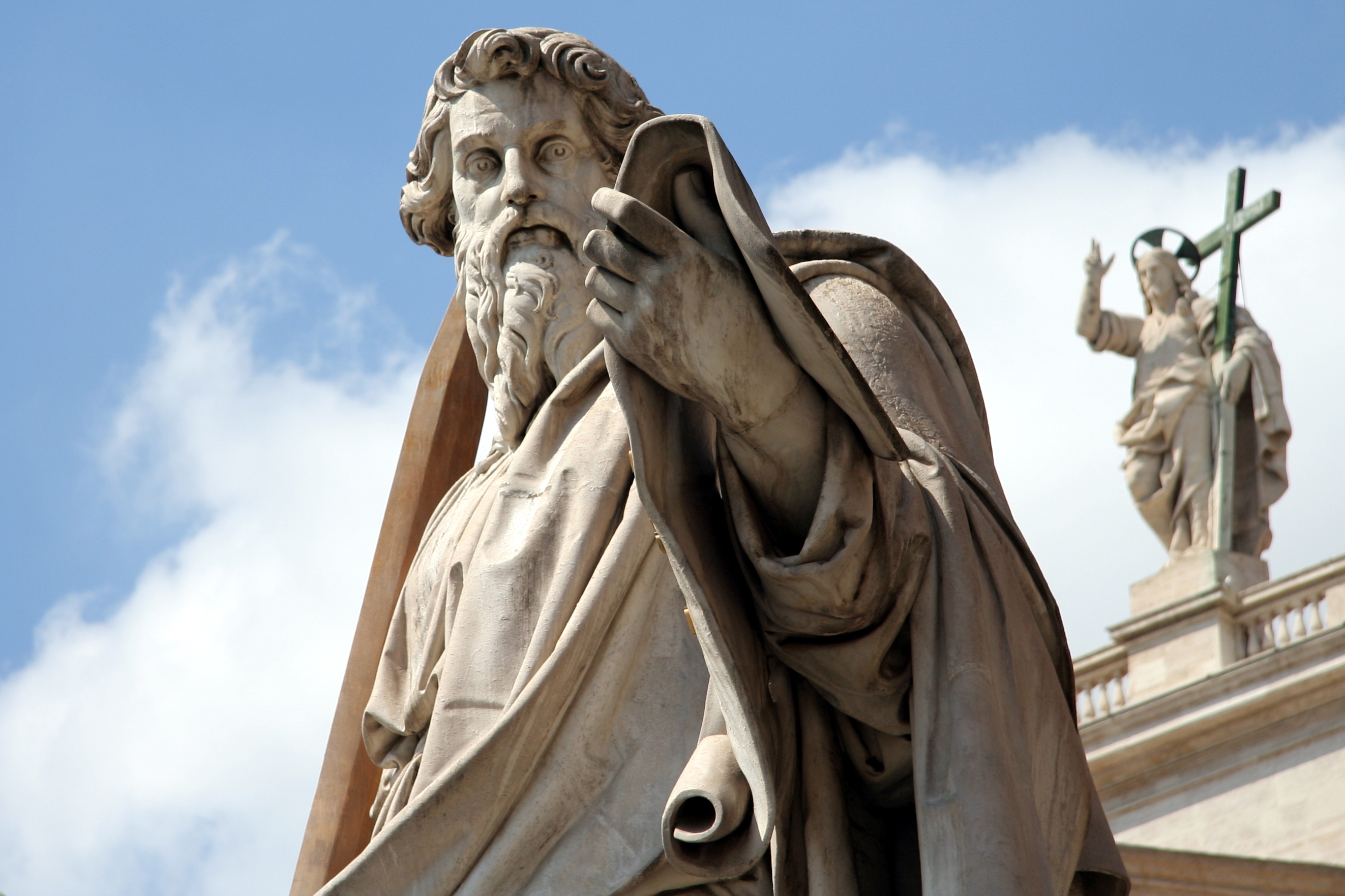
Wiki-image by AngMoKio of a statue of St. Paul is used according to the Creative Commons Attribution ShareAlike 2.5 license. Wiki-image from a copy of the Book of Revelation is in the public domain.

Tuesday, October 27, 2009

Tuesday word, 27 Oct 2009

Fred Rudin funeral (27 Oct 2009)
Eccl 3. 1-14; Ps; Rv 20.13; Jn 14. 1-6
Homily of Fr. Paul Panaretos, S.J.
God’s Loyalty

On behalf of Gesu Parish, I extend our prayers and heartfelt sympathy to you, Rosemarie, at the death of your spouse of more than 50 years; to you, Kathryn, Fred, Joseph, Susan, Carolyn, Stephen and James at the death of your father. Be more courageous than your grief is sharp. Your children grieve, too. Your confidence in our risen Messiah will help your children grieve well. Christopher, Lauryn, Annmarie, Matthew, Lesley and Michael: you will help your parents to experience your grandfather’s presence in real and new ways. All Fred’s family and friends will experience his presence in real and new ways.

Today the Catholic church bids farewell to one of hers. I offer a few words to console and strengthen you in your grief; to help you appreciate God’s astounding compassion by noticing Jesus’ victorious dying and rising were present in Fred Rudin./1/

We are grateful, James, for your words of remembrance. Your words help us connect Fred with the mystery of Jesus’ dying and rising we celebrate today. I want to reflect briefly with you on the scriptures Fred’s family chose for his funeral and a detail they reveal.

When Fred’s children were selecting scriptures for his funeral mass, their memories painted a portrait in words to help me appreciate their spouse and father. At one point, James, interjected how his thoughts about his dad organized themselves: “PHD: provider; husband; dad.” Your individual memories shared with me highlighted each of those descriptions. Also, they suggest sacramental images which, I hope, benefit you today and in your future.

In bringing Fred to church for the last time, we gather around the altar-table of our Lord Jesus. While it is significant in many ways, our gathering around the altar-table of our Lord Jesus reassembles each of us into a community of his disciples. The time you spent with your husband and father around your kitchen table echoes our gathering today. Around your kitchen table you listened to one another as well as spoke. Here we listen to God’s shaping and saving word. Around your kitchen table you enjoyed your mom and grandmother’s delicious meals. Here we feast on the body and blood of Jesus so we can live more like him wherever we are.

As the eucharist nourishes us in deeply real ways, it does not slake our hunger and thirst. Even as your meals at home satisfied your hunger and thirst, you received more real and more substantial nourishment from your spouse, father and grandfather. He let you know he was proud of you. He encouraged you to grow, be yourselves, pursue your dreams and do your best. That nourishment is more substantial, not only because you remember, but because it has shaped you to be who you are.

Beyond the kitchen table and their home and their young years, Fred kept in touch with his children. He loved calling them, and he enjoyed hearing their voices. On the phone Fred echoed what he had told them in person: “I’m here for you if you need me.” If the moment was difficult or challenging, Fred would close with encouragement: “keep smiling!”

Fred’s closing opens another sacramental effect. Jesus is the sacrament of God. The Latin word sacrament translated the earlier way people spoke of Jesus as embodying God. Sacrament was the oath Roman soldiers made to the emperor. Christians made it their word to convey loyalty they wanted to express. Looking at Jesus reminds us that Jesus reversed the direction of loyalty—from God to us—and embodied God’s solemn promise to abide with us! Fred’s “I’m here for you if you need me,” echoed Jesus’ sacrament—God’s solemn promise—I am with you always, even to the close of the age!/2/

The Book of Revelation, seeking to console people who suffered, expressed Jesus’ promise in words we just heard. Behold, God’s dwelling is with the human race. He will dwell with them, and they will be his people, and God...will always be with them as their God. More substantial than a dwelling with walls, God is personally with us! No walls, yet real and abiding presence!

Our imaginations are limited by our senses. Jesus recognized our limits and with limited imagery expressed personal presence with us and action for us: I go and [I] prepare a place for you...where I am you also may be. Sharing life, Jesus’ risen life, is the point.

I think Fred intuited that. He knew we are limited in all kinds of ways. He knew that things, gifts, sporting tickets, shared activities with family and with his extended family of Gesu pointed to the truly substantial: affection; joy; family bonds; love in all its forms.

Our celebration of Christmas embodies that. What is more substantial than God sharing our humanity so we become divine, to share God’s enduring life? Christmas will sting this year because your, spouse, father, grandfather, relative and friend will not be there to welcome you home, to have him available to you as he was. That is real and will be difficult. You told me you are already anticipating it. Yet his more substantial presence & love, which contributed greatly to shaping who you have become today, will remain with you. How to describe it? A spatial image, limited as it is, may help.

When my father realized he would die, he told my niece, “I’m sorry, Diana, but I don’t think I’ll see you and Jeff get married.” Diana replied with a smile: “You’ll be there, Grandpa, you’ll see us from a different seat.” I was and am proud of my niece’s faith. Her faith conviction did not minimize her pain of sadness and loss or mine. I share that moment with you to recall for us all that Christian funerals do not dismiss anyone’s pain. They bring us together to remember Jesus abides with us no matter where we may be.

Together we encourage each other to hope in the more substantial life Jesus promises and to embody his more substantial life the best we can, just as Frederick E. Rudin modeled it for his family, friends and his brother- and sister-Catholics. His life is changed not ended,/3/ and he taught you how to live our transformed life in Jesus so that you may teach each other and all you meet as Fred did.

___________________
1. Cf. Order of Christian Funerals, 27.
2. Matthew 28.20.
3. Preface for Christian Death I,
Roman Missal.
_______________________________________________
Wiki-images of anastasis and of Grunewald's Resurrection are in the public domain.

Sunday, October 25, 2009

Sundayword, 25 Oct 2009

30th Sunday of the Year (25 Oct 2009)
Jer 31. 7-9; Ps 126; Hb 5. 1-6; Mk 10. 46-52
Homily of Fr. Paul Panaretos, S.J.

Three Features

Mark’s is an intricate gospel. It’s brevity—the shortest of the four gospel-portraits of Jesus—makes us dismiss its details. One of its details is that Jesus’ disciples, including the apostles he called to follow him, were slow to grasp the identity of Jesus and slow to appreciate what Jesus taught. That detail describing the disciples, doesn’t it describe us, too? We’re not quicker than the disciples. We are like them, even with our advantage of seeing the entire story of Jesus, something his disciples could not.

Today’s gospel selection reminds us that Mark’s gospel remembers Jesus healed two blind men with different effects. The first blind man, unnamed, Jesus healed gradually. Mark recalled it this way:
Putting spittle on his eyes [Jesus] laid his hands on him and asked, “Do you see anything?” Looking up he replied, “I see people looking like trees and walking.” Then [Jesus] laid hands on his eyes a second time and he saw clearly; his sight was restored and he could see everything distinctly. Then [Jesus] sent him home./1/
In today’s gospel Jesus healed Bartimaeus instantly:
Bartimaeus threw aside his cloak, sprang up, and came to Jesus. Jesus said to him..., “What do you want me to do for you?” The blind man replied to him, “Master, I want to see.” Jesus told him, “Go your way; your faith has saved you.” Immediately he received his sight and followed [Jesus] on the way.
Details confuse people about Mark’s lesson then and now. Some people are stymied by Jesus gradual healing of the first blind man. Others miss that Bartimaeus threw aside his cloak. Still others forget that Jesus’ many discouraged Bartimaeus, which surely is evidence enough that the they were slow to get Jesus’ mission.

Both men and Jesus’ response to them are icons for us today. The blindness of the first man was from no faith to faith. Jesus sent him home, that is, to protect and cultivate his faith until he was ready.

Faith, in visual language, allowed him to see everything distinctly, which even the disciples could not do! Yet, new faith needs protection, and it needs to grow strong.

Bartimaeus had strong faith: no one could quiet it in him. Jesus saw his faith and he recognized a new disciple, as we heard: “Go your way; your faith has saved you.” Immediately [Bartimaeus] received his sight and followed [Jesus] on the way.

We share significant features with Bartimaeus. Let me name three. We are named and our names have been sealed by baptism. Second, our baptism consecrated us on mission with Jesus: we follow Jesus on his way. Three, our baptism gave us faith, and the eucharist sustains the faith our baptisms began.

Our faith, we know from experience, gets shrouded, and at times, we even allow it to be invisible. More often, whatever cloaks our faith doesn’t allow others to recognize our true features as Jesus’ contemporary disciples. Baptized into faith and faith sustained by the eucharist, we all have our cloaks, to which we cling or which cling to us. We recognize Jesus heals us—that is, empowers us to live the pattern of his life—when we throw aside our cloaks and live with faith’s freedom to replicate the pattern of Jesus’ dying and rising day to day.

In your daily 15 minutes with Jesus this week, ask the Trinity to enlighten you and bless your vision. Ask Bartimaeus to present you to Jesus. In your words thank Jesus for your faith, then ask Jesus to help you identify your cloak and give you strength to throw it aside for the freedom of faith to imitate the pattern of Jesus’ dying and rising. Close by saying slowly the Lord’s Prayer. It is both example and power: Jesus’ example of living freely and faithfully, and his power in us to do the same and to follow him on his way.


____________
1. Mark 8.23-26.
___________________________________________
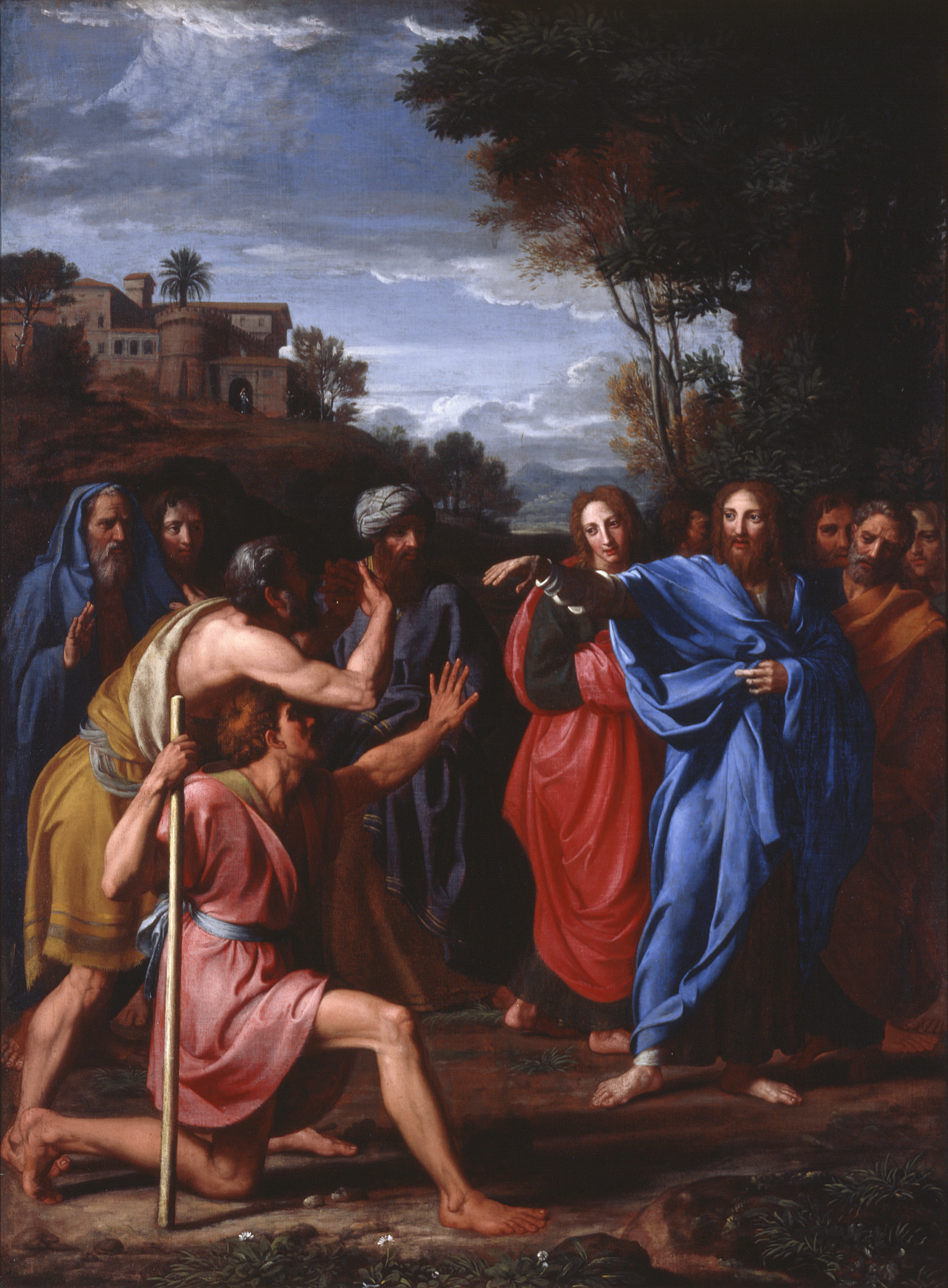
Wiki-mage of Jesus healing the blind is in the public domain.

Saturday, October 24, 2009

Saturday word, 24 Oct 2009

Joan Czyzak-Matthugh McManus wedding (24 Oct 2009)
Tobit 8. 4b-8; Ps 128; Philippians 4. 4-9; Matthew 7. 21, 24-29
Homily of Fr. Paul Panaretos, S.J.
Foundation and Compassion

Joni and Matt, by celebrating your wedding you give us an opportunity to appreciate yet another facet of the mystery of Jesus and his church. You inaugurate a mystery: your married life, which is two individuals making one life together. This has always been so, and today the church enriches and strengthens you with [the sacrament of matrimony]/1/ to live together your Catholic selves. I want to reflect with you and your guests on one way the sacrament enriches and strengthens you, as well as your role in deepening its grace.

While no mechanics of grace exists, all the baptized share in God’s life--to what the word “grace” points us. God’s life is God’s gift to us; like all gifts we don’t control receiving them. Also like gifts, God’s life in us is real and affects us for our good. You know this from your experience of falling in love. Love has no blueprint. You knew love was shaping you because it allowed you to see yourselves in each other; plus, your love helped you see aspects of each other with a clarity neither of you enjoyed before.

This clarity expresses itself in many ways. All the ways share in a hallmark of married life, equality. A 3rd-Century Christian described this equal expression in a letter to his wife. Speaking of spouses, he wrote:
Together they pray, ...together perform their fasts; mutually teaching, mutually exhorting, mutually sustaining. Equally both [are] in the Church of God; equally at the banquet of God; equally in straits, in persecutions, in refreshments. Neither hides from the other; neither shuns the other; neither [troubles] the other. The sick is visited, the indigent relieved, with freedom. [They give] alms [freely and]…without scruple./2/
Since that early Christian wrote his wife, the church grew to appreciate equality as a hallmark of Christian marriage. I have come to define Christian marriage as two individuals making one life together. Each of you will remain individuals, and you will make one life. Your differences will strengthen your one life, not just your similarities.

The scriptures you chose for your wedding help us see how. The reading from the Book of Tobit is a starting point. It is not only about people in the past; it is autobiographical. Both of you pray. While you have already prayed for one another and with one another, from this day your prayer will be one voice from two selves. If you allow Tobias and Sarah to guide you, as you pray you will rehearse creation as they did: Blessed are you, O God of our ancestors! reminding each other that together yours is a noble purpose.

Your purpose is to continue learning what is true and to keep on doing the truth in love. To keep your purpose alive and fresh, to keep learning each other as you have been, allow me to suggest this: in the weeks, months and years to come, Matt and Joni, give your relationship the same priority you have given it since beginning to date seriously and to prepare to marry. That’s no canned line: my parents did that during their 60 years together, long before I realized they did so.

If you give to each other in years to come the priority—that is, the honor, the respect, the tender love as well as to admire each other as you do today—not only will you Rejoice! We will rejoice with you. Making one life that way also will make your joy and your kindness for one another known to all and felt by all who meet you.

Giving each other and your life together at each future moment the priority you have given each other in the earliest phases of your relationship is your foundation: not only the foundation of your relationship; it is the foundation of your life together, who is none other than Jesus for us Catholics.

Jesus, of course, does not want to be idolized and remain distant. The empty cry of Lord! Lord! in the gospel Matt and Joni chose alludes to idolizing Jesus and keeping him distant. Some of you may know that the gospel we heard impressed Matt from grade 1 or 2 and stayed with him. Joni welcomed his choice of it for their wedding. In the familiar parable of Jesus about building on sand or on rock, sand, rock, houses and even building are minor characters. They support Jesus’ point that doing God’s desires is each one’s vocation.

With what greater authority will both of you do and fulfill your vocation than as spouses? With what greater authority than as spouses will you give witness to us and the world that God works in all human lives for good? With what greater authority will you model compassion than by the joyful compassion by which you carry each other and care for each other as spouses? Your mutual compassion for one another will fashion you from today as a domestic church./3/ It will help you save each other’s souls and welcome children lovingly from God/4/; it will also allow Jesus to work through you for the sake of the world.

Joni & Matt, I want to affirm what you have allowed me to see: your desire to live a Catholic marriage. I also want to remind you that at each step of making one life together, Jesus accompanies you, drawing you and your love for each other into the mutual love, which his Father and Jesus and their Spirit enjoy—our destiny. You’ll never lack for Jesus’ companionship blessing your love with the love of the Trinity.

Matt and Joni, I’m very proud of you and, I wish you every good thing. I congratulate you on behalf of the church. Please remember that in pledging yourselves to each other you allow Jesus to work through you for your Christian destiny—the salvation of each other as well as our world. As you forge one life together Jesus begets something new: a new harmony to feel Jesus creating you and your mutual love for each other; and to help us and others feel Jesus recreating the world not from afar but with us and for us all.

______________
1. Rite of Marriage, Ch.1: 23.
2. Tertullian, To My Wife, 2,8:4, in AnteNiceneFathers, IV:48.
3. Dogmatic Constitution on the Church, 11, of The Second Vatican Council.
4. Rite of Marriage, Ch.1: 24.

____________________________________________
Wiki-image by Jeff Belmonte of wedding rings is used according to the Creative Commons Attribution 2.0 license. Wiki-image of life of Jesus window is in the public domain.

Friday, October 23, 2009

Friday word, 23 Oct 20

Henry Hentemann funeral (23 Oct 2009)
Eccl 3. 1-14; Ps 27; Rv 14.13; Mt 11. 25-30
Homily of Fr. Paul Panaretos, S.J.
Work and Rest

On behalf of Gesu Parish, I extend our prayers and heartfelt sympathy to you, Jean, at the death of your spouse; to you, Chris, Mark, Gretchen and Eric at the death of your father. Be more courageous than your grief is sharp. Your children, Henry, Emma, Patrick, Tatum, Grace and Emerson, will miss their grandfather. Your confidence in our risen Messiah will help your children grieve well. Henry, Emma, Patrick, Tatum, Grace and Emerson, as you grow you will help your parents to experience your grandfather’s presence in real and new ways. All Hank’s family and friends will experience his presence in real and new ways.

Today the Catholic church bids farewell to one of hers. I offer a few words to console and strengthen you in your grief; to help you appreciate God’s astounding compassion by noticing Jesus’ victorious dying and rising were present in Hank Hentemann./1/ We are grateful, Chris and Eric, for your words of remembrance. Their words help us connect Hank with the mystery of Jesus’ dying and rising we celebrate today. I want to reflect briefly with you on the scriptures Hank’s family chose for his funeral & a detail they reveal.

When Jean and her children were selecting scriptures for Hank’s funeral mass, they helped me learn again that scriptures are not only about people and events in the past; they are biographical of us all. Work and rest in scripture appeared to them repeatedly to fit Hank. Hank’s family reminded me that Hank’s descent from German immigrants—Hank was 1st-generation German-American—shaped his attitude toward work. Hank’s immigrant ancestors helped each other struggle and work to survive. Hank struggled and worked, and with Jean to help him, so that they and their children could thrive. Hank worked with modesty and humility, never losing touch with people: vital for a civil defense attorney.

As you spoke of Hank, you reminded me of my father’s desire to be at home. Hank’s desire to be at home allowed him to balance his career with life at home. Hank loved his home and used his talents to make their house a home for Jean and their children. Mark likened Hank to a German primogenitor, the ancestor who established his estate and cared for it not only for the present but for its future after him.

While Hank’s work demanded him to use sets of skills and knowledge, they did not fashion him into their image. Rather, his fairness, his decency, his enjoyment of family and friends and his sensitivity to human predicaments as well as human potential shaped him as thoughtful, modest and without pretense. By exercising his talents outside of work, Hank “got his peace,” as Eric put it; and Chris turned the phrase, “Dad was a project guy.” In addition to the long deck, rooms, lawn and woods were a few of his projects.

Yet another, different project was dear to your dad: passing on to you a desire to live your lives in ways that affected other people and the world for the better. His “red-wine wrap sessions” with you was one of his ways of doing that more real, more vital project than his others.

If anyone doesn’t know, Hank enjoyed long conversations with his children when they were together, sipping wine as they solved the problems of the world. Because Jean had already solved them in her way, she retired early. Hank’s family can give you details. My point is twofold: one, conversation is a great teacher, helping us learn while we’re not aware that we are learning; two, Jesus engaged people in conversation so they might learn God and God’s astounding compassion.

I’m convinced the most effective learning happens when we’re unaware we are learning. Afterward, we come to realize our minds and our hearts have become more spacious, that we have grown more patient and more wise. You used “patient” and “wise” frequently in describing your husband and your father. I trust you are aware that you enjoy a share in his patience and wisdom. You are his estate, for patience and wisdom were its land and its walls. Patience and wisdom were Hank’s more real success; you will continue to bless others with his more substantial success by your lives, you his more vital project than his others. If a spouse and father’s success can be measured, then Hank’s success rested on his patience and his wisdom. They were his work and his rest.

The author of Ecclesiastes wrestled with work and rest and noticed degrees of difference. The author expressed one degree with the word, time and another with the phrase the timeless. Time denotes what can be seen, felt and measured, including human toil. The timeless denotes things more substantial, like patience, wisdom, decency, fidelity, hospitality and concern, which make us humane and images of God. They give us respite. Usually hidden, we know godly values by their effects. Godly values endure beyond all else.

In our Catholic sensibility work and rest point to deeper realities, which I think Hank intuited. Looking to Jesus helps us appreciate how different! When Jesus praised his Father for revealing hidden things to unpretentious people—what childlike means—Jesus was responding to hostility self-important people leveled at him because Jesus accepted prostitutes and sinners and shared with them time and table-fellowship./2/ The unpretentious ones recognized God drew near them in Jesus. When Jesus promised to give them rest, he promised them God’s life, what no adversary could wrest from them.

By looking to Jesus, I suggest Hank’s success flowed from work and rest, which participated in the divine life Jesus revealed and continues to reveal by his Spirit. The routine way Jesus reveals is through other people. Because Hank pursued this work and rest, in both his career and in the simple tastes his life at home offered, you are proud to call him husband, father, grandfather, relative, friend and colleague. It also makes it difficult to let him go, when you desire to have him with you. Our Christian conviction that life is changed not ended/3/ challenges us to let go of Hank, no longer available to you, his family and friends, as he was.

We shall be reunited when Jesus returns in glory with salvation for his people./4/ It is while we await Jesus’ return, the resurrection of the dead and our reunion with them that we need to remember that promise and live from it: that in baptism we have all died in the Lord. That is a blessing we find difficult to imagine and none of us can explain. It is at once both a dying and a living, a rising with Jesus yet to come to completion in each of us.

Hank goes ahead of you: as in life, by his livelihood and his more vital project of instilling in his family and others substantial, godly, enduring values of patience, wisdom, decency, fidelity, hospitality and care, God transforms him into God’s project of rest and the unending life God works more completely in Hank, the same work and rest in which all of us place our hope.

___________________
1. Cf. Order of Christian Funerals, 27.
2. Matthew 11.18-19.
3. Preface for Christian Death I,
Roman Missal.
4. Penitential Rite (C,ii),
Roman Missal.
_____________________________________________
Wiki-images of an icon of the Beatitudes and of the Lamb in a folio of the Book of Revelation are in the public domain.
Monday, October 19, 2009

Monday word, 19 Oct 2009

Bernard Lukco funeral (19 Oct 2009)
Ecclesiastes 3. 1-11; Ps 63; Romans 6.3-9; Luke 12. 35-40
Homily of Fr. Paul Panaretos, S.J.
Two Eras

On behalf of Gesu Parish, I extend our prayers and heartfelt sympathy to you, Lynn, at the sudden death of your brother. To you, Mary, at the sudden death of your spouse; and to Beth and Laurie, Michael and Matthew at the death of your father and stepfather. Your children grieve, too, for their grandfather and great uncle. Be more courageous than your grief is sharp. Your confidence in our risen Messiah will help your children grieve well. Nicholas and Carolyn and Grace, you will help your parents to experience your grandfather’s presence in real and new ways. All of Bernie’s family will experience his presence in real and new ways.

Today the Catholic church bids farewell to one of hers. I offer a few words to console and strengthen you in your grief; to help you appreciate God’s astounding compassion by noticing Jesus’ victorious dying and rising were present in Bernard Lukco./1/

We are grateful, Diana, for your words of remembrance. Her words help us connect Bernie with the mystery of Jesus’ dying and rising we celebrate at his funeral mass. I want to reflect briefly with you on the scriptures Bernie’s family chose for his funeral.

As their were two eras in Bernie’s life, with Beth and Laurie and their mom and with Mary, Matthew and Michael, we all live in two eras of grace. The two eras of grace are before Jesus, the incarnation of God, and since Jesus. The church has always reminded us that the second era, the one in which we live, is yet to be completed: God-with-us in Jesus did not obliterate the human aspect of the world with its limits and imperfections. To use the words of Ecclesiastes, both time and the timeless, that is, God’s self, exist together. In different words Paul expressed the same in his Letter to the Romans: death and resurrection.

What does that mean for all of you? First, each person grieves in his or her way. Second, we experience people in different ways. Third, each of us develops over time. The fact that we grieve differently means our support of each other is vital. At times one person will feel Bernie’s loss more sharply than another. Our sensitivity to one another helps all of us. It also gives us courage when we experience Bernie’s absence in a painfully sharp way.

As we experience people differently, Bernie had different facets in his life. Beth named an earlier facet succinctly: “he spent his time and effort raising us.” Your education was important; he wanted you to “embrace what we love.” As I listened, I heard of a man who was captivated by things outside himself. Later, Bernie was able to be more reflective. Michael expressed that he saw Bernie was “where [Bernie] needed to be”; that implies not where Bernie felt he needed to be. Growth, much of it invisible to others, happened between these facets. It is not that Bernie became a different person but that his interests and his ways of being in the world shifted.

One way that presents to me, who did not have the privilege of knowing Bernie, is his career history: social studies teacher, job corps, guidance counselor, Ohio State, EPA, management & marketing. While education is the umbrella for them all, a subtle shift appears to me: from imparting knowledge to managing knowledge. I know that’s extremely simple, yet it parallels the difference between “facts and wisdom.” Having facts does not guarantee we use them well. The author of Ecclesiastes wrestled with that. There is an appointed time for everything, and often our busied lives prevent us from discovering that God is in all our time and activities; that God gave us creation to help us make a return of love to God more easily./2/ That is the beginning of graced wisdom for us.

Perhaps over time Bernie’s move from participating and leading associations to collecting antiques and doing his part to further historical restoration and preservation points to that shift from exterior to interior, from world to grace, from death to resurrection.

Bernie’s sudden death may well have left him with things undone and unsaid and desires to put into effect graced wisdom he had discovered. Mary chose the gospel selection in the light of Bernie’s sudden death, and she chose it because of the wisdom it imparted to her, to her family and to all of us.

Whatever Bernie may have left undone and unsaid is no fault. It is one of those twists of time over which none of us has control. Even our Messiah Jesus, who pitched his tent in our time-limited humanity, did not control it while he lived in our flesh.

Mary and her family chose the gospel selection with confidence that Jesus waits on Bernie because of Bernie’s faith in Jesus. The Prayer over the Gifts at a funeral mass echoes your confidence—indeed the confidence of the church—as it implores God: be merciful in judging our brother for he believed in Christ [Jesus] as his Lord and Savior./3/ That Jesus waits on us in the kingdom he has promised helps us appreciate the dry truth St. Paul announced: a dead person is absolved from sin. The church buries, it does not blame.

Plus, our Christian conviction is that life is changed not ended./4/ That conviction of our faith challenges us to let go of Bernie, no longer available to you, his family and friends, as he was, though our desire is to have him with us. We shall be reunited when Jesus returns in glory with salvation for his people./5/ It is while we await Jesus’ return, the resurrection of the dead and our reunion with them that we need to remember that promise and live from it: that our era of grace is victorious even without humans ever discovering...the work which God has done in Jesus by their Holy Spirit, work the Trinity continues to do in all people. By grace each of puts into effect what time did not allow Bernie to put into effect in his life.


___________________
1. Cf. Order of Christian Funerals, 27.
2. Ignatius of Loyola, Spiritual Exercises, 23.
3. (A) One Person, Outside the Easter Season, Roman Missal.
4. Preface for Christian Death I, Roman Missal.
5. Penitential Rite (C,ii), Roman Missal.
__________________________________________________________
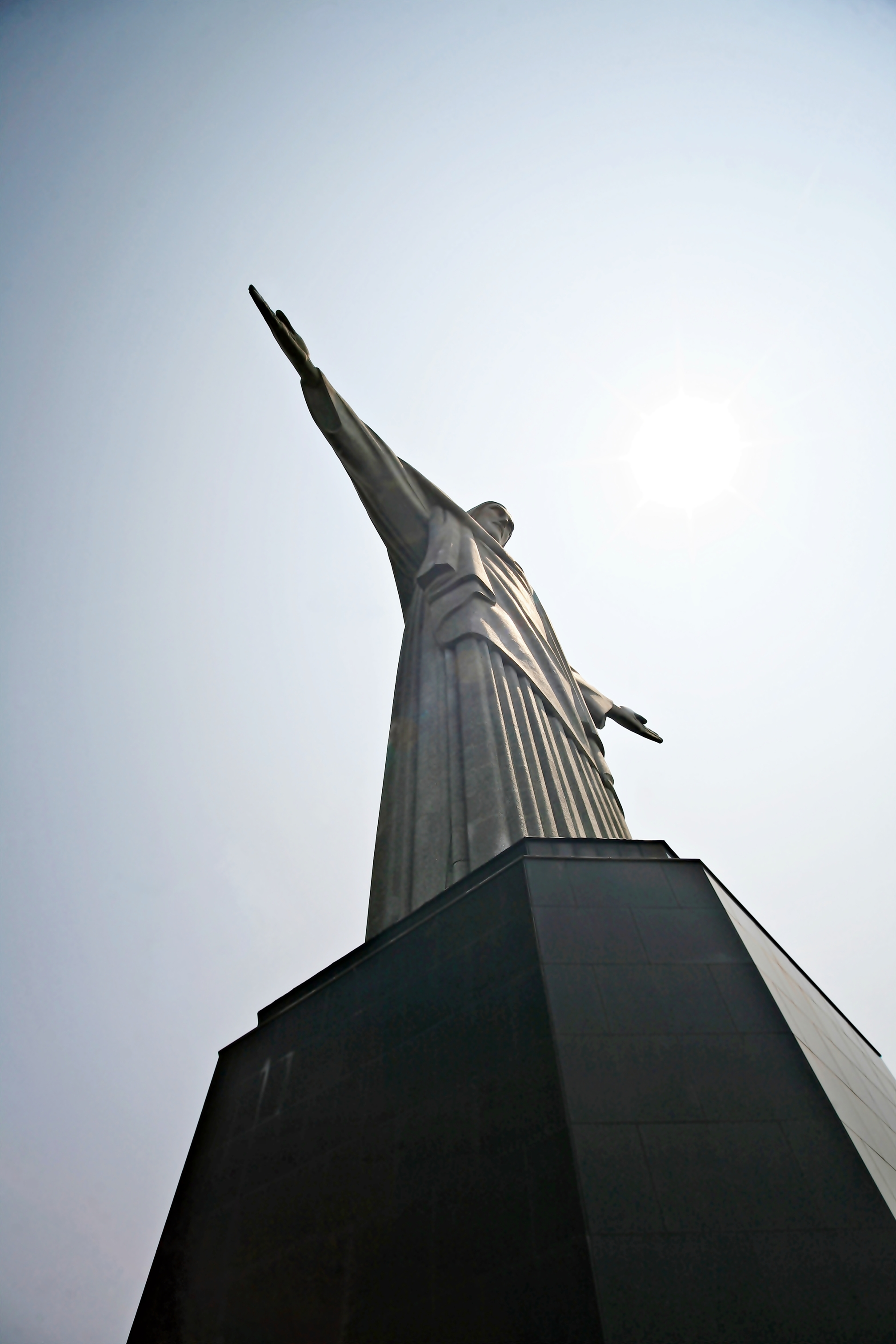
Wiki-image by Laszlo Ilyes of Christ the Redeemer statue is used according to the Creative Commons Attribution 2.0 license. Wiki-image of Resurrection Angel by Plasmoid is used according to the Creative Commons Attribution ShareAlike 3.0 license.

Sunday, October 18, 2009

Sunday word, 18 Oct 2009

29th Sunday of the Year (18 Oct 2009)
Is 53. 10-11; Ps 33; Hb 4. 14-16; Mk 10. 35-45
Homily of Fr. Paul Panaretos, S.J.
Toward Living More Faithfully

The church wants us to think differently; to think “outside the box,” as the current phrase has it. The early Christians did that more easily than we do. Our inquiring minds prefer one-to-one matches: the first among you will be the slave of all. Jesus was human. Jesus is divine.

The first example, the first among you will be the slave of all, is very difficult for us to own, so we make it an ideal rather than a practice, or we reject it altogether. To first [I must] be the slave of all we say, “I can’t do that.” Yet, that is certainly a different way of thinking.

It doesn’t get easier thinking about Jesus. It is not that Jesus has no one-to-one match, but that we can better appreciate Jesus with one match after another! Jesus was human. Jesus is divine. Jesus is our high priest. Jesus, Son of God, sympathizes with our weakness. Our Messiah was crushed with infirmity, the way he shall justify many.

The word priest to describe Jesus is not isolated in scripture’s Letter to the Hebrews. Jesus as priest seeped early into Christian vocabulary and Christian imagination. Yet it didn’t stop one early Christian pastor from describing a deacon’s task as imitating Jesus. /1/ Nor did it stop another early Christian pastor from calling Jesus the first deacon! Of course, both of them would have called Jesus priest as well.

Serving others describes well what Jesus did. Jesus’ service sought to improve, to develop the life of people. It worked this way: Jesus began what people continued. Jesus healed some and they followed Jesus, providing for him and his disciples from their means. Jesus called others to continue his work, a call that was a discreet moment yet echoed through the lives of those called and beyond them. Jesus gave new hope, new energy, new purpose to people, and with that new hope, new energy and new purpose people reoriented their lives. Jesus began, people continued; and, Jesus sustained what people continued.

This Year of the Priest includes every Catholic. It would be impossible to celebrate otherwise. It helps us think differently, more broadly, to be precise, about priests. The Second Vatican Council noted priests have three functions: to “preach the gospel and shepherd the faithful and to celebrate divine worship.”/2/ This year of priests invites Catholics to appreciate not only what they routinely see and enact with priests, mass and other liturgies. It reminds us that priests are to renew the priority they allow scripture to have on them so that their ministry will be a relationship of caring service. Caring service shapes our relationships with one another, no matter one’s particular vocation. Even the pope is called the “servant of the servants of God!”/3/

Plus, the pope is called the first missionary of the church, remembered each Mission Sunday. Christian mission is less about what any Christian controls and more about feeling in the control of, that is, enveloped and steered by something greater than self. That something is the power the earliest Christians experienced and to which they witnessed by their lives. It remains ever new, which is one reason it will always feel like it doesn’t fit and challenge us to think outside the narrow confines of our experience and imagination.

My visits to missions in Brazil, Sri Lanka and India remind me how narrow my experience and imagination is, and how others allow their lives to be guided and steered by the power of our crucified and risen Messiah. Priesthood, missionary, slave of all offer us the power of more supple imagination and bolder experience. To think differently this way is to think and to live more faithfully.

In your daily 15 minutes with Jesus this week, refresh yourself in the presence of our Triune God. Ask your patron saint to present you to Jesus. In your words thank Jesus for the many avenues to serve in his name Gesu offers you. Ask Jesus for the grace to renew your exercise of pastoral care in one ministry and so deepen your friendship with him. Close by saying slowly the Lord’s Prayer to remind us to think differently, that is, to consider ourselves and others with the mind and attitude of Jesus./4/


____________
1. Ignatius of Antioch: “Let the bishop preside in God’s place and presbyters take the place of the apostolic council and let the deacons...be entrusted with the ministry of Jesus Christ” (Letter to the Magnesians, ch 6); Also, Ignatius of Antioch: “In like manner let everyone respect the deacons as they would respect Jesus Christ, and just as they respect the bishop as a type of the Father, and the presbyters [priests] as the council of God and college of Apostles. Without these, it cannot be called a Church” (Letter to the Trallians, ch 2; quoted in Catechism of the Catholic Church, 1554).
2. Dogmatic Constitution on the Church (Lumen gentium), 28.
3. Paul VI restored this 6th Century appellation, first used by Gregory the Great.
4. See St. Paul’ Letter to the Philippians, ch. 2-3.
____________________________________________
Wiki-image of San Biblia church doors by Giovanni Dall'Orto, who gives permission for its use. Wiki-image of Jesus washing his disciples' feet is in the public domain.