Saturday, August 22, 2009

Saturday word, 22 Aug 2009

Queenship of the Blessed Virgin Mary (22 Aug 2009)
Ru 2. 1-3,8-11, 4. 13-17; Ps 128; Mt 23. 1-12
Homily of Fr. Paul Panaretos, S.J.
Courageous, Loving Humility


This memorial celebrating Mary’s queenship is younger than we are. Yet in the 4th Century, poet-St. Ephrem called Mary “queen.” Reflecting on her annunciation, Ephrem sang, “Mother of God, queen of the universe, you are above all the saints, the hope of the patriarchs and the joy of the saints.” In a prayer he composed, Ephrem called the “Mother of God,” “...Queen of the world, hope of those who are in despair: You are the joy of the saints; you are the peacemaker between sinners and God….”/1/

When we pray “Hail Holy Queen,” when we ponder the rosary-mysteries of her assumption and her queenship of heaven and earth, we touch an ancient detail of our church’s tradition.
The first reading about Ruth suggests that Mary’s royal reach exceeds Catholics and other Christians. Islam, too, reveres Mary. Many people with no affiliation with faith don’t fight to get out of Mary’s orbit. Indeed, the queenly “consolation of the world”/2/ does not discriminate on the basis of faith or even on how well people, who claim faith, live it.

The first reading about Ruth recalls God’s love is universal and worked in all things and people so that in the fullness of time Mary’s Son would live, die and rise to absolutely new life. Ruth, not a Jew, was kind to her Jewish mother-in-law and sister-in-law. The people praised the foreigner because she loved her husband and his mother, Naomi. People said to her, “[Your] daughter-in-law...loves you. She is worth more to you than seven sons!” Ruth was the grandmother of David, is whose line Jesus was born.

Jesus’ matriarchal ancestor, Ruth, was also modest: Freely showing deference, Ruth said to [Boaz], “Why should I, a foreigner, be favored with your notice?” Hers was not false humility nor poor self-esteem; she was not puffed up.

Being puffed up, a phrase St. Paul used/3/, is a human temptation, and it’s more seductive when one knows privilege. If following Jesus is a challenge, then it’s a daily one of aligning hearts and minds with strong, courageous, loving humility, which shapes us not honors, privilege or moral superiority. That’s how Jesus encouraged his disciples to differ from the scribes and the Pharisees, who occupied…the chair of Moses. Jesus was not merely advising, “Practice what you preach,” because anyone can do what is right without have one’s heart in the doing.

Staking one’s heart and life on this new way instead of on privilege is the royal/4/ way Jesus embodied and proclaimed. What Jesus embodied and proclaimed returns us to the “Queen of world” and “of the universe.” Rejoicing in Mary’s Assumption and Queenship increases our joyful courage to anticipate her destiny by the ways we live.

____________
1. Ephrem’s Marian Prayer calls Mary “queen” twice.
2. Ibid.
3. 1 Corinthians 4. 6, 18, 19; 5. 2; 13. 4; Colossians 2. 18.
4. See James 2.8.

_____________________________________________
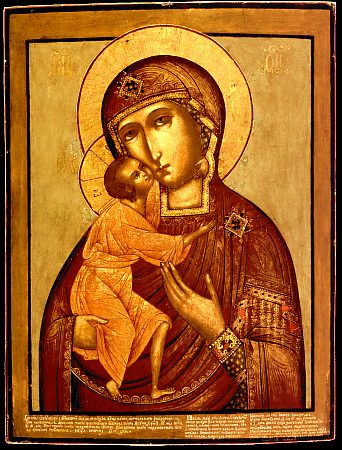
Wiki-image of icon of Mary is in the public domain .

Friday, August 21, 2009

Catholic Job-hunting site

Just discovered:
CatholicJobs.com features free job listings for Catholic organizations, as well as free job searches and career tools for anyone seeking employment.
Description is from the site's home-page. People may customize to make this domain their home-page. Check it to see it's offerings updated regularly.

Sunday, August 16, 2009

Sunday word, 16 Aug 2009

20th Sunday of the Year (16 Aug 2009)
Prv 9. 1-6; Ps 34; Eph 5. 15-20; Jn 6. 51-58
Homily of Fr. Paul Panaretos, S.J.
Graced Self-Knowledge

The struggle to understand Jesus’ words about his self-proclaimed identity as the bread...from heaven and his life-giving quality astonished his hearers, who quarreled among themselves, saying,“How can this man give us his flesh to eat?” I want to reflect briefly with you on this astonishment then on communion’s effect on us.

This part of the Fourth Gospel remains difficult to appreciate for one reason because it challenges interpreters of scripture. It’s also difficult to appreciate because humans then and now object to cannibalism./1/ Yet, in the earliest days of the church that’s exactly one charge leveled at Christians. The Romans were a modest people, although exceptions existed, which isn’t different from us. Anything that deviated from their accepted norms was objectionable. The way to deal with the objectionable was to call it as one thought it was. People were accurate sometimes but not accurate at others, as with the Christians.

One defender preserved these discrediting remarks. These are mild ones. We are in church, after all.
[Christians] know one another by secret marks and insignia, and they love one another almost before they know one another; everywhere also there is mingled among them a certain religion of lust, and they call one another promiscuously brothers and sisters...it is thus that their vain and senseless superstition glories in crimes.”/2/
Brother and sister, the common way Christians called each other confused those who did not share their unifying experience with and in Jesus. The cannibalism charge is too gory to relate; see my blog. My point is that people in the days during and after Jesus took very seriously their norms and their religions.

Earliest Christians had something we lost: a freedom to imagine themselves in the past and future as well as the present./3/ We connect with their freedom at mass when we proclaim the mystery of faith: Dying you destroyed our death, rising you restored our live, Lord Jesus come in glory! That form includes us. Another form, Christ has died, Christ is risen, Christ will come again, does not include us, which may impress us as no more than a mental act of remembering just as the ones that include us.

Yet the earliest Christians were not mentally remembering during their eucharistic celebrations. They were doing as Jesus told them—and us: Do this in memory of me. Memory was less mental and more active.

Each celebration made present the past—at the altar, what Jesus did; and the future beyond the altar in daily life—Jesus at work in and through believers. This freedom, Jesus past work alive in the present with power to reshape the future, is less not forgetting than enjoying graced self-knowledge. Our sacramental eating and drinking at the Lord’s table is our communion with Jesus; our communion with him, deepened by our sacramental eating and drinking, also helps us recognize ourselves on mission with Jesus and each other.

Christian self-knowledge is practical now as then. Christian self-knowledge is wisdom. Wisdom is not knowledge; wisdom puts to good use what we know and what we believe. St. Paul calls us to be wise, and told us what he meant: Watch carefully how you live, not as foolish people but as wise...do not continue in ignorance, but try to understand what are the Lord’s desires for you. Eucharistic eating and drinking intensifies our relationship with Jesus and helps us grow more alert to what Jesus invites each of us to do in his name day to day.

In your daily 15 minutes with Jesus this week, be alert to the Trinity choosing you. Ask your patron saint to present you to Jesus to converse with him. Confide in Jesus your astonishment at this invitation to feast on him. Recall a communion that moved you, changed you, strengthened you, and tell it to Jesus. Write it as a letter to Jesus if you find that helpful. Ask Jesus to deepen your longing for him to keep inviting you to join him and to give you courage to join him. Close by saying slowing the Lord’s Prayer, pausing to desire at its phrase, daily bread, that the eucharist will keep you close to Jesus and to others.


____________
1. One charge of it is in Minucius Felix Octavius, R. E. Wallis, trans., The Ante-Nicene Fathers (Buffalo, N. Y.: The Christian Literature Publishing Co., 1887), Vol. 4, pp. 177-178.

2. Ibid. The tamer remarks! Of course, New Testament writers witnessed that Christians referred to one another as brothers and sisters (James 2.15) and greeted one another with a holy kiss (Romans 16.16).

3. David Bennett offered this insight to this freedom: “The Greek word for remembrance, anamnesis, does not imply simple psychological recollection. Enlightenment rationalistic assumptions have clouded many an interpretation of Jesus' words here. The word anamnesis, as it was often used in ancient times, means to bring the past into the present and the present into the past. In the Eucharist, we truly experience Christ's life, death, and resurrection, and Christ is made present to us, and we are made present to Him. This is far more dynamic than merely remembering something.” In “The Eucharist: The Medicine of Immortality.”

_____________________________________________
Wiki-images of postage stamp recalling a World Eucharistic Congress and of a knight receiving communion are in the public domain.

Saturday, August 15, 2009

Saturday word, 15 Aug 2009

Meredith Nice-Andrew Barnett wedding (15 Aug 2009)
Rv 11.19; 12. 1-6,10; Ps 128; 1Co 12. 31-13. 8a; Lk 1. 39-56
Homily of Fr. Paul Panaretos, S.J.
Destiny

Meredith and Andrew, you give us an opportunity to appreciate together a mystery of Mary and the mystery you are becoming today in Christian marriage. By choosing today for your wedding, its Solemnity of the Assumption into heaven of the Blessed Virgin Mary allows us to consider destiny, very fitting as you begin your married life together. First, Mary modeling Christian destiny; then, you living it through Christian marriage.

Several are the ways to appreciate Mary’s assumption into heaven: as mystery; as her personal participation in her son’s resurrection; as dogma—an article of faith we cannot abandon and call ourselves Catholic; and as destiny.

Christian destiny is not that unwelcome, even cruel, reversal we name fate. Nor is Christian destiny predetermined, insulting human freedom to make life fruitless folly. No! Christian destiny is life with our triune God, as Jesus revealed it and as Jesus fulfilled it in his dying and rising.

The dead-and-risen One shares his absolutely new life in the Spirit with us! Jesus did not reserve it to himself, which is the conviction closing the first reading from the Book of Revelation: “Now have salvation and power come, and the Kingdom of our God and the authority of his Anointed One.” Christian destiny is about being saved, that is, caught up in Jesus’ resurrection-life already.

Mary modeled the already of God’s saving power: My soul proclaims the greatness of the Lord; my spirit rejoices in God my Savior for he has looked with favor on his lowly servant. ...the Almighty has done great things for me and holy is his Name. She shared her joy by caring for her pregnant cousin.

Being saved, that is, being caught up in Jesus’ risen life at our every breath, fuels each one’s Christian life. Christians by their choices and actions grow in union with our Messiah Jesus and one another; living their union with Jesus affects others and the world, infusing the world with the effects of faith, hope and love/1/ and changing lives.

Faith, hope and love: the practical effects of our Christian destiny focus any description of it—like my opening remarks—on concrete action. You allowed St. Paul to remind you and all of us that abiding, mutual Christian love is practical. It will challenge you, at times with some surprise. Christian love, St. Paul reminded, is patient and kind, but sometimes lovers are not. Christian love does not envy or boast, but sometimes lovers do. Christian love bears...[and] endures all things, but sometimes lovers do not. Christian love does not insist on its own way but sometimes lovers do.

That last, Christian love does not insist on its own way, brings us back to the hallmark of Christian love: it’s mutual. Andy and Meredith, I want to affirm what you have allowed me to see: your desire to live a Catholic marriage. I also want to remind you that at each step of making one life together, Jesus accompanies you, drawing you and your love for each other into the mutual love, which his Father and Jesus and their Spirit enjoy—our destiny. You’ll never lack for Jesus’ companionship blessing your love with the love of the Trinity.

Your mutual compassion for one another will fashion you from today as a domestic church./2/ Your married life will help you save each other’s souls and welcome “children lovingly from God”/3/; your married life will also allow Jesus to work through you for the sake of the world. You will never lose your individual selves. In Christian marriage both of you will strive to make one life together.

Even more than the way you give love, the way you receive love from each other will allow Jesus to guide you on that still more excellent way, your mutual compassion. Jesus embodied and models compassion for you and for all, and continues creating you to be the man and woman God desires you to be for each other. Your married life, with its challenges and its privileged joys, will allow you to live your Christian destiny and help others to live it, too.

I mentioned joys and challenges. Joys are obvious, challenges need a word. Together you have already had your share of challenges, recently the death of Andy’s grandmother. Loss is always a challenge. Not as recent but still fresh is the challenge you negotiated when we began marriage preparation. You negotiated it well, and I remember how emphatic you were that marriage preparation could not have come at a better time for you. While challenges demand our attention and energy, challenges are not without opportunities. The opportunity of living faith, hope and love affects you as spouses by deepening your intimacy, drawing you closer and blessing us and the world with yet one more expression of Christian destiny.

Meredith and Andrew, I’m very proud of you and, I wish you every good thing. I congratulate you on behalf of the church. It is true that Jesus created you for one another. It is even more true that Jesus will create you each moment for everything ahead of you. Please remember that in pledging yourselves to each other you allow Jesus to work through you for our Christian destiny—the salvation of each other as well as our world. As you forge one life together Jesus begets something new: a new harmony to feel Jesus creating you and your mutual love for each other, and to help us and others feel Jesus recreating the world to taste his salvation and power.


______________
1. See Decree on the Apostolate of the Laity, 4, of The Second Vatican Council.
2. Dogmatic Constitution on the Church, 11, of The Second Vatican Council.
3. Rite of Marriage, Ch.2: 42.
_________________________________________________________________________
Wiki-images by Jason Hutchins of exchanging wedding rings and by pabloendemico of Calceolaria cana are used according to the Creative Commons Attribution 2.0 license .

Wednesday, August 12, 2009

Word about the Word

Because Jesus reassured that "when two or three are gathered in my name, I am in the midst of them" (Matthew 18.20; from today's gospel at mass), the statement is not fluff. Does it mean something for contemporary Christians?

His promise rests between the being-with bookends of this gospel: Jesus is Emmanuel, which means God with us (1.23), and I [Jesus] am with you always (28.20).

In what ways is God with us? Fr. Jack Mahoney invites readers of a Thinking Faith online-essay to explore that.

Tuesday, August 11, 2009

Updated Website for Catholic Charities USA

The sanctity of life and human dignity drive the vision and mission of Catholic Charities, which seeks to serve people in need and eliminate oppression in all its forms. Each diocese in the United States has a Catholic Charities to help people to serve as well as to be served. The updated website is a treasure trove of information, inspiration and facilitates taking action on behalf of and for others.

Catholic Charities USA is a member of Caritas International.

Monday, August 10, 2009

Monday word, 10 Aug 2009

Monique Gonda memorial mass
(11 Aug 2009) Is 25. 6a, 7-9; Ps 23; 1Jn 3. 1-2; Mt 5. 1-12a
Homily of Fr. Paul Panaretos, S.J.
Divine Doing

On behalf of Gesu Parish, I extend our prayers and heartfelt sympathy to you, Les, Doug, Chris and Karen at the death of your mother, Monique. Your children grieve, too. Your mom’s final months were long and challenging for you as well as her. I know what that’s like because my sister informed me while I was living in Asia that Alzheimer’s began to manifest itself in our mom. When I returned in six months I was able to help my sister, who had been doing the lion’s share of being with our mom and getting her good care.

Although my mom is still alive, I grieve often as she lives her long good bye, as Alzheimer’s is aptly called. I pray that you be more courageous than your grief is sharp. Your confidence in our risen Messiah will help you grieve well and come to experience your mom’s presence in real and new ways.

Today the Catholic church bids farewell to one of hers. I offer a few words to console and strengthen you in your grief; to help you appreciate God’s astounding compassion by noticing Jesus’ victorious dying and rising were present in Monique./1/

We are grateful for the words of remembrance Doug, Chris and Karen offered. They helped us connect your mom and her passing with the mystery of Jesus’ death and resurrection. I am grateful to Karen for selecting the scriptures proclaimed at Monique’s memorial mass. They shape my brief reflection with you.

I met Monique at University Hospital after Monique’s surgery. Even in her pained weariness, Monique was delightful. She looked very tired, and I asked her if she slept at night. Monique told me she did, but the most draining thing for her after her abdominal surgery was sitting up in bed. That was more tiring than the short walks she made to restore muscle tone and her body’s energy.

Unfortunately, Monique was unable to make steady progress. That is particularly painful to you, her children and friends, because Monique was vibrant. Her final illness and its repercussions challenged her in many ways, particularly in letting go.

Not only did we staff members who visited Monique these many months notice her weakening, we also noticed her resistance in the face of it. This resistance is no shortcoming or failing; it is part of our human condition. Being with Monique did not mean that you, Les, Doug, Chris and Karen, or any of us could affect changes that would restore her health. Being with her--whether in person or over distances that separated you--was more important than anything you did. Being with Monique was more–life-giving than doing for her.

I saw that at The Normandy when I visited Monique there. More than once did I see a caregiver sitting with a resident outdoors or in the person’s room. One day when I arrived at Monique’s room, caregiver, Debbie, was sitting in a chair at the head of her bed. That was what Debbie was doing. She spent more time doing that than any other service she performed to ensure Monique’s comfort. I did that, too.

Why is that so important? All of us can name challenging times in our lives when people accompanied us through a challenge. All of us can recall how important their presence was, although they could and did not change our circumstances.

Monique weathered many challenges in her long life, from her youth in France to raising her family in the States and seeing them grow to adulthood. For a vivacious, thinking and thoughtful Monique, her challenge to let go--of her strength, of her routine, of her house, of her independence--Monique’s challenge to let go was steep and lonely. That’s why to have company was so important for her; why it was so life-giving because everything by which Monique measured her life was ebbing.

Vivacious Monique did not want to die. I know she didn’t because a caregiver observed what I observed, and Karen confirmed that.

Of course, Monique’s life is changed not ended./2/ That conviction of our faith challenges us to let go of Monique--she is not available to you, her family and friends, as she was--even though our desire and the assurance of our faith promise that we shall be reunited when Jesus returns in glory with salvation for his people./3/ It is during the interval while we await Jesus’ return, the resurrection of the dead and our reunion with them that we need graced companionship. That’s why we come here. We pray for ourselves as much as, or even more, than for Monique.

Graced companionship is not limited to church. God works in every moment of our lives. At each moment our triune God creates us. When people enjoy clarity rather than live under a veil, to use Isaiah’s image, people enjoy God’s companionship. When we experience anew our connection with God--St. John described that connection as being children of God--we enjoy God’s companionship. Jesus revealed the implications of being children of God throughout his life on earth.

When she was still alert and able to communicate, Monique remarked to her family that at The Normandy she felt love--loved by the caregivers and some of the residents. Monique’s final journey to let go and to accept God changing her life not ending it is Monique’s lesson to me. Being accompanied means we allow others to love us, we allow others in, we allow God in. Allowing others is active; it doesn’t seem so because we are not in control. The Beatitudes challenge us precisely to welcome God’s loving kindness each day so that, like Monique, we will one day be able to rest in God’s merciful doing and enjoy new life, life more vivacious than we can imagine.

Until we enjoy God’s life in an unveiled way and rejoice to see God as [God] is, graced companionship in its many forms, especially as human accompaniment, we will recreate us and wipe away the tears, which blur our faith-vision and challenge us to live it.


___________________
1. Cf. Order of Christian Funerals, 27.
2. Preface for
Christian Death I, Roman Missal.
3. Penitential Rite (C,ii), Roman Missal.
________________________________________________
Wiki-images of Jesus announcing the Beatitudes and of the New Jerusalem are in the public domain.

Sunday, August 09, 2009

Sunday word, 09 Aug 2009

19th Sunday of the Year (09 Aug 2009)
1Kg 19. 4-8; Ps 34; Eph 4. 30-5.2; Jn 6. 41-51
Homily of Fr. Paul Panaretos, S.J.
Two Ways

All writings offer perspectives: those ways authors communicate through their writings. One perspective, which the Fourth Gospel offers, is that two ways of living exist. One way is familiar, and we can gain access to it. The other way we receive as a gift; our efforts cannot make it possible.

The familiar, customary way of living even offers us apparent security. The Fourth Gospel uses the phrase, the world, to name our familiar, customary way of living. Some characteristics of the world, along with familiar and customary, are visible, measurable, available through human effort. Of course, what may be familiar to one may not be to another, and what makes one person feel secure may threaten another. Thus, one more feature of the world may be summarized as often divided rather than united.

The other way of living harmonizes with Jesus and his good news. We do not always perceive his good news as good because it challenges us both to adopt and to exercise in our daily living the values Jesus revealed in his person and continues to reveal by his Spirit, whom he gives us.

Jesus’ word challenges us to move beyond our security and to live his life. Jesus pointed out that the world on its own cannot fulfill us and satisfy our deep longings. In the language of the Fourth Gospel values of the world are empty and misleading. These clearly different ways do not mean that creation is evil or that it is without value. Indeed, God surveyed all creation and found it very good./1/

To live the Christian life seeks to balance living in the world and exercising the values of Jesus and his gospel. At times the world does not favor Jesus’ values or those who try to live them. To live the Christian life also respects and cherishes our humanity and keeps alert to the ways Jesus offers us his divinity and invites us to incarnate it by our living day to day.

That Jesus offers us divinity and invites us to reveal it reminds us that his offer and his invitation are grace; neither is the result of human effort.

To use words from the lips of Jesus, we may say that his offer of divinity and his invitation to reveal it to others by how we live came down from heaven. The language is spatial, but its meaning is more real than space or place. God’s continues to make self-revelation; Christians try to align themselves more with who God is and what God desires.

God’s gift in Jesus by their Spirit began in each of us at baptism. We come to the Lord’s table and share in his body and blood because the eucharist nourishes and sustains what baptism began. One liturgical guide expressed that this way. “The food of the eucharist becomes for us, not a sort of accessory, but the very source of growth in the word of God. It is not just a religious ceremony for one hour a week, but it becomes a way of living our faith.”/2/

When the eucharist is not “a sort of accessory,” it allows Christians to shed bitterness, fury, anger, raised voices and cutting speech and to exercise kindness, compassion and to forgive because God has forgiven [us] in Christ. St. Paul was always practical in encouraging people to live the faith of Jesus!

In your daily 15 minutes with Jesus this week, become alert to the presence of our triune God around you, embracing you and vibrating in every cell of your being. Ask Elijah to renew your confidence in your life and your faith and to present you to Jesus. Converse with Jesus: lay all your doubts at his feet; ask Jesus to help you be more alert to how Jesus offers you divine life and more alert to how Jesus invites you to reveal it by your daily living. Close by saying slowly the Lord’s Prayer, pausing to desire at its phrase, daily bread, that the eucharist will never be for you “a sort of accessory” but nourishment to exercise your faith and trust in Jesus and to live it with greater vigor and joy.


Link to this homily's Spiritual Exercise
___________
1. Genesis 1.31.
2. Kevin Irwin, Sunday Worship: A Planning Guide to Celebration. New York: Pueblo, 1983, p. 247.
____________________________________________
Wiki-images of Jesus feeding the multitude and a mosaic floor is in the public domain.

Saturday, August 08, 2009

Saturday word, 08 Aug 2009

St. Dominic, Memorial (08 Aug 2009)
Dt 6. 4-13; Ps 18; Mt 17. 14-20
Homily of Fr. Paul Panaretos, S.J.
Itinerant: His Practical Approach

"If he hadn’t taken a trip with his bishop, Dominic would probably have remained within the structure of contemplative life. . .” so began a brief summary/1/ of St. Dominic. This year’s semi-continuous scripture readings are apt for the founder of the order of men and women, which bears his name, particularly the familiar words from Deuteronomy:
Hear, O Israel! The LORD is our God, the Lord alone! Therefore, you shall love the Lord, your God, with all your heart, and with all your soul, and with all your strength. Take to heart these words…Drill them into your children. Speak of them at home and abroad, whether you are busy or at rest.
The key phrase is, Take to heart. This means personal appropriation not just memorization or mental knowing. Personal appropriation includes living one’s relationship with God our Lord. On that “trip with his bishop” Dominic noticed that was not happening.

Their trip took them to Spain’s home territory of the Albigensians, who lived a heresy with several earlier incarnations. They considered all material things to be evil. You can imagine the implications of such a principle: sacraments were evil; also the body--which meant procreation was evil and so was healthy eating. Their behavior flowed from their belief: the Albigensians did not believe a good God could create a world filled with pain and suffering. Purists--Albigensians called themselves the Pure--in any age have great difficulty being realists.

St. Dominic wanted to curb and correct this distorted view of God, the world and people. Preachers came and went, but many “traveled with horse and retinues, stayed at the best inns and had servants.”/2/ The Pure, of course, and others rejected them. So Dominic began to move about humbly with three Cistercian monks.

Cistercians, more often called Trappists, emphasized manual labor and self-sufficiency. This preaching effort, in imitation of the apostles, led to the Order of Preachers. Its membership seeks to keep alive Dominic’s ideal: “to pass on the fruits of contemplation.”/3/ This describes the vocation of most of the faithful in the church.

God calls less of us to focus our lives on contemplation only. Indeed, St. Ignatius of Loyola, born 270 years after Dominic had died, was very fond of Dominic. St. Ignatius recognized that contemplation is important and is the foundation of action. Long before Ignatius and his contemporaries/4/ coined the phrase “contemplatives in action,” St. Dominic lived it. Many of us here are called to live that way as well.

____________
1. Saint of the Day, 08 Aug at AmericanCatholic.org.
2. Ibid.
3. The meaning of
contemplata tradere.
4. Jerome Nadal, S.J., gave particular emphasis to this phrase in his recollection of St. Ignatius.

____________________________________________
Wiki-image of El Greco's St. Dominic is in the public domain.

Friday, August 07, 2009

August sky

August hosts the Perseid metershower.

Viewers want clear skies and do well to nap in order to be awake in the wee hours.
_______________
Wiki-image by Mila Zinkova of trajectories of two meteorites is used according to the Creative Commons Attribution ShareAlike 3.0 license.

Thursday, July 23, 2009

July Sky

The AccuWeather.com site may be consulted most often for temperature and weather patterns.

The site also has an Interests tab along the top and near the right-end of the series of tabs located their.

Astronomy is the first of several categories. With data from the Hubble Telescope, one can enjoy a good video-preview of the night sky. Of course, automatically one checks the day's weather to see if clouds or rain will frustrate the anticipation of viewing the sky with the human eye.
____________________________________________
Wiki-image by Vinish K Saini of a view of the moon and Venus is used according to the Creative Commons Attribution ShareAlike license 2.0.

Wednesday, July 22, 2009

No Casual Calamari

In San Diego, California, divers and cruising pods of Humboldt squid (also called "flying squid" and diabolos rojos [red devil]) had surprising and even frightening encounters.


The CSM article also boasts a 2008 photo of other Humboldt squid out of their element. No mention of Jules Verne and his imagined squid suggests these squid were also out of the running for giant category.
____________________________________________
Wiki-image of a stamp bearing an image of a squid is in the public domain.

Tuesday, July 21, 2009

On Vacation

A recent opinion column about Pope Benedict's most recent encyclical.

Monday, July 20, 2009

On Vacation


A 2008 story of Bellarmine House, the villa of the Jesuit Community of Boston College, has an intersecting history of architecture, names and uses.


______________________________________________________________
Wiki-image of Minot Light House is in the public domain.

Sunday, July 19, 2009

Sunday word, 19 Jul 2009

16th Sunday of the Year (19 Jul 2009)
Jr 23. 1-6; Ps 23; Eph 2. 13-18; Mk 6. 30-34
Homily of Fr. Paul Panaretos, S.J.
Offering What We Receive

Scriptures grace us provided we are open and do not read them according to our categories of thinking. The ancient Mediterranean people and their culture—Jesus’ kin and culture—differed from ours in many ways. I’m about to leave on vacation and rest, relax and enjoy the time with others at the ocean. I can count on an easy pace in a quiet setting, but if I need something, I can walk to a market to get it.

The less hurried place I will visit is not at all like the deserted place to which Jesus called his disciples, who returned from their mission of preaching repentance to prepare Jesus’ way. People lived in small hamlets of not many people. A town like Nazareth may have ranged from 50 to 150 people. People knew one another too well for our liking—and maybe for theirs!

Between their towns and hamlets were large open spaces, undeveloped by nature or humans. Moving through them was no walk in the park, nor was moving through them anything but hostile: no CVS, Target or Giant Eagle to get a much needed bandage, new dish or food to fill it.

Great was the need to take care and to care for children, older people as well as animals when traversing deserted places. Jesus noted necessity to enter such a place. People were coming and going in great numbers, and [Jesus and his apostles] had no opportunity even to eat. If people could be nosy and interfering in ordinary circumstances, then the comings and goings of great numbers of people probably to gawk at Jesus and his apostles would have been too much to take.

The gospel injects humor into the scene, adding, People saw them leaving and many came to know about it. They hastened there on foot from all the towns and arrived at the place before them. How they kept their eyes on Jesus and his followers!

Jesus responded to them all with compassion. The image of shepherd, long before Jesus and Jeremiah, was united with royal leader in the person of David, the shepherd-king. The union of shepherd and leader emphasized care for people, suffering with people—compassion. God desired all rulers of God’s people to embody compassion. Because we share in our Messiah Jesus’ royal leadership by baptism, God desires us to show compassion in all our dealings.

Compassion does not call anyone to be a doormat for others. It does call us to imitate God’s heart as much as we humans can. How do we imitate God’s heart?

First, we can do that by being in touch with God. Cultivating our relationship with our Creator and Redeemer includes allowing ourselves to be embraced by Jesus, being nourished by his word and his sacraments, aligning ourselves with Jesus’ banner of cross-leading-to-resurrection. Allowing ourselves to be embraced by Jesus, nourished by him and aligning ourselves more closely with Jesus take many forms of personal prayer, public worship and Christian service. We are fortunate that Gesu Parish and School offer us so much assistance in all those ways.

Second, we imitate God’s heart when we extend to others what God has done in and for us. Living as one reconciled by God in Jesus by their Spirit; extending to others the goodness and kindness they offer; and inviting others to enjoy what we enjoy, that access [we have through Jesus] in one Spirit to the Father. That is how we live divine love through our frail, human bodies. Christian love is not about being perfect, it’s about freeing ourselves to be led, nourished, guided and perfected by our Good Shepherd.

In your daily 15 minutes with Jesus this week, pause in the love our triune God shines on you. Ask the apostles to present you to Jesus so you may converse with him. In your words thank Jesus for his patience with you; savor one way you have enjoyed his goodness and kindness he has offered you. Ask for Jesus to help you deepen your desire to welcome his faithful love at each moment. Close your time saying slowly the prayer Jesus taught us. Praying it allows Jesus to transform us to be his apostles of reconciliation today.

Link to this homily's Spiritual Exercise


_____________________________________________
Wiki-image of Jesus and apostles is in the public domain.

Saturday, July 18, 2009

Israeli Soldiers

What do some Israeli soldiers think about the January 2009 Operation Cast Lead?

Gaza was the objective of that operation. The website, Breaking the Silence, offers soldiers' Testimonies divided into several categories. This is not the first time some Israeli soldiers have protested and objected to their orders.

Monday, July 13, 2009

Road Map for the Pope's Newest Encyclical

Jesuit Father James Hug has made available on the Center of Concern website a precis to the encyclical, Caritas in Veritate (Charity in Truth).

It downloads as a portable document file (.pdf). It is in sentence-outline format and is a great help to read before, with and after reading the pope's full text.

Jesuit Father Brendan MacPartlin wrote a briefer overview of the encyclical at the British Jesuits e-zine, Thinking Faith. He
considers the vision delivered in this long awaited document, which picks up on the themes of Populorum Progressio to look at issues of development and social action: ‘Charity in truth drives the authentic development of all persons.’


________________________________________________________________
Wiki-image by Odder of road sign is used according to the Creative Commons Attribution ShareAlike 2.5 license.

Sunday, July 12, 2009

Sunday word, 12 Jul 2009

15th Sunday of the Year (12 Jul 2009)
Am 7. 12-15; Ps 85; Eph 1. 3-14; Mk 6. 7-13
Homily of Fr. Paul Panaretos, S.J.
Transformers

We may not see much for us in the Word today. Amos was one of the prophets, Jesus sent out apostles with him to prepare his way by preaching repentance and St. Paul praised and thanked God in an extended way in his letter to the Ephesians, a single letter originally meant to be read in many churches.

Popes write encyclicals for the world church. We don’t preach dramatically like Jesus’ apostles or cry out like the prophet Amos. Popes, apostle, prophets: they all seem out of our league, don’t they? Nevertheless, the scriptures do address us. The common denominator is that God chose and continues choosing unprepossessing people like us.

Amos was a shepherd and pruner of trees. Many of the apostles were fishermen. All St. Paul’s learning and religious zeal were no antidote to his human weakness. God’s way of operating throughout the ages has been consistent: to choose ordinary people for the extraordinary desire of God, the salvation of the world. Jesus fulfilled God’s desire as he set ordinary people in motion to do just that: Jesus summoned the Twelve and began to send them out two by two and gave them authority over unclean spirits. He instructed them to take nothing for the journey but a walking stick.

If we think in our western and modern ways, we miss how extraordinary was the authority Jesus gave them. You and I think nothing of traveling. However, in the ancient Mediterranean one would not travel unless one had to leave the extended family and the village because both provided a social network and the necessities of daily living.

Further, the ancient Mediterraneans believed in nonhuman beings and ranked them according to power: our God—the God of Abraham, Isaac and Jacob—other gods, archangels, angels, spirits and demons. Jesus’ people called demons unclean spirits, who disturbed human well-being in all manners of ways. Jesus, authorizing his apostles to have power over unclean spirits, gave them new power.

You and I may be mesmerized by power and miss how Jesus sent them: two by two. Each was an extension of the apostolic band, and each was an extension of the other’s extended family, providing the social network so important to living a human life.

Jesus transformed our humanity by his death and resurrection. Jesus sends us, too, ordinary people that we are, to continue his transforming work. By baptism we
share in the priestly, prophetic, and royal office of Christ [Jesus] and therefore have [our] own role to play in the mission of the whole People of God in the Church and in the world. [What is our mission? We]...bring[] the gospel and holiness to [all], and [transform all] things through the spirit of the gospel./1/
We are one another’s support to continue the mission of Jesus. Travel today, as popes, presidents and ordinary people like us testify, is not the limited or even dreaded activity of Jesus’ culture. Our closeness, support, encouragement and companionship are just as important for us as in his culture. Perhaps it is more important because we tend to privatize faith and to go it alone because our culture values individualism so highly. Yet, God continues to work through individuals, calling them first into communion with Jesus and with one another so that we may allow Jesus to send us for the sake of our world.

In your daily 15 minutes with Jesus this week, pause, aware of being in the presence of the Trinity. Ask the apostles to present you to Jesus. Speak to Jesus your hesitation at being his apostle today. Affirm your trust in Jesus and ask for the grace to infuse your world with Jesus’ Spirit by the way you live. After several minutes, close your prayer by saying slowly the Lord’s Prayer, which is our going-on-mission prayer. Saying it keeps us close to the apostles, whose mission we extend as we put into practice our faith, hope and love.

____________
1. Second Vatican Council, Decree on the Apostolate of the Laity 2.
______________________________________________
Wiki-images of the Prophet Amos and the Twelve Apostles are in the public domain.

Saturday, July 11, 2009

Saturday word, 11 Jul 2009

Julie Beran-Brice Westhoven wedding (11 Jul 2009)
Gn 2. 18-24; Ps 128; 1Co 12.31-13-8a; Jn 15. 9-12
Homily of Fr. Paul Panaretos, S.J.
Two Making One LIfe


Julie and Brice, you give us an opportunity to appreciate more God’s word as we join in your celebration of the Sacrament of Matrimony. You chose St. Francis Chapel of this university because you enjoyed your first date at John Carroll. Together you made history with your first date. Because yours is the first wedding I witness here, this is our first date at John Carroll to make new history.

Making history: to begin history is part of making history. Weddings celebrate history begun as well as history yet to be lived. Your wedding is about your early history growing into this present moment and opening onto your future, as two individuals making one life together.

In choosing the selection from the Book of Genesis, you confess and proclaim that God, who has created you, has brought you together, and you implore God to favor you in your mutual love and life. The scriptural phrase, one body, is expressed by mutual love and living.

Jesus gave new emphasis to mutuality. It was a new emphasis because from the beginning God made men and women partners. Humans ceded more to men than women from the beginning, too, which frustrated God’s desire for humans. The new emphasis Jesus gave rested in his word abide: abide in my love, which was and is a mutual love sealed by divine love. “As the Father has loved me, so I have loved you; abide in my love.”

You allowed St. Paul to remind you and all of us that abiding, mutual Christian love is practical. It will challenge you, at times with some surprise. Christian love St. Paul reminded is patient and kind, but sometimes lovers are not. Christian love does not envy or boast, but sometimes lovers do. Christian love bears...[and] endures all things, but sometimes lovers do not. Christian love does not insist on its own way but sometimes lovers do.

That last, that Christian love does not insist on its own way brings us back to the hallmark of Christian love: it is mutual. Brice and Julie, I want to affirm what you have allowed me to see: your desire to live a Catholic marriage. I also want to remind you that at each step of making one life together, Jesus accompanies you, drawing you and your love for each other into the mutual love, which his Father and Jesus and their Spirit enjoy. You’ll never lack for Jesus’ companionship blessing your love with the love of the Trinity.

Your mutual compassion for one another will fashion you from today as a domestic church./1/ Your married life will help you save each other’s souls and welcome “children lovingly from God”/2/; your married life will also allow Jesus to work through you for the sake of the world. You will never lose your individual selves. Instead, both of you will strive to make one life together.

Even more than the way you give love, the way you receive love from each other will allow Jesus to guide you on that still more excellent way, your mutual compassion. Jesus embodied and models compassion for you and for all, and continues creating you to be the man and woman God desires you to be for each other.

I’m very proud of you and, I wish you every good thing. I congratulate you on behalf of the church. It is true that Jesus created you for one another. It is even more true that Jesus will create you each moment for everything ahead of you. Please remember that in pledging yourselves to each other you allow Jesus to work through you for the salvation of each other as well as our world. As you forge one life together Jesus begets something new: a new harmony to feel Jesus creating you and your mutual love for each other, and to help us and others feel Jesus recreating the world as the world sees you receive love as well as give it and abide in it.

______________
1. Dogmatic Constitution on the Church, 11, of The Second Vatican Council.

2. Rite of Marriage, Ch.2: 42.
_____________________________________________
Wiki-images of Jesus' farewell to his disciples (when he said, "Abide in my love") and of wedding rings are in the public domain .

Sunday, July 05, 2009

Sunday word, 05 July 2009

14th Sunday of the Year (05 Jul 2009)
Ezk 2. 2-5; Ps 123; 2Co 12. 7-10; Mk 6. 1-6
Homily of Fr. Paul Panaretos, S.J.
Seeing Beyond a Conversation

Cultures assess themselves with different criteria. We tend to assess ourselves and others using economic criteria. What we possess or lack shapes our social standing and self-worth. We use other criteria, too, but we seem to give socioeconomic data first place.

My visit over 20 years ago to the mission-parish of the Archdiocese of Detroit in Recifé, Brazil, allowed me to see how wealthy poor people are. The people I met were wealthy in hospitality, happiness and faith. My visit opened my eyes to wealth that is more valuable than money. Those among us who have visited Honduras over the years can say something similar. My visit to Recifé, Brazil, opened my eyes to God at work now in me. My visit helped me see one way today’s readings are related. Let me begin with the gospel.

Wealth affected ancient Mediterraneans. Yet, they assessed themselves even more by honor and shame. Honor came with birth, and people rarely moved beyond the status bestowed by birth. Craftsmen, for example, took pride in making things so that without them no city could be lived in, and that they did not need to worry about hunger./1/ Jesus’ father was a craftsman; carpenter suggests to us a more specific occupation using wood, but in Palestine stone was more available than wood and less costly.

The social expectation was that Jesus, like any son, would continue his father’s work. Craftsmen were necessary, and the idea of doing something different was an alien thought in that culture. Yet, a Jewish man was free to study torah and become well-versed in those holy writings. Still a craftsman—who spent hours at his work and often traveling—did not have the time other men, like scribes or those born into affluence, had to devote to studying the holy writings and the discussions of rabbis preserved for generations.

While Jesus astonished many by his ability to cite scriptures, as well as to converse about and teach them, the majority of people could not give Jesus any more honor than that of a craftsman.
If honor was key in assessing self and others in Jesus’ culture, then shame was its other side. The gospels make clear that Jesus held his own in all kinds of conversations. In the one we just heard in which some withheld from Jesus a prophet’s honor, Jesus quickly took the wind out their sails: A prophet is not without honor except in his native place and among his own kin and in his own house.

If I stopped here I would be simply rehearsing cultural history and how people ascribed honor or not, and how people defended it. What does it offer us now? As fully human, Jesus felt the sting of honor withheld, even though he could defend himself. Defense doesn’t always guarantee acquittal, after all. Jesus was not immune to human hurt or the need for affection. When others left Jesus and he asked his apostles, “Do you also want to leave?”/2/ Jesus was not speaking rhetorically. He felt vulnerable and its painful effects.

Vulnerability in any culture is not easy to tolerate and more difficult to manage. St. Paul also knew vulnerabilities, and one in particular haunted him. Its more than difficult to diagnose someone dead for almost two millennia, plus the distance between his culture and ours makes the effort extremely hazardous. What we can learn from St. Paul is that he used his weakness to remain closer to God, who had vindicated God’s son from a shameful death by raising Jesus to unending life!

The value for us in both Jesus and Paul—with his constant focus on Jesus—is the courage they give us to look differently at our vulnerability: our limits; our foibles; our compulsions; our sinfulness. That difference is to see our vulnerability as a grace to taste God’s consoling presence, instead of how the world would have us see it, as worthless weakness and a shameful blot on our humanity. That is wealth more valuable than money.

In your daily 15 minutes with Jesus this week, pause in the presence our triune God. Ask St. Paul to present you to Jesus, who was intimately acquainted with human weakness. Converse with Jesus: renew your confidence that Jesus was often vulnerable; then speak to him about your weakness. Ask for new courage to see your weakness honestly and to appreciate it as an opening for Jesus to work in and through you. Close by saying slowly the Lord’s Prayer, savoring its phrase deliver us. With that phrase we pray not that God change our circumstances but that God work more powerfully and make us channels of God’s life for and with others to honor and glorify God.


_____________
1. Sirach 38.32. Chapters 38.24-39.11 vividly describe honor and people’s roles in life.
2. John 6.67.
______________________________________________
Wiki-images of Jesus teaching in a synagogue and of a most important papyrus of Paul's words about weakness and grace heard today are in the public domain. [Learn more about
Papyrus 46.]