Tuesday, May 26, 2009

Tuesday word, 26 May 2009

St. Philip Neri, Memorial (26 May 2009)
Ac 20.1-8; Ps 68; Jn 17. 1-11a
Homily of Fr. Paul Panaretos, S.J.
Future Now

Today’s gospel began Jesus’ solemn prayer at the Last Supper. We will hear it through to its conclusion as the gospels at mass tomorrow and Thursday. It is a remarkable blessing because Jesus’ prayer states that the disciples already possessed eternal life/1/ and glory/2/ and were being consecrated/3/ by the love of God in them as it abided in Jesus./4/

One thing making his blessing remarkable is that the disciples shared in Jesus’ glory in the present moment! That is equally true of disciples in each age. Even more remarkable was the fact that the disciples shared Jesus’ eternal life, glory and consecration before Jesus was exalted on the cross!

That the future was already present boggles our minds. We are linear thinkers, after all and our thinking moves in one way, from past to present to future. Jumbling the order is upsetting, to say the least. Worship at the altar, however, jumbles the order without end.
The eucharist, we profess, makes the once-and-for-all sacrifice of Jesus, present at each altar. We profess, too, to share in the divine life now, even though we have yet to share it fully. Fulness in the future does not make divine life more real. More available, perhaps, but not more real. Yet in the present everything, human and divine, is available to us in part not in full.

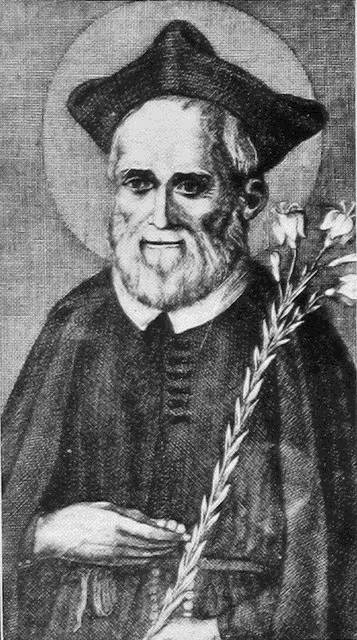
Today’s Memorial of St. Philip Neri, suggests to me that prayer, especially the Eucharist and the Liturgy of the Hours, transposes future, present and past. We ought not try to constrain prayer to our routine approach to time; rather, we do best to follow prayers lead. Philip is known for bringing priests into prayerful fraternity with the goal of guiding others to live their baptisms fully.

Philip may be less known for prolonged ecstasies while saying mass. As one biography sketched, his “[altar] server sometimes used to absent himself for two hours and then come back when the saint returned to normal.”5 Jesus’ Last Supper prayer causes me smile and wonder, not at Philip’s ecstasy, but at what is “normal”: routine existence or being possessed by God’s glory.


____________
1. John 17.3--today’s gospel selection.
2. John 17.22--Thursday’s gospel selection.
3. John 17.19--Tuesday’s gospel selection.
4. John 17.26--Thursday’s gospel selection.
5. See this first entry of five.
____________________________________________
Wiki-image of St. Philip Neri is in the public domain.

Monday, May 25, 2009

Monday word, 25 May 2009

Seventh Easter Monday [U.S. Memorial Day] (25 May 2009)
Ac 19.1-8; Ps 68; Jn 16. 29-33
Homily of Fr. Paul Panaretos, S.J.

Two Needs
Even as the Acts of the Apostles suggests the ineluctable movement of Jesus’ Spirit among people to spread his gospel and to upbuild the church, Luke’s account recognized the movement of the Spirit was not without twists and turns. We heard one of them.

Believers in the great cultural center of Ephesus only knew the baptism of John. It introduced people to reforming their lives. Spirit baptism, the baptism Jesus commissioned his followers to practice, empowered people to lived reformed lives not just reform their lives.

All of us know the difference from experience. We set new directions for our lives in a variety of areas--exercise; diet; choosing to read more than watching TV; offering time at a shelter; making a point to keep in touch with people; setting aside time with family; you can others.

We set new directions for our lives, and it isn’t long that we find ourselves veering back to a patterns we wanted to change! Reforming our lives is one thing, indeed; living reformed lives is not easy. Perseverance is truly saintly. Perseverance returns us to a life-giving path from which we’ve strayed or never really began.

The paths I mentioned are human. Those I mentioned and those you name as yours challenge us to exploit our human potential to the advantage of each individual and society. We accept Jesus’ Spirit as part of our lives so that, along with our humanity, the image of God in whom we have been created may shine more clearly to each person and in society. Welcoming Jesus’ Spirit is not without twists and turns. We do it reluctantly sometimes; at other times we drink in Jesus’ Spirit; sometimes we even spit out the Spirit, who earlier had slaked thirsts so hard to name yet so very real.

Memorial Day reminds us of twists and turns that threats to society have posed and continue to pose. War’s greatest threat to individuals is death. The death of combatants snuffs out lives too young. Their deaths tear them from loved ones with a finality defying description. Today, war kills more noncombatants than before.

This wrenching pain felt by people had long found an outlet in both spontaneous and planned expressions of remembering and honoring the dead in our nation’s Civil War. Like many streams meeting to form a river, those spontaneous and planned expressions of remembering and honoring the dead gave birth to Memorial Day.

Some say that when Congress passed the Holiday Act of 1971, moving Memorial Day from May 30 to the last Monday in May, its meaning drowned in a three-day weekend. Our human need to honor those who gave their lives in serving our country runs deep. Another need, at once human and divine, calls us.

Pope Paul VI, expressed it before the United Nations General Assembly in October 1965, in that era when nations felt greater need to end the threat of war. Pope Paul made his impassioned plea and pledge: “No more war, war never again!” Other popes have repeated it and clothed it in their words.

People can reform their lives so that they shun battlefields of territory as well as of the heart. Yet, we need power from beyond ourselves to live peacefully and to cultivate peace. We Catholics, joined by other Christians, know that Jesus’ Spirit empowers us to live peacefully and to cultivate peace.

Honoring our dead does not challenge us, that is, it comes naturally. Living the pledge of “No more war, war never again!” does not come naturally. Our war-dead, like the survivors of war, want our honor of them to include living the pledge of peace. We honor them well when we also call on Jesus’ Spirit, and desire to grow more familiar with the Power, who empowers us to wage and to live peace.
________________________________________________________________
Wiki-image is used according to the GFDL.

Sunday, May 24, 2009

Sunday word, 24 May 2009

Ascension (24 May 2009)
Ac 1. 1-11; Ps 47; Eph 4.1-13; Mk 16. 15-20
Homily of Fr. Paul Panaretos, S.J.
Looking Forward

The Ascension of Jesus is more about us than about Jesus. That was true for the first disciples, too. To them Jesus had said, “Go into the whole world and proclaim his good news to every creature.” Jesus would abide with them through his Spirit, in a more real way than if they could see him as they had when he was with them.

Ascension is the enthronement of Jesus as Messiah, Lord and Redeemer of the universe. The beginning of the Acts of the Apostles, which opened our liturgy of the word, presented Jesus’ ascension as his enthronement and as something more: the commissioning by Jesus of his successors to continue his prophetic and redeeming work, which he had begun.

That is why we can say that the Ascension is more about us, his contemporary successors, than it is about Jesus. If Jesus had remained physically present, he would have been available only to those immediately present to him in space and time. Scripture contains other leave-takings so that people could begin their ministry, announce God’s desires and fulfill their lives.

One example was Moses, who had to leave for Joshua to succeed him. Joshua, son of Nun, was filled with the spirit of wisdom, since Moses had laid his hands upon him; and so the Israelites gave him their obedience, thus carrying out the Lord’s command to Moses./1/

Another example was Elijah, who was taken up into heaven,/2/ so that his protege, Elisha, could receive a double portion of his mentor’s prophetic spirit./3/ Both Joshua and Elisha were empowered by the spirit after their mentors left them.

Likewise, Jesus’ successors received the promise of Holy Spirit at his ascension. However, leave-takings of every sort are difficult, even when a gift is given. That’s why we sympathize with the disciples gazing heavenward, looking intently...as Jesus was lifted up...from their sight.

Because we know how their mission would unfold and that they would continue Jesus’ work, the angel’s question was more than appropriate. “Men of Galilee, why are you standing there looking at the sky?” It propelled the disciples to begin to proclaim Jesus as Messiah.

Today is a turning point, then, from looking back to looking forward. We have spent six weeks looking back and savoring the resurrection of Jesus. Today we look forward to our role in the proclamation of his gospel and begin to recall how Jesus’ Spirit empowers us to preach Jesus, dead and risen, with our lives. We look forward to taking up again the mantle, which makes us successors of Jesus and apostles to our world.

Because our mantle is Jesus’ Holy Spirit, the Spirit infuses us with his power and life. We don’t wear the Spirit; the Spirit refashions and reshapes us into witnesses for one, holy, catholic and apostolic church, the source of Jesus’ life for the world.

We join the parents and godparents of Jemma Ann D’Amico, Eugene William Richter and Carly Sandra Heflin as they begin to give witness to their children born anew in Jesus. We are fortunate that you chose to baptize your children with us at this mass: you remind everyone more eloquently than I could say what it means to look forward to giving witness to the good news of our risen Lord Jesus by how we live.

In your daily 15 minutes with Jesus this week, continue to feel recreated by our triune God. Ask your patron saint to present you to Jesus. Converse with Jesus about your life and the ways you give witness to his gospel with your life. Ask for the grace to be more alert to the prompting of Jesus’ Spirit equip you for building up the body of Christ in your lifetime. Close by saying slowly the Lord’s Prayer, which Jesus gave us to know in practical ways each day how to live as his successors.

___________
1. Deuteronomy 34.9.
2. 2 Kings 2.1; 11-13.
3. 2 Kings 2.9.
____________________________________________
Wiki-image of Benjamin West's Ascension of Jesus is in the public domain. Wiki-image of Juergen Kappenberg's photo of a column remembering Ascension and Pentecost is used according to the Creative Commons Attribution ShareAlike 2.5 license.

Saturday, May 23, 2009

Saturday word, 23 May 2009

Sixth Easter Saturday (23 May 2009)
Ac 18.23-28; Ps 47; Jn 16. 23b-28
Homily of Fr. Paul Panaretos, S.J.
The Asking Hour

In the Fourth Gospel, the word hour fell from Jesus’ lips with a particular meaning. His hour was the time of his glorification on the cross, of being lifted up to draw all people to himself./1/ That was the time when Jesus no longer spoke in figures but most clearly about [his] Father and his vocation.

The gift of Holy Spirit made the disciples representatives of Jesus and empowered them to continue his ministry in different places and different times. One thing, though, would not be different. Jesus’ disciples would encounter opposition even to death./2/ An hour would come for each disciple; and that would be the time to ask the Father for anything, which would strengthen the disciple’s resolve and keep the disciple single-minded in serving in Jesus’ name.

Chances are that we hear Jesus say anything for any time. That is not faithful to Jesus’ words; we will share, each in each one’s way, in Jesus’ hour. Our share in Jesus’ hour seals God’s love for us. Our share in Jesus’ hour makes God’s love visible to others.

How do others see God’s love? Faith in God and union with Jesus in his church enlightens eyes. Yet, even people without faith or reject it and the church are not unmoved when disciples make God’s love visible. For some it may take a long time to come to faith or to the church of Jesus. Sharing Jesus’ hour is never done in vain. It is the most powerful way that we bring strength to other disciples.

____________
1. John 12.32.
2. See John 13.36.
____________________________________________
Wiki-image of the triumph of Jesus the Messiah is in the public domain .

Sunday, May 17, 2009

Sunday word, 17 May 2009

Easter Sunday6 (17 May 2009)
Ac 10.25-26,34-35,44-48; Ps 98; 1Jn 4.11-16; Jn 17. 11b-19
[Because Ascension is celebrated on Sunday, the 2d reading and gospel may be taken from the 7th Sunday of Easter]

Homily of Fr. Paul Panaretos, S.J.
Universal Not Ethnic


We may be tempted in the Easter season to think danger had passed for the church with the resurrection of Jesus. God had validated the ministry, the life and dying of Jesus by raising him from death. Yet dangers faced the early disciples in many forms. However, the most dangerous step did not come from outside the church but from within: reaching out to those who were not Jews to include them in the promises God made first to Abraham.

To make the move from an ethnic religion to a universal one--from Judaism to Christianity--dripped with fear, anxiety, contention and debate among the apostles. The Acts of the Apostles presented the promises God made first to Abraham as the gift of Holy Spirit. A key lesson was that no one--not even an apostle--can domesticate the Spirit of God. It began with a vision while Peter was praying.

Our first reading brought us onto the scene after Peter had had a vision/1/ of various foods, many of which were not kosher. When he refused to eat, a voice in his vision bade him to eat, which perplexed him greatly. His vision threatened his identity as a Jew and all the symbolism of Judaism. It was no hunger-induced vision as his next encounter proved: Cornelius and his household were similar to the non-kosher foods of his vision: Jews didn’t mix with gentiles./2/ Yet what did Peter’s vision mean?

Peter began to understand that risen Jesus’ command to him and the apostles, to preach the forgiveness of sins in [Jesus’] name to all the nations/3/ did not mean within boundaries but to include all peoples; in other words, to be a universal gospel not an ethnic one. In the house of Cornelius, Peter put it this way: “In truth, I see that God shows no partiality. Rather, in every nation whoever fears [God] and acts uprightly is acceptable to [God].” That was astonishing for Peter, a Jew, to say when we recall that only the Jews awaited a messiah.

Peter was grasping as he spoke that to which his vision had called and prepared him. How would it unfold? As Peter grasped and as he spoke, the holy Spirit fell upon all who were listening to the word. ...astounded that the gift of the holy Spirit should have been poured out on the Gentiles also [before baptism!], caused Peter to call out in awe, “Can anyone withhold the water for baptizing these people, who have received the holy Spirit even as we have!”

Gentiles and Jewish-Christians shared the gift of God’s Spirit! The implications of living that shared gift the early church would discover and wrangle over at all levels. The bond of God’s Spirit, not a bond of human making, not only united all who believed in Jesus as Messiah and Lord. It challenged, and it continues to challenge believers to accept who God accepts and to do so wholeheartedly. God abides in us to help us accept that challenge.

God abides in us by God’s Spirit. We are to foster unbroken fellowship with one another. That is how we abide in God and with each other. We are able to do this by the gift of God’s Spirit, which makes Christian love much more than a feeling and a human power. Not only with one another: we are to extend ourselves so that others may respond to God who is impartial, universal and who desires God’s people to grow more like Jesus, who revealed God’s love in flesh and blood. Abiding in divine love changes how we act, live and choose. We may perceive that change as most dangerous to ourselves and difficult to undertake. That’s why Jesus gave us his Spirit.

In your daily 15 minutes with Jesus this week, continue to feel recreated by our triune God. Ask Peter and Cornelius, who both desired to live as friends of Jesus and for Jesus to consecrate their lives, to present you to Jesus. Converse with Jesus, asking him to strengthen your relationship with Jesus and to encourage you to let go of what hinders your relationship with Jesus. Ask for the grace to act, live and choose in ways which harmonize with Jesus’ gospel. Close your prayer by saying slowly the Lord’s Prayer. Each time we pray it we re-consecrate ourselves to Jesus, and Jesus consecrates us in the truth of his risen life as apostles to our world.

____________
1. The Greek word in Acts 10.10 ekstasis, from which we get our word ecstatic. Its root meaning is a change of state, here in a way of approaching the world with one’s mind that is not the usual way. The verse makes clear that Peter was not ecstatic as the word may suggest to us; instead he was hungry and wished to eat, and he was at prayer even as the meal was being prepared.
2. See Acts 10.19. The entire chapter of simultaneous visions and then Holy Spirit falling on Cornelius and his household before they were baptized is a splendid narrative depicting discernment.
3. Luke 24.47.
_____________________________________________
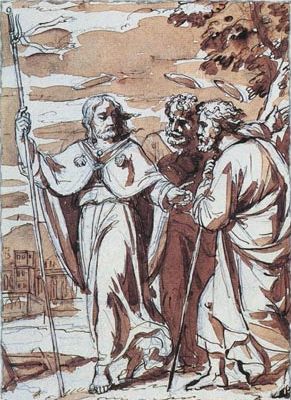
Wiki-image of the baptism of Cornelius is in the public domain. Wiki-image--photograph by Giovanni Dall'Orto--of Jesus teaching his apostles is in the public domain.
Saturday, May 16, 2009

Saturday word, 16 May 2009

St. Simon Stock, Carmelite(16 May 2009)
Eph 6.10-13,18; Ps 1; Jn 15. 9-17

Homily of Fr. Paul Panaretos, S.J.
England, Elijah and a Pilgrim

Today Carmelites celebrate the Englishman, St. Simon Stock. In the 13th Century during the crusades Simon made a pilgrimage to the Holy Land. He met hermits on Mount. Carmel. Mount Carmel is a ridge of mountains, rising 1740 feet above the sea. It is a continuation of the hills of Samaria, which divided Galilee to the north from Judea to the south./1/

Mount Carmel drops steeply into the Mediterranean. Caves dot its cliffs, which provided shelter for people who left the world to live in prayerful solitude. The hermits Simon met remembered Elijah and his followers. When it became too dangerous for pilgrims and natives because of the crusades, Simon returned to England with some of the hermits.

To live they begged, like the Franciscans and Dominicans, orders familiar to the people. The mendicant Carmelites--new way of living for them--elected Simon as their Superior-general.

As their order began to grow Simon established new houses. The shift from solitary to communal living was not easy. That shift was difficult for the Carmelites, who sought to live solitary lives. Also, the established orders resented the newcomers and their devotion to Mary.


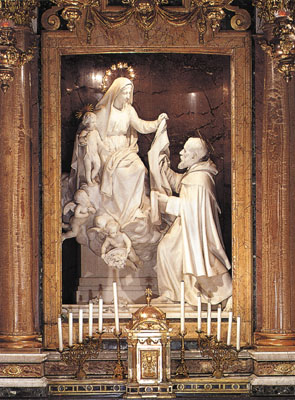
That may surprise us, yet that is how it was. Introducing something new plays on human insecurity and challenges accepted ways. When Simon withdrew from everything for some relief from the problems vexing him and the Carmelites, Simon beheld Mary presenting him with a brown scapular to protect him and all Carmelites from “eternal fire. It shall be a sign of peace and a safeguard in times of danger.”/2/ Mary depends on her son’s mediation, and she offered Simon relief through her maternal care so that Simon would depend on Jesus’ mediating love, too.

Simon's story is not a familiar one to us “non-Carmelites,” which is why I rehearsed it. God works in surprising ways to help people save their souls. An Englishman in the Holy Land met hermits who continued to remember Elijah, not only Simon’s help to salvation but others’ as well. People resented them and without realizing it resented God’s ongoing efforts to save the world.


That is not what Jesus encouraged, as we heard in the gospel, but to abide in [his] love. Grow[ing] strong in the Lord, to use St. Paul’s phrase, is not a brash effort. Grow[ing] strong in the Lord is a discerning effort, which seeks to notice God moving in all things, the new as well as the familiar. That requires humility, something that St. Simon Stock had and encourages all Jesus’ friends to cultivate and to nourish no matter anyone’s vocation.


____________
1. Find Mount Carmel and its ridge at D 5 on this map.
2. This timeline contains the full quotation at 1251 on the timelime.
_______________________________________________________
Wiki-image of St. Simon Strock receiving the scapular from Mary is in the public domain.
Tuesday, May 12, 2009

Tuesday word, 12 May 2009

Easter Tuesday 5 (12 May 2009)
Ac 14. 19-28; Ps 145; Jn 14. 27-31a
Homily of Fr. Paul Panaretos, S.J.
Witness to Truth and Life

We are aware in our nation that many are put death: captial punishment and abortion are enemies of truth and life. Abroad many die by violence we cannot imagine. Each one is a crime against life and truth. Yet it is Truth and Life, who we continue to celebrate particularly this season. It is also clear to me that same Risen Jesus is present in all who die. In them Risen Jesus shows us his wounds today.

It was like that from Easter night, when the disciples recognized Risen Jesus by his wounds; when they were harried and wounded in Jerusalem; to Antioch where the disciples were first called Christians. Today’s passage of Acts focuses Jesus’ farewell, Peace I leave with you, my peace I give to you; not as the world gives as mandate and warning. God seeks peace through those who are related to God as Jesus was: attuned to God; aligned with God’s heart; and—dreadfully difficult to hold in view but clearly present in Jesus before his resurrection—accepting suffering for others and with others.

In this last, Risen Jesus’ gift–mandate also warns us not to shun our duty to mediate God’s peace to persecutors. Put another way: courageously always stand for Truth and Life. Will we be stoned? More than likely, no. Surely, though, our hearts will be bruised; our reputations wrinkled (if not ruined); and our lives will be ever different.

As the Letter to the Hebrews said: In your struggle against sin you have not yet resisted to the point of shedding your blood./1/ But struggle—bloody or no—belongs to us all. Our greatest struggle has the greatest suffering-for-others power: witness—to give it and to be it. Pity that the lectionary omitted Jesus’ final words in the last verse we heard: Get up, let us go. Today and until Risen Jesus’ returns, let us go is witness.


_______________
1. Hebrews 12.4.
_____________________________________________
Wiki-image of the Antioch Chalice is in the public domain.
Pope's Royal Guide


Not on the itinerary Sunday was Jordan's King Abdullah II, who gave Pope Benedict a personal tour of an area around the Jordan River. Jordan's
King Abdullah is planning to build five Christian churches near the historical site some refer to as the birth of Christianity. And one of the expected consequences of the Holy Father's visit to the location is that pilgrims will rediscover its significance.
[Source: ZENIT]
The pope blessed two foundations of those future churches, one Latin rite, the other Greek-Melkite.
__________________________________________________________
Wiki-image of the Rift Valley is in the public domain.

Monday, May 11, 2009

Pope Benedict Aims at Both Past and Future

Pope Benedict continues his visit to the Middle East. He remembered the Holocaust's victims at both the Tel Aviv airport and later at Yad Vashem, the Holocaust Memorial. Mr. John L. Allen Jr. posted again as he accompanies the papal tour; he noted:
With Israeli President Shimon Peres and Prime Minister Benjamin Netanyahu looking on, Benedict XVI prayed that "both peoples may live in peace in a homeland of their own, within secure and internationally recognized borders."

That comment comes at a time when Netanyahu's new government is sending mixed signals about its commitment to Palestinian statehood.

Mr. Allen's post included remarks by the pope to Israeli leaders as well as "ordinary families of Israel."

_________________________________________________

Wiki-image of multi-language mosaic at Yad Vashem is used according to the GFDL.

Sunday, May 10, 2009

Sunday word, 10 May 2009

Easter Sunday5 (10 May 2009)
Ac 9.26-31; Ps 22; 1 Jn 3.18-24; Jn 15. 1-8
Homily of Fr. Paul Panaretos, S.J.
Organic View

While waiting for my early morning dental cleaning last week, I perused an article about gardening. It featured a balcony-garden plan, advertising a large planter-box more versatile and attractive than a terra-cotta alternative. “Not if one likes earthenware,” I thought. However, the author seemed not to prefer earthenware.

Today’s scripture selections remind us that God prefers what is earthy, namely us humans. In a few verses, Luke rehearsed the history of Saul who became Paul. God had chosen the former murderous enemy of the church to be God’s instrument on behalf of it. Yet the disciples, to whom Barnabas brought Saul, feared him. What they knew prevented them from believing God’s preference for Saul and God’s Spirit at work reshaping him to become the Apostle to the Gentiles.

Paul’s story became a story shared as Barnabas related it to the disciples. Barnabas was called the son of consolation, and he lived his name by rescuing Paul and dispelling the fear, which gripped the disciples. Barnabas was not the sole agent of consolation. He was the choice of Holy Spirit on that occasion. The consolation of the Holy Spirit gave growth to the church through him.

Jesus, like rabbis before him, named Holy Spirit Consoler. That’s what Paraclete means. What effect does Holy Spirit’s consolation have? One is boldness. As Barnabas described Paul, the former murderer of disciples of Jesus had spoken out boldly in the name of Jesus. The disciples recognized themselves in Paul because they had been frightened to proclaim Jesus as Messiah and Lord. Holy boldness is a gift of Holy Spirit, and it allows us to love not in word or speech but in deed and truth.

Spiritual consolation also allows us to see differently, or better, to see with the vision of our Messiah and Lord. We need to be careful with this effect lest we think that have Jesus in our pocket instead of trying to measure up to the vision of Jesus, to which the church is called.

For a long time the church acted presumptuously instead of allowing Jesus’ vision to be its measure. Today’s gospel and the way the church saw itself until the Second Vatican Council provide us with one example.

The church had moved away from its evangelical beginnings and came to see itself as led by Jesus, then as the hierarchy and then the hierarchy leading the laity. The bishops gathered in Council in the 1960s began with that plan. As they prayed and discussed they set it aside in favor of teaching that the church is led by Jesus, then seeing the People of God, and then naming how God’s people relate with the world and one another, as hierarchy and laity./1/

Jesus had thought that organic way not the way that had become the standard way of thinking among Catholics. I am the true vine, and my Father is the vine grower. ...Abide in me, as I abide in you. ...I am the vine, you are the branches. [Those who] abide in me and I in [them] will bear much fruit, because without me you can do nothing. It allows the church to see authority as servant-leadership, which Jesus modeled, and which Catholics have recovered, thanks to the Second Vatican Council.

Holy Spirit is the energy of our growth as branches grafted to Jesus, our vine. Our limitations as earthen vessels are opportunities for Jesus, his Father and their Holy Spirit to give growth to the People of God and to the world through us. Our spiritual reshaping affects more than us. It is the beginning of bearing fruit, for the sake of our world.

In your daily 15 minutes with Jesus this week, continue to fee recreated by the life of our triune God. Ask St. Barnabas to present you to Jesus. Converse with Jesus, naming ways that you abide in him and ways that you separate yourself from him. Ask for the grace to join yourself to Jesus more completely. Close by saying slowly the Lord’s Prayer. Each time we pray it helps us measure up to Jesus’ vision and praise Jesus in deed and truth.


____________
1. The Second Vatican Council expressed the mystery of the vine and branches as: Jesus; people of God; and roles in the church in its Dogmatic Constitution on the Church (Lumen gentium). The Council expressed the church’s relationship with the world in its Pastoral Constitution on the Church in the Modern World (Gaudium et spes).
____________________________________________________________
Wiki-image of vine and branches by Bernt Rostad
is used according to Creative Commons Attribution 2.0.

Sunday, May 03, 2009

Sunday word, 03 May 2009

Easter Sunday4 (03 May 2009)
Ac 4.8-12; Ps 118; 1Jn 3.1-2; Jn 10. 11-18
Homily of Fr. Paul Panaretos, S.J.
Universal and Particular

The imagery of shepherd and Jesus’ self-designation as the good shepherd invite us to consider Jesus as our anchor for each of us personally as well as for the church. A word about our Shepherd, and a word about us.

As good shepherd Jesus is more than a guide. Jesus offers us the life he shares with his Father. We heard him remind us that he his this life’s cornerstone and foundation: This is why the Father loves me, because I lay down my life in order to take it up again. No one takes it from me, but I lay it down on my own. What we name as resurrection is the measure of God’s love for Jesus, the son.

God’s resurrection-love for Jesus widens the meaning of shepherd. By calling himself the good shepherd, Jesus was not merely speaking in human terms. His self-designation means he is the true and perfect guide and model of living and loving: Freely I lay down my life in order to take it up again. He desired all sharers in his life and love may come to know God, whom he called his dear Father.

Jesus reshaped shepherd to mean giver of divine life and not in any random way. Jesus shares his risen life with each of us as if each of us was the sole person in the universe. By his Spirit, the energy of his risen life, Jesus joins us to himself with intimate knowledge: I know mine and mine know me, just as the Father knows me and I know the Father. In Jesus you and I become children of God.

Far from belittling, children is an endearing term. Unlike the word sheep, children suggests our future is to grow in our identity as beloved by Jesus, who is beloved by God. This well describes the dynamic of the Easter mystery. It is also the lifelong task of each of us. The word the church uses for our task is “vocation.”

Pope Benedict this year has focused vocation this way: “Faith in the divine initiative--the human response.”/1/ Vocation has two dimensions, universal and particular. The universal dimension is easily lost. The universal call to holiness/2/ is the vocation of all the baptized. We seek to infuse with “religious values” all our “earthly activities.”/3/

The particular dimension applies to each one’s life path: single; married; men and women in consecrated life, who take vows of chastity, poverty and obedience; and priests and bishops.
All Christians are to “stimulate our concern for cultivating this [earth]” on our pilgrimage to the “new earth” awaiting us./4/

Praying for vocations is at once universal: that all baptized into our risen Messiah and Lord may become more generous children of God, whose lives witness to the new life our risen Messiah has won for us. Praying for vocations is also particular: that each person will faithfully live as God has created each of us. Praying for vocations also requests God to grace young people to preach the message of our Good Shepherd by lives as consecrated religious or to preach it in word and sacrament so that all the activities of the faithful will be bathed in the light of the gospel.”/5/

In your daily 15 minutes with Jesus this week, continue to feel recreated by our triune God. Ask your patron saint to present you to Jesus. Consider you life as it has been, as it is and as you desire it to be; then entrust your life to Jesus and ask that he consecrate it to his service and glory. Ask Jesus to enlighten your mind and heart so that your personal vocation may invite others to respond to the divine energy risen Jesus reveals in his church. Close by saying slowing the Lord’s Prayer, which helps us appreciate better what we are sent into the world to do each day.


_____________
1. His Message on the occasion of the 46th World Day of Prayer for Vocations.
2. The title of Chapter 5 of the Decree on the Church (Lumen gentium) of the Second Vatican Council. The chapter devoted itself to following Jesus in daily life.
3.The Second Vatican Council’s Pastoral Constitution on the Church, 43.
4. Ibid., 39.
5. Ibid., 43.
_____________________________________________
Wiki-image by PetrusSilesius of the main portal of Berlin-Charlottenburg's Sacred Heart Church is used according to the Creative Commons Attribution ShareAlike 3.0 license.

Saturday, May 02, 2009

Saturday word, 02 May 2009

Elizabeth Walsh-Kevin Frey wedding (02 May 2009)
Tobit 8. 5-7a; Ps 128; Colossians 3.12-17; John 15. 12-16
Homily of Fr. Paul Panaretos, S.J. A New Image

Elizabeth and Kevin, you give us an opportunity to appreciate more God’s word as we join in your celebration of the Sacrament of Matrimony. While that’s true at every wedding, you chose scriptures that are not often heard together. Like all choices yours echo who you are. They also shine a light on Christian marriage.

In choosing the selection from the Book of Tobit, you confess that God has brought you together and you implore God to favor you with continued help in your mutual enterprise. God offers you the Sacrament of Matrimony to do that. The grace of this sacrament sets you on your course in life as two individuals striving to make one life together. In addition to the mundane challenges of married life, the Sacrament of Matrimony offers you divine help to save each other’s souls by growing in holiness marked by married fidelity and sharing your faith with others, above all your children.

You will grow to know at once intimately and concretely that the gift of your faith, while deeply personal, is not private. You have already begun to realize that by your faithful and caring ways by which you have begun learning one another.


Your married life, incarnated by your lives and your home, will share in the mystery, unity and fruitful love between our risen Jesus and his church./1/ Together you are an image of the church.

What does it mean to be an image of the church? First, it means, Kevin, you bring Elizabeth closer to Jesus by revealing divine love in your person; and Elizabeth, you bring Kevin closer to Jesus by revealing divine love in your person. To reveal Jesus to each other is down to earth, most practical as well as a great grace, as St. Paul expressed it. Using a clothing-metaphor, St. Paul realized this great grace is one with our humanity.

So adorn yourselves in heartfelt compassion, kindness, humility, gentleness and patience, bearing with one another, if one as a grievance against another. I pray you enjoy many years in which to put on love, your bond of perfecting one another.

To be an image of the church also means that you learn both to receive love from each other and to give love--in all those myriad ways St. Paul named, as well as ways you will discover on your own. How you learn both to give and to receive love from each other will allow you to move with greater Christian poise among people. People may not know how to name what they sense, but they will feel something unique, for you will be revealing Jesus to them even without saying a word.

Third, to be an image of the church means that affection is true communication. In your married relationship, as I mentioned in one of several conversations we enjoyed, everything is a medium of communication. Besides words, silence, time, eating, laughing, crying, challenging, money and sex are ways you will communicate. Your affection for each other is unique and belongs solely to you both. In the future, your children will school you in showing affection and communicating in ways that will gratify you and challenge you to be more loving than you have yet to imagine.

The Sacrament of Matrimony doesn’t only offer you the opportunity to become an image of the church, an image of Jesus’ compassion. The Sacrament of Matrimony graces you to be a “domestic church,”/2/ to incarnate Jesus by your life and love for the sake of our world. Jesus’ compassion is your vocation of married maturity, which flows from your baptismal maturity. To continue to grow more mature requires keeping near Jesus.

The Sacrament of Matrimony graces you to do that. Staying connected with the church graces you to do that. Living the Christian life, beginning with each other in those practical ways St. Paul listed, graces you to grow more mature in and with Jesus.

Kevin and Elizabeth, the Sacrament of Matrimony deepens your relationship with Jesus, who calls his faithful followers friends. Christian friendship is more than closeness, it is a mutual sharing in the mission of his gospel and revealing Jesus more clearly by your lives. You married love uniquely reveals Jesus in a world that so needs apostles of his presence.

I’m proud of you both and delighted in your future. I’m grateful to you for being honest with one another. I congratulate you personally and on behalf of the church, who rejoices that you have agreed to save each other day by day and to reveal Jesus by your married life and love to us, who know you, as well as to people who do not.


_____________
1. Rite of Marriage, 11.
2. The Second Vatican Council’s Decree on the Church (Lumen gentium), 11.
____________________________________________
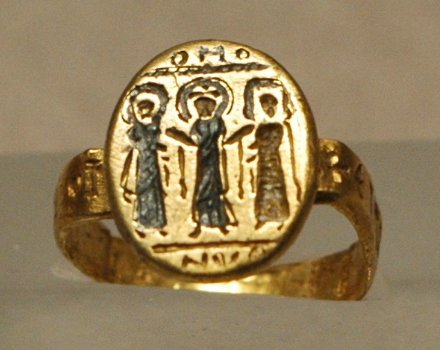
Wiki image by Wolfgang Sauber of symbols of marriage is used according to the Creative Commons Attribution ShareAlike 3.0 license. Wiki-image of a 7th-century gold wedding ring is in the public domain.

Sunday, April 26, 2009

Sunday word, 26 Apr 2009

Easter Sunday3 (26 Apr 2009)
Ac 3.13-15,17-19; Ps 4; 1Jn 2.1-5a; Lk 24.35-48
Homily of Fr. Paul Panaretos, S.J.
Energetic, Enthusiastic and Alert


The 50-day Easter festival allows us to fall deeper into the mystery of our crucified and risen Messiah. Lest our spirits wilt along with petals of the lilies, we can use every reminder that our Messiah is the Living One, the author of life [we] put to death, but God raised him from the dead; of this we are witnesses. I’d like to reflect with you on our witness.

One thing witness is not is seeing the resurrection happen. No one saw it. The message of the empty tomb underscores that God alone raised [Jesus] from the dead. God did not resuscitate Jesus’ corpse. Resuscitation brings back to life a person who had slipped away from life. Resuscitation isn’t resurrection.

Resurrection is an astonishing transformation. It is God’s work beyond time and history and beyond human knowing. The message of the appearances of the risen Jesus is that people encountered the living One as truly alive and transformed beyond immediate recognition.

The first witnesses recognized Jesus by the marks of his death in his glorious flesh. Jesus helped them to see him as a living, bodily presence: “Have you anything here to eat?” They gave him a piece of baked fish; he took it and ate it in front of them. They became his witnesses because he encountered them.

Risen Jesus is more powerfully present by his Spirit now that Jesus no longer appears to us in surprising forms. Risen Jesus speaks to us in the word written about him. Risen Jesus consoles us in each person’s experiences of forgiveness of sins and of becoming whole. Because we are human we respond--often wordlessly yet with feeling--to risen Jesus in moments of sacrament, of community, of serving and of being served.

Luke’s narrative artistry makes the account of risen Jesus and the two disciples walking to Emmaus more attractive./1/ Yet narrative is two-way. Our experiences of connecting with Jesus in sacrament, in community, in serving and in being served bring to life Luke’s richly and subtly detailed scene.

As often happens the gospel turns things upside down. The disciples offered hospitality, prevailing on Jesus to accept it, yet the risen Lord served them, helping them to rise above their fatigue of grief, their frustration over dashed hopes and forgetting God’s promises in him.

More than anything else that may be why we connect with that resurrection appearance. Grief feels as if it will never end no matter how many times we say it will. Shattered hopes frustrate any confidence we may have in others, in ourselves, in the future. We forget God’s promises more often than we shape our lives by them.

The encounter with risen Jesus transformed the two disciples, fatigued, frustrated and forgetful, into energetic, enthusiastic and alert apostles. The more we allow risen Jesus to encounter us in sacrament, community, service and in being served, the more energetic, enthusiastic and alert apostolic witnesses we become.

In your daily 15 minutes with Jesus this week continue feeling recreated by our triune God. Ask the two disciples to welcome you and present you to Jesus. Converse with Jesus: ask Jesus to open your mind to understand the Scriptures and others’ testimony to him; tell Jesus your desire to be a more energetic, enthusiastic and alert apostle of his resurrection in how you live and work. Name what holds you back and place it in Jesus’ hands. Close by saying slowly the Lord’s Prayer. To request our daily bread is an empty request until we give our Redeemer what keeps us from making room for his divine gifts.


____________
1. The opening verses of today’s gospel selection is the hinge between that memorable scene and the appearance of risen Jesus to the gathered disciples described in the succeeding verses of this gospel selection.
____________________________________________
Wiki-images of an ivory relief of risen Jesus appearing to his disciples and of risen Jesus walking with the two disciples are in the public domain.

Sunday, April 19, 2009

Sunday word, 19 Apr 2009

Easter Sunday2 (19 Apr 2009)
Ac 4.32-35; Ps 118; 1Jn 5:1-6; Jn 20.19-31
Homily of Fr. Paul Panaretos, S.J.
Faith-Twins


The idealized description of the first assembly of believers in the risen Jesus does not mean we may ignore it or that it offers us nothing. Central to the description are the apostles, who with great power, bore witness to the resurrection of the Lord Jesus. The power of their proclamation matched risen Jesus’ power of his Holy Spirit, who transformed the first disciples, who had seen Jesus taken and killed.

The point is this: the apostles had to accept this power, which risen Jesus invites each of us to do. One way the Fourth Gospel functions leads me to suggest today’s selection invites us to see our limitations as opportunities to accept risen Jesus’ power, too.

Throughout, the Fourth Gospel refers to a beloved disciple. It never names the beloved disciple, which means that each of us, indeed all believers, may give our names to the disciple Jesus loved./1/ Love, especially Jesus’ risen love, cannot be contained by time or place. Further, being loved changes us, and being loved by risen Jesus transforms us most of all.

Some of that transformation remains unseen by others. Yet our ways of living and choosing as well as our service in the name of Jesus are glimmers that we have been transformed and continue to be transformed by our Messiah. Unless we welcome Jesus’ transforming love, we refuse to be gripped by his life-giving power. This is how Thomas figures for us.

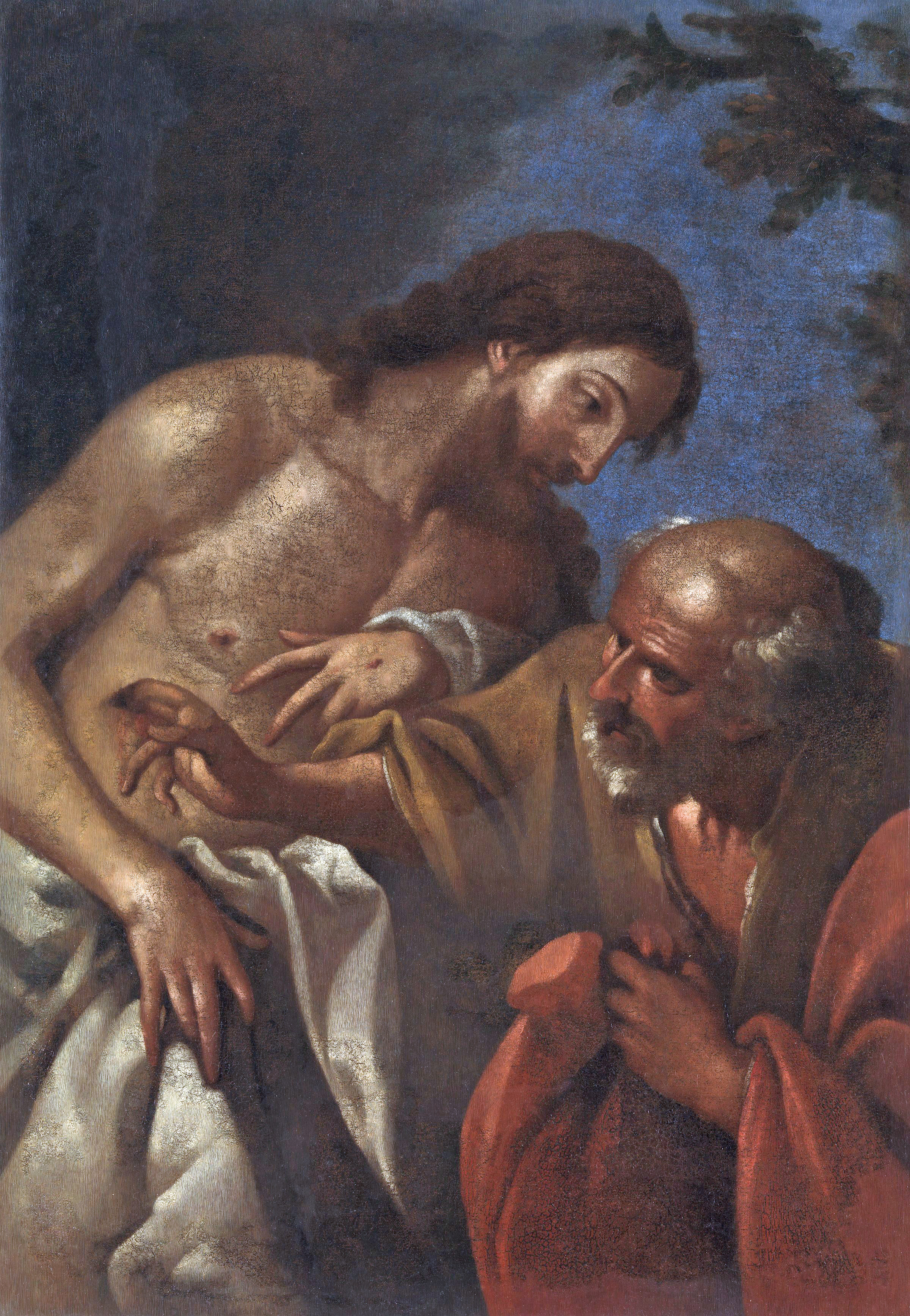
Thomas, like many people past and present, had a nickname, the Twin./2/ Thomas is our twin, indeed the twin of all believers in Jesus. How like our twin we are! It is silly to think that only as time passed people had difficulty with welcoming the deepest reality of Jesus’ resurrection. Within a week of Jesus rising from the dead, one of his apostles was more resistant than the others. Thomas was the same apostle who had a couple weeks earlier urged them all, Let us go to die with [Jesus]./3/ Like our twin we have our exhilarating moments.

We also have a weakness for fact, for reality we can measure, see and touch. So did Thomas as we heard: Unless I see the mark of the nails in his hands and put my finger into the nail-marks and put my hand into his side, I will not believe. Thomas did come to believe by releasing his resistance.

Because we are more than our bodies we also have a desire for more than reality we can measure, see and touch. We desire to be in communion with our Creator and Redeemer, our risen Jesus, the victor over the world. While we commune with Jesus through many incarnate ways, much exists to frustrate our deeper desire. Like our twin Thomas, we have our times of denial, despair and doubt. Jesus never chastised or belittled Thomas for being himself, for being human. Nor does Jesus belittle us twins of Thomas either.

We may have a mistaken notion that the opposite of faith is doubt. Unless one is a fanatic, then doubt has no room. The ancient Roman, Cicero, described humans well: “By doubting we come at truth.”/4/ So it is! What is more true and amazing and consoling is that Jesus, our Truth, comes to us! Jesus visits us not to chastise or belittle us but to invite us to place our selves--not our minds only but ourselves--in his care and his power, his divine mercy. The memory of Thomas and many others is handed on to us to encourage us to do that and come to believe/5/ that Jesus is our Truth and our power. Faith is a life-giving process.

In your 15 minutes with Jesus this week, continue feeling recreated by the life of our triune God. Ask Thomas, our model twin, to encourage you to entrust yourself to Jesus. Converse with Jesus: tell him your desire to follow him wholeheartedly. Ask Jesus for the courage to live as his disciple. Close by saying slowly the Lord’s Prayer, which is about God reshaping you with power so you may live from it at each moment, aware of Jesus meeting you and giving you a mission at once human and divine.


_____________
1. See John 13.23; 19.26 and Chapters 20 and 21.
2. It is peculiar that printed versions of the gospel have reverted to the Greek word for Twin, Didymus, when few hearers know Greek!
3. John 11.16.
4. Quotation #5243 from Cole's Quotables
5. This is the meaning of the Greek tense of the verb, to believe, indicating that it is a life-long process.
__________________________________________________________
Wiki-images of the Incredulity of St. Thomas and a star cluster are in the public domain.

Sunday, April 12, 2009

Easter Sunday word, 12 Apr 2009

Easter Sunday1 (12 Apr 2009)
Ac 10.34a, 37-43; Ps 118; 1Co 5:6b-8; Mk 16.1-7
Homily of Fr. Paul Panaretos, S.J.
Making No Mistake
Happy Easter! Is anyone here by mistake? Are you sure? Are you here by mistake? Are you? I give you fair warning because I used to think the focus of today was Jesus, our dead and risen Messiah. Jesus’ resurrection is not a preacher’s focus only today. Jesus’ resurrection empowers all preachers to witness to the one event that reshapes the world as it reshapes people. That’s why I asked if any of us are here by mistake. Let me say first what the resurrection was not before we decide if any of us is here by mistake.

The resurrection was not a reappearance of Jesus as if Jesus never died. St. Paul was emphatic: Christ [Jesus] died!/1/ Nor was the resurrection resuscitation. Scripture mentions several resuscitations, like Lazarus, who was brought back to life by Jesus and lived his old life until he died again./2/ Like the sons of widows the prophet Elijah/3/ and Jesus/4/ restored to their mothers. Their mothers were happy but no world shaking thing happened beyond that. The resurrection, however, shook the world. It scandalized many, who looked at things in only human ways. It shattered the thoughts of the disciples of Jesus before it reshaped them.

The disciples: they remind me to ask again, “Is anyone here by mistake, thinking the resurrection focuses on Jesus?” Are you ready for the truth? The resurrection was not so much about Jesus as it was about his disciples. When my teacher said that long ago, I listened, puzzled and wanting to listen. The resurrection was less about the future of Jesus and more about the future of his disciples. Scripture makes that clear. Recall St. Paul: nearly each time he pronounced that our Messiah Jesus died, Paul followed it with for us. Likewise his resurrection was for his disciples, and it is for us, his disciples today.

In the beginning the first disciples were distraught. Human living and dying were categories they could not change by their power, why Jesus’ resurrection was unthinkable. Opponents and scoffers of what they experienced were straitjacketed by the same categories, too. What was the difference?

If you are here by mistake, then you may be shocked to know the difference was this: the disciples opened themselves to allow God to transform, refashion, reshape, recreate, reconfigure their lives whole and entire. They named the symbol of this recreation Holy Spirit. Spirit because it was personal power. Holy indicated that was a power not of human origin or human control.

Today the scandal of the resurrection doesn’t exist. The resurrection no longer shocks us. The resurrection no longer moves us the way it moved the first disciples to proclaim the utterly new thing God does in Jesus for us. What if we allowed the resurrection to grip us down to the marrow of our bones and propel us into the world to help it refashion itself as we have been refashioned, reshaped, recreated and configured anew to our Messiah? We would be the world’s leaven.

We are its leaven. Like yeast gives its life to leaven dough and give birth to a loaf, the resurrection empowers our lives to transform the world with sincerity and truth. That’s why the resurrection is more about us because Jesus died and rose for us to transform the world.

Each of us is a resurrection, a personification of Jesus for the world, partial to be sure but really a resurrection by baptism. We are empowered by his Holy Spirit to do things we cannot imagine for the sake of the world and the glory of God.

In your daily 15 minutes with Jesus this week feel recreated by the life of our triune God. Ask Mary of Magdala, the first apostle of the resurrection, to ready your heart to grow more certain that Jesus loves you as if you are the only person on the planet. Allow Jesus to enter the garden of your life as it is: dry or moist; weedy or flowery; barren or lush; with young fruit or old, gnarled stems. Converse with Jesus: tell him your desire to be fresh leaven in your home, in your school, in your neighborhood, in your parish, in your world; ask Jesus for the courage to live as his disciple. Close by saying slowly the Lord’s Prayer, which is about God reshaping us with power not from us but filling us daily with its new life both human and divine.


____________
1. See the correspondence of Paul, beginning with his Letter to the Romans.
2. John 11.1-45.
3. 1Kings 17.17-24.
4. Luke 7.11-16.
___________________________________________
Wiki-image of Mary of Magdala and the risen Jesus is in the public domain. Wiki-image by Tauʻolunga of a flowering apostle plant is used according to the Creative Commons Attribution ShareAlike 2.5 license.

Saturday, April 11, 2009

Passion Need Not Jettison Charity

Charity and Perspective: those two virtues ought to guide discussion about the Notre Dame invitation to the President to speak at its commencement. Mr. John L. Allen Jr. notes it is an event not without worries to Catholics, but it is not without hope either. Mr. Allen notes at the outset:
Inviting a pro-choice president of the United States to speak at the country’s premier Catholic university may be highly charged at the level of symbolism and political fallout, but that does not make its advisability a matter of dogma. There’s no heresy implied in either supporting or opposing the move, so Catholics ought to be able to disagree without casting one another as enemies of the faith.
Read his All Things Catholic column for both charity and perspective on this issue.

Friday, April 10, 2009

Good Friday word, 10 Apr 2009

Good Friday (10 Apr 2009)
Is 52.13-53.12; Ps 31; Hb 4.14-16;5.7-9; Jn 18.1-19.42
Homily of Fr. Paul Panaretos, S.J.
Praise, Gratitude, Service: Gifts of the Cross


Today we remember that in Jesus God suffered for us and all creation. Not only did God suffer, God died. That has caused people to riot: God could not die and still be God! Throngs of people rioting about God dying may not move us. However, who here has not rioted within, and who has not endured the pains of internal revolt when God seems dead? Who of us has not writhed inside when God does not live up to our expectations? Who of us has not raged that God not only did not live up to our expectations but that God died?

Perhaps these seem silly or pointless distractions. If we live in the capital letters of high-definition and surround sound, when every scintilla of sight, sound, passion and pulse are clear, focused and palpable, God may register as a distraction. However, when we live in capital-letter worlds of suffering or of indescribable joy, when things don’t register like facts or seem as they appear, then we begin to sense God as real and challenging even if not near or vibrant.

This sketch of two worlds, the first in which we are in some semblance of control and the second in which we are not, invites us to take refuge in God our Lord, as the Psalmist sang and Jesus echoed personally in his Passion. To take refuge admits I’m not in control.

To move beyond reproach and “poor me” to affirming, You are my God. In your hands is my destiny, is each one’s passion. Today we focus on our Lord’s passion in its own capital-letter world, which high-definition and surround sound can never recapture. His cross offers us a new way to consider suffering.

Our sufferings will probably never come close to those of Jesus, or of the many in the world who suffer atrocious physical trials. The cross allows us to focus our sufferings: past and present; verbal; emotional; familial; social; those which accompany aging; and those which flow from infirmity--to name a few.

No one’s sufferings are trivial. Jesus’ courage during his passion encourages us as it reminds us that many of our personal sufferings are not of the caliber of high drama. Yet no matter their depth our wounds shape us. “Christ [Jesus] is still pained and tormented in his [sisters and brothers], made like him.”1 Jesus’ wounded glory forges an intimate bond with humans, and it reshapes each one’s suffering. The paschal mystery reshapes human feelings, sorrows, fears, sadness, suffering--and death itself.

Often we’ve heard and maybe even said, “Death is a part of life.” What kind of part? Is it possible to appreciate it? Perhaps words attributed to Chief Tecumseh can help us appreciate death--and any little death we may experience--as part of life, which acknowledges fears and abandoned feelings and gives birth to praise, gratitude and service.
Live your life that the fear of death can never enter your heart.
Love your life, perfect your life, beautify all things in your life.
Seek to make your life long and of service to your people.
Prepare a noble death song for the day when you go over the great divide.
When you arise in the morning, give thanks for the light, for your life, for your
strength.
Give thanks for your food and for the joy of living.
If you see no reason to give thanks, the fault lies in yourself.
When your time comes to die, be not like those whose hearts are filled with fear of
death, so that when their time comes they weep and pray for a little more time
to live their lives over again in a different way.
Sing your death song, and die like a hero going home./2/
To the world Jesus seemed lost, forsaken, yet he was “going home.” To the world Jesus seemed silent, because he opened not his mouth, yet he overflowed with eloquence. To the world Jesus seemed a criminal, yet was heroic beyond compare, our chief high priest. Precisely why we acclaim: “We adore you, O Christ, and we praise you!” / “because by your holy cross you have redeemed the world!”
____________
1. Pastoral Care of the Sick: Rites of the Anointing and Viaticum, 2 (see 2 Corinthians 4.17).
2. Reprinted in Sacred Journey: the Journal of Fellowship in Prayer, April 2004, p. 32.
___________________________________________
Wiki-image by Clio20 of Crucifixion in ivory is used according the Creative Commons Attribution ShareAlike 2.5 license. Wiki-image of a crucifixion pendant is in the public domain.

Monday, March 30, 2009

Jesus' Passion

With the Fifth Week of Lent the church sharpens its focus on the passion of Jesus. The phrase paschal mystery reminds that his passion is not separate from his resurrection. The relation between the two is intrinsic: no resurrection without the passion, and the passion has no meaning with out the resurrection. The risen Lord is both dead and risen. St. Paul could not say either one: It is Christ (Jesus) who died, rather, was raised, who also is at the right hand of God, who indeed intercedes for us (Romans 8.34).

Yet our limited minds need to look at things separately. Fr. Ronald Rolheiser, O.M.I., is a helpful guide to understand better the passion of Jesus. In a still-current 2008 Catholic Update, Fr. Rolheiser both surveys the passion and highlights the message of love Jesus' passion fulfilled. He mentions Dr. Martin Luther King's experience to make Jesus' passion concrete and to illustrate its "moment of grace."
____________________________________________
Wiki-image by Irmgard of a window depicting a scene in Gethsamane is used according to the Creative Commons Attribution ShareAlike 3.0 license.

Sunday, March 29, 2009

Sunday word, 29 Mar 2009

Lenten Sunday5 B Scrutiny 3 (29 Mar 2009)
Ezk 37. 12-14; Ps 130; Rm 8. 8-11; Jn 11. 1-45
Homily of Fr. Paul Panaretos, S.J.
Reshaped by God

Today’s third scrutiny of our Elect again shapes our Sunday celebration. As their pace of formation has increased, others of us are, to quote one parishioner I overheard last week, “excited” for you, Elect and Candidates. I’d like to offer us all a way to appreciate both our growing excitement and faith. Helping our faith to grow, Elect and Candidates, is one way you minister to us, as you know.

Your first scrutiny, a rite like the next two to help the Elect turn from sin and grow more godly, flowed from Jesus’ conversation with the woman at the well, a powerful image of personal and communal conversion. Today’s scrutiny, like last week’s, flowed from one of seven actions of Jesus in the Fourth Gospel. We can appreciate all of them in a way the church has for centuries. Each revolves around something within our human experience, which God in Jesus by their Spirit reshaped.

Last week’s rite, in which we prayed for you who will soon be baptized, savored Jesus healing the man born blind. The lack of human sight was the matter within our human experience.

Restoring sight certainly was a sign of God’s desire for him and all people. But it was not enough. An interior sight, a graced self-knowledge, was the more real healing. The man recognized Jesus, as he said of Jesus, “He is a prophet”; and he worshiped Jesus as Lord./1/ Today it is life that Jesus restored not just sight. Jesus resuscitated Lazarus who had been dead four days. Like anyone else, Lazarus’ life would end one day. But human life is not the point; God’s life, which we name as grace, is the point. God’s life reshapes our lives so that we may live not only as credible witnesses of Jesus, as his friends and friends of one another and of the poor; divine life reshapes us so that we may live in Christian freedom. Christian freedom flows from Jesus’ Spirit dwelling in us.

How is that exciting? It is exciting when we--Elect and already fully-initiated--notice how God reshapes us, that is, how God graces us, and the concrete effects it has on us: such as being more aware of others and of our environment; having more supple hearts; desiring to make Jesus present by our presence and by our simple service; wanting to follow more closely and love Jesus more ardently./2/

We know God in Jesus by their Spirit works in us when we feel free, not fearful, to do these and other actions which make and keep us Christian. This Christian freedom is grace, pure gift. We all know how it feels to live constrained by our fears, our obsessions and our compulsions. Divine life at work in us grants us more freedom from our constraints. I see myself in Lazarus responding to Jesus command, “Lazarus, come out!” The dead man came out, tied hand and foot with burial bands, and his face was wrapped in a cloth. So Jesus said to them, “Untie him and let him go.”

Here the meaning of let go has the sense of depart. At Jesus’ call Lazarus departed the realm of death. That’s obvious to our human knowing. More exciting and of our Catholic faith is that each of us is both called and by grace made more free to depart whatever hinders us from living the freedom of Christian disciples. That reassures me when I admit my sinfulness because it helps me not be overwhelmed by it. It offers us all new life and strength to practice it. You, Elect and Candidates, help us respond to Jesus. Your fresh response freshens ours.

In everyone’s daily 15 minutes with Jesus this week, savor the new life of grace the Trinity offers you. Ask Lazarus to present you to Jesus. Name contours of new life our risen Lord offers you: stewardship; generosity; focused prayer; more supple hearts; the desire to make Jesus present to others; and the like. Tell Jesus if you are feaful to live them or if you feel free to live them. Ask Jesus for the grace to live more free as his witness today. Close by saying slowly the Lord’s Prayer. The more we pray it from our hearts, the more free we become to make Jesus present by our lives.


____________
1. John 9. 17, 38.
2. This last is the grace St. Ignatius of Loyola invites retreatants to make when reflecting on Jesus’ life. See his Spiritual Exercises, 104.
____________________________________________
Wiki-image by Karl Isakson of Jesus raising Lazarus is in the public domain.

Friday, March 27, 2009

Theology of Liberation. . .

. . .again?

Names shape how people think and their expectations. The phrase theology of liberation, which arose in Latin America in the 1970s and 1980s, connotes many things and specifies time, place, personalities and actions. Beyond them all Jesus came to liberate people. Indeed, many of the specifics of the Latin American version of the theology of liberation flow from that conviction.

Yet Jesus liberates all people in all circumstances, in all times and all places. Can other versions of theology of liberation exist? Indeed they can. One example comes from Africa. In his column, All Things Catholic, Mr. John L. Allen Jr. expresses the difference between these two: "What African Catholicism has to offer the global church is liberation theology without the hang-up over ecclesiastical authority." Mr. Allen explains his meaning in his column. He focuses on "Health Care," "Lay Attitudes" and "Good Government."