Sunday, September 08, 2013

Sunday word, 08 Sep 2013

Transforming
23rd Sunday of the Year C (08 Sep 2013)
Homily of Fr. Paul Panaretos, S.J.
Solomon is well known; not so Philemon. Many are unsure how to say his name: FILL-ee-mun. Both have something to say to us about wisdom. Today’s first reading recalled Solomon’s prayer for wisdom. Solomon knew human wisdom—our deliberations—is timid. He did not mean shy. He meant not certain, not secure. Something not secure may be dangerous. The range from insecure to dangerous describes the uncertainty of our reason, emotion and resolve. Our reasoning and feelings get tripped; and we often live in fits and starts instead of single-minded purpose. Jesus’ remarks, spoken with conviction and no gentle color, revealed Solomon was correct.


God’s wisdom, though, is con-fident. God’s holy spirit imparts God’s wisdom to mortals. Risen Jesus gives us access to God’s holy spirit so we may live with confident trust. Our access is not breezy; following Jesus has demands. Anything can block and interrupt our following. Jesus warned things close to us have the most power: possessions and relationships. Jesus spoke not of feelings when he spoke of hating family. Jesus’ strong language means choosing Jesus as our primary relation. To renounce possessions means saying goodbye to them as primary. Disciples welcome Jesus and his word as primary and find Jesus and his word useful for living. St. Paul’s note to Philemon offers an example of divine wisdom in human life with Jesus as first.


St. Paul remarked about weakness throughout his letters. He admitted anxiety1 and other interior weakness2 as well as physical weakness due to disease,3 beatings4 and imprisonment.5 He wrote more than once as a prisoner. His weaknesses did not transform him; Christ Jesus did. Transformed by Christ Jesus Paul wrote Philemon, Take Onesimus to your heart as you would me. Paul asked his benefactor and his brother in Christ Jesus to reform his personal attitude about his possession.


Onesimus was Philemon’s runaway slave. He could end the lives of rebellious slaves. Onesimus found himself in prison with Paul. Onesimus feared his master wanted his property and feared the worst. During their imprisonment Onesimus helped Paul; he wrote his benefactor and brother in Christ Jesus: I urge you on behalf of my child Onesimus, whose father I have become in my imprisonment, who was once useless to you but is now useful both to you and me.6

Paul wrote in Greek. In who was once useless to you but is now useful both to you and me, Paul made a deft play on words. Chreestos [χρηστος] is the root of both useful and useless. Non-Christians confused chreestos with its sound-alike Christos [Χριστος], the Greek title for Jesus as Messiah.7 It was not uncommon.8 St. Paul played on useful and useless in his note to Philemon. St. Paul suggested that before his conversion Onesimus was useless without Christ. Now Onesimus was a good Christian useful to Paul. Paul recognized a good coworker.


Philemon, too, supported Paul’s work. He reminded Philemon that he had Paul to thank for bringing him, his family, Onesimus and all his slaves to Christ Jesus. The benefactor of Paul was in the Apostle’s debt: “May I not tell you that you owe me your very self.”9 St. Paul did not lord that over Philemon when he noted it for the record.  He recognized Jesus had made Philemon and Paul each a partner of the other.10
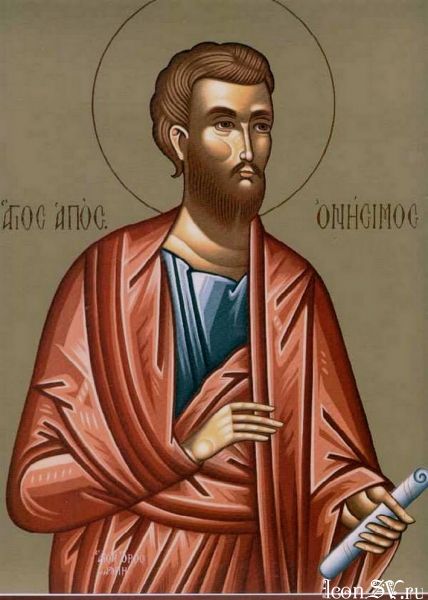


The point is transformation. Transformation worked by risen Jesus through his Spirit. Transformation of a timid Paul: he stood up for a slave who was much more: a brother in Jesus; brother even to his master.11 With Jesus as the hinge in their and all relationships transformation of their social obligation was afoot. Real obligation and gratitude for living belong to risen Jesus. Benefactor Philemon owed it no less than receiver of kindness, Paul.

Transformation invites us: the way we understand useful in our Catholic lives. Jesus invites us to understand useful not as doing but as identity: being in risen Jesus. Knowing ourselves rooted in Jesus and created by Jesus each moment helps us appreciate all humans are images and likenesses of their Creator and Redeemer. Noticing Jesus creating and redeeming us releases us from the grip of our weaknesses, possessions and relationships to partner freely with Jesus and give witness to him by our choices and our ways of living. Pope Francis recently expressed the usefulness of Christian identity this way: “Be always united with Christ, building his Kingdom with fraternity, sharing and merciful works.”12

In your daily 15 minutes with Jesus this week
  • Pause in the bright shadow of the Trinity.
  • Ask St. Paul to present you to Jesus.
  • In your words chat with Jesus: praise him for creating and redeeming you; thank him for choosing you to serve…[his] gospel.
  • Ask Jesus for the grace to allow him to transform you more into the person Jesus creates and redeems: a wise not a timid disciple.
  • Close saying slowly the Lord’s Prayer. Thy will be done on our lips is not about any whims of God but about serving the gospel. The gospel guides us to embody God’s desires for the world. Jesus gives us his wisdom to live them.

Link to this homily’s Spiritual Exercise
___________
  1. 2 Corinthians 11.28: And, apart from other things, there is the daily pressure upon me of my anxiety for all the churches.
  2. 2 Corinthians 12.7-10: What began in his flesh affected his inner self.
  3. Galatians 4.13-14. 
  4. If I must boast, I will boast of the things that show my weakness. St. Paul enumerates several causes in 2 Corinthians 11.23-27, of which beatings was one.
  5. Also see Philippians 1.
  6. Philemon 11.The lectionary framers did not include this verse which is within today’s reading.
  7. Suetonius, The Lives of the Twelve Caesars: Life of Claudius, 25:4, is one example.
  8. Early preachers of Christianity played on the misunderstanding in their defense. Justin Martyr did in his First Apology.
  9. Philemon 19.
  10. Philemon 17.
  11. Philemon 16.
  12. At the 04 September General Audience to Arabic speaking pilgrims.
________________________________________________________________

Saturday, September 07, 2013

Saturday Homily of Pope Francis

Pope Francis pleaded for “forgiveness, dialogue, reconciliation” before 100,000 in St. Peter’s Square. His homily is available in eight languages here.

Saturday’s Prayer Vigil

At 19:00 local time in Saint Peter’s Square Pope Francis will preside at a liturgy of prayer. It is part of the international day of prayer and fasting for peace in Syria and the world. YouTube has a site already counting down to the service. The pope’s office for liturgical celebrations has prepared an illustrated “Booklet for the Celebration” (Italian). Vatican Today has made available the schedule (English).
_____________________________________________
Wiki-image by AzaToth of Peace dove CC BY-SA 3.0.

Friday, September 06, 2013

“More Forceful This Time”?

Talk of response to recent events in Syria may cause many to recall a decade ago. Mr. John L. Allen remarked that “both the sequence of events and even the language being used by the Vatican today provoke a dizzying sense of déjà vu.” He also cited the Chaldean Catholic Bishop of Aleppo. He said in a recent interview: “we see now...how [in 2003 Iraq] came to be destroyed. The first to lose were the Christians of Iraq. We must say that, what the U.S. did in Iraq, we don’t want repeated in Syria.” Read Mr. Allen’s All Things Catholic for today.
_______________________________________

Wednesday, September 04, 2013

Last Fast?

Jesuit Drew Christiansen recalled crises when Presidents Washington, Adams and Lincoln summoned Americans to fast. Pope Francis has called Catholics everywhere to fast in the face of the Syrian crisis. Fr. Christiansen noted that for all Christians, “Saturday will also be a time to lament the impending threat of the disappearance of Middle Eastern Christianity.” Another layer of lament added to that for loss of life and for displacement of 5,000 Syrians per day.

______________________________

Sunday, September 01, 2013

Sunday word, 01 Sep 2013

A Tie, a Thread, a Tool
22st Sunday of the Year C (01 Sep 2013)
Homily of Fr. Paul Panaretos, S.J.
Early in their marriage my sister and brother-in-law dined with my family. Abe wore a smart tie. I admired it and told him. “You like it?” Abe asked, placing his open hand behind its knot to let the tie drape over his knuckles from knot to tip. Then to my surprise Abe untied it, slid it from beneath his collar, saying, “It’s yours, enjoy wearing it.”

Abe is Lebanese. The Lebanese among us can appreciate that moment. Those who know Lebanese can tell of their good-nature and generosity. Their generosity and self-effacing manner; my experience at our dining room table; and even a few corpuscles of Mediterranean blood flowing in any of us alert us to a message today’s scriptures offer us. Its message is conveyed by a thread of Mediterranean culture.

That thread lives today as it did well before Jesus’ parable. He told it to status-conscious religious professionals invited to the same dinner as Jesus. In every culture humility and status rest together awkwardly. In Mediterranean culture humility involves not overstepping one’s status; not claiming more honor than one deserves; not grasping for or clinging to gifts. Gifts can tempt us to give gifts in return. If we consent to that we end up trading not giving for the sake of giving. We can also be tempted to outdo others in our giving.

Outdoing is not limited to others. We are tempted to live beyond ourselves; not only our means, ourselves. We run risks when we live beyond ourselves. The Book of Proverbs counseled: Claim no honor in the king’s presence, nor occupy the place of great men; ...it is better that you be told, “Come up closer!” than that you be humbled before the prince.1 That is an obvious risk. Another is less obvious: when we live beyond ourselves we risk putting others in our debt. Christians do not put others in their debt. Being Christlike is not confining; it opens us to our true selves. Living beyond ourselves does not.

Jesus more than confirmed the honor in not living beyond oneself and the shame attached to giving gifts to gain gifts or attention or status. Jesus exposed our human fondness toward self-importance and self-exaltation with his ever-troubling line: All who exalt themselves will be humbled, but those who humble themselves will be exalted. Jesus’ line makes our souls itch. We itch because Jesus addresses attitudes, frames of mind and hearts craving exaltation.

All who exalt themselves will be humbled, but those who humble themselves will be exalted. Jesus’ summary of his parable did no violence to self-esteem or self-respect. Instead it helps us appreciate Jesus’ attitude, his frame of mind and his heart so we may have them, too.2 His heart desires to defend and shelter the forsaken. The attitude of our Messiah is water which quenches a flaming fire and seeks to give alms, which atone for sins. His heart pulses with life for all.

How do we put on the mind3 of our Messiah? One way is to cultivate openhanded, wide-hearted generosity into lavish, selfless giving. Its practice becomes a tool. That tool transforms our attitudes and widens our thinking. It shapes us to be God’s heart for others. Putting on the attitude of our Messiah Jesus is our lifelong vocation. Repeated practice is key. The more often we put on the mind of our Messiah Jesus the more often we will succeed to stand against movements within as well as circumstances outside us that coax us to have another mind about how we choose to live.

Jesus’ ancient Mediterranean culture is distant from us in many ways. Yet its thread of selfless generosity abides in our time. The generosity—not only to me—of my Lebanese brother-in-law, friends and colleagues; and of my Greek cousins, many resting in peace, serves as a tool helping me to notice Jesus as my days unfold. Their frequent practice of generosity helps me meet Jesus more readily in the words of scripture. Their practice and my often clumsy one bring to life what often appears “dead and deformed”4 on the bible’s pages.

Our Messiah Jesus was once dead and deformed by his passion. Now he lives fully human and divine. He is not an idea, even a holy one. Jesus is our pioneer of faith.5 He allows us to be ourselves and do what we think we could never do: to choose and act with hearts like his.

In your daily 15 minutes with Jesus this week
  • Pause to feel our triune God offering you sheltering embrace in the divine heart.
  • Ask your patron saint to present you to Jesus so you may converse with him.
  • Chat with Jesus about his attitude: how it kept him from exalting himself; how it opened his heart to others. Resolve to put on his attitude and put it into practice in concrete ways this day.
  • Ask him for the grace to live that way, the way Jesus created you not how you want to create yourself.
  • Close saying slowly the Lord’s Prayer. His prayer guides us to live modestly and never beyond ourselves. It helps us share his attitude and live from it.

Link to this homily’s Spiritual Exercise

______________
  1. Proverbs 25.6-7.
  2. St. Paul said this to his beloved Philippians 2.5. He implied in the familiar words that follow that we are to stretch toward divinity as Jesus participated in our humanity.
  3. St. Paul was fond of this metaphor. He used it in other letters: put on the Lord Jesus Christ (Romans 13.14); put on the new self, created in God’s like-ness (Ephesians 4:24); put on the new man, which is being renewed in knowledge after the image of its creator (Colossians 3.10). To put on echoed baptism, in which Christians first clothed themselves with Risen Jesus (Galatians 3.27). 
  4. The phrase is from this sentence of Peter of Celle, a 12th-century French Benedictine bishop: “What lies dead and deformed in the letter on the dead parchment comes to life when what is read is put into practice.” Hugh Feiss quoted it in his Essential Monastic Wisdom: Writings on the Contemplative Life. New York: HarperCollins, 2000.
  5. Hebrews 12.2. The Greek word translated also as leader, suggests “leading by example.” That nuance is faithful to the mission of Jesus, who is like us in all things but sin (see Hebrews 4.15).
________________________________________________________________

Saturday, August 31, 2013

Telling Choice

Pope has named his Secretary of State of the Vatican. Mr. John L. Allen Jr. introduces Archbishop Pietro Parolin and how chooing him “would seem to offer...three insights about the kind of pope Francis intends to be.”
Update: Mr. Allen posted the last interview with the Archbishop before his new post.

Making Space

The pope’s General Prayer Intention for September is: “Value of Silence. That people today, often overwhelmed by noise, may rediscover the value of silence and listen to the voice of God and their brothers and sisters.” Jesuit Joe Simmons recalled many today are “buzz-fed”: “But thankfully, even buzz-fed city minds like mine can fall quiet – if given the space.” He was given space at a cottage in his youth. The Prayer Intention of the pope reminds that later in life making space for silence is an adult decision.

___________________________________________________
Wiki-image by Bosc d'Anjou of quiet spot CC BY 2.0.

Friday, August 30, 2013

Perspective

Earlier this week U.S. Catholic posted to its blog an interview with a theologian. To Roberto S. Goizueta the magazine posed the question, “How should First World Christians respond to [Pope Francis’] invitation and challenge [to be a church of the poor]?” An important part of the answer includes the fact that First World Christians are the minority. The Boston College theologian offers much more in his response.
___________________________________________________

Monday, August 26, 2013

4%

A Forbes interview revealed that in mid-July 2010 a group stopped counting websites used for porn. Its estimate: four percent. The fraction is small, but the number of webistes sites accessed was not. What to do? How to choose for one-self and for others? Last week Jesuit Michael Rozier asked that question. Along the way he linked to an opinion column about “soft paternalism” to increase readers’ understanding.

______________________________

Sunday, August 25, 2013

Sunday word, 25 Aug 2013

21st Sunday of the Year C (25 Aug 2013)
Homily of Fr. Paul Panaretos, S.J.
The letters of St. Paul enjoy frequent readings in church. The Letter to the Hebrews does not. That is unfortunate because we share challenges with its first hearers Like us they faced temptations not to live their Christian, prophetic vocation. Their temptations ran from imprisonment, loss of life and property to daily pinpricks; they lured them not to proclaim [God’s] glory among the nations and fulfill Jesus’ desire: Go out to all the world and tell the Good News.1 Today’s selection invites us to face our temptations and adversities. It invites us to see that they educate us and God works in them for us. A story my mentor told me as a young priest helps illustrate that.

My mentor was superb. Denny shared his experiences, and the way he did placed me in them. One story was a lasting education. Education is what scripture meant by discipline.  Its relative, disciple, means a learner. Disciples learned more than facts; they practiced ways to strengthen their characters. The Letter to the Hebrews communicated that with popular athletic imagery: athletes practiced to strengthen their bodies. People responded to that image then and now. But I get ahead of Denny’s story.

Denny helped a couple prepare for marriage. The wedding day arrived. Denny waited as the last guests took their seats. At the appointed time the first bridesmaid did not take her place to begin the procession; no bridesmaid did. Denny waited patiently but not for them. The groom had not arrived! The groomsmen had but not the groom. Several more minutes of waiting: they seemed an eternity to the wedding party and longer to the bride. Denny walked from the altar to the bride’s room. He told her the groom had not arrived; then he asked the bride what to do. She calmly replied they ought to wait for him, so they did.

After several minutes Denny repeated his walk. He asked the bride what she wanted to do. She replied they ought to wait some more. Denny agreed; more waiting. After another interval Denny repeated his walk and his question. The bride paused. Denny asked her if she wanted him to do anything. The bride said they had waited long enough. She asked Denny if he would inform her waiting guests. Denny calmly did.

His experience illustrates two aspects of our Christian, prophetic vocation to which the Letter to the Hebrews witnessed. First, the bride endured her personal cross that day. Talk about feeling abandoned and what comes with it: embarrassment; shame; pain! They tempt us not to proclaim the Good News by our lives. Second, Denny stood with her. He did nothing without her consent and direction: he asked the bride if she wanted him to do anything.

The bride was not totally surprised when her groom failed to appear. Nor was she as angry as she might have been. She was invested in her wedding and her plans for her future. Sadly, it soured in a moment. She didn’t rage and blame him on the spot for ruining her life—her day, yes, but not her life. If she had focused on him she would have numbed her suffering. Her suffering offered her education for her life.

My education in Denny’s story connected me with an ancient Greek, wise saying well-known to early Christians: to learn is to suffer. The ancients intuited it in reverse: suffering is learning; it teaches valuable lessons about life. Not at all masochists, ancient Greeks were realists. They puzzled over suffering in the world and found lessons for endurance. Our saying, “no pain, no gain,” captures their sense. It is less outside us and more from within. Like other interior qualities, it strengthens character. The Letter to the Hebrews’ focused it with athletic imagery: running with endurance with eyes fixed on Jesus.2 Our “no pain, no gain” has roots in athletic imagery, too. The Letter to the Hebrews continues to speak to us.

The bride left alone at the church by her no-show groom probably did not know that pithy phrase, to learn is to suffer. Yet she tasted its truth. I’ve long hoped she profited from it and did not choke on it. The wisdom of the phrase the Letter to the Hebrews applied to Jesus: Son though he was, he learned obedience from what he suffered. Jesus learned from what he endured. His cross was not only his glorious education. Jesus invites us to see in our crosses—even our more tame ones—opportunities to know ourselves better and to feel Jesus accompanying us as he promised.3 God works for us through Jesus by their Holy Spirit.

In your daily 15 minutes with Jesus this week
  • Desire to feel wrapped ‘round by the love of our triune God.
  • Ask Mary and the saints to present you to Jesus.
  • Chat with Jesus: praise him for enduring the cross to be raised in glory as Messiah and Lord. Thank him for sharing your trials.
  • Ask Jesus for the grace to stand against temptations to numb sufferings instead of to learn from them.
  • Close saying slowly the Lord’s Prayer. Jesus’ words, lead us not into temptation, on our lips remind us no one is exempt from challenges or suffering. His words also encourage us to allow Jesus to do what we cannot: to gain his victory by imitating his faith. Along the way we can profit from adversity rather than choke on it.

Link to this homily’s Spiritual Exercise


___________
  1. Mark 16.15, Jesus’ farewell to his apostles.
  2. Hebrews 12.1-2.
  3. For where two or three are gathered in  my name, I am there in their midst (Matthew 18.20). I am with you always (Matthew 28.20).
________________________________________________________________