Sunday, January 24, 2010

Sunday word, 24 Jan 2010

3rd Sunday of the Year C (24 Jan 2010)

Neh 8. 2-4a, 5-6, 8-10; Ps 19; 1Co 12. 12-3-; Lk 1.1-4; 4.14-21

Homily of Fr. Paul Panaretos, S.J.

Word No One Likes

The reading from the Book of Nehemiah reminds us that our worship depends on ancient Jewish synagogue worship. God’s self-revelation in words of scripture brings us together, at least week in and week out. The gospel reminds us that God, who had chosen to make self-disclosure through words of scripture, embraced us more closely through a personal revelation by becoming human for us.


The Spirit joins us to our Messiah Jesus, who fulfilled all scripture, indeed all the divine desires for humans in every time and place. We are united with our Messiah Jesus in fact; as St. Paul wrote, “you are the body of Christ.” Lest we become puffed up by our new status as member of our Messiah’s body, St. Paul reminds us as he reminded the Corinthians of two things: gift and dependence. What do they mean and how do they function for us?


First, gift: we don’t earn our union with Jesus. Our union with Jesus is gift, grace, accomplished by Jesus’ Spirit. We live it, even though partially at present; This Spirit-gift is our hope to be confident we will live it fully one day. This Spirit-gift joins us to Jesus and inspires us to live it with confidence that we will enjoy complete union when Jesus returns in glory.


Second, our gift has a consequence. The consequence of being one body in Christ1 Jesus is our dependence on our Messiah Jesus and his dying and rising. Baptism began our union with and dependence on our risen Messiah. Our lifelong vocation is to enjoy a deeper felt knowledge that each of us is Beloved by God, to recall an image at Jesus’ baptism.2 The eucharist sustains our union with Jesus and nourishes us on our pilgrim way to discover how each of is beloved by God. The other sacraments help promote our union and to restore it when we allow our dependence on Jesus and our interdependence on each other to weaken.


Dependence is a word of which none of us is keen. Feelings dependence causes and evokes in us make us uncomfortable. In part, we dislike dependence because its discomfort threatens our pride. In part, we dislike dependence and its feelings because of our national heritage and the way it shapes us as rugged individuals, a myth blinding us to our vulnerable selves: we are all susceptible to physical and emotional distress, even harm.


St. Paul used the image of the body that practical philosophers of his day had circulated. He used it to teach the Corinthians, who had a puffed up sense of themselves: their knowledge made them more eager to consider themselves before others. What did the body-image offer? We depend on our Messiah’s dying and rising for our lives, and we are interdependent on each other the way hands, feet, eyes, ears and head depend on each other. The eye cannot say to the hand, “I do not need you,” nor again the head to the feet, “I do not need you.” Indeed, the parts of the body that seem to be weaker are all the more necessary.


Being in awe of who we are and who we grow to be welcomes dependence on our Messiah and both dependence and interdependence on one another. It shapes us as disciples of Jesus and stewards of one another. Benedictine Sr. Joan Chittister put well what this means and how it functions in Christian lives.

The God who made us what we are knows what we desire to be and waits with infinite patience while we become what we can. We, on the other hand, know that whatever we need to become all that we can be, this same great and loving God will supply. For all of that, we are thankful. From that gratitude grow love and commitment, faith and trust, wonder and worship.3
Love and commitment, faith and trust, wonder and worship help us appreciate that being vulnerable graces us to live as liberated, saved people who help others to discover their liberation and real life are Spirit-gifts Jesus has secured for all of us to enjoy together.


In your daily 15 minutes with Jesus this week, quiet yourself in the presence of the Trinity. Ask St. Paul to present you to Jesus so you may converse with Jesus. Express your fears and your reluctance to place yourself in his hands and heart. Ask for the grace to feel with greater confidence Jesus’ infinitely patient love he has for you. Close by saying slowly the Lord’s Prayer. Each time we pray it we unite ourselves with the faith of Jesus which allowed him to depend totally on his Father and to see it bear fruit.


——————

  1. Romans 12.5.
  2. Luke 3.22.
  3. In her book, The Liturgical Year: The Spiraling Adventure of the Spiritual Life. Nashville, TN: Thomas Nelson, 2009.
__________________________________________________________
Wiki-image of an early catacomb painting of Jesus with a scroll is in the public domain.

Saturday, January 23, 2010

Saturday word, 23 Jan 2010

Delphine Bucchieri funeral (23 Jan 2010)

Sir 26. 1-4, 13-18; Ps 23; Rm 6. 3-4, 8-9; Mt 5. 1-12a

Homily of Fr. Paul Panaretos, S.J.

Faith Is Practical


On behalf of Gesu Parish, I extend our prayers and heartfelt sympathy to you, Sam, at the passing of your dear spouse. As I mentioned to you yesterday, I cannot know how you feel, yet I know that 72 years with your beloved Delphine makes her absence very, very difficult to bear. No one, as you told me, can fix things and bring her back. Yet, all of us are here to help each other to be more courageous than grief is sharp. Your confidence in our risen Messiah will help you and your children, Stephen and Delphine to grieve well. Your grandchildren and their children grieve, too. You will help them experience Delphine’s presence in real and new ways. Enrika, I express my sympathy to you as well. You cared lovingly for Delphine, and so you know sad pain, too.


Joining all of you today the Catholic church and Gesu Parish bid farewell to one of theirs. I offer a few words to console and strengthen you in your grief; to help you appreciate God’s astounding compassion by noticing Jesus’ victorious dying and rising were present in Delphine Bucchieri.1


I’m grateful, Rick, for your words of remembrance. Your words help us connect your grandmother with the mystery of Jesus’ dying and rising we celebrate here. I want to reflect briefly with you on the scriptures chosen for Delphine’s funeral mass.


Sam, yesterday you emphasized to me something that I want to repeat. You told me that Delphine’s "highest pleasure" was loving you and your family. She practiced her love. Putting love into practice is our Christian life. Indeed, Jesus desires each of us to put our faith into practice and become the person he created each of us to be


Some people hear the word faith and equate faith with esoteric or religious behavior. Faith is a relationship with God and through God with others. It is practical; it shapes lives. The Book of Sirach described faith as relationships and their effects. The feature of faith-relationships is that people are blessed by God and that people are God’s blessings for others. A spouse is the choicest of blessings, as we heard.


Choicest blessings register in many ways: happiness, at peace, full of life, contentment, delight, many kisses and loving taps after them. Those blessings and the many more to which Delphine gave her personal stamp shaped your lives, forming you and helping you to be in the world as the individuals Jesus has created and redeemed.


Jesus gave voice to blessings that have become hallmarks of his disciples in every age. They, too, are practical. Poor in spirit is not poverty but a freedom to consider others as well as self. People who mourn not only receive comfort, we know how to comfort people in ways we could not had we not mourned before. Meekness is not being puffed up, and hunger and thirst for extending God’s justice here and now is a blessing that does things so more people may enjoy right relationship with God and with others. Mercy is not pity but compassion, feeling with others. Seeking to make peace is not smoothing out, or worse, ignoring differences, but moving beyond them. At times, others take offense when people practice the blessed life of faith, of relationship with God. People who remain connected with their blessings endure, and their enduring is more than an example, it’s another blessing!


Perhaps you can see, indeed have known Delphine, in the personal ways she embodied these blessing and extended them to you. How she considered you important; how she comforted you; how you, individually and all together, were the center of universe; how she shaped you to be in the world as the men and women and children you are; how her compassion for you blessed you to be compassionate in your ways and so be channels of Jesus’ blessing to one another and to the world.


For blessing we were joined with our Messiah Jesus in baptism. Baptism established our relationship of blessing with Jesus, who desires that we extend our blessings to the world. This blessed relationship begins at home. Parents nurture it. The Sacrament of Matrimony you, Sam, and Delphine enjoyed for 72 years strengthened you to extend your blessings to your children and to theirs. Indeed, our relationship with Jesus is a friendship. How we practice our friendship with Jesus at home shapes how we practice our friendship with Jesus beyond our homes: at school; at work; in our neighborhoods. This is most practical: Jesus is recognized in his friends.


Because of the many ways Delphine blessed you, you will always remember her. Through those blessings, her practical ways she embodied Jesus’ love for you, you will experience her presence in real and new ways. This won’t be imaginary but yet another blessing. You will not forget her. When Jesus returns in glory Jesus will reunite you and Delphine and all who have enjoyed his friendship and made him more present by how they lived their lives.


You have enjoyed Jesus blessing you through Delphine, your spouse, your mother, your grandmother, your relative, your friend. Cultivate the blessings you received through her. She prepared you well to bless others and now can intercede for you to grow in faith and to continue to practice it so others will have a felt knowledge that our faith is practical.

___________________

  1. Cf. Order of Christian Funerals, 27.
_____________________________________________________________________________
Wiki-image by Francesca D'Errico of Jesus in blessing is used according to the Creative Commons Attribution ShareAlike 3.0 Unported license. Wiki-image of the Throne of God is in the public domain.

Tuesday, January 19, 2010

While Eyes Are on the Western Hemisphere. . .

. . .a massive earthquake in the Eastern Hemisphere may have become more likely.

Things in Haiti remain dire, and efforts to help its people remain in high gear. Before the quake word about the possibility of a dire earthquake preceded it. Forecasting earthquakes eludes seismologists and other geoscientists.

September last year saw another earthquake rock Indonesia. Situated in the Ring of Fire because many volcanoes are both below and above in that area of the vast Indian Ocean. Today's Science Daily reports that
The earthquake which rocked Padang, western Sumatra in September last year killing more than 1000 people was not the 'great earthquake' which earth scientists are waiting for. In fact, it may have made the next massive earthquake more likely.
What to do when forecasting quakes isn't possible? "Professor John McCloskey of the University of Ulster, who was the lead author of the study and an internationally respected authority on Sumatran earthquakes, has issued the following appeal to the international community." Prepare on a large scale.
"We can't continue to refuse to accept the inevitable; earthquakes happen, they kill people, they will kill more and more people if we [governments and non-governmental organisations] don't organise ourselves properly. We must start now."

Saturday, January 16, 2010

Sunday word, 17 Jan 2010

2nd Sunday of the Year C (17 Jan 2010)

Is 62. 1-5; Ps 96; 1Co 12. 4-11; Jn 2. 1-11

Homily of Fr. Paul Panaretos, S.J.

Agent of Change


Exploring the history and development of Christian worship is a travelogue. Christians in a region of cities or in a single city followed one gospel as theirs. Often it was the gospel used to invite them to faith and to wear it as their faith in practice. Egypt had an affection for the gospel of Mark; Asia Minor--today’s Turkey--the gospel of John; and Jerusalem was shaped by the gospel of Matthew.


When you and I hear and think of the Epiphany of the Lord we think of the Magi in Matthew’s gospel. Other Christian communities shaped by other gospels associated epiphany with Jesus’ baptism, when Jesus was manifested as God’s beloved son. In the eastern regions of the infant church, the wedding at Cana in John’s gospel seems to have focused the epiphany of Jesus: Jesus did this as the beginning of his signs at Cana in Galilee and so revealed his glory, and his disciples began to believe in him.


While this travelogue-knowledge may expand our appreciation for the diversity of Christian worship still practiced throughout the world, it doesn’t inspire us to wear our faith as our faith in practice: example, deed, as well as word. Inspiration to wear our faith in practice day in and day out is vital. Without inspiring helps to live our faith we easily succumb to pressures from so many quarters not live it, and life’s tragic twists and turns can frighten us not to follow the promptings of Jesus’ Spirit to hold fast and endure with Jesus and feel Jesus enduring with us.


The spousal imagery of Isaiah and the wedding at Cana are rich, yet they can distract us from the new thing God does in Jesus by their Spirit for us and through us for our world. Indeed, the first of Jesus’ transforming signs pointed to the transformation: Jesus’ cross, the symbol of absolutely new life born from his death. For that Jesus was born; Jesus replied to his mother’s request at Cana, My hour has not yet come. Cana’s sign pointed to his cross.


We don’t shiver with awe of the first Christians at the cross. They shivered with awe because an instrument of capital execution—cross—Jesus transformed into the tree of life. By his dying and rising Jesus has become the agent of transforming change for us and through us for the world. Yet, at best we are uncomfortable with change, even change that will help us—a reason why many new year’s resolutions have such short lives. At worst we fear change.


As our messiah and savior, Jesus transforms us from people with no future to people whose future is Jesus and his promise of life. As our messiah and savior, Jesus transforms us from people with no name, giving us a new name, My Delight, and sends us forth to brighten our world with his light ablaze within us and manifest by every deed we do in his name.


The change Jesus works in us by his word and his sacraments is no mere rearrangement as we’d rearrange furniture, and it’s no cosmetic change to keep up appearances. The change Jesus works in us by his word and his sacraments is a life-altering transformation. Each of us is a new creation not just in the realm of the spirit. Pope Benedict reminded us of that not long ago, saying,

“Being Christian is more than a cosmetic operation that embellishes life...it is a new beginning and rebirth, death and resurrection. ...It is not purely spiritual but involves the body, the cosmos, and extends to the new earth and to the new heavens.”1

Our vocation is to discover more clearly in this far-reaching, unmatched experience and relationship the way Jesus delights in us.


In your daily 15 minutes with Jesus this week, pause in the recreating light and life of our triune God. Ask Mary to present you to her son. Converse with Jesus: ask him to give you new or renewed purpose as his disciple and to pour into you a new measure of his life; notice Jesus’ response to you as it registers in your feeling, your awareness or your desire. Ask Jesus for the grace to notice more clearly and to act on the grace he gives you. Close by saying slowly the prayer Jesus taught us. Praying give us this day our daily bread is praying to be changed: transformed by putting on the attitude of Jesus more courageously and wearing it in practice: example, deed, as well as prayer.


____________

1. From the pope's catechesis on the sacraments. He taught this when he delivered this catechesis on 10 Dec 2008.

___________________________________________________________

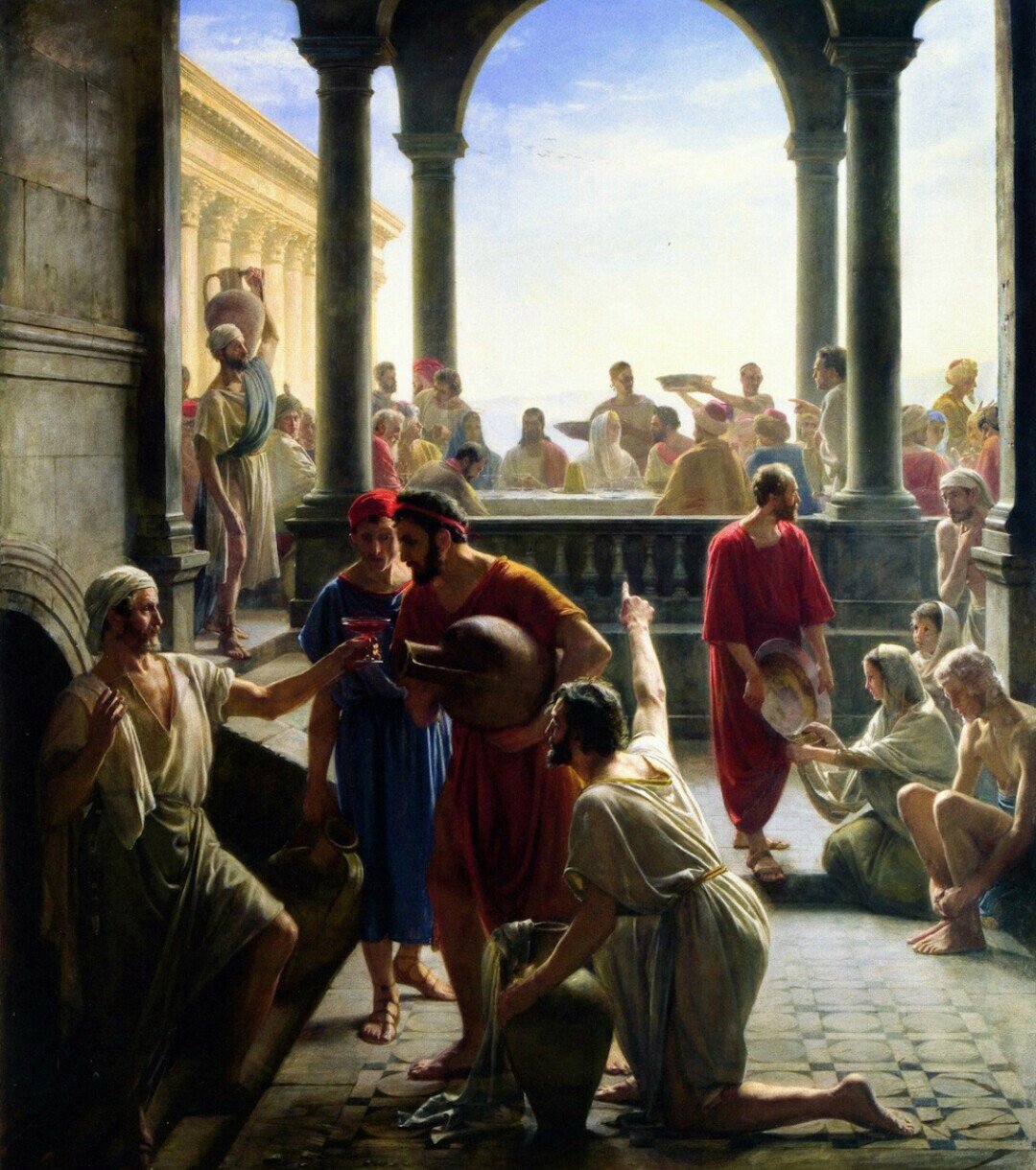
Wiki-image of a scene of the wedding at Cana is in the public domain.

Haitians Here Granted TPS

Word arrived late afternoon yesterday that Homeland Security Secretary, Janet Napolitano, granted Temporary Protected Status to Haitians in the United States. This means that they can stay here until it is safe to return to their devastated native country.

Here is a link to a short Associated Press story with the announcement and some details.

Many groups urges Congress to take this action on behalf of the Haitians living in the U.S. One group was the Jesuit Refugee Service [JRS]/USA. It posted the news of the TPS with details updating the dire circumstances in the island nation of Haiti.

Video Report from Archbishop Timothy Dolan about Haiti

Archbishop Timothy Dolan offered these remarks about Haiti and the contributions of the Catholic Church and its service arms to the people of Haiti. The situation is "analogous to the [26 December] tsunami of 2004."

Friday, January 15, 2010

Voices from Haiti


Jesuit Refugee Service/USA yesterday posted comments from individuals in Haiti at the time of its devastating earthquake.

Also, CNN.com posted a video of people in the darkness of night and nothing.


__________________________________________________________
Wiki-image of animated flag of Haiti is in the public domain.

Thursday, January 14, 2010

Helping Haiti

The Society of Jesus is active in Haiti. Word arrived early this morning from the assistant to the Provincial of the Chicago & Detroit Provinces of the Society of Jesus that all the Jesuits in Haiti are accounted for except one, who was not in the house during the quake and its aftershocks.

The communication also stated:
The Catholic community in Haiti has suffered a great loss: The cathedral has been destroyed and Archbishop Joseph Serge Miot has been killed. Additionally, the main hospital in Port-au-Prince has been destroyed.

At a time like this many feel the desire to help. We are in the midst of collecting as much information as possible about the status of Jesuit communities, their ministries and the wider needs of the community in Port-au-Prince. If you, your community, your ministry, friends or family would like to support the Jesuit ministries in Haiti, you may contribute online through the Chicago Province or Detroit Province website (links below):

Chicago Province Online Donation

Detroit Province Online Donation

Know that 100% of the donations will serve the people of Haiti. All monies will be directed to the French Canada Province and JRS USA to coordinate our support for the Jesuit response to the dramatic events taking place in Haiti.
_______
Donations also may be given directly to Jesuit Refugee Services USA.
_______

At the Vatican yesterday, Pope Benedict XVI said:
I appeal to the generosity of all people so that these brothers and sisters of ours who are experiencing a moment of need and suffering may not lack our concrete solidarity and the effective support of the international community. The Catholic Church will not fail to move immediately, through her charitable institutions, to meet the most immediate needs of the population.