Sunday, December 13, 2009

Sunday word, 13 Dec 2009

Advent Sunday3 (13 Dec 2009) Zeph 3. 14-18a; Resp Is 12; Phil 4. 4-7; Lk 3. 10-18

Homily of Fr. Paul Panaretos, S.J.

Joy In Practice


I was ordained in Advent. My Advent-ordination reshaped me. The Advent scriptures invite us to allow Jesus reshape us. They began sounding the note of friendship, especially of God with us.1 Advent blossomed from friendship to glory, God present with us.2 Today’s readings sound the note of joy with particular passion: shout for joy...God rejoices over us. Rejoice in the Lord. Why? Because the Lord is near, filling us with expectation for our Messiah’s return with glory and salvation. Our expectation shapes our action: Now we watch for the day, hoping that the salvation promised us will be ours when Christ our Lord will come again in his glory.3


To watch for the day of our Messiah is the Christian disposition and attitude, daily attitude more than calendar watching. Advent sings over and again that God has befriended us to share God’s glory with us; to glory in our friendshipwith God and to rejoice in our share in living thenew creation. Our service to so many is how we putour Christian attitude in action. Your service to so many serves my priesthood.


I have no things to show for my years of ministry. I have people. Jesus put many people in my life who long to feel him and, feeling, know him. Living for his return seeks to feel[] the joy and hope of his presence in his Spirit now. Living for hisreturn looks forward with longing to his return at the end of time.4 Our desire to live for our Messiah’s return is God’s gift, not our ingenious, pious effort. That is reason to rejoice. We don’t try to produce God’s life—as if we could. We desire to open ourselves to God’s self-gift to make our hearts more supple; and to savor God’s kindness to us.


You teach me that God’s kindness to us is not our private gift. God transforms and renews us with divine kindness to be apostles of kindness in our living day to day. The gift of God’s kindness to us—loving us as we are; healing us; guiding us; reassuring us; forgiving us always; revealing God’s self to us throughout our days; and inviting us to extend God’s good news of Messiah Jesus in deed and word—the gift of God’s kindness to us we make real with our own lives.


You make real for me St. Paul’s reminder to us that our Christian kindness should be known to all. Christian kindnessbegins as humane behavior which Jesus’ Spirit gradually trans-forms into ever more selfless behavior. In other words, hearing Jesus’ words is not enough; nor keeping our friendship with him private. Christian kindness is concrete actions.


People who welcomed God’s forgiving, healing transformation into themselves from John the Baptizer asked what to donext. What shall we who are transformed by God’s love do? John was practical: share your clothing and food with thosewho have none; do not live greedily; do not extort, lie or accuse. Instead, grow satisfied with what you have. Satisfied maysound smug, but it’s not. Because possessions are extensions of ourselves, satisfied means growing content with whom Jesus has created each of us to be.


In practice it works this way. Whatever we may want to erase because we feel it taints us will have power over us as long as we insist we can overpower it. Accepting its presence is the beginning of feeling the joy and hope of [Jesus’] presence. Jesus presence transforms us with his friendship; his friendship allows us to show his kindness to others. This Year of the Priest includes all Jesus’ friends helping all of us to surrender ourselves to Jesus and continue to be transformed by him. Advent celebrates our triune God transforming us by giving us their friendship so we can make the effects of their glorymore available to one another and to all in the practical ways we practice our Christian joy.


In your daily 15 minutes with Jesus this week, quiet yourself in the presence of the Trinity. Ask John the Baptizer to prepare your way to Jesus. Speak with Jesus: name your most in-tense feeling: sorrow; pain; joy; strength; doubt or need;ask Jesus to join you to carry it. Ask Jesus to help you recognize yourself in stronger, felt ways and grow more content as his friend; his modern day apostle, co-sharing his attitude. Close saying slowly the Lord’s Prayer, which Jesus gave us to help us bring his joy to everyone we meet—our practical grace.


Link to this homily's Spiritual Exercise


____________

  1. See the readings of the First Sunday of Advent.
  2. See the reading of the Second Sunday of Advent.
  3. Advent Preface I, which we use the first three weeks of the season.
  4. Words of the Alternative Opening Prayer of today.
__________________________________________________________________
Wiki-image by Josef Suveg of statue of John the Baptizer is used according to the Creative Commons Attribution ShareAlike 3.0 license.

Saturday, December 12, 2009

Saturday word, 12 Dec 2009

Our Lady of Guadalupe (12 Dec 2009) Zech 2. 14-17; Resp Judith 3; Lk 1. 39-47

Homily of Fr. Paul Panaretos, S.J.

First Frontier


Today’s feast honors the memory of the Virgin Mary’s appearance to a Mexican man in 1531. Juan Diego was humble and poor. For this reason, more than reasons national and ethnic, Spanish-speaking people respect the Virgin in ways with which others may not resonate.


Earlier this week, during novenas honoring our Lady of Guadalupe in many places near and far, the Bishop of Dallas concisely expressed why this is so. “The Virgin of Guadalupe continues to be a symbol of dignity, hope and compassion for all who are marginalized.”1 Advent and Christmas are full of marginalized people from captives exiled from their land and temple; the prophets who announced God’s hope to be the people’s hope; to Mary, who learned she would give human nature to the Second Person of the Trinity; to Joseph, who led her in flight with the Infant; to the shepherds, the first humans to hear of and see with their eyes Emmanuel.


The history of the Americas marginalized its native peoples, whose descendants continue to suffer the effects of long ago. Many who flee their homes and come to the Americas for freedom also suffer those effects. Those of us who remain deaf to them or blind to their presence suffer marginalization from the heart of God, who showed especial care for the lowly and the hungry and all in need of mercy.2


The Basilica of Guadalupe, built a short walk down the hill from where Mary appeared to Juan Diego, Pope John Paul II called “the Marian heart of America.”3 He had completed his Apostolic Exhortation after the synod of bishops had focused on the American continent. He brought a copy with him to the “the Marian heart of America,” saying:


I have come here to place at the feet of the mestiza Virgin of Tepeyac, Star of the New World, the Apostolic Exhortation Ecclesia in America, which incorporates the contributions and pastoral suggestions of that Synod, entrusting to the Mother and Queen of this continent the future of its evangelization.4


Evangelization is key to this feast, celebrated in the Americas with particular fervor. Evangelization looks ahead for the sake of advancing the gospel. Evangelizers look to their history, especially the roots of how the church began and grew, in order to move forward and advance the gospel to the frontiers both faithfully and effectively.


Evangelizers’ first frontier, of course, is their hearts. When has my heart, my being felt forced to the margins? Have I surrendered to Mary’s son in those moments? How have I noticed Jesus accompany me, join me, choose me, restore and strengthen me? In what way and for what purpose has Jesus transformed my vision?


When we entertain those and similar questions of the heart, our first frontier, we acknowledge our human poverty—Jesus called it poor in spirit:5 more difficult to acknowledge than poverty of things—and allow Jesus to evangelize us then choose us to announce his good news and to live what we announce. This is a pattern of living humility as Jesus did. It takes strength, self-esteem, vision, compassion and desire to apply oneself anew each day. They require a realism we Catholics name faith. Faith daily calls Jesus to complete what we cannot do solely by human effort.


Mary demonstrated that faith never dismisses human effort but allies with it; that people are the hands, feet, eyes, ears and heart of the holy one. Faith is a verb, people in action, as Elizabeth reminded Mary of her esteem for which we remember her and desire to imitate: Blessed are you who believed that what was spoken to you by the Lord would be fulfilled. We learn that better “at the feet of the Star of the New World,” wherever we may be.


____________

  1. Bishop Kevin Farrell of the Diocese of Dallas, in the Dallas Morning News, 11 December 2009, electronic edition.
  2. Luke 1.52-54, part of Mary’s praise. Its beginning closed today’s gospel.
  3. His homily at the Basilica of Our Lady of Guadalupe, Mexico City, Saturday, 23 January 1999, during his Apostolic Journey to America.
  4. Ibid.
  5. Matthew 5.3.
___________________________________________________________________________
Wiki-image by Castores of a fiesta at the Basilica of Guadalupe is used according to the Creative Commons Attribution ShareAlike 3.0 license.

Thursday, December 10, 2009

CNN Show To Consider Faith and $$$

This December 19 a CNN special is scheduled, "Faith and Money." Yesterday, Mr. John L. Allen Jr., one of the panelists on the show, reported
The CNN program covers a vast range of topics, from the economics of Mega-churches (a segment driven by an interview with Joel Osteen) to the effect of church money on American politics. I was part of a panel devoted to trying to gauge the impact of the economic crisis on religious groups around the country.

Without stealing the show’s thunder, I can briefly summarize three points I tried to make:

Tuesday, December 08, 2009

Daily word, 08 Dec 2009

Immaculate Conception of Mary (08 Dec 2009) Gn 3. 9-15, 20; Ps 98; Eph 1. 3-6, 11-12; Lk 1. 26-38

Homily of Fr. Paul Panaretos, S.J.

Full, Rich and Living


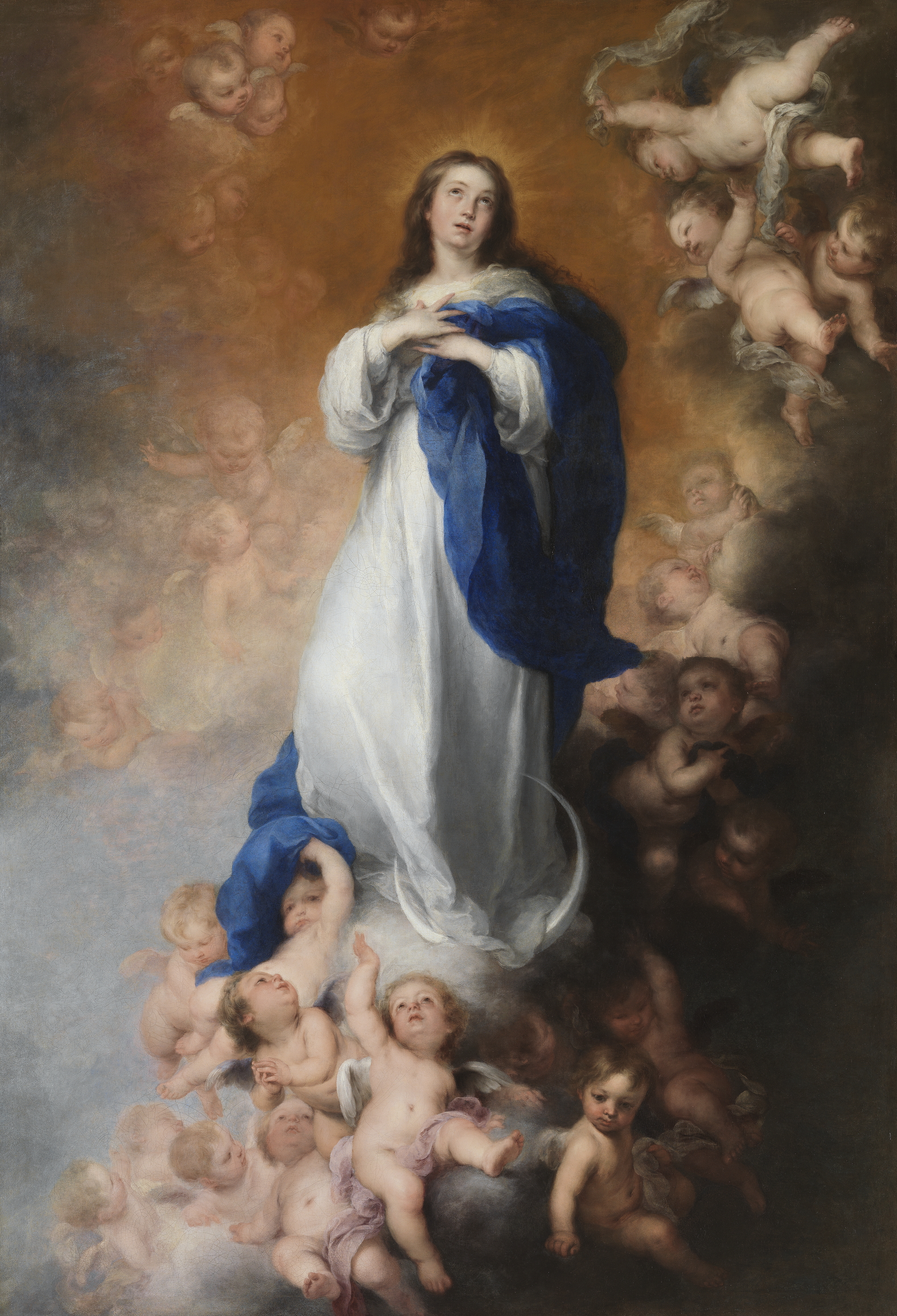
The immaculate conception means Mary was untouched by sin from the beginning of her existence. It does not mean that Mary was incapable of sinning but that she chose to have no part with it, like her son of whom scripture says: For we do not have a high priest who is unable to sympathize with our weaknesses, but one who has similarly been tested in every way, yet remained apart from sin.1


Recalling Mary Pope Paul VI noted as she was the “first of the redeemed, immaculate from the moment of her conception, the incomparable dwelling-place of the Spirit, the pure abode of the Redeemer of mankind, she is at the same time the beloved Daughter of God and, in Christ, the Mother of all. She is the perfect model of the Church both on earth and in glory.”2 Pope Paul noted also Mary was the first “expression of the purest and most burning joy.”3 How can we begin to share true joy? How is Mary our model? Let me suggest how from art and from a prayerful writer.


When you have stood before a painting of the this gospel scene of the Annunciation, or sat with one in a book open in your hands, have you felt anything in particular? Different artists capture different moments of this gospel-scene in their paintings: the angel addressing Mary; Mary’s confusion; Mary responding to the angel; and all the others moments as well. What I feel from the paintings, some more than others yet common to all of them, is silence. I know that has something to do with what I am seeking to discern God desires for me and from me. Yet, we all discern the particular desires of God for us within our deep self, not in a void but in the very heart of God and ours. Silence limps to describe that full, rich and living truth.


Kathleen Norris, a contemporary, prayerful and reflective writer, described Mary’s silence as model silence:

consider the nature of Mary's silence, which is the gift of being able to sit at God’s feet and listen. It is not silence as enforced by the world, the false silence that an adult seeks to impose on a child, for example, in an abusive relationship. It is not the silence of the story that a browbeaten woman might have told, were it not for social and economic pressures bent on keeping her quiet. It is not the silence of the writer jailed for exposing a lie, or of the political prisoner, whose silence is often bought with blood. It is a good, healthy, open silence, a freeing silence that might lead a person anywhere. Even...to a reading of the Bible that is free to question it, and also to let it question you.4
Not “enforced by the world”; or “imposed” by one person on another; neither beaten nor “bought with blood”; rather, “ a good, healthy, open silence, a freeing silence that might lead a person anywhere.” Mary could not have imagined being called to mother God into our world, nor could she have imagined where her Yes would lead.


When you and I discover a renewed or even new allegiance to Mary’s son, his Father and their holy Spirit, then we’ve entered and entertained that full, rich and living silence. When you and I discover a renewed and even new allegiance to Mary’s son, his Father and their holy Spirit, then we taste again Christian joy. When we discover a renewed and even new allegiance to Mary’s son, his Father and their holy Spirit, then we enjoy more clearly God inviting us to grow more humane and to be living channels leading others into “a good, healthy, open silence, a freeing silence,” which gives birth to Jesus here and now for the sake of the gospel and our world.

____________

  1. Hebrews 4.15. The Greek word we translate as without has an active sense of keeping apart or aloof from.
  2. On Christian Joy, Apostolic Exhortation of Paul VI, 9 May 1975, Part IV.
  3. Ibid.
  4. in her Amazing Grace: A Vocabulary of Faith (Riverhead Books 1998).
__________________________________________________________________
Wiki-image if Murillo's Immaculate Conception is in the public domain.

Ignatian Blog Follows Climate-Conference Proceedings. . .

. . .in Copenhagen

With entries in both English and Spanish, Jesuits José Ignacio García and Jacques Haers post to the IgnatianEconet's Blog: Meeting Point for Faith and Ecology. Their brief description invites participation.
On the occasion of the COP 15 meeting at Copenhagen, the Ignatian Network on Environment starts up this blog. José-Ignacio Garcia and Jacques Haers, both Jesuits active at OCIPE in Brussels (Belgium) will offer food for thought and discussion. We hope that readers will actively participate and share their own opinions and ideas.
The blog links to other climate-related sites.