Monday, August 10, 2009

Monday word, 10 Aug 2009

Monique Gonda memorial mass
(11 Aug 2009) Is 25. 6a, 7-9; Ps 23; 1Jn 3. 1-2; Mt 5. 1-12a
Homily of Fr. Paul Panaretos, S.J.
Divine Doing

On behalf of Gesu Parish, I extend our prayers and heartfelt sympathy to you, Les, Doug, Chris and Karen at the death of your mother, Monique. Your children grieve, too. Your mom’s final months were long and challenging for you as well as her. I know what that’s like because my sister informed me while I was living in Asia that Alzheimer’s began to manifest itself in our mom. When I returned in six months I was able to help my sister, who had been doing the lion’s share of being with our mom and getting her good care.

Although my mom is still alive, I grieve often as she lives her long good bye, as Alzheimer’s is aptly called. I pray that you be more courageous than your grief is sharp. Your confidence in our risen Messiah will help you grieve well and come to experience your mom’s presence in real and new ways.

Today the Catholic church bids farewell to one of hers. I offer a few words to console and strengthen you in your grief; to help you appreciate God’s astounding compassion by noticing Jesus’ victorious dying and rising were present in Monique./1/

We are grateful for the words of remembrance Doug, Chris and Karen offered. They helped us connect your mom and her passing with the mystery of Jesus’ death and resurrection. I am grateful to Karen for selecting the scriptures proclaimed at Monique’s memorial mass. They shape my brief reflection with you.

I met Monique at University Hospital after Monique’s surgery. Even in her pained weariness, Monique was delightful. She looked very tired, and I asked her if she slept at night. Monique told me she did, but the most draining thing for her after her abdominal surgery was sitting up in bed. That was more tiring than the short walks she made to restore muscle tone and her body’s energy.

Unfortunately, Monique was unable to make steady progress. That is particularly painful to you, her children and friends, because Monique was vibrant. Her final illness and its repercussions challenged her in many ways, particularly in letting go.

Not only did we staff members who visited Monique these many months notice her weakening, we also noticed her resistance in the face of it. This resistance is no shortcoming or failing; it is part of our human condition. Being with Monique did not mean that you, Les, Doug, Chris and Karen, or any of us could affect changes that would restore her health. Being with her--whether in person or over distances that separated you--was more important than anything you did. Being with Monique was more–life-giving than doing for her.

I saw that at The Normandy when I visited Monique there. More than once did I see a caregiver sitting with a resident outdoors or in the person’s room. One day when I arrived at Monique’s room, caregiver, Debbie, was sitting in a chair at the head of her bed. That was what Debbie was doing. She spent more time doing that than any other service she performed to ensure Monique’s comfort. I did that, too.

Why is that so important? All of us can name challenging times in our lives when people accompanied us through a challenge. All of us can recall how important their presence was, although they could and did not change our circumstances.

Monique weathered many challenges in her long life, from her youth in France to raising her family in the States and seeing them grow to adulthood. For a vivacious, thinking and thoughtful Monique, her challenge to let go--of her strength, of her routine, of her house, of her independence--Monique’s challenge to let go was steep and lonely. That’s why to have company was so important for her; why it was so life-giving because everything by which Monique measured her life was ebbing.

Vivacious Monique did not want to die. I know she didn’t because a caregiver observed what I observed, and Karen confirmed that.

Of course, Monique’s life is changed not ended./2/ That conviction of our faith challenges us to let go of Monique--she is not available to you, her family and friends, as she was--even though our desire and the assurance of our faith promise that we shall be reunited when Jesus returns in glory with salvation for his people./3/ It is during the interval while we await Jesus’ return, the resurrection of the dead and our reunion with them that we need graced companionship. That’s why we come here. We pray for ourselves as much as, or even more, than for Monique.

Graced companionship is not limited to church. God works in every moment of our lives. At each moment our triune God creates us. When people enjoy clarity rather than live under a veil, to use Isaiah’s image, people enjoy God’s companionship. When we experience anew our connection with God--St. John described that connection as being children of God--we enjoy God’s companionship. Jesus revealed the implications of being children of God throughout his life on earth.

When she was still alert and able to communicate, Monique remarked to her family that at The Normandy she felt love--loved by the caregivers and some of the residents. Monique’s final journey to let go and to accept God changing her life not ending it is Monique’s lesson to me. Being accompanied means we allow others to love us, we allow others in, we allow God in. Allowing others is active; it doesn’t seem so because we are not in control. The Beatitudes challenge us precisely to welcome God’s loving kindness each day so that, like Monique, we will one day be able to rest in God’s merciful doing and enjoy new life, life more vivacious than we can imagine.

Until we enjoy God’s life in an unveiled way and rejoice to see God as [God] is, graced companionship in its many forms, especially as human accompaniment, we will recreate us and wipe away the tears, which blur our faith-vision and challenge us to live it.


___________________
1. Cf. Order of Christian Funerals, 27.
2. Preface for
Christian Death I, Roman Missal.
3. Penitential Rite (C,ii), Roman Missal.
________________________________________________
Wiki-images of Jesus announcing the Beatitudes and of the New Jerusalem are in the public domain.

Sunday, August 09, 2009

Sunday word, 09 Aug 2009

19th Sunday of the Year (09 Aug 2009)
1Kg 19. 4-8; Ps 34; Eph 4. 30-5.2; Jn 6. 41-51
Homily of Fr. Paul Panaretos, S.J.
Two Ways

All writings offer perspectives: those ways authors communicate through their writings. One perspective, which the Fourth Gospel offers, is that two ways of living exist. One way is familiar, and we can gain access to it. The other way we receive as a gift; our efforts cannot make it possible.

The familiar, customary way of living even offers us apparent security. The Fourth Gospel uses the phrase, the world, to name our familiar, customary way of living. Some characteristics of the world, along with familiar and customary, are visible, measurable, available through human effort. Of course, what may be familiar to one may not be to another, and what makes one person feel secure may threaten another. Thus, one more feature of the world may be summarized as often divided rather than united.

The other way of living harmonizes with Jesus and his good news. We do not always perceive his good news as good because it challenges us both to adopt and to exercise in our daily living the values Jesus revealed in his person and continues to reveal by his Spirit, whom he gives us.

Jesus’ word challenges us to move beyond our security and to live his life. Jesus pointed out that the world on its own cannot fulfill us and satisfy our deep longings. In the language of the Fourth Gospel values of the world are empty and misleading. These clearly different ways do not mean that creation is evil or that it is without value. Indeed, God surveyed all creation and found it very good./1/

To live the Christian life seeks to balance living in the world and exercising the values of Jesus and his gospel. At times the world does not favor Jesus’ values or those who try to live them. To live the Christian life also respects and cherishes our humanity and keeps alert to the ways Jesus offers us his divinity and invites us to incarnate it by our living day to day.

That Jesus offers us divinity and invites us to reveal it reminds us that his offer and his invitation are grace; neither is the result of human effort.

To use words from the lips of Jesus, we may say that his offer of divinity and his invitation to reveal it to others by how we live came down from heaven. The language is spatial, but its meaning is more real than space or place. God’s continues to make self-revelation; Christians try to align themselves more with who God is and what God desires.

God’s gift in Jesus by their Spirit began in each of us at baptism. We come to the Lord’s table and share in his body and blood because the eucharist nourishes and sustains what baptism began. One liturgical guide expressed that this way. “The food of the eucharist becomes for us, not a sort of accessory, but the very source of growth in the word of God. It is not just a religious ceremony for one hour a week, but it becomes a way of living our faith.”/2/

When the eucharist is not “a sort of accessory,” it allows Christians to shed bitterness, fury, anger, raised voices and cutting speech and to exercise kindness, compassion and to forgive because God has forgiven [us] in Christ. St. Paul was always practical in encouraging people to live the faith of Jesus!

In your daily 15 minutes with Jesus this week, become alert to the presence of our triune God around you, embracing you and vibrating in every cell of your being. Ask Elijah to renew your confidence in your life and your faith and to present you to Jesus. Converse with Jesus: lay all your doubts at his feet; ask Jesus to help you be more alert to how Jesus offers you divine life and more alert to how Jesus invites you to reveal it by your daily living. Close by saying slowly the Lord’s Prayer, pausing to desire at its phrase, daily bread, that the eucharist will never be for you “a sort of accessory” but nourishment to exercise your faith and trust in Jesus and to live it with greater vigor and joy.


Link to this homily's Spiritual Exercise
___________
1. Genesis 1.31.
2. Kevin Irwin, Sunday Worship: A Planning Guide to Celebration. New York: Pueblo, 1983, p. 247.
____________________________________________
Wiki-images of Jesus feeding the multitude and a mosaic floor is in the public domain.

Saturday, August 08, 2009

Saturday word, 08 Aug 2009

St. Dominic, Memorial (08 Aug 2009)
Dt 6. 4-13; Ps 18; Mt 17. 14-20
Homily of Fr. Paul Panaretos, S.J.
Itinerant: His Practical Approach

"If he hadn’t taken a trip with his bishop, Dominic would probably have remained within the structure of contemplative life. . .” so began a brief summary/1/ of St. Dominic. This year’s semi-continuous scripture readings are apt for the founder of the order of men and women, which bears his name, particularly the familiar words from Deuteronomy:
Hear, O Israel! The LORD is our God, the Lord alone! Therefore, you shall love the Lord, your God, with all your heart, and with all your soul, and with all your strength. Take to heart these words…Drill them into your children. Speak of them at home and abroad, whether you are busy or at rest.
The key phrase is, Take to heart. This means personal appropriation not just memorization or mental knowing. Personal appropriation includes living one’s relationship with God our Lord. On that “trip with his bishop” Dominic noticed that was not happening.

Their trip took them to Spain’s home territory of the Albigensians, who lived a heresy with several earlier incarnations. They considered all material things to be evil. You can imagine the implications of such a principle: sacraments were evil; also the body--which meant procreation was evil and so was healthy eating. Their behavior flowed from their belief: the Albigensians did not believe a good God could create a world filled with pain and suffering. Purists--Albigensians called themselves the Pure--in any age have great difficulty being realists.

St. Dominic wanted to curb and correct this distorted view of God, the world and people. Preachers came and went, but many “traveled with horse and retinues, stayed at the best inns and had servants.”/2/ The Pure, of course, and others rejected them. So Dominic began to move about humbly with three Cistercian monks.

Cistercians, more often called Trappists, emphasized manual labor and self-sufficiency. This preaching effort, in imitation of the apostles, led to the Order of Preachers. Its membership seeks to keep alive Dominic’s ideal: “to pass on the fruits of contemplation.”/3/ This describes the vocation of most of the faithful in the church.

God calls less of us to focus our lives on contemplation only. Indeed, St. Ignatius of Loyola, born 270 years after Dominic had died, was very fond of Dominic. St. Ignatius recognized that contemplation is important and is the foundation of action. Long before Ignatius and his contemporaries/4/ coined the phrase “contemplatives in action,” St. Dominic lived it. Many of us here are called to live that way as well.

____________
1. Saint of the Day, 08 Aug at AmericanCatholic.org.
2. Ibid.
3. The meaning of
contemplata tradere.
4. Jerome Nadal, S.J., gave particular emphasis to this phrase in his recollection of St. Ignatius.

____________________________________________
Wiki-image of El Greco's St. Dominic is in the public domain.

Friday, August 07, 2009

August sky

August hosts the Perseid metershower.

Viewers want clear skies and do well to nap in order to be awake in the wee hours.
_______________
Wiki-image by Mila Zinkova of trajectories of two meteorites is used according to the Creative Commons Attribution ShareAlike 3.0 license.

Thursday, July 23, 2009

July Sky

The AccuWeather.com site may be consulted most often for temperature and weather patterns.

The site also has an Interests tab along the top and near the right-end of the series of tabs located their.

Astronomy is the first of several categories. With data from the Hubble Telescope, one can enjoy a good video-preview of the night sky. Of course, automatically one checks the day's weather to see if clouds or rain will frustrate the anticipation of viewing the sky with the human eye.
____________________________________________
Wiki-image by Vinish K Saini of a view of the moon and Venus is used according to the Creative Commons Attribution ShareAlike license 2.0.

Wednesday, July 22, 2009

No Casual Calamari

In San Diego, California, divers and cruising pods of Humboldt squid (also called "flying squid" and diabolos rojos [red devil]) had surprising and even frightening encounters.


The CSM article also boasts a 2008 photo of other Humboldt squid out of their element. No mention of Jules Verne and his imagined squid suggests these squid were also out of the running for giant category.
____________________________________________
Wiki-image of a stamp bearing an image of a squid is in the public domain.

Tuesday, July 21, 2009

On Vacation

A recent opinion column about Pope Benedict's most recent encyclical.

Monday, July 20, 2009

On Vacation


A 2008 story of Bellarmine House, the villa of the Jesuit Community of Boston College, has an intersecting history of architecture, names and uses.


______________________________________________________________
Wiki-image of Minot Light House is in the public domain.

Sunday, July 19, 2009

Sunday word, 19 Jul 2009

16th Sunday of the Year (19 Jul 2009)
Jr 23. 1-6; Ps 23; Eph 2. 13-18; Mk 6. 30-34
Homily of Fr. Paul Panaretos, S.J.
Offering What We Receive

Scriptures grace us provided we are open and do not read them according to our categories of thinking. The ancient Mediterranean people and their culture—Jesus’ kin and culture—differed from ours in many ways. I’m about to leave on vacation and rest, relax and enjoy the time with others at the ocean. I can count on an easy pace in a quiet setting, but if I need something, I can walk to a market to get it.

The less hurried place I will visit is not at all like the deserted place to which Jesus called his disciples, who returned from their mission of preaching repentance to prepare Jesus’ way. People lived in small hamlets of not many people. A town like Nazareth may have ranged from 50 to 150 people. People knew one another too well for our liking—and maybe for theirs!

Between their towns and hamlets were large open spaces, undeveloped by nature or humans. Moving through them was no walk in the park, nor was moving through them anything but hostile: no CVS, Target or Giant Eagle to get a much needed bandage, new dish or food to fill it.

Great was the need to take care and to care for children, older people as well as animals when traversing deserted places. Jesus noted necessity to enter such a place. People were coming and going in great numbers, and [Jesus and his apostles] had no opportunity even to eat. If people could be nosy and interfering in ordinary circumstances, then the comings and goings of great numbers of people probably to gawk at Jesus and his apostles would have been too much to take.

The gospel injects humor into the scene, adding, People saw them leaving and many came to know about it. They hastened there on foot from all the towns and arrived at the place before them. How they kept their eyes on Jesus and his followers!

Jesus responded to them all with compassion. The image of shepherd, long before Jesus and Jeremiah, was united with royal leader in the person of David, the shepherd-king. The union of shepherd and leader emphasized care for people, suffering with people—compassion. God desired all rulers of God’s people to embody compassion. Because we share in our Messiah Jesus’ royal leadership by baptism, God desires us to show compassion in all our dealings.

Compassion does not call anyone to be a doormat for others. It does call us to imitate God’s heart as much as we humans can. How do we imitate God’s heart?

First, we can do that by being in touch with God. Cultivating our relationship with our Creator and Redeemer includes allowing ourselves to be embraced by Jesus, being nourished by his word and his sacraments, aligning ourselves with Jesus’ banner of cross-leading-to-resurrection. Allowing ourselves to be embraced by Jesus, nourished by him and aligning ourselves more closely with Jesus take many forms of personal prayer, public worship and Christian service. We are fortunate that Gesu Parish and School offer us so much assistance in all those ways.

Second, we imitate God’s heart when we extend to others what God has done in and for us. Living as one reconciled by God in Jesus by their Spirit; extending to others the goodness and kindness they offer; and inviting others to enjoy what we enjoy, that access [we have through Jesus] in one Spirit to the Father. That is how we live divine love through our frail, human bodies. Christian love is not about being perfect, it’s about freeing ourselves to be led, nourished, guided and perfected by our Good Shepherd.

In your daily 15 minutes with Jesus this week, pause in the love our triune God shines on you. Ask the apostles to present you to Jesus so you may converse with him. In your words thank Jesus for his patience with you; savor one way you have enjoyed his goodness and kindness he has offered you. Ask for Jesus to help you deepen your desire to welcome his faithful love at each moment. Close your time saying slowly the prayer Jesus taught us. Praying it allows Jesus to transform us to be his apostles of reconciliation today.

Link to this homily's Spiritual Exercise


_____________________________________________
Wiki-image of Jesus and apostles is in the public domain.

Saturday, July 18, 2009

Israeli Soldiers

What do some Israeli soldiers think about the January 2009 Operation Cast Lead?

Gaza was the objective of that operation. The website, Breaking the Silence, offers soldiers' Testimonies divided into several categories. This is not the first time some Israeli soldiers have protested and objected to their orders.

Monday, July 13, 2009

Road Map for the Pope's Newest Encyclical

Jesuit Father James Hug has made available on the Center of Concern website a precis to the encyclical, Caritas in Veritate (Charity in Truth).

It downloads as a portable document file (.pdf). It is in sentence-outline format and is a great help to read before, with and after reading the pope's full text.

Jesuit Father Brendan MacPartlin wrote a briefer overview of the encyclical at the British Jesuits e-zine, Thinking Faith. He
considers the vision delivered in this long awaited document, which picks up on the themes of Populorum Progressio to look at issues of development and social action: ‘Charity in truth drives the authentic development of all persons.’


________________________________________________________________
Wiki-image by Odder of road sign is used according to the Creative Commons Attribution ShareAlike 2.5 license.

Sunday, July 12, 2009

Sunday word, 12 Jul 2009

15th Sunday of the Year (12 Jul 2009)
Am 7. 12-15; Ps 85; Eph 1. 3-14; Mk 6. 7-13
Homily of Fr. Paul Panaretos, S.J.
Transformers

We may not see much for us in the Word today. Amos was one of the prophets, Jesus sent out apostles with him to prepare his way by preaching repentance and St. Paul praised and thanked God in an extended way in his letter to the Ephesians, a single letter originally meant to be read in many churches.

Popes write encyclicals for the world church. We don’t preach dramatically like Jesus’ apostles or cry out like the prophet Amos. Popes, apostle, prophets: they all seem out of our league, don’t they? Nevertheless, the scriptures do address us. The common denominator is that God chose and continues choosing unprepossessing people like us.

Amos was a shepherd and pruner of trees. Many of the apostles were fishermen. All St. Paul’s learning and religious zeal were no antidote to his human weakness. God’s way of operating throughout the ages has been consistent: to choose ordinary people for the extraordinary desire of God, the salvation of the world. Jesus fulfilled God’s desire as he set ordinary people in motion to do just that: Jesus summoned the Twelve and began to send them out two by two and gave them authority over unclean spirits. He instructed them to take nothing for the journey but a walking stick.

If we think in our western and modern ways, we miss how extraordinary was the authority Jesus gave them. You and I think nothing of traveling. However, in the ancient Mediterranean one would not travel unless one had to leave the extended family and the village because both provided a social network and the necessities of daily living.

Further, the ancient Mediterraneans believed in nonhuman beings and ranked them according to power: our God—the God of Abraham, Isaac and Jacob—other gods, archangels, angels, spirits and demons. Jesus’ people called demons unclean spirits, who disturbed human well-being in all manners of ways. Jesus, authorizing his apostles to have power over unclean spirits, gave them new power.

You and I may be mesmerized by power and miss how Jesus sent them: two by two. Each was an extension of the apostolic band, and each was an extension of the other’s extended family, providing the social network so important to living a human life.

Jesus transformed our humanity by his death and resurrection. Jesus sends us, too, ordinary people that we are, to continue his transforming work. By baptism we
share in the priestly, prophetic, and royal office of Christ [Jesus] and therefore have [our] own role to play in the mission of the whole People of God in the Church and in the world. [What is our mission? We]...bring[] the gospel and holiness to [all], and [transform all] things through the spirit of the gospel./1/
We are one another’s support to continue the mission of Jesus. Travel today, as popes, presidents and ordinary people like us testify, is not the limited or even dreaded activity of Jesus’ culture. Our closeness, support, encouragement and companionship are just as important for us as in his culture. Perhaps it is more important because we tend to privatize faith and to go it alone because our culture values individualism so highly. Yet, God continues to work through individuals, calling them first into communion with Jesus and with one another so that we may allow Jesus to send us for the sake of our world.

In your daily 15 minutes with Jesus this week, pause, aware of being in the presence of the Trinity. Ask the apostles to present you to Jesus. Speak to Jesus your hesitation at being his apostle today. Affirm your trust in Jesus and ask for the grace to infuse your world with Jesus’ Spirit by the way you live. After several minutes, close your prayer by saying slowly the Lord’s Prayer, which is our going-on-mission prayer. Saying it keeps us close to the apostles, whose mission we extend as we put into practice our faith, hope and love.

____________
1. Second Vatican Council, Decree on the Apostolate of the Laity 2.
______________________________________________
Wiki-images of the Prophet Amos and the Twelve Apostles are in the public domain.

Saturday, July 11, 2009

Saturday word, 11 Jul 2009

Julie Beran-Brice Westhoven wedding (11 Jul 2009)
Gn 2. 18-24; Ps 128; 1Co 12.31-13-8a; Jn 15. 9-12
Homily of Fr. Paul Panaretos, S.J.
Two Making One LIfe


Julie and Brice, you give us an opportunity to appreciate more God’s word as we join in your celebration of the Sacrament of Matrimony. You chose St. Francis Chapel of this university because you enjoyed your first date at John Carroll. Together you made history with your first date. Because yours is the first wedding I witness here, this is our first date at John Carroll to make new history.

Making history: to begin history is part of making history. Weddings celebrate history begun as well as history yet to be lived. Your wedding is about your early history growing into this present moment and opening onto your future, as two individuals making one life together.

In choosing the selection from the Book of Genesis, you confess and proclaim that God, who has created you, has brought you together, and you implore God to favor you in your mutual love and life. The scriptural phrase, one body, is expressed by mutual love and living.

Jesus gave new emphasis to mutuality. It was a new emphasis because from the beginning God made men and women partners. Humans ceded more to men than women from the beginning, too, which frustrated God’s desire for humans. The new emphasis Jesus gave rested in his word abide: abide in my love, which was and is a mutual love sealed by divine love. “As the Father has loved me, so I have loved you; abide in my love.”

You allowed St. Paul to remind you and all of us that abiding, mutual Christian love is practical. It will challenge you, at times with some surprise. Christian love St. Paul reminded is patient and kind, but sometimes lovers are not. Christian love does not envy or boast, but sometimes lovers do. Christian love bears...[and] endures all things, but sometimes lovers do not. Christian love does not insist on its own way but sometimes lovers do.

That last, that Christian love does not insist on its own way brings us back to the hallmark of Christian love: it is mutual. Brice and Julie, I want to affirm what you have allowed me to see: your desire to live a Catholic marriage. I also want to remind you that at each step of making one life together, Jesus accompanies you, drawing you and your love for each other into the mutual love, which his Father and Jesus and their Spirit enjoy. You’ll never lack for Jesus’ companionship blessing your love with the love of the Trinity.

Your mutual compassion for one another will fashion you from today as a domestic church./1/ Your married life will help you save each other’s souls and welcome “children lovingly from God”/2/; your married life will also allow Jesus to work through you for the sake of the world. You will never lose your individual selves. Instead, both of you will strive to make one life together.

Even more than the way you give love, the way you receive love from each other will allow Jesus to guide you on that still more excellent way, your mutual compassion. Jesus embodied and models compassion for you and for all, and continues creating you to be the man and woman God desires you to be for each other.

I’m very proud of you and, I wish you every good thing. I congratulate you on behalf of the church. It is true that Jesus created you for one another. It is even more true that Jesus will create you each moment for everything ahead of you. Please remember that in pledging yourselves to each other you allow Jesus to work through you for the salvation of each other as well as our world. As you forge one life together Jesus begets something new: a new harmony to feel Jesus creating you and your mutual love for each other, and to help us and others feel Jesus recreating the world as the world sees you receive love as well as give it and abide in it.

______________
1. Dogmatic Constitution on the Church, 11, of The Second Vatican Council.

2. Rite of Marriage, Ch.2: 42.
_____________________________________________
Wiki-images of Jesus' farewell to his disciples (when he said, "Abide in my love") and of wedding rings are in the public domain .

Sunday, July 05, 2009

Sunday word, 05 July 2009

14th Sunday of the Year (05 Jul 2009)
Ezk 2. 2-5; Ps 123; 2Co 12. 7-10; Mk 6. 1-6
Homily of Fr. Paul Panaretos, S.J.
Seeing Beyond a Conversation

Cultures assess themselves with different criteria. We tend to assess ourselves and others using economic criteria. What we possess or lack shapes our social standing and self-worth. We use other criteria, too, but we seem to give socioeconomic data first place.

My visit over 20 years ago to the mission-parish of the Archdiocese of Detroit in Recifé, Brazil, allowed me to see how wealthy poor people are. The people I met were wealthy in hospitality, happiness and faith. My visit opened my eyes to wealth that is more valuable than money. Those among us who have visited Honduras over the years can say something similar. My visit to Recifé, Brazil, opened my eyes to God at work now in me. My visit helped me see one way today’s readings are related. Let me begin with the gospel.

Wealth affected ancient Mediterraneans. Yet, they assessed themselves even more by honor and shame. Honor came with birth, and people rarely moved beyond the status bestowed by birth. Craftsmen, for example, took pride in making things so that without them no city could be lived in, and that they did not need to worry about hunger./1/ Jesus’ father was a craftsman; carpenter suggests to us a more specific occupation using wood, but in Palestine stone was more available than wood and less costly.

The social expectation was that Jesus, like any son, would continue his father’s work. Craftsmen were necessary, and the idea of doing something different was an alien thought in that culture. Yet, a Jewish man was free to study torah and become well-versed in those holy writings. Still a craftsman—who spent hours at his work and often traveling—did not have the time other men, like scribes or those born into affluence, had to devote to studying the holy writings and the discussions of rabbis preserved for generations.

While Jesus astonished many by his ability to cite scriptures, as well as to converse about and teach them, the majority of people could not give Jesus any more honor than that of a craftsman.
If honor was key in assessing self and others in Jesus’ culture, then shame was its other side. The gospels make clear that Jesus held his own in all kinds of conversations. In the one we just heard in which some withheld from Jesus a prophet’s honor, Jesus quickly took the wind out their sails: A prophet is not without honor except in his native place and among his own kin and in his own house.

If I stopped here I would be simply rehearsing cultural history and how people ascribed honor or not, and how people defended it. What does it offer us now? As fully human, Jesus felt the sting of honor withheld, even though he could defend himself. Defense doesn’t always guarantee acquittal, after all. Jesus was not immune to human hurt or the need for affection. When others left Jesus and he asked his apostles, “Do you also want to leave?”/2/ Jesus was not speaking rhetorically. He felt vulnerable and its painful effects.

Vulnerability in any culture is not easy to tolerate and more difficult to manage. St. Paul also knew vulnerabilities, and one in particular haunted him. Its more than difficult to diagnose someone dead for almost two millennia, plus the distance between his culture and ours makes the effort extremely hazardous. What we can learn from St. Paul is that he used his weakness to remain closer to God, who had vindicated God’s son from a shameful death by raising Jesus to unending life!

The value for us in both Jesus and Paul—with his constant focus on Jesus—is the courage they give us to look differently at our vulnerability: our limits; our foibles; our compulsions; our sinfulness. That difference is to see our vulnerability as a grace to taste God’s consoling presence, instead of how the world would have us see it, as worthless weakness and a shameful blot on our humanity. That is wealth more valuable than money.

In your daily 15 minutes with Jesus this week, pause in the presence our triune God. Ask St. Paul to present you to Jesus, who was intimately acquainted with human weakness. Converse with Jesus: renew your confidence that Jesus was often vulnerable; then speak to him about your weakness. Ask for new courage to see your weakness honestly and to appreciate it as an opening for Jesus to work in and through you. Close by saying slowly the Lord’s Prayer, savoring its phrase deliver us. With that phrase we pray not that God change our circumstances but that God work more powerfully and make us channels of God’s life for and with others to honor and glorify God.


_____________
1. Sirach 38.32. Chapters 38.24-39.11 vividly describe honor and people’s roles in life.
2. John 6.67.
______________________________________________
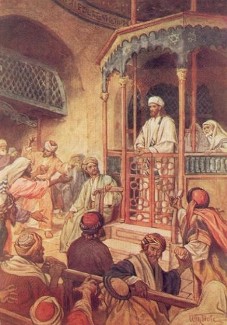
Wiki-images of Jesus teaching in a synagogue and of a most important papyrus of Paul's words about weakness and grace heard today are in the public domain. [Learn more about
Papyrus 46.]

Friday, July 03, 2009

Encyclical Key

Entitled, "A key to reading Benedict's social encyclical," Mr. John L. Allen Jr.'s recent post offers a guided preview of the pope's encyclical due next week, Tuesday.

In this "key" Mr. Allen makes a point that news media may either miss or not elaborate.
Though the pope may not spell it out quite this way, much of Caritas in Veritate could well shape up as an attempt to synthesize three of the most persistent -- and, Benedict would doubtless say, artificial -- dichotomies in recent Catholic experience:

* Personal conversion versus social reform;
* Pro-life versus peace and justice commitments;
* Horizontal versus vertical spirituality.

All three points can be understood as partial versions of one "grand dichotomy," that between truth and love.
Christian love is active, something it has always been and will always be. The Christian desire aims to love genuinely and not in an "artificial" way. Reading Mr. Allen before reading Pope Benedict may help to that.

Wednesday, July 01, 2009

More Popular + A Quiz

Citizens of which two countries gave a rating of 'more popular' to President Obama than his own country?

  • A WorldPublicOpinion.org poll included the question, "'[Would President Obama] do the right thing regarding world affairs?'”
  • At the end of June the Christian Science Monitor noted that in its brief summary of some of the results of the poll

Hints:
The poll targeted "countries that make up 62 percent of the world’s population," according to the CSM report; and

The two countries are not on the same continents.


Find the answers in the CSM report.

Monday, June 29, 2009

Closing Year Opens More About Encyclical

Pope Benedict closed the Year of Paul with Evening Prayer I of the Solemnity of Ss. Peter and Paul. The pope presided at the Basilica of St. Paul Outside-the-Walls. His homily Sunday evening also previewed his forthcoming encyclical due for release in next month.

Mr. John L. Allen Jr. pointed out at that the appearance of the encyclical "may well seem largely anti-climactic." Extracts of it have been appearing in the Italian press; however, the "pontiff actually scooped himself by devoting his remarks for the close of his “Pauline Year” to the theme of Caritas in Veritate, “Charity in Truth,” also the title of his long-awaited meditation on the economy."

Read Mr. Allen's remarks today to appreciate the forthcoming encyclical and its cosmic dimension for each Christian.
Benedict argued that because Christ’s love extends to the entire universe, Christian concern for the world must likewise have a cosmic dimension. Though the pontiff did not develop the point last night, on previous occassions that insight have provided the basis for a strong environmental message.
The link also redirects readers to more analysis of the soon-to-be-released encyclical.
____________________________________________
Wiki-image by Jakob Øhlenschlæger of statue of St. Paul at the basilica over the place where was martyred is used according to the Creative Commons Attribution ShareAlike 3.0 license.

Sunday, June 28, 2009

Sunday word, 28 June 2009

13th Sunday of the Year B (28 Jun 2009)
Wis 1. 13-15; 2, 23-24; Ps 30; 2Co 8. 7, 9, 13-15; Mk 5. 21-43
Homily of Fr. Paul Panaretos, S.J.
Faith First
I don’t know about you, but I remember hearing more than a few times in my religious training that the miracles of Jesus proved his identity and instilled faith in those who witnessed them. Had any of you heard those or similar words? I thought as much.

Such points of view get accepted into common understanding. The common understanding (which in this case is “misunderstanding”) overshadows any challenge to it, even ones that come from scripture itself.

Faith comes from hearing, as St. Paul wrote./2/Today’s gospel selection offers such a challenge.The woman, who said “If I but touch his clothes, I shall be cured,” demonstrated faith in Jesus before she tasted Jesus’ healing power. The woman was a flesh-and-blood challenge to the misunderstanding that miracles preceded faith. Skeptics might muse that surely she was on the fringe of one or another large crowd in which Jesus had performed a miracle. Scripture doesn’t muse: she had heard about Jesus, and her learning was one that came to her ears not from witnessing Jesus at another time./1/

We are hearers, who have never seen Jesus in the flesh. Our faith-hearing is more significant than we may think. The woman in the gospel reminds us of that. The fact that she is unnamed has this advantage: we can easily lend our names to her experience: “When Kathy had heard about Jesus”; or, “When Kevin had heard about Jesus.”

That advantage is of great value when it comes to our relationship with scripture: In whom do we see ourselves as we read it? Our seeing changes as we grow and develop as humans and as people of faith. Also certain things remain constant, a sinful tendency as well as a fruit of the Spirit, to which any of us may be inclined. The Book of Wisdom voiced God’s undying purpose and the lurking of the Enemy of our human nature, always vying for our allegiance.
God fashioned all things that they might have being; and the creatures of the world are wholesome [and humans are] the image of [God’s] own nature. But by the envy of the devil, death entered the world, and they who belong to his company experience it.
The drama of Christian living is seeking to appropriate God’s desire and brighten the image of God’s own nature in ourselves. That begins by hearing and is deepened by hearts open and receptive to God and skilled at noticing what the Enemy of our human nature subtly and shrewdly has us think is wholesome and godly but is not.


St. Paul put this in practical terms of excelling: As you excel in every respect, in faith, discourse, knowledge, all earnestness, and in the love Jesus and the saints have for us. Every respect includes excelling in generosity, supplying others’ needs, in Paul’s language.

Even more practical are the many ways that Gesu Parish and School assist us throughout our development to live our faith. Those many, varied ways help you and me to keep hearing Jesus address our hearts; to keep touching him; and to keep drawing others close to him and to his recreating love.

In your daily 15 minutes with Jesus this week pause in the love and light of our triune God. Ask the unnamed woman in the gospel to present you to Jesus. With her to help you, draw close to Jesus, and speak clearly to Jesus about what surrounds your heart or pours from it. Ask Jesus to embolden you to draw near to him—even to run to Jesus—so that Jesus may renew your life. Close saying slowly the Lord’s Prayer, which Jesus gave us to praise God for rescuing us, and to allow God to provide for us and to change[ our] mourning into dancing. Jesus’ prayer takes courage: courage to praise God; and courage to allow God to transform our lives to be ever more wholesome and brimming with faith.


_______________
1. The Greek verb specifies what “comes to one’s ears.”
2. Romans 10.17.
______________________________________________
Wiki-image by Michael Manas of Jairus and the woman touching Jesus' cloak is used according to the Creative Commons Attribution ShareAlike 2.5 license. Wiki-image by Yoruno of a blessing Jesus is used according the Creative Commons Attribution ShareAlike 3.0 license.

Friday, June 26, 2009

Saturday word, 27 June 2009

12th Saturday of the Year (27 Jun 2009)
Gn 18. 1-5; Resp Luke 1; Mt 8. 5-17
Homily of Fr. Paul Panaretos, S.J.
Miracles of the Servant

Matthew’s gospel was composed for a community of Jewish-Christians, people of the covenant God initiated with Abraham. They were different from others because they came to believe in Jesus as revealing and fulfilling in his person that very covenant. God had come close in Jesus, proclaimed by them to be Emmanuel, which means “God is with us.”/1/

The community for which Matthew composed his gospel defined themselves as distinct from those for whom the Mosaic way of living in the world was ultimate. In Jesus’ time and after, the Pharisees and then the rabbis interpreted Moses to and for the people.

Believers in Jesus and believers in Moses were neighbors. Believers in Jesus inhabited the symbolic world of Moses, and they sought to explain, both to themselves and to those, who worshiped in the synagogue down the street, why they no longer worshiped there.

That’s why the First Gospel brims with explicit references to the Hebrew scriptures. These references are indicated either after an event: All this took place to fulfill what the Lord had said through the prophet.../2/; or before a statement: It is written…./3/

For the community of Matthew’s gospel these statements indicate that it truly breathed the atmosphere of the covenant. For us the statements are clues. First, they are clues to how the community reread their scriptures in the new light of Jesus. Second, some of them even help us faithfully interpret Jesus’ actions as in today’s gospel selection. Jesus healed to fulfill what had been said by Isaiah the prophet: He took away our infirmities and bore our diseases.

Chapters 8-9, which we began hearing at mass yesterday, contain 10 miracles. Matthew interpreted them with this verse from Isaiah./4/ The one who took away [human] infirmities and bore [human] diseases was the Servant of God. Several rabbis interpreted the Suffering Servant as “King Messiah.” Rabbi Moshe Kohen Ibn Crispin of 14th Century Spain noted
if anyone should arise claiming to be himself the Messiah, we may reflect, and look to see whether we can observe in him any resemblance to the traits described here; if there is any such resemblance, then we may believe that he is the Messiah our righteousness./5/
A record of rabbinic discussions begun 500 years before Jesus noted
The Messiah—what is his name?…as it is said, “surely he has borne our griefs and carried our sorrows: yet we did esteem him a leper, smitten of God and afflicted….”/6/
The First Gospel reminds us of who we are and strive to be: sisters and brothers of Messiah Jesus, women and men who seek to live in ways, which point to reconciling as well as model it. That is no option! By Jesus’ Spirit you and I are servants after the manner of Jesus. We provide our world with the link to God with us, who our world still needs.

____________
1. Matthew 1.23.
2. Matthew 1.22 and following.
3. Matthew 4.4 and following.
4. Isaiah 53.4.
5. From his commentary on Isaiah, quoted in The Fifty-third Chapter of Isaiah According to the Jewish Interpreters, Ktav Publishing House, 1969, Volume 2, pages 99-114.
6. Babylonian Talmud, Sanhedrin 98b. Find both of these citations and more here.
__________________________________________________________
Wiki-image of Jesus healing Peter's mother-in-law is in the public domain.

Monday, June 22, 2009

Vatican Eye on the Heavens Moving

This month the Vatican Observatory, housed since 1939 at the papal summer palace in Castel Gondolfo. Its move there--after 300 years--was necessary because of increased "light pollution" in the city of Rome. The observatory will move to Albano, Italy. Its new home

will give the Jesuits who work there better living and working space, and better accommodate visitors to the Observatory. ...
The move is an undertaking that involves the 22,000-volume library, which includes a collection of ancient books, as well as works by Copernicus, Galileo, Newton, Kepler and others.
The Vatican Observatory has its own website full of information about its history as well as current events, research, instrumentation, publications and activities.
___________________________________________________________
Wiki-image of a piazza near Albano's cathedral is in the public domain.

Sunday, June 21, 2009

Sunday word, 21 June 2009

12th Sunday of the Year (21 Jun 2009)
Jb 38. 1, 8-11; Ps 107; 2Co 5. 14-17; Mk 4. 35-41
Homily of Fr. Paul Panaretos, S.J.
Honor Not Power

On the first day of this month a Passionist Priest, Fr. Thomas Berry, died. The natural world fascinated him from boyhood. Fr. Berry deeply explored the natural world and history of cultures. God is not abstract but always making self-revelation through the natural order. Fr. Berry’s First Principle (of 12) stated:
“The universe, the solar system, and planet earth in themselves and in their evolutionary emergence constitute for the human community the primary revelation of that ultimate mystery whence all things emerge into being.”/1/
I quote Fr. Berry to emphasize his point that the universe needs no context; it cannot have one for us. Individuals need contexts: family of origin; faith; spouse; personal vocation; and the like. For example, I’m a Panaretos, who is a celibate, a Jesuit, a priest. Things, too, are mediated to us via our senses in the context of our experience. Yet the universe tells its story on its own, which may be why it awes us.

Fr. Berry’s insight offers entry into today’s scriptures to help us appreciate them more. In the Sunday lectionary the first reading is chosen to harmonize with the gospel reading, in which Jesus revealed and fulfilled what God had revealed in early heroes and heroines of faith.

Job, whom we know better because of the calamities the befell his family, property and his body, sought to comprehend his grievous misfortune. That is the movement of the Book of Job. His sorrow morphed into anger, and his anger into arrogance toward God, whom Job could not dismiss from his heart and mind. We came in on Job realizing his arrogance by appreciating that God’s power is “primary,” which humans experience as akin to the sea, because our puny power cannot enclose it.

In the divine cross-examination of Job, God speaks of creating. Genesis speaks about God creating. We just heard God speak in the first person about creating. God heaped image upon image: God spoke in feminine imagery of womb as well as builder’s imagery, and where Job got hung up—like all humans—on power.

In the ancient Mediterranean world power deserved proper honor. After the divine cross-examination, Job admitted his angry arrogance. I know that you can do all things, and that no purpose of yours can be hindered. I have dealt with great things that I do not understand; things...which I cannot know. ...Therefore I disown what I have said, and repent in dust and ashes./2/ Scripture is clear that Job had no need to honor God with any thing more!

The disciples saw Jesus exert power over a stormy sea. They didn’t scratch their heads over his identity. Their question, “Who then is this whom even wind and sea obey?” did not flow from puzzling over Jesus’ identity but what honor Jesus deserved from them. Mediterranean peasants appreciated an extensive order of spirits and people who possessed power to do what ordinary humans could not do. People needed to show proper honor to such powerful beings. Not only that day on the sea, Jesus often behaved beyond his lowly human origins, always increasing his disciples’ concern to honor him properly.

A particular way people demonstrated honor was by showing loyalty. We hear faith and think propositions first; Hebrew- and Greek-speaking people thought loyalty first. Our loyalty to Jesus, as our Christian service clearly demonstrates, is not about our power. It’s about entering into new relationships with each other, with those in need, indeed with the earth itself. Jesus invites us, like God invited Job, to reconsider our loyalty to our Creator and Redeemer so we may live as the new creation, which baptism has recreated each of us and by which Jesus’ eucharist sustains our baptisms.

In your daily 15 minutes with Jesus this week, quietly present yourself to our triune God. Ask the disciples to present you to Jesus so you may pledge again your loyalty to Jesus. Tell Jesus what your heart moves you say about his re-creation of you at each moment. Ask Jesus for his help to grant you peace in your tumult and awe in being created anew by him and in him. Close by saying slowly the Lord’s Prayer. Praying it slowly allows us to deepen our awe before God, one another and even to look afresh at our earth, its powers and its bounty given us to love God more easily and wholeheartedly./3/

______________
1. From his “Twelve Principles for Understanding the Universe and the Role of the Human in the Universe Process.”
2. Job 42.2-6.
3. Paraphrase of St. Ignatius of Loyola: his Spiritual Exercises, [23].
____________________________________________
Wiki-images of Job and Jesus calming a storm are in the public domain.

Thursday, June 18, 2009

This Ignatian LIfe

This blog states its purpose at the tab, About This Project:
The Ignatian Life web site is dedicated to exploring how to live Ignatian Spirituality. Much of what is “out there” about living in this tradition regards how Jesuits live and practice the faith. But Ignatian spiritual practices have implications not only for Jesuits, but also for lay men and women, single and married, young and old.

At this web site we seek to capture some of that diverse perspective.
Readers of this blog may find helpful This Ignatian Life: Ignatian Spirituality in Real Time.

Wednesday, June 17, 2009

Wednesday word, 17 June 2009

Dominic Lonardo funeral (17 Jun 2009)
Is 61. 1-6; Ps 23; 1Th 4. 13-18; Jn 14. 1-6
Homily of Fr. Paul Panaretos, S.J.
Divine As Well As Human

On behalf of Gesu Parish, I extend our prayers and heartfelt sympathy to you, Joseph and John at the death of your dear brother, Dominic. In part I pray that you be more courageous than your grief is sharp. Your confidence in our risen Messiah will help you grieve well. Dominic’s nephews, nieces and their families grieve, too. You will all experience his presence in real and new ways.

Today the Catholic church bids farewell to one of hers. I offer a few words to console and strengthen you in your grief; to help you appreciate God’s astounding compassion by noticing Jesus’ victorious dying and rising were present in Dominic./1/

I am at a disadvantage because I did not know Dominic. You moved away from Gesu well before my arrival. I am grateful to Joe and Pat for drawing a portrait in words of Dominic for me. Because Joe coordinated things from Washington so well, John, you were present in spirit on Monday when Joe and Pat met with me.

We gather in University Heights, the home of your youth, in your boyhood parish of Gesu. While we gather people near and as far as Milwaukee, both Carolinas, Floridian cities, of course, California and New Jersey have expressed their condolences to you and their fond memories of and how Dominic affected their lives on the Plain Dealer guestbook webpage. Some of the people who expressed their sentiments on it may be only a few of the many with whom Dominic kept in touch.

I’d like to reflect with you on one aspect of our life with Jesus, which Dominic enjoyed. What moved me in getting acquainted with Dominic through you was the aspect of Jesus we call prophetic. Baptized into Jesus incorporates us into our Messiah, whom we describe as Priest, Prophet and King. Those titles are remembered as each of us was anointed with fragrant chrism, that oil named for Jesus’ Spirit. As the priest anointed the newly baptized Dominic—indeed as priests anoint all infants—with the chrism of salvation, he spoke:
As Christ Jesus was anointed Priest, Prophet and King, so may you live always as a member of his body, sharing everlasting life./2/
Membership in Jesus’ body is not passive. It’s an active incorporation into the risen life of our Messiah Jesus. That means that by baptism our Christian living is priestly because our living sanctifies our world; our Christian living is royal because it imparts new values to all for the sake of our world; and our Christian living is prophetic because our living communicates divine life to our world.

Prophet and prophetic may suggest doom and gloom because we so often use the words in that context. That use limits their first meaning because prophets are megaphones for God, who uses human speech and living to communicate with humans. Prophets channels divine life to us: at times prophets challenge; they also affirm and inspire godly living.

Prophets are “thoughtful” and “deliberate,” two words, you Pat, used in describing Dominic. In recalling Dominic’s youthful career as Mr. Magic, Joe, you summarized by saying that one of your brother’s outstanding gifts as “he captured the hearts and feelings of people in addition to their attention.” Those are prophetic features. “thoughtful” and “deliberate”; “captured the hearts and feelings” are prophetic qualities.

All of us baptized into Jesus and into one another—his body—are called to focus on Jesus and to reshape our lives according to his life, to make our way of choosing ever more in sync with his gospel. That kind of focus we call praying, and the act of praying helps our spirits to follow the promptings and the lead of Jesus’ Spirit.

Paying attention to Jesus’ heart and to our hearts allows God to recreate us at each moment, as oaks of justice and ministers of our God, as Isaiah reminded us.

The ministry God gives each of us connects people. Dominic “connected with people,” which is why people were attracted to him and why so many kept in touch. What I hope you will always remember and cherish is that while connecting with people is a human quality, it’s a divine quality at the same time, a grace given to us so that we can make a return of love to God more easily each day we live on earth./3/

Isaiah offered us a litany of the effects of God’s Spirit in action: to bring glad tidings to the lowly, to heal broken hearts, to announce... [God’s] liberty...and to comfort all who mourn. We tend to think of Isaiah’s words as a prophet’s job description, and so they are. They also describe effects on people God’s Spirit accomplishes through us when we give ourselves to the Spirit.

Artis Claudle of Charlotte, North Carolina, one who used the Plain Dealer Guestbook, expressed the concrete effect Dominic had on him: “I miss him, love him, and will never ever forget the impact he has had on my life all these years.”/4/ Dominic gave himself to Jesus’ Spirit, who empowered him to effect Artis and many others in concrete ways.

Dominic’s hugs, his smile, his warm, voice-mail messages, his joy with his family gathered are more concrete effects. Dominic allowed himself to be moved by Jesus’ Spirit, which is why he was able to affect the lives of people the ways he did.

These effects allow us to taste God’s love here and now. Tasting God’s love now can limit our hope in its fullness to come. Yet God’s love is both present and future as Jesus reminded us. Jesus reminder we heard in his words to his disciples: I am going to prepare a place for you...and I will come back again and take you to myself, so that where I am you also may be. Where I am going you know the way.

Fortunately for you, his family and friends, Dominic pointed the way for you to continue your travel—even for me, who only knows him through your kindness. Dominic will continue to guide you as you experience his presence in those real and new ways which God promises each of you, ways you will discover.

___________________
1. Cf. Order of Christian Funerals, 27.
2. Rite of Baptism for Children, 141 & 63.
3. Paraphrase of St. Ignatius of Loyola: his Spiritual Exercises, [23].
4. Plain Dealer online Guest Book, p. 1.
_________________________________________________________________
Wiki-images of Isaiah and Jesus' farewell to his disciples are in the public domain.

Tuesday, June 16, 2009

Year of Prayer for Priests


Following on the Year of St. Paul, which closes with Evening Prayer on the Solemnity of Ss. Peter and Paul, Apostles (29 June), will be a Year For Priests. It will begin on the Solemnity of the Sacred Heart of Jesus on 19 June. It will conclude in Rome with an international gathering of priests with Pope Benedict on June 19, 2010.

Pope Benedict announced the year in an address about the "missionary dimension of the priesthood." The description on the U.S. Bishop's website also lists events connected with it and encouraging everyone to pray for priests, transitional deacons and seminarians.

Sunday, June 14, 2009

Sunday word, 14 June 2009

Body and Blood of Christ Jesus (14 Jun 2009)
Ex 24. 3-8; Ps 116; Hb 9. 11-15; Mk 14. 12-16,22-26

Homily of Fr. Paul Panaretos, S.J.
Water-Jar Living

We consider the Sacrament of Jesus’ Body and Blood from many angles. His Body and Blood has shaped us in many ways and will continue to shape us differently and anew in our futures. This year in our annual festive celebration our scripture selections invite us to consider the Eucharist by noting covenant and remembering.

Very briefly about covenants: in the ancient Middle East a covenant was a relationship of unequals, the greater providing for the lesser partner. In return for protection or for use of water of an oasis, say, the one who offered privileges expected certain behavior as well as tribute in return. That’s the covenant-significance of the people’s acclamation to Moses, “All that the Lord has said, we will heed and do.”

Jesus’ entire ministry prepared and shaped his disciples to live their covenant with God more wholeheartedly. Loving God and loving others summarized covenant-living. Few words, which we know, challenge us all.

At the end of his life, dining at their most sacred meal, Jesus transformed covenant by giving his disciples himself:
he took bread, said the blessing, broke it, gave it to them, and said, “Take it; this is my body.” Then he took a cup, gave thanks, and gave it to them, and they all drank from it. He said to them, “This is my blood of the covenant, which will be shed for many.”
His phrase, blood of the covenant, would not have sounded at all strange to his disciples. Biblical covenants were ratified in blood. Blood normally evokes death in our minds, but not to the Semitic, and thus, Jesus’ mind! Jesus offered his disciples himself! Jesus, who transformed the covenant, asked his followers to remember him each time they broke bread and shared a blessing cup of wine.

Biblical—thus ancient Middle Eastern culture generally—biblical remembering was and is much richer than recall. Recall retrieves a fact, a face, a phone number: recall retrieves data. Ritual remembering—remembering in the context of a ceremony—makes present an event which occurred in the past. Our liturgical remembering is not recall.

Our liturgical remembering makes Jesus present in our midst and within our hearts. Distance disappears between us and Jesus & his first disciples, who ate with him his last Passover meal. Thus, covenant, the new covenant ratified in Jesus’ blood, emerges for us. It invites us to practice which Jesus taught, to more wholeheartedly and more freely honor God and respect and care for all people, especially those in need.

That’s what the new covenant ratified in Jesus’ blood, his very blood we drink at his altar, invites us to do. Our longings to do that and to see others do that are themselves gracious gifts of our Creator and Redeemer! How well we know that those graced longings clash with other longings: to live more conveniently; not to be bothered; desiring to be the center of our universes. When that clash exists, when we feel it inside, when we’d rather not do the Christian thing because we’ll stand out or look odd: we will love God and others when we choose to do what may go against the culture’s tide.

When Jesus sent two of his disciples to get things ready for their Passover meal and said to them,“Go into the city and a man will meet you, carrying a jar of water. Follow him,” they would not have missed him. Why? In that culture women ordinarily drew water and carried it in jugs from wells./1/ Will loving God and others always make us stand out like him? No, but at times it will. Will we usually feel it will make us stand out? Yes. That’s recalling our new covenant and being reshaped by it. When we do follow Jesus’ lead, we remember him and become his real presence wherever we are.

In your daily 15 minutes with Jesus this week, pause in the love of our Triune God. Ask the disciples who prepared the Passover to present you to Jesus to converse with him. Tell Jesus what moves you most about sharing his Body and Blood; then tell him how you desire to witness to his new covenant. Ask for his grace to live your desire with courage. Close by saying slowly the prayer Jesus taught us. When we say it we do not only recall God’s love and Jesus’ counsel about praising and forgiving. Each time we pray it we refashion ourselves into Jesus’ presence where we live, work and play.

______________
1. See Genesis 24.11.

___________________________________________
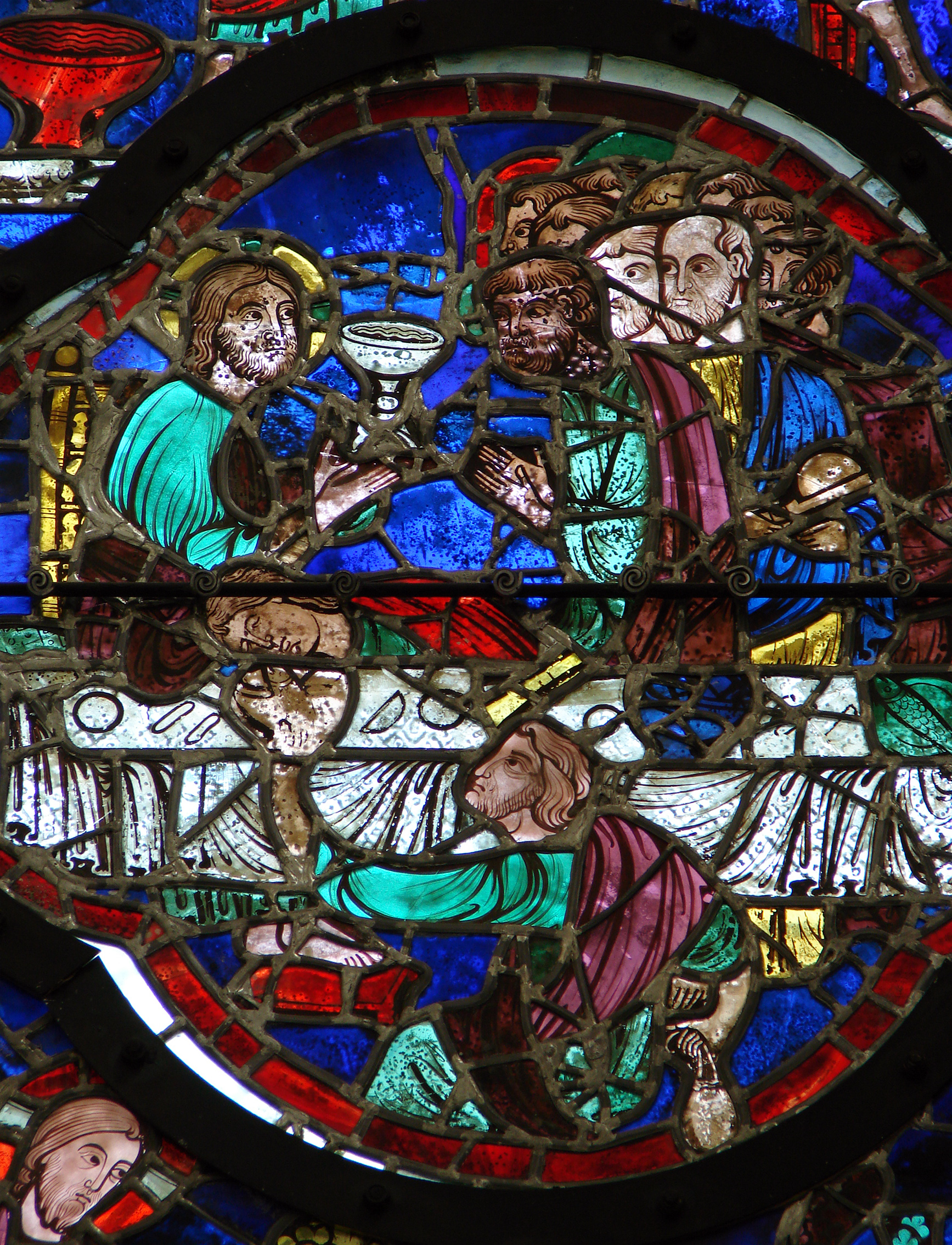
Wiki-image of the Last Supper is in the public domain. Wiki-image of water jar by Marie-Lan Nguyen is used according to the Creative Commons Attribution 2.5 license.

Monday, June 01, 2009

On Retreat. . .


. . .from 31 May through 08 June


__________________________________________________________
Wiki-image of Rock Outcrop is in the public domain.